Keywords
Delphi, consensus, paediatric, paediatric rheumatology, rheumatology, healthcare technologies, technology enabled care, digital

Delphi, consensus, paediatric, paediatric rheumatology, rheumatology, healthcare technologies, technology enabled care, digital
Children and young people (CYP) cared for in paediatric rheumatology services often experience inflammatory conditions, with up to two-thirds of these CYP remaining in adult services1,2. Other CYP experience a range of non-inflammatory musculoskeletal conditions. Consequently, CYP can have varying, chronic, painful symptoms, requiring ongoing outpatient management. Often with no cure, many CYP need long-term management with cytotoxic disease-modifying antirheumatic drugs and multi-disciplinary specialist input. CYP’s management can necessitate long travel distances and lead to reduced school and work attendance. One potential method of increasing service efficiencies and decreasing the burden for families within paediatric rheumatology may be to provide more services using technology enabled care (TEC).
Although some clinical teams were providing TEC Eg. remote services prior to COVID-193, the pandemic forced a steep rise in using TEC for remote management4,5. National Health Service (NHS) Trusts in the UK strived to reduce face-to-face appointments to 20%6. Furthermore, stipulations within NHS England required healthcare providers to minimise routine visits, resulting in a rapid move to remote management with limited training for safe implementation using TEC7. Therefore, there has been considerable variability in TEC to support such rapid changes8.
There is a firm commitment in the UK to drive TEC9–12. UK national plans are outlined in the NHS Blueprint and built into the NHS Long Term Plan to ensure TEC is provided in a ‘modern way’ to retain what is argued to be valuable adaptations to NHS services for some patients during COVID-19. A change in UK government in 2024 continued to highlight the need for change in the NHS, by launching a ‘rallying cry’ for members of the public and NHS staff to share thoughts about the future of the NHS. This exercise was underpinned by three big shifts, of which ‘analogue to digital’ was one13, and was incorporated into the 10-year Health Plan for England14. Furthermore, an independent investigation of the NHS found that while there is great potential for TEC to transform NHS services, there is much more work to do to realise its full potential13. As highlighted by the NHS Federated Data Platform, there has been minimal change over the last two decades, specifically with CYP and how their care is co-managed with parents15. Looking further afield, there is a drive to lead, retain and streamline healthcare technology innovations across Europe16 and to work together globally17.
CYP are known to be avid, proficient users of all things technology-related, seen by the increased use of smartphone technologies18. Examples of TEC in action may include wearable technologies, e-patient reported outcome questionnaires, web-based tools for peer support, or the use of various online applications for provision of virtual clinics and medication reminders19. With these considerations in mind, it would therefore seem logical that TEC should be used routinely to support CYP, by empowering them to use their technological skills to develop self-management skills and to support their care decisions20. For the purposes of this study, Technology Enabled Care is used as a collective term and is defined here by Norwegian colleagues:
“Telecare, telehealth, telemedicine, mobile (m)-, digital- and electronic (e) health services21.”
There has been some empirical work published describing the changing landscape of TEC with CYP in cardiology22, those with complex needs23, and palliative care24. Focusing on paediatric rheumatology, one survey found face-to-face consults more acceptable to parents25, with other findings reporting on financial cost-savings for patients but not necessarily for healthcare providers when using TEC for remote services26. Two systematic reviews have been published on the usability and effectiveness of electronic (e)-health27 and mobile (m)-health28 interventions for patients with juvenile idiopathic arthritis; these reviews were limited to studies only reporting on empirical research using quantitative methodologies.
This protocol paper sets out the process for a consensus study, linked to a wider PhD-related project (PeRFekT study), where the overall focus is on providing evidence-based guidance for TEC in paediatric rheumatology. This present protocol is intended to fulfil the final work package of the wider PhD programme. Previous work packages entailed the following:
• WP1 – a mixed methods systematic review (PROSPERO number: CRD42023443058; published protocol: https://bmjopen.bmj.com/content/14/2/e082515)29.
Aim: To provide a comprehensive understanding and evaluation of the adoption of TEC by patients in paediatric rheumatology services, to establish best practices.
Status: Completed
• WP2 – an e-survey with industry partners.
Aim: To explore innovative technologies being developed for CYP’s healthcare to support TEC across the UK.
Status: Completed
• WP3 – a mixed methods study with rheumatology healthcare professionals, CYP and parents.
Aim: To investigate what Technology Enabled Care practices are taking place and how Technology Enabled Care can be used to support and improve the management of Children and Young People across UK paediatric rheumatology departments.
Status: Analysis almost complete
What this study will bring
This consensus study will bring together all previous work package findings, from which the consensus statements are currently being generated. The project is based upon the results of a large mixed methods systematic review. Although included papers in the review did not provide the opportunity to undertake a full quantitative analysis due to a lack of randomised controlled trials, a full narrative analysis has been performed inclusive of all types of paper. Furthermore, WP2 and 3 provide further robust evidence in generating consensus statements. Rather than relying solely on the literature, patients, parents, healthcare professionals or the lead author, this study will incorporate the views of a wide range of invested stakeholders for consensus input into a guidance framework.
The process to be used will follow similar principles to a recent clinical consensus format30. The current, consensus project aim, is to agree upon, by multi stakeholder consensus, the strongest 10–20 Technology Enabled Care statements for inclusion into the final framework for use as guidance in paediatric rheumatology services.
This study is the 4th and final PhD work package, and NPT has been used throughout. NPT is a middle-range, evidence-based, consistent framework used to explain implementation factors when considering the late stage of adoption of innovations in healthcare31. As part of the wider programme of work the statements will be mapped to NPT.
The current, consensus project aim, is to agree upon, by multi stakeholder consensus, the strongest 10–20 Technology Enabled Care statements for inclusion into the final framework for use as guidance in paediatric rheumatology services.
The study design takes a consensus-based approach, by undertaking an online modified Delphi study, with various stakeholders.
Characteristics of participants
Healthcare Professionals:
Healthcare Professionals from the multidisciplinary team in paediatric rheumatology departments (including but not limited to: Clinical Nurse Specialists, Consultants, Registrars, Youth Workers, Research Nurses, Psychologists and Allied Healthcare Professionals).
Families:
CYP aged 11–17 years cared for within acute paediatric rheumatology services and their parents.
Other Stakeholders:
A range of other stakeholders: NHS Commissioners and Business Managers (working within general paediatric or paediatric rheumatology services), charity workers and industry partners (working in the health tech or digital health space).
Previous Delphi studies have reported varying sample sizes from less than 20 and up to 80+32,33, often based on sparse robust evidence and dependent perhaps upon diversity of participants and the project undertaken34. Due to the lack of standardised approach, no formal sample size has been calculated. Drawing on previous PhD work packages and speaking with participants, as well as available literature, 16 participants from each of the above stakeholder groups (total 64) are anticipated to be recruited to allow for drop out between Rounds and to answer the research question.
Inclusion criteria
Healthcare Professionals:
Multidisciplinary Team staff members who support the care of Children and Young People aged 11 – 17 years of age in paediatric rheumatology services in the UK.
CYP and their parents/guardians:
CYP aged 11 – 17 years inclusive who are cared for (regardless of diagnosis and length of time from diagnosis) in paediatric rheumatology services in the UK.
Other stakeholders:
NHS Commissioners and Business Managers, charity workers and industry partners.
All participants having the ability to read and understand the English language.
Exclusion criteria
There are no specific exclusion criteria, other than not being able to meet the above inclusion criteria.
Healthcare Professionals, CYP, parents/guardians and other stakeholders either taking part in the earlier stages of the PhD project or who have offered contact details to take part in further work, will be invited to take part during previous study interactions with the lead author. HCP participants will also be approached via national paediatric rheumatology professional groups, namely: Clinical Nurse Specialists, Clinical Psychology Network, Trainee Network, Allied Health Professionals Network, and the Barbara Ansell National Network for Adolescent Rheumatology (BANNAR). Recruitment materials will be sent to professionals (Eg. commissioners) to share across their networks.
Social media (X – formerly Twitter, Facebook and LinkedIn) will be used to maximise awareness, with the study link to the Participant Information Sheet and Consent Statement being made available via the study link. CYP in the Patient and Public Involvement group ‘Your Rheum’35 will be approached by the group’s coordinator. Three charities have agreed to share the study on their social media channels +/- approach via official charity emails (Children's Chronic Arthritis Association – CCAA36, National Rheumatoid Arthritis Society – NRAS37, and Lupus UK38).
A purposive sampling approach39 will be used to target a range of participants Eg. in terms of professional background, age of CYP, CYP diagnosis, location and whether participants have taken part in previous PhD work packages (a mixture of both will be targeted). Please see Table 1–Table 4 for the Sampling Frameworks.
| Main sampling Category | |||
|---|---|---|---|
| 1. Gender | Female | Male | Other |
| 2. Ethnicity | White | Ethnic minority background | |
| 3. Participated in previous PhD work package | Yes | No |
All potential participants will first be asked to assess their eligibility within Online Surveys (a web-based platform to distribute electronic questionnaires). Next, study documents will include a participant-specific Participant Information Sheet (PIS) and a Consent Statement (CS) and will be available within Online Surveys for all participants to read. Once the PIS and CS have been read, participants will enter their name and date, indicating their informed, digital consent to take part and providing contact details for the lead author to follow up with them. The lead author’s contact details will be provided within the study documents if any participants would like to discuss the study directly with a member of the research team.
All CYP aged 16 years and over will provide informed consent for themselves following the above method and using separate PIS’s and CS’s. Parents of CYP less than 16 years will provide consent on behalf of their child following the above method and using separate PIS’s and CS’s. As is best practice, CYP less than 16years will also be required to provide assent, or their agreement to take part, again following the above method and using separate PIS’s and CS’s.
If electronic consent +/- assent is difficult for a participant or would result in them being excluded in taking part, then every effort will be made to accommodate individual requirements (Eg. by collecting a wet ink signature via paid postage of the appropriate documents).
All consent discussions, recruitment etc will be carried out according to Good Clinical Practice principles. CYP and parents taking part in the study will be provided with a £20 voucher per completion of each of the online modified Delphi rounds (£40 total) to thank them for their time and providing their perspectives. CYP will also receive a certificate.
The Study Advisory Group and Participant Flow chart are included as Figure number 1.
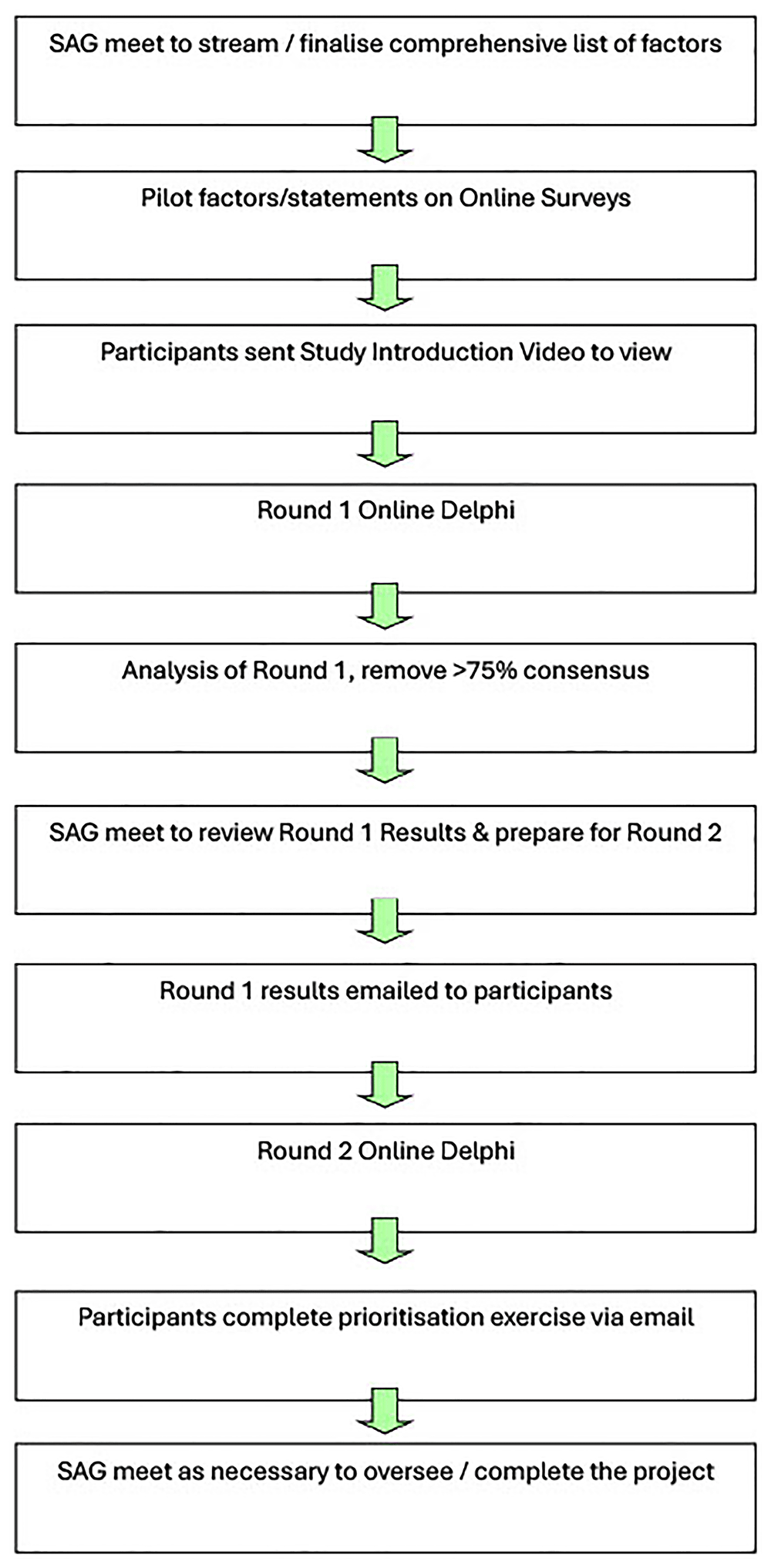
Data collection will take place using an online modified Delphi technique40. The format of the Delphi Rounds will follow a similar method used recently by the Study Advisory Group’s methodologist, Adam Galloway (AG)30.
Study Advisory Group
A Study advisory group (SAG) has been convened, consisting of the lead author, the academic supervisory team, 2 PPI representatives (1 young person and 1 parent) and an experienced appropriate methodologist (AG). The SAG will meet to organise and streamline all TEC implementation factors and previous PhD work package findings prior to undertaking the consensus exercise. The streamlined statements/factors will be piloted on Online Surveys to check accessibility and formatting.
The SAG will meet again following Round 1 of the online modified Delphi exercise (see below) to discuss the outcomes of Round 1, incorporate any additional comments (by agreement with the SAG), and plan for Round 2.
Subsequent SAG meeting(s) will remain flexible and essentially used for discussion and agreement regarding any outliers or cases of uncertainty.
Study introduction video
All participants will be asked to view a short (10–15 mins) recorded introduction video made by the lead author. The video will introduce all previous related work to date and explain what is expected from participants during the online modified Delphi rounds and prioritisation ratings undertaken via email.
Online modified Delphi rounds
There will be 2 Rounds of online modified Delphi consensus exercises for all recruited and consented participants. Both Rounds will be conducted using Online Surveys. Round 1 is planned to take place during November/December 2025 and Round 2 at the start of 2026.
Round 1 Online modified Delphi consensus exercise
All participants will be asked to undertake an online consensus exercise. All streamlined statements agreed by the SAG will be listed within Online Surveys and participants will indicate their level of perceived importance using a 5-point Likert scale (1=very important – 5=very unimportant. A free text space will be available for each statement to suggest new statements/clarification. All statements reaching >75% level of consensus will be removed prior to Round 2 to reduce the burden on participants during Round 2. The exercise will remain open online for up to a month afterwards for pragmatic reasons, to give more opportunity for participants to complete it on their own.
Round 2 Online modified Delphi consensus exercise
All participants will be sent a summary of the Round 1 results prior to the Round 2 exercise. Only those statements not meeting consensus, plus any new considerations suggested by participants from Round 1, will be included in Round 2. There will be no free text options during Round 2 and the same Likert scale (1–5) will be used again. Otherwise, the exercise will follow the same format as Round 1.
All factors rated as ‘Important’ or ‘Very important’ by at least 75% of all respondents in Round 1 & Round 2 will be included in a prioritisation exercise.
Prioritisation
Ten to twenty statements are planned to be included in the final framework. Regardless of how many statements meet the >75% inclusion threshold, all participants will be asked to complete a prioritisation exercise. The exercise will indicate priority to implement statements into practice, based on importance, level of agreement, and perceived priority. The prioritisation exercise will be completed via email after Round 2. The top 10–20 prioritised statements will be included in the final framework guidance. The timescale for completing the prioritisation exercise is January 2026.
Data analysis
Free text responses offered during Round 1 of the online modified Delphi exercise will be analysed using content analysis41 and added to the comprehensive list of statements (if agreed by the SAG) either as a new statement in its own right or as a sub-factor within a broader theme.
Quantitative analysis will be used to describe minimal non-identifiable participant details and for Round 1 to report the level of consensus, to remove those factors >75% consensus from the Round 2 exercise. Quantitative analysis will then be used for Round 2 to identify >75% consensus, then all those factors reaching >75% consensus from both Round 1 and Round 2 will be included for the prioritisation exercise, again using quantitative analysis.
Normalisation Process Theory
As alluded to in the introduction, NPT is a sociological theory that can be used flexibly to explain implementation factors when integrating innovative interventions into healthcare settings31. It provides a framework as a tool using the domains ‘Coherence (understanding), Cognitive Participation (relational work that builds a community of practice around an intervention), Collective Action (operational work that people need to do to make an intervention successful), and Reflexive Monitoring (appraisal work). NPT also considers the context of implementation and outcomes.
Patients and the public have been involved with the PhD at numerous stages, including overall design, data collection, and previous publication29. For this specific sub-project, eligible PPI contributors will be invited to take part as participants in order for their views and opinions to be taken into account when providing guidance on TEC.
Study design and concept April 2024-January 2025; REC approval received April 2025; Participant approaches and consents received from June 2025 (ongoing); Data collection planned from October-February 2025/26; Data analysis planned for February 2026; Dissemination planned for submission March 2026.
The range of different participants, inclusive of patients and parents, is viewed as a strength of the study
Consensus statements are based upon comprehensive evidence-based PhD project findings
Involvement of patients and the public throughout the project and earlier PhD findings has increased relevancy of the outcomes
Consensus is limited at the outset to two adapted Delphi rounds to incorporate a pragmatic approach, which may be seen as a study limitation
BANNAR: Barbara Ansell National Network for Adolescent Rheumatology
CCAA: Children's Chronic Arthritis Association
CS: Consent Statement
CYP: Children and Young People
PeRFekT: PaEdiatric Rheumatology FramEworK for Technology enabled care
PIS: Participant Information Sheet
PPI: Patient and Public Involvement
NHS: National Health Service
NPT: Normalisation Process Theory
NRAS: National Rheumatoid Arthritis Society
REC: Research Ethics Committee
SAG: Study Advisory Group
TEC: Technology Enabled Care
WP: Work Package
This consensus project has received ethical approval from the University of Leeds (School of Medicine ethical approval number 2550), with full consideration of ethical and safety implications outlined within the REC application. All participants will provide digitally recorded consent to take part. A full outcome report will be produced and published in a leading journal in this field. The review report will also be submitted to the British Society for Rheumatology conference and/or Paediatric Rheumatology European Society conference. Members of Your Rheum and Barbara Ansell National Network for Adolescent Rheumatology (BANNAR) will be invited to share their creative dissemination ideas. This consensus paper and overall PhD results are part of a wider programme of work aiming to create guidelines for implementing future TEC approaches.
Not applicable.
Provide sufficient details of any financial or non-financial competing interests to enable users to assess whether your comments might lead a reasonable person to question your impartiality. Consider the following examples, but note that this is not an exhaustive list:
Sign up for content alerts and receive a weekly or monthly email with all newly published articles
Register with NIHR Open Research
Already registered? Sign in
If you are a previous or current NIHR award holder, sign up for information about developments, publishing and publications from NIHR Open Research.
We'll keep you updated on any major new updates to NIHR Open Research
The email address should be the one you originally registered with F1000.
You registered with F1000 via Google, so we cannot reset your password.
To sign in, please click here.
If you still need help with your Google account password, please click here.
You registered with F1000 via Facebook, so we cannot reset your password.
To sign in, please click here.
If you still need help with your Facebook account password, please click here.
If your email address is registered with us, we will email you instructions to reset your password.
If you think you should have received this email but it has not arrived, please check your spam filters and/or contact for further assistance.

Comments on this article Comments (0)