Keywords
Climate change, Extreme weather events, Flooding, Heavy rainfall, LMICs, Maternal Health Services, Pregnancy

Climate change, Extreme weather events, Flooding, Heavy rainfall, LMICs, Maternal Health Services, Pregnancy
Climate change, attributed to the rising global temperatures, is associated with the increasing occurrence of extreme weather events, including heavy rainfall and flooding.1 Heavy rainfall is defined as precipitation exceeding a high local percentile threshold (typically ≥95th percentile of daily totals; very heavy ≥99th percentile) over a given period and geographic area, often overwhelming natural and built drainage systems and increasing the risk of flooding.2 Flooding is an accumulation of drainage water over areas which are not normally submerged, commonly due to prolonged or intense rainfall, river overflow, or inadequate drainage infrastructure.3
Climate-related hazards are seen to greatly affect health and the healthcare systems globally, causing an increase in injuries, displacement, morbidity, and mortality.4 Climate change also impacts the health workforce and health infrastructure, reducing system capacity to deliver universal health coverage (UHC).5 Floods in particular are associated with increased risks of morbidity and mortality globally. Between 1998–2017, floods affected more than 2 billion people worldwide6 and over 200,000 deaths in the past three decades. Although drowning is the leading cause of flood-related deaths, other immediate causes include adverse health outcomes, damage to health facilities, and disrupted access to essential health services.7
Low- and middle-income countries (LMICs) are at a higher risk of disruption of health and health services from heavy rainfall and flooding due to limited infrastructure, poor governance, and inadequate resources to adapt to the effects of these climatic hazards.8 The Intergovernmental Panel on Climate Change (IPCC) estimates that the effect of climatic hazards was 15 times more intense in vulnerable regions (LMICs) than in less vulnerable regions.1 In these settings, heavy rainfall and flooding frequently damage roads and bridges, geographically isolates communities, and restricts movement, making it difficult for both patients and health workers to reach health facilities.1 Health facilities may be damaged or declared non-functional, and there could be a shortage of resources (material and human). These disruptions affect the delivery of maternal health service, a critical time-sensitive health care service.9
Maternal health services involve a range of health services provided to women during pregnancy, childbirth, and the postpartum period, with the goal of ensuring safe outcomes for mothers and newborns.10 These services include antenatal care, skilled attendance at birth, emergency obstetric and newborn care, and postnatal follow-up. Effective delivery of maternal health services depends on several interrelated health system components, including physical access to facilities, availability of skilled health workers, functional referral and transport systems, facility readiness, availability of required resources, and continuity of care across the antenatal, intrapartum, and postpartum periods.11 Disruptions to any of these components can result in delays in care, compromised safety, and increased risk of adverse maternal and perinatal outcomes.
For the purposes of this scoping review, maternal health service delivery is operationally defined as the availability, accessibility, and quality of formal health services provided to women during pregnancy and childbirth. In line with internationally accepted health systems and quality-of-care frameworks, this review focuses on two key dimensions of service delivery that are particularly vulnerable to heavy rainfall and flooding disruptions: access to maternal health services and quality of maternal health services. Access involves the ability of pregnant women and healthcare workforce to physically reach health facilities. The quality of maternal health services will be examined through six core domains; timeliness, safety, effectiveness, equity, patient-centeredness and efficiency according to the WHO framework on quality of health services.10 To ensure clarity and consistency, operational definitions of the terms used in this study are presented in Table 1.
| Term | Definitions |
|---|---|
| Maternal Health services | Refer to the range of health services provided to women during pregnancy, childbirth, and the immediate postpartum period with the aim of promoting and maintaining the physical, mental, and social well-being of the mother. These services include antenatal care, intranatal care-skilled care during labour and delivery, emergency obstetric care, and immediate postpartum care delivered through the formal health system.10 |
| Quality of maternal health services | The extent to which health care services are provided to individuals and patient populations to improve desired health outcomes. To achieve this, health care must be safe, effective, timely, efficient, equitable, and people centered.
|
| Access to maternal health service | Access to maternal health services refers to a woman’s ability to reach and use appropriate maternal health services when needed, including physical accessibility, availability of services, and actual utilization of care.22 |
| Low- and middle-income countries | Countries classified by the World Bank as low-income, lower-middle-income, or upper-middle-income based on gross national income (GNI) per capita in the year the study was conducted.23 |
Maternal mortality and morbidity remain important health outcomes, particularly in LMICs, where most global maternal deaths occur.12 Studies conducted in LMICs have reported delayed care seeking, reduced antenatal attendance, lower rates of facility-based delivery, disrupted referral pathways, shortages of skilled health workers, and compromised facility readiness during flood events.13,14 Given the diversity of study designs, settings, and methodological approaches in this field, a scoping review will be conducted to systematically map the available evidence on how heavy rainfall and flooding affect the accessibility and quality of maternal health services in LMICs. The findings of this scoping review will inform future primary research and support policy development and planning efforts, aimed at strengthening climate-resilient maternal health systems and improving maternal health outcomes in vulnerable settings.
A conceptual framework has been developed to illustrate the pathways through which heavy rainfall and flooding affect maternal health service delivery in LMIC ( Figure 1).
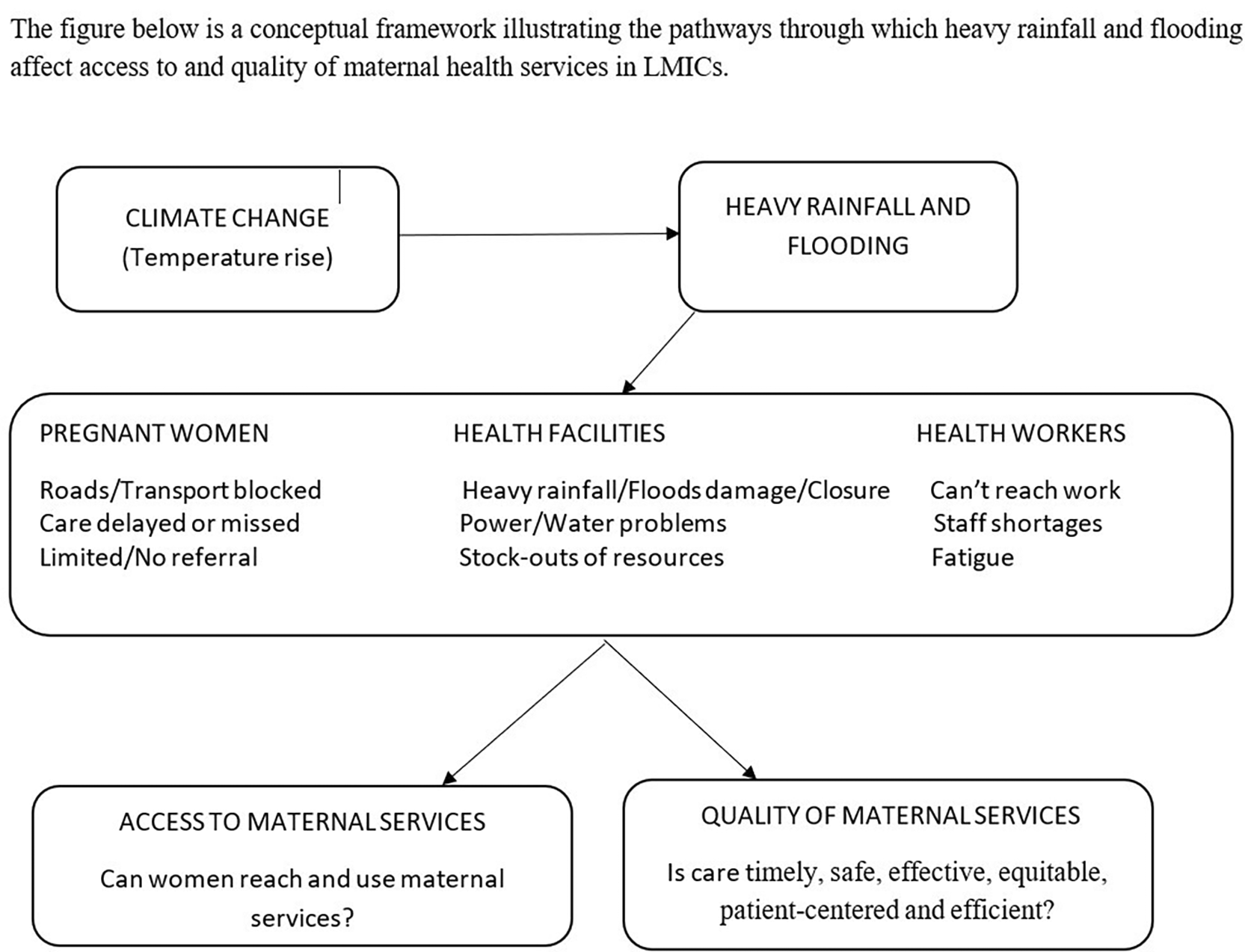
The framework shows how climate-related events can disrupt transportation systems, health facility functionality, and healthcare workforce availability, thereby affecting access to maternal health services and the quality of care provided during pregnancy and childbirth.
The framework highlights how climate-related events disrupt transportation systems, health facility functionality and healthcare workforce availability, ultimately influencing both access to maternal health services and the quality of care provided.
Broad Objective: To map and synthesize existing evidence on how heavy rainfall and flooding affect accessibility and quality of maternal health service delivery during pregnancy and childbirth in LMICs.
Research Question: How does heavy rainfall and flooding as an extreme weather event affect accessibility and quality of maternal health services during pregnancy and childbirth in LMICs?
Specific objectives:
This exploratory scoping review will follow the JBI Scoping Review methodology.15 It will be an exploratory scoping review that will map and describe existing evidence on how heavy rainfall and flooding affect maternal health service delivery during pregnancy and childbirth in LMIC.
Patient and public were not involved in the development of this scoping review protocol. This study involves synthesis of evidence from previously published literature and does not involve primary data collection.
The eligibility criteria for this scoping review will be guided by the Population–Concept–Context (PCC) framework.15 The PCC framework is defined to align closely with the review objectives and research question by specifying the target population, the climate-related exposures of interest, and the contextual setting. We will therefore capture relevant articles on how heavy rainfall and flooding affect maternal health service delivery in LMICs, while excluding studies outside the defined scope in terms of population, exposure, outcomes, setting, study design, and publication characteristics. A full summary of the inclusion and exclusion criteria is presented in Table 2.
The scoping review search strategy will be designed in accordance with the PCC framework, in consultation with a research librarian, to ensure comprehensive identification of relevant literature search terms related to the population, concept, and context, and will be combined using Boolean operators “OR” and “AND”. Synonyms and related terms will be included to capture variations in terminology across disciplines and study designs. The key search terms and corresponding MeSH terms developed using the PCC framework are illustrated in ( Table 3). The full search strategy, including database-specific search strings and combinations of terms, is provided in ( Tables 4 and 5).
| Name of the database: PubMed (1) - on 4th, December 2025 | ||
|---|---|---|
| Search query | Number of articles hit | |
| Search term category 1- Population
Combined both population categories with OR. | (Pregnant OR gravida OR gestational OR antenatal OR prenatal OR intrapartum OR intranatal OR labour OR labor OR childbirth OR delivery OR postpartum OR post-partum OR maternal OR postnatal AND (1990:3000/12/12[pdat])) OR (Midwife OR nurse OR obstetrician OR “health worker” OR “health personnel” OR “health facility” OR “maternity ward” OR “maternity unit” | 4,720,253 |
| Search term category 2
Concept 1- exposure (heavy rainfall and flooding) Combined all three with OR Maternal health services OR access OR quality | Flood* OR “flash flood” OR “river flood” OR “coastal flood” OR “heavy rain” OR “intense rain” OR “extreme rain” OR “heavy precipitation” OR “extreme precipitation” OR “rainfall event” OR “extreme weather” | 35822 |
| Search term category 3
Concept 2- (access and quality of maternal health services) | (((“maternal health service” OR “maternity care” OR “obstetric care” OR “emergency obstetric care” OR “skilled birth attendance” OR “facility-based delivery” OR “facility birth” OR “institutional delivery” OR ANC OR “antenatal care” OR “prenatal care” OR “postnatal care” OR “post-partum care” OR “continuity of care” OR “health service” OR “service disruption” OR “health system” AND (1990:3000/12/12[pdat])) OR (access OR “health service access” OR “geographic access” OR “physical access” OR “care seeking” OR “delayed care” OR “three delays” OR “service utilization” OR “service use” OR “service disruption” AND (1990:3000/12/12[pdat]))) OR (“Timely care” OR timely OR “quality of care” OR “service quality” OR “patient safety” OR “facility readiness” OR efficient OR “continuity of care” AND (1990:3000/12/12[pdat])) AND (1990:3000/12/12[pdat])) | 3,016,326 |
| Search term category 4 (1 AND 2 AND 3) | 1622 | |
| Search term category 5
Context- LMIC | “low-income country” OR “middle-income country” OR “low- and middle-income country” OR LMIC OR “developing country” OR “low- and middle-income populations” OR “low- and middle-income economies” OR “low- and middle-income nations” OR “low-income economies” OR “low-income populations” OR “middle income economies” OR “middle-income populations” OR “resource-limited setting” OR “resource-constrained setting” OR reginal terms according to the world bank classification23 | 4,614,455 |
| Search term category 6 (4 AND 5) | Final string after combining it all. | 563 |
| Name of the database: PubMed – on 8th, December 2025 | ||
|---|---|---|
| Search term category 1- population
Combined both population categories with OR. | (Pregnant OR gravida OR gestational OR antenatal OR prenatal OR intrapartum OR intranatal OR labour OR labor OR childbirth OR delivery OR postpartum OR post-partum OR maternal OR postnatal OR parturition AND (1990:3000/12/12[pdat])) OR (Midwife OR nurse OR doctor OR “medical doctor” OR clinician OR “medical doctor” OR “skilled birth attendant” OR “health professionals” OR obstetrician OR “health worker” OR “health personnel” OR “health facility” OR “maternity ward” OR “maternity unit” OR “health facility” AND (1990:3000/12/12[pdat])) Filters: from 1990–3000/12/12 | 5,539,849 |
| Search term category 2
Concept 1- exposure (heavy rainfall and flooding) | Flood* OR “flash flood” OR “river flood” OR “coastal flood” OR “heavy rain” OR “intense rain” OR “extreme rain” OR “heavy precipitation” OR “extreme precipitation” OR “rainfall event” OR “extreme weather” | 35,848 |
| Search term category 3
Concept 2- (access and quality of maternal health services) Combined all the three with OR Maternal health services OR access OR quality | ((“maternal health service” OR “maternity care” OR “obstetric care” OR “emergency obstetric care” OR “comprehensive obstetric care” OR “skilled birth attendance” OR “facility-based delivery” OR “facility birth” OR “institutional delivery” OR ANC OR “antenatal care” OR “prenatal care” OR “postnatal care” OR “post-partum care” OR “continuity of care” OR “health service” OR “service disruption” OR “health system” AND (1990:3000/12/12[pdat])) OR (access OR accessibility OR “health service* access” OR “access to care” OR “care seeking” OR “care-seeking” OR “help seeking” OR “delayed care” OR “missed visit*” OR “service utilization” OR “service utilisation” OR “healthcare utilization” OR “health care utilization” OR “geographic access” OR “physical access” OR “transport barrier*” OR “road access*” OR “referral delay*” OR “referral breakdown*” OR “barriers to care” OR “service disruption*” OR “service interruption*” OR “facility closure*” OR “reaching care” OR “delay in reaching care” AND (1990:3000/12/12[pdat]))) OR (“quality of care” OR “quality improvement” OR “care quality” OR “health care quality” OR “maternal care quality” OR “obstetric care quality” OR “safe care” OR “patient safety” OR “service safety” OR “safety of care” OR “quality standards” OR “quality indicators” OR “quality measures” OR “timeliness of care” OR “timely care” OR “delays in care” OR “delay in receiving care” OR “waiting time” OR efficiency OR “service efficiency” OR “health system efficiency” OR “continuity of care” OR “continuity of services” OR “disrupted continuity” OR “referral quality” OR “facility readiness” OR “facility preparedness” OR “service readiness” OR “health facility readiness” OR “emergency obstetric readiness” OR “availability of skilled staff” OR “staff shortages” OR “equipment availability” OR “supply availability” OR “drug shortages” OR “service capacity” OR “quality challenges” OR “compromised quality” OR “poor quality care” AND (1990:3000/12/12[pdat])) | 2,904,374 |
| Search term category 4 (1 AND 2 AND 3) | 1,629 | |
| Search term category 5
Context- LMIC | “low-income country” OR “middle-income country” OR “low- and middle-income country” OR LMIC OR “developing country” OR “low- and middle-income populations” OR “low- and middle-income economies” OR “low- and middle-income nations” OR “low-income economies” OR “low-income populations” OR “middle income economies” OR “middle-income populations” OR “resource-limited setting” OR “resource-constrained setting” OR reginal terms according to the world bank classification.23 | 4,614,455 |
| Search term category 6 (4 AND 5) | Final string after combining it all. | 559 |
A comprehensive search will be conducted in MEDLINE, Global Health, and Web of Science, as well as relevant grey literature sources. The search will be limited to studies published in English between 1990 to 2025 as guided by the Kyoto Protocol establishing the base year for monitoring greenhouse gas reductions as 1990.16 Reference list of included studies and relevant reviews will be screened to identify additional relevant publications. An initial search strategy, which will be refined during the review, has been developed ( Tables 4 & 5).
Retrieved articles will be imported to Covidence software,17 where de-duplication will be performed automatically. The title and abstract screening will be conducted by two independent reviewers using the predefined inclusion and exclusion criteria. Articles deemed potentially eligible will proceed to full text screening, which will be conducted by two reviewers independently (VB)1 and (MN)1. Any disagreements at either stage will be resolved through discussion and where consensus cannot be reached, a third reviewer will be consulted. The study selection process will be documented and summarized using the Preferred Reporting Items for Systematic Reviews and Meta-Analyses (PRISMA) flow diagram.18
Relevant data will be extracted using a pre-developed data charting template in Covidence and then exported to Excel for analysis. Extracted data will include aspects such as study characteristics, type of heavy rainfall or flooding events, maternal health service components examined, and key findings related to access and quality of maternal health service delivery. Data extraction will be conducted by one reviewer (VB)1, with a second reviewer independently (CW)1 checking a 20% sample of extracted studies for consistency and accuracy [1]. Any discrepancies identified will be discussed and resolved by consensus. A sample data extraction table is included in Table 6.
Extracted data will be cleaned and organized using Microsoft Excel prior to synthesis. Findings will be synthesized descriptively and narratively. For Qualitative data, we will employ both deductive and inductive thematic analysis. Results will be grouped according to key dimensions of maternal health service delivery, including access and quality of care, with quality further organized by domains such as timeliness, safety, effectiveness, equitability, patient-centeredness and efficiency. The results will be presented in a combination of tables and narrative summaries to map the range and characteristics of the existing evidence. Reporting of the review will follow the Preferred Reporting Items for Systematic Reviews and Meta-Analyses extension for Scoping Reviews, PRISMA-ScR,18 where appropriate, findings will be presented by geographic region, type of flooding or rainfall event, and maternal health service components to enhance clarity and interpretability.
This scoping review is nested within an ongoing Novel Extreme Weather and Risk Insurance for Kenya, NEWRISK project. NEWRISK has received ethical approval from the Scientific and Ethics Review Unit, Kenya Medical Research Institute (KEMRI/SERU/CGMR-C/315/4971). The findings of this review will be disseminated through publication in a peer-reviewed journal and presentation at relevant academic and policy forums. The results will contribute to understanding how heavy rainfall and flooding affect maternal health service delivery in low- and middle-income countries and may inform future research, policy development, and health system planning aimed at strengthening climate-resilient maternal health services.
This protocol is registered on the Open Science Framework (OSF) under the Creative Commons Attribution-ShareAlike 4.0 International (CCBY-SA 4.0) license.19 All protocol metadata and methodological details are thus publicly available. DOI: https://doi.org/10.17605/OSF.IO/E9ZFC.19
Provide sufficient details of any financial or non-financial competing interests to enable users to assess whether your comments might lead a reasonable person to question your impartiality. Consider the following examples, but note that this is not an exhaustive list:
Sign up for content alerts and receive a weekly or monthly email with all newly published articles
Register with NIHR Open Research
Already registered? Sign in
If you are a previous or current NIHR award holder, sign up for information about developments, publishing and publications from NIHR Open Research.
We'll keep you updated on any major new updates to NIHR Open Research
The email address should be the one you originally registered with F1000.
You registered with F1000 via Google, so we cannot reset your password.
To sign in, please click here.
If you still need help with your Google account password, please click here.
You registered with F1000 via Facebook, so we cannot reset your password.
To sign in, please click here.
If you still need help with your Facebook account password, please click here.
If your email address is registered with us, we will email you instructions to reset your password.
If you think you should have received this email but it has not arrived, please check your spam filters and/or contact for further assistance.

Comments on this article Comments (0)