Keywords
Randomised controlled trials; disability; neurodiversity; accessibility; inclusion; clinical trial methodology; behaviour change; Person-Based Approach.

Randomised controlled trials; disability; neurodiversity; accessibility; inclusion; clinical trial methodology; behaviour change; Person-Based Approach.
In the UK, a person is considered disabled according to the Equality Act 2010 if they have a physical or mental health condition or illness that has a substantial and long-term adverse effect on their ability to carry out normal daily activities.1 Approximately 16.8 million people in the UK are disabled (around 25% of the UK population),2 and there is a higher proportion of disabled people in areas with higher levels of deprivation.2,3 In addition, around 15–20% of the UK population have a neurodivergent condition such as autism, ADHD, dyslexia, or Tourette’s syndrome,4,5 but may not necessarily consider themselves disabled, even if they have to navigate significant challenges in order to carry out normal daily activities.
Disabled and neurodivergent people face worse access to healthcare in the UK,6–10 and clinical research in healthcare settings often risks replicating the systemic barriers that result in these health inequalities. The extent to which disabled and neurodivergent people are prevented from participating in clinical trials is difficult to estimate because data about disability are not routinely or consistently collected and reported.11 However, evidence suggests that disabled and neurodivergent people are often excluded from clinical trials due to poorly-designed or inflexible trial protocols and processes, such as strict eligibility criteria, requirements for in-person study visits, and written informed consent.12–14 For example, one systematic review of 182 studies on medication adherence included in a Cochrane review found that 1% actively excluded people for hearing impairment, 3% for motor impairment, 7% for visual impairment and 32% for cognitive impairment,12 and another survey of 300 randomly selected trials found that only six (2%) clearly included people with an intellectual disability.15
Designing trials that work for disabled and neurodivergent people is critical to the success of research into long-term conditions and multi-morbidities. It is also vital to ensuring fair and equal access to participation in trials, and hence the generalisability of findings on the safety and efficacy of new interventions to more of the clinical population. This is especially important given evidence that suggests that trial participants benefit from participation, regardless of their treatment allocation.16 However, guidance on how to achieve this is currently scarce, although a recent scoping review highlighted that protocol design and ethical approval processes play a key role.13 Consequently, this protocol reports on the development and evaluation of the Promoting Accessibility in Clinical Trials (PRACTICALs) intervention. PRACTICALs is designed for protocol contributors and research ethics committee (REC) members who review clinical trial protocols with the aim of improving the accessibility of clinical trials for disabled and neurodivergent people.
Members of the public with lived experience of disability, and carers of those with a disability, were involved in the research since its inception. Recognising the need for this work, and the way we proposed to address it, involved discussion with patients and the public as well as other key stakeholders (including researchers and trial site staff ). At the pre-funding stage we benefited from the advice of four individuals with lived experience of physical and/or mental disabilities, two parents/caregivers of a person with a severe learning disability, and a research assistant who was approached by a patient whose disability was not accommodated for by the trial protocol.
The PRACTICALs stakeholder group was then formed at the very beginning of the grant funded period, comprising three disabled and/or neurodivergent people and five representatives of the ‘target users’ of the intervention (one academic clinical fellow, one non-clinical academic researcher, one former NHS REC chair and two research nurses, one of whom is also an ethics committee member). They have been involved in the research through two meetings to date (held online, at member request) and by providing asynchronous feedback on the protocol, participant-facing materials and intervention resources. Patient and Public Involvement contributors are reimbursed for their time and expenses using NIHR guidelines to ensure best practice.
2.1.1 Stakeholder group meetings
The first stakeholder meeting sought input on the design of the literature reviews underpinning the intervention, in terms of deciding what health conditions, study settings, types of disability and information sources the reviews should include. As a result of stakeholder input, learning disability, rare genetic diseases, allergies, amputation, and comorbidity were added to the MeSH terms included in the reviews, and paramedicine, prisons and the armed forces were added to included settings. The second stakeholder meeting sought input on the content of the PRACTICALs e-learning module, and the needs, issues and challenges around protocol contributors and REC members improving the accessibility of clinical trials. As a result of stakeholder input, we were able to make additions to the handbook such as guidance around getting ethical approval for studies where people had reduced capacity to consent, Good Clinical Practice regulations around inclusive research, and the NIHR’s commitment to inclusive research by providing additional funds for inclusive design in some funding streams. They also contributed to the content of the e-learning module; for instance, they felt strongly that the advice should be framed in a way that rewards any inclusive features in a trial and that the audit tool should be used to identify areas of a trial that are inclusive and any ways in which accessibility could be improved with relatively small changes, rather than a way to scrutinise studies and pick fault.
2.1.2 Asynchronous feedback
The stakeholder group also reviewed the draft guidance handbook and outline plan for the e-learning resource and are currently undertaking initial user testing and feedback on the e-learning resource. They also reviewed the protocol for the pilot study and all participant-facing materials. As a result of their input, changes were made to these materials, such as the response options for gender in the demographic questionnaire, and clarification of the wording of some of the questions in the pilot surveys.
2.1.3 Future PPI activities
Once data collection is complete, the stakeholder group will also be involved in interpretation of the results and co-producing a dissemination strategy that engages members of the public with the project and its outputs.
The PRACTICALs study comprises two main phases: 1) Intervention development, and 2) A single-arm, mixed-methods, interventional pilot study of the acceptability, relevance and potential impact of the PRACTICALs intervention. The intervention has five aims:
1. To increase awareness that some trial participants may have access needs due to being disabled, neurodivergent, or having a long-term physical or mental health condition. This includes studies of conditions where the population is not usually considered disabled by virtue of their diagnosis.
2. To encourage more positive attitudes towards, and knowledge about, disabled and neurodivergent people, and increase understanding of the consequences of these under-served populations being excluded from clinical trials.
3. To increase understanding of what protocol contributors and REC members can do to make clinical trials more accessible for disabled and neurodivergent people, and to encourage proactive planning for the necessary resources.
4. To increase protocol contributors’ and REC members’ confidence to raise the issue of accessibility with their research team and in funding applications, and to make ethical arguments to support the protocol adjustments they are implementing or recommending.
5. To improve access to resources, support, and guidance around including disabled and neurodivergent people in clinical trials.
The study was granted ethical approval by the University of East Anglia’s Faculty of Medicine and Health Sciences Research Ethics Committee on 08/02/2026 and amendments were approved on 24/04/26 and 04/08/2026 (ref. ETH2627-0007). The protocol was registered on the Open Science Framework on 09/02/2026 (registration available at https://doi.org/10.17605/OSF.IO/DR4SF).
The PRACTICALs intervention development follows an iterative design process guided by the Person-Based Approach17 and Medical Research Council (MRC) guidelines on the development of complex interventions.18,19 The intervention is being developed using the Behaviour Change Wheel20,21 in line with MRC guidance that intervention development should be systematic and theory-based and because evidence suggests that interventions with a robust theoretical underpinning are more effective.22 It is being designed in partnership with the study’s stakeholder group (see Section 2.1) and Disability Rights UK.
2.3.1 Review of the evidence
Three distinct literature reviews were first conducted to provide us with a clear understanding of the problem of disabled and neurodivergent people being excluded from clinical trials: 1) An audit of thirty recently-published clinical trial protocols, to identify barriers and enablers to the participation of disabled and neurodivergent people in clinical trials; 2) A larger narrative review (N = 182) of clinical trials with a disabled or neurodivergent population to identify concrete suggestions of ways in which researchers can make their trials more accessible; and 3) A rapid literature review (N = 14) to identify protocol contributor and REC member needs to address the issues and challenges around improving the accessibility of clinical trials. We aim to publish these reviews in full in due course and their contribution to the development of the PRACTICALs intervention will be explicated in a separate intervention development paper.
2.3.2 Intervention modelling
The intervention modelling stage used the evidence from the literature reviews to develop the PRACTICALs intervention in line with a) the seven steps of the Behaviour Change Wheel21 and b) the intervention’s guiding principles according to the Person-Based Approach.17 Two target behaviours were identified: 1) Protocol writers adding adjustments into protocols that will help disabled and neurodivergent people access the trial; and 2) REC members considering whether clinical trial protocols put up unnecessary barriers for disabled and neurodivergent people when reviewing them and making suggestions for improvements in their review. Seventeen behaviour change techniques from v1 of the Behaviour Change Techniques Taxonomy23 were identified as relevant and feasible for inclusion in the intervention. These were also reviewed by the stakeholder group and a clinical trials researcher with expertise in behaviour change. Behavioural analysis tables will be created for each of the intervention’s target behaviours, which will then inform the logic model. The development process will be reported in full in a separate paper using TIDieR to ensure completeness of reporting.24
2.3.3 User testing
A first version of the guidance handbook and a draft outline of the e-learning module were first created and reviewed with the stakeholder group, with feedback collated in a table of changes in line with the Person-Based Approach.17 A second version of the handbook and a full first version of the e-learning module were then developed and are now in the process of being presented to several ‘target users’ from Norwich Clinical Trials Unit. These target users will take part in think-aloud1 sessions via video call, where feedback will be elicited to ensure that the messaging makes sense to, and is likely to influence, the target group’s thinking and behaviour around improving the accessibility of clinical trials for disabled and neurodivergent people. All comments will be recorded in the table of changes and any changes that are deemed to be easy and uncontroversial will be acted on immediately in order to progress the e-learning module before the next think-aloud session. Asynchronous feedback from members of the stakeholder group and a clinical trials researcher with expertise in behaviour change is also being sought at this stage and will then be used in conjunction with the findings of the think-aloud sessions to refine the intervention19 before the pilot is launched.
The study is a longitudinal, single-arm, mixed-methods, interventional pilot study of the acceptability, relevance and potential impact of the PRACTICALs intervention, comprising a guidance handbook and e-learning resource. The Kirkpatrick Model27 will be used to assess the acceptability, relevance and potential impact of the intervention. The study is entirely remote; the intervention will be delivered online, and surveys will be administered electronically via REDCap. Participants will be recruited from the UK only due to international differences in clinical trial processes and procedures.
2.4.1 Participants and sample size
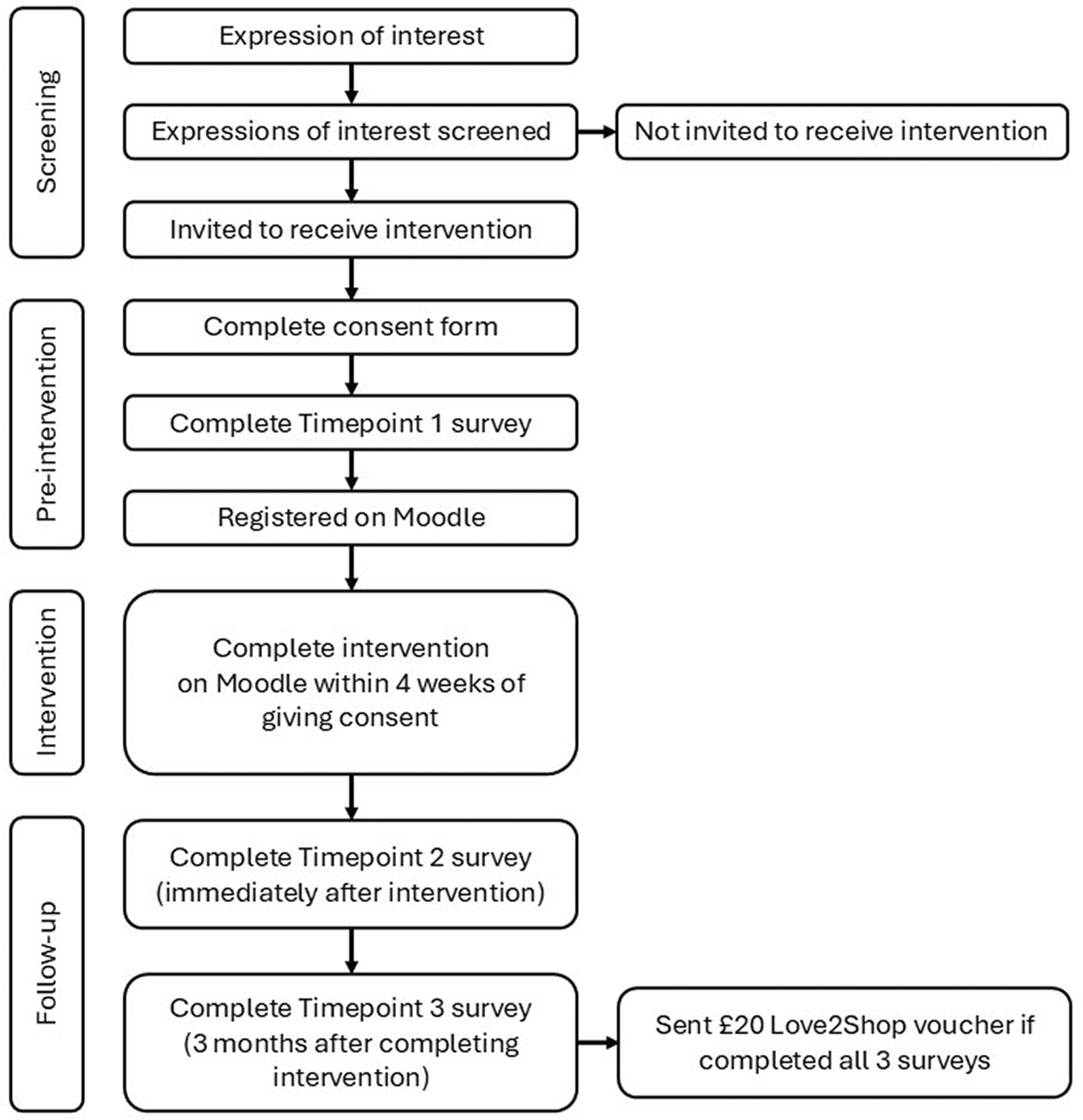
Participants will be 60 clinical trials researchers, ethics committee members and Patient and Public Involvement (PPI) contributors that have written, contributed to, or reviewed a clinical trial protocol or intend to do so in the three months following their enrolment in the study. We aim to recruit approximately 40 researchers and 20 REC members and intend for around 7–10 of these to be PPI or lay member participants who are either research co-applicants or REC members. Participants who complete an expression of interest form for the study will be asked to complete a brief screening questionnaire on their role in protocol design and/or review, allowing us to monitor the breadth of the sample during the study and target underrepresented groups if needed. Two members of the research team (PA and RL) will screen expressions of interest and issue invites to participants if there are slots available for their particular role, bearing in mind the proportion of participants from each group that the study is aiming to recruit. Informed consent will be obtained from participants using an online consent form which they will need to complete before they are able to continue on to the first survey and the training. See Figure 1 for a diagram of the flow of participants through the study.
There is no standard sample size for the conduct of a Kirkpatrick evaluation; it is often dependent on cost, time and other practical constraints. Four recent pilot evaluations that employed the Kirkpatrick methodology for training evaluation had samples in the range of 39–57 participants.28–31 All four studies yielded useful, publishable results against similar objectives to ours. We therefore feel that 60 is an appropriate target for a mixed-methods pilot evaluation and anticipate reaching saturation in terms of the diversity and depth of data from our participants.
2.4.2 Recruitment and retention
Researchers will be recruited via advertisements circulated by a number of organisations including the UK Trial Manager Network, the UK Clinical Research Collaboration’s CTU network and several NIHR Health Protection Research Units. Consent for advertisement has already been secured from these organisations. All participants will be offered a £20 Love2shop voucher for participation if they complete the e-learning and all three surveys.
2.4.3 Intervention
The intervention consists of a guidance handbook and e-learning resource that provides training on how to make clinical trial protocols more accessible for disabled and neurodivergent participants. The resource will be hosted on the Moodle e-learning platform and will be presented in varied formats, including videos and text-based learning resources as well as short within-module quizzes and self-reflection opportunities. It is designed to take around one hour to complete.
2.4.4 Outcomes
The Kirkpatrick Model27 will be used to assess the acceptability, relevance, and potential impact of the intervention. The first three levels of the model will be explored, namely: 1) Learner satisfaction; 2) Knowledge acquisition; and 3) Application of new knowledge. These outcomes will be assessed using bespoke, mixed-methods, questionnaires at three timepoints: Immediately prior to taking part in the training (Timepoint 1); immediately after completing the training (Timepoint 2); and three months after completing the training (Timepoint 3). Questionnaires will be sent to participants via email using unique REDCap survey links. Knowledge acquisition will also be assessed using within-module quizzes. Participant engagement and interaction will be assessed using Moodle usage statistics and learning analytics, and the participants’ self-reflection responses within the training.
2.4.5 Data analysis
A ‘convergent parallel’ research design (as defined by Creswell and Plano-Clark’s32 typologies of mixed methods research) will be used. Quantitative and qualitative data will be analysed separately and results that address related questions will then be integrated during the interpretation phase, using a weaving approach.33
For each data source (Timepoint 1, 2 and 3 surveys, Moodle usage statistics and learning analytics, within-module quizzes and self-reflection responses, technical support log), learners will be characterised using descriptive statistics. For free text responses, framework analysis34 will be used.
2.4.6 Dissemination
Dissemination of the study’s findings will be via similar routes as the pilot study’s recruitment, particularly the UK Trial Manager Network, the UK Clinical Research Collaboration, the Trial Methodology Research Partnership and the Health Research Authority. Interim findings were presented at the UK Trial Manager Network conference in June 2026 by RB. Whilst the dissemination strategy will mostly be aimed at the research community, we will also seek to engage members of the public with the project and its outputs, including through our partnership with the charity Disability Rights UK, to help them to highlight to researchers the importance of accessibility in clinical trials. The messaging we co-develop with our stakeholder group around this will have a bearing on future work and implementation of the training if the pilot is successful. All papers associated with the study (i.e. intervention development, literature review findings and pilot study results) will be submitted for publication in Open Access peer-reviewed journals, and once all findings have been accepted for publication, the anonymised dataset will be archived with the Open Science Framework.
The exclusion of disabled and neurodivergent people from clinical trials is a significant problem that has an impact on the health and wellbeing of disabled people and the impact and generalisability of research. The PRACTICALs intervention is designed to improve researcher knowledge, skills and attitudes around disability and neurodiversity in the clinical trial context. It is robustly underpinned by behaviour change theory and being developed using the Person-Based Approach to ensure its relevance and usefulness to the researchers, ethics committee members and Patient and Public Involvement contributors that it is designed to support. The planned pilot evaluation will help us to refine the intervention and will support the design of future research into the impact of this intervention on the inclusion of disabled and neurodivergent people in clinical trials.
This study has several limitations. Our recruitment methods may result in self-selection bias, with participants interested in inclusion and accessibility being more likely to volunteer. Also, the lack of a control group prevents causal inferences, the pilot was not powered to detect effectiveness, and the UK-only setting limits the generalisability of the findings. Nevertheless, we hypothesise that the PRACTICALs intervention will have an impact on clinical trial design and lead to greater representation of disabled and neurodivergent people in clinical trials, therefore promoting equity in trial participation opportunities and enhancing the generalisability of trial findings.
Provide sufficient details of any financial or non-financial competing interests to enable users to assess whether your comments might lead a reasonable person to question your impartiality. Consider the following examples, but note that this is not an exhaustive list:
Sign up for content alerts and receive a weekly or monthly email with all newly published articles
Register with NIHR Open Research
Already registered? Sign in
If you are a previous or current NIHR award holder, sign up for information about developments, publishing and publications from NIHR Open Research.
We'll keep you updated on any major new updates to NIHR Open Research
The email address should be the one you originally registered with F1000.
You registered with F1000 via Google, so we cannot reset your password.
To sign in, please click here.
If you still need help with your Google account password, please click here.
You registered with F1000 via Facebook, so we cannot reset your password.
To sign in, please click here.
If you still need help with your Facebook account password, please click here.
If your email address is registered with us, we will email you instructions to reset your password.
If you think you should have received this email but it has not arrived, please check your spam filters and/or contact for further assistance.

Comments on this article Comments (0)