Keywords
randomised controlled trial, consent, communication, research, death

randomised controlled trial, consent, communication, research, death
Involving critically ill patients in research is important to help find treatments that save lives.1 Approximately 90% of patients in intensive care units (ICU) lacked decisional capacity to provide informed consent at the point of admission to ICU.2 Mortality rates are high amongst severely ill patients,2 and excluding the most critically ill from research may introduce bias and diminish the validity of findings.3
In emergencies, where participants are unable to provide consent, alternate consent models can be used where individuals can be entered into a study using ‘Research Without Prior Consent’ (RWPC), also known as ‘deferred consent’.4,5 When interventions are not time critical, models of consent include approaching the patient’s relative to seek their consent or, where it is not possible to do so, involving an independent professional to decide whether to enrol the patient in research.4,5 Where alternate consent models are used, guidance suggests that consent from the patient is then sought upon their recovery.4,5 However, in a lactate-guided resuscitation trial in patients with sepsis, 11% of patients died before investigators could obtain consent from the patient or their “surrogate decision-maker”.5
A review of emergency department and intensive care clinical trial protocols in 2023 indicated that very few studies include a process of informing bereaved relatives about research involvement in their protocol.6 It is therefore not uncommon for ICU patients to die before research participation is discussed or consent obtained, leaving the bereaved unaware of research participation, including the use of the deceased patients’ data. There is a lack of insight to establish whether it is ethically appropriate to notify relatives, or indeed, whether relatives would wish to know. Clinicians, researchers, ethicists, and patient partners have raised concerns about the best approach to discussing research involvement with grieving relatives and are fearful of causing additional burden.7–9 Ethically informed research and guidance are needed to determine whether bereaved relatives would like to receive information about patient participation in research without prior consent before death, and if so, what would be the most appropriate processes of communication.7
The paper outlines the ENHANCE study guidance development process and good practice guidance for future trials. We summarise the methods used to develop the guidance below. Full details of the study which underpinned the guidance can be found in our related publication.6
The aim of the ENHANCing Communication with bEreaved relatives about emergency and critical care trials (ENHANCE) study was to assess and improve communication strategies with bereaved relatives, when a patient dies after enrolment in an emergency or critical care study without prior informed consent. The objectives were to explore bereaved relatives’ preferences regarding being informed about their family member’s research participation and receiving study findings, and to assess the feasibility and acceptability of integrating this communication into routine contact made by the Medical Examiner (ME) office after a death. The ME system is established in the National Health Service in England and Wales to independently scrutinise deaths with the aim of improving communication with bereaved relatives by discussing the cause of death. The ENHANCE study took place in the United Kingdom between March 2023 and August 2024.
The study involved a mixed methods design involving surveys, interviews and guidance development workshops across three workstreams (see Figure 1). A review of literature was conducted at the study design stage and again before workstream 3 to identify previous studies in this area to inform guidance development. MEDLINE, EMBASE, PsycINFO and Scopus were searched for articles using key terms (e.g. bereavement, relatives, research, trials, adult critical care, death, emergency care, communication, information sharing, preferences). No relevant studies were identified in adult settings where research was conducted without prior consent.
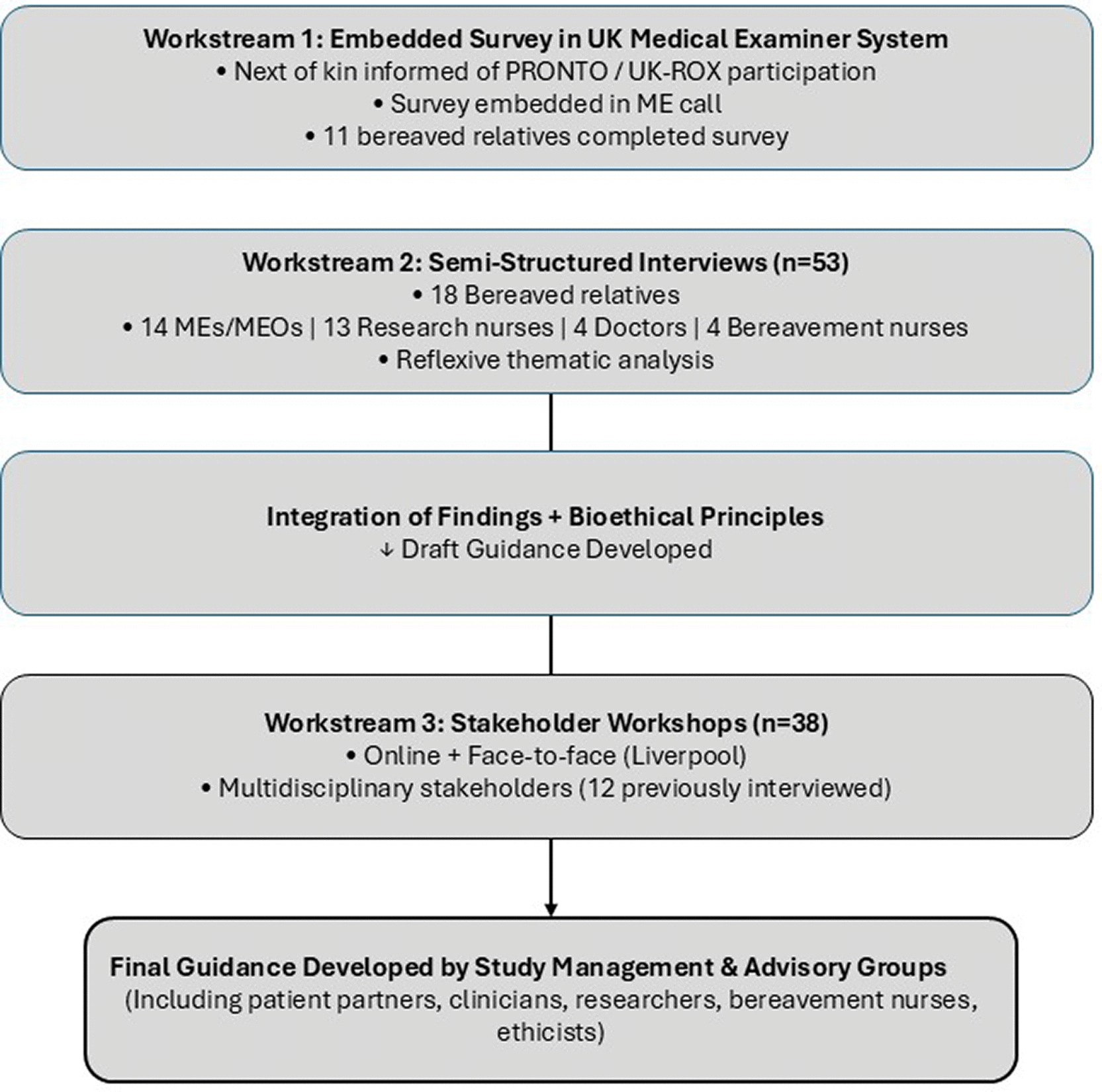
Workstream 1 was a survey embedded within the UK medical examiner system. This statutory system began in 2024 across England and Wales to provide independent scrutiny of deaths. Part of the ME role is to discuss the cause of death with the bereaved and establish if they have questions or any concerns with care before death. The ENHANCE survey was embedded in a call from the ME service Medical Examiner (ME) or Medical Examiner Officer (MEO) with the recently bereaved next of kin who were informed of deceased patient involvement in either the NIHR funded PRONTO trial (PRONTO - Centre for Trials Research - Cardiff University), or UKROX trial (ICNARC – UK-ROX). Bereaved relatives were asked if they would like to receive further information from the research team and/or take part in an interview at a later date.
Workstream 2 involved semi-structured interviews with bereaved relatives, ME’s and MEO’s, research and clinical staff involved in emergency and critical care trials in England and Wales. Bereaved relatives were recruited via social media and the Workstream 1 survey. Staff were recruited via social media and research networks. Qualitative data were analysed using reflexive thematic analysis10 and quantitative data was analysed using descriptive statistics. Findings and bioethical principles were considered to inform draft guidance. The final workstream involved two stakeholder workshops (one online, one face-to-face in Liverpool) to review draft guidance for future research.
Sixty-five participants took part between June 2023 and May 2024. Written informed consent was obtained from all study participants in each study workstream. Eleven bereaved relatives completed the workstream 1 survey; fifty-three participants (18 bereaved relatives, clinical staff including 14 ME’s/Medical Examiner Officers, 4 doctors 4 bereavement nurses and 13 research nurses) took part in workstream 2 interviews; and one bereaved relative participated in both workstreams.
For the final workstream, 38 stakeholders (8 relatives, 6 ME’s/ME Officers, 7 research nurses, 1 Health Research Authority representative, 2 ethics board members, 6 clinical nurses, 5 doctors, 3 bereavement nurses and 8 researchers attended one of two guidance development meetings, 12 of whom had also taken part in the interviews. Post meeting guidance were developed by the study management group and advisory group, which included patient partners, doctors, research and bereavement nurses, researchers and ethicists.
The ENHANCE study provided new evidence which indicated that the bereaved had mixed views on whether they or their relatives would want to know about critical care research involvement.6 Whilst most of those interviewed or contacted by ME office, stated they would wish to be notified, there were exceptions. Ethical concerns were raised about a lack of transparency when bereaved relatives are not informed, as well as the duty of candour, which emphasises the importance of being open and transparent about the quality and type of care patients receive. Researchers, ME’s, MEO’s, and relatives acknowledged that bereaved relatives could find out about research participation through different means, such as a request to see medical notes, which may compromise trust in healthcare providers. However, some raised concerns over the potential burden of automatic disclosure by the ME service. Study findings highlight the importance of providing bereaved relatives with the option to receive sensitively worded information about research involvement at an appropriate time, soon after death. The need for honesty and transparency was paramount.
This work was supported by the National Institute for Health and Care Research (NIHR), Research for Patient Benefit Program (Reference: 204067).
Ethical approval was granted by the NHS Yorkshire & The Humber – Leeds West Research Ethics Committee on the 4th April 2023 (Reference: 23/YH/0052) and informed consent was obtained from all participants. All procedures involving human participants were conducted in accordance with the ethical standards of the institution and ethics committee and conformed to the provision of the Declaration of Helsinki.
We established a Study Management Group (SMG), including a critical illness survivor (JC) who was a co-investigator and had extensive experience supporting bereaved relatives. Our Study Advisory Group (SAG) also included a PPI partner who is a lead support nurse for the UK charity, Sepsis Trust PPI partners were crucial in assisting our interpretation of findings to create appropriate recommendations. PPI partners provided study oversight and were involved in the interpretation and dissemination of study findings.
The following sections provide an overview of key recommendations from the ENHANCE Study. Full guidance is available at (ENHANCE | Institute of Population Health | University of Liverpool).
ENHANCE findings suggest that research and/or clinical teams (with knowledge of the study) should discuss emergency or critical care research involvement with bereaved relatives as soon as appropriate after enrolment. We acknowledge that it is not always appropriate, or possible, to approach relatives about research involvement before death, or before bereaved relatives leave the hospital after death.
The following recommendations provide options for researchers to consider when designing emergency or critical care studies where consent may not have been obtained from a patient or relative before death. Recommendations are presented to inform study protocols, research ethics committee applications and staff training. Recommendations are structured to recognise the varying systems and staffing structures across NHS Trusts and Health Boards. All recommendations comply with English and Welsh legislative frameworks and should be used with close reference to those. Appendix 2 of the full guidance (ENHANCE | Institute of Population Health | University of Liverpool) provides a description of approaches to recruitment and consent in emergency situations by study type (e.g. Clinical Trials of Investigational Medicinal Products (CTIMPs) and non CTIMPs). While frameworks in Scotland and Northern Ireland differ from those in England and Wales, we expect the guidance to be broadly transferable throughout the UK and beyond.
Who is this guidance for?
The ENHANCE guidance is for all those with a direct or indirect role in the funding, design, conduct, governance, and ethical review of emergency and critical care studies involving adults. This includes, but is not limited to doctors, nurses, paramedics, researchers, patient and public involvement (PPI) contributors, members of research ethics committees, study sponsors, funding committees, peer reviewers, and clinical trials unit staff. The guidance will also be of interest to patients, family members, NHS Research and Development staff, other members of the public and organisations representing the interests of patients and the public. We use the terms bereaved relatives and the bereaved. In this context, we are referring to a person (or persons) who are close to the patient and may be listed as their ‘next of kin’.
What should the research team consider at the study design stage?
Researchers should seek the views of patients and families at the research planning stage to consider the most appropriate and practicable approach (of those stated below) to notifying bereaved relatives, where it has not been possible to seek consent for research participation before death. When seeking patients and public involvement contributors for your study, aim for diversity of experience and background e.g. variance in experience or knowledge of research, different ethnic or cultural backgrounds, as well as previous ICU admission.
When an appropriate notification process has been identified, ensure the time and resources associated with this process are included in the research funding application. It is important to consider how research participation and type of consent is sought (e.g. if applicable, professional legal representative or professional consultee), and study names are recorded within NHS Trust/Health Board records and potential gaps. For example, consider how ambulance-led studies that use alternative consent pathways are recorded in hospital records so these patients can be identified in addition to those conducted within the ED and ICU.
If your chosen notification route involves letters for bereaved families (e.g. option 2) these letters should be tailored for the individual study in collaboration with PPI representatives and approved by a research ethics committee. As some families may not visit the hospital or live abroad, digital versions should be considered. Research teams using NHS data should also consider in their protocol what should happen if a patient has opted out of NHS National data sharing before death, and whether this may have implications for the bereaved family notification process.
Who should notify families and what information should they provide?
It is important that bereaved relatives are not automatically notified about patient research participation without prior consent before death as some may not wish to know. At an individual study level, establish whether it will be the clinical or bereavement team who will establish IF the bereaved family member would like to find out about research participation. Ensure this role is clarified in the study protocol and on study delegation logs.
The designated person/team should use their professional judgment on when to approach the bereaved relative. They should begin the discussion by explaining how the hospital is involved in research to inform future patient care and how some patients may have been involved in emergency or critical care research before they passed away. The designated person/team should then ask the bereaved if they would like to know whether their relative was involved in research during their hospital admission.
Asking the bereaved IF they would like to know about research involvement ought to be consistent with the ethically approved study protocol. The conversation should take place as soon as practically possible after patient death and complement bereavement guidance at each participating hospital.
If it is not deemed appropriate to discuss the study at that point in time, the designated person should consult with colleagues to identify an appropriate time to contact relatives using a research ethics committee approved personalised letter from the research team, written in the appropriate language. This written communication should take place sooner rather than later (e.g. within a week after death).
If the family member states they would like to know about research involvement, check the medical records and confirm whether the deceased patient did take part in the research and who approved their involvement (e.g. independent doctor). Box 1 shows two potential options for providing information to bereaved family members who state they would like to receive further information.
Option 1: Obtain contact details to send to a designated research team and/or clinician
• Ask the bereaved family member if they would like the designated member of the research team and/or clinician (whoever is deemed appropriate for the individual study) to contact them with information about the research.
• Ask how and when they would like to be contacted (e.g. face-to-face discussion or letter and identify any communication or language needs).
• Seek consent to provide their preferred contact details and preferred method of contact to the research team member and/or designated clinician.
• Be prepared to respond to family members who are concerned that study participation may have contributed to their relative’s death.
Option 2: Send a letter to the bereaved next of kin
• Send a letter to the bereaved family member from the study team.
• Template letters should be developed at the study design stage, approved by a research ethics committee and made available to the designated person/team. These should be written in close consultation with PPI representatives/bereaved family members/bereavement specialists/relevant interest groups. The letter should be personalised, signed by a research lead (known to the family if possible), including a named contact, email address (e.g. research team email to help prevent delays in responding) and telephone number and emphasise that a face-to-face meeting is optional.
• Consider which letter translations will be required for the local population.
• The letter should explain that if the bereaved family do not wish to have a face-to-face meeting, further information about the study can be made available (e.g. by post or study website). Provide contact details to the bereaved family in case they wish to discuss the research at a later date. Add a potential time frame for the research team to respond to the family. An example letter is provided in Appendix 4 of the guidance.
• A copy of the letter sent should be placed in the patient’s notes.
Could this communication form part of bereavement information materials?
If the NHS Trust or Health Board involved in emergency or crucial care research usually provide bereavement information (e.g. bereavement pack or booklet), it may be appropriate to include a letter that states the possibility of research involvement. This letter should be sensitively worded and describe how this is a research-active hospital, and that their family member may have been involved in emergency or critical care research during the hospital admission or ambulatory care before they died. An example letter is provided in Appendix 5 of the full guidance.
It is important for bereaved relatives to have a point of contact if they wish to find out about study involvement. If a Trust or Health Board has multiple studies recruiting critically ill this contact point will need to respond appropriately to relative enquiries. The key contact will need knowledge of emergency and critical care research within their Trust/Health Board, including information on the studies that are conducted without prior informed consent and have notification of bereaved next of kin in their protocol.
What should I consider when discussing research without prior consent with bereaved relatives?
During face-to-face discussions or telephone calls, explore bereaved relatives’ views and understanding of the study, as well as why informed consent could not be sought, so that any immediate concerns can be addressed. It is important to tailor communication for each individual with consideration of any questions or concerns about the study as well as their communication/language needs (e.g. use an interpreter if required). The points in box 2 may be helpful to consider. Please note that this is not a checklist as some points will not be relevant and may depend on the study type, data collected and family awareness of the research.
• Describe how consent is commonly sought from a patient before involvement in research however, in an emergency, which requires rapid assessment and treatment, legislation allows research studies to enrol participants without prior consent.
• Clarify how alternate models of consent are often used. These include approaching the patient’s family to seek their advice or consent or, where it is not possible, involving a nominated independent professional, such as a doctor, in deciding whether to enrol the patient in research.
• Explain how patients enrolled in emergency research based on consent or agreement/advice from an independent professional may sadly die before the study is discussed with relatives.
• Explain that permission from an NHS research ethics committee was sought to enrol patients in this way.
• Explain that research into treatments given in emergencies is important to help save lives in the future, and how the information collected from their relative’s medical records can be used to improve the care of patients.
• Provide information about the study interventions and how they compare with usual clinical care.
• Clarify that all information collected is anonymous meaning that no one outside of the hospital team has access to any personal identifiable information.
• Confirm that under the legal framework (in England & Wales), no additional written permissions are needed at this time.
• If families question whether the death was related to study participation, involve the clinical team in these discussions and check if the family have spoken to a ME. Do not give false reassurance that the study did not contribute to their family member’s death, unless it has been established by the principal/chief investigator or coroner that the cause of death was not related to the study.
• Provide an information sheet for bereaved relatives, which details a timeframe for when the study findings will be available and how they can be accessed (e.g. study website or research team contact details) if they wish to do so.
The ENHANCE study guidance addresses an important gap in clinical trial protocols and procedures by providing recommendations to support communication with bereaved relatives about research participation, when a patient dies following enrolment in an emergency or critical care trial. This guidance enables research and clinical staff to uphold their duty of candour and to facilitate transparent, sensitive communication with bereaved relatives.
Provide sufficient details of any financial or non-financial competing interests to enable users to assess whether your comments might lead a reasonable person to question your impartiality. Consider the following examples, but note that this is not an exhaustive list:
Sign up for content alerts and receive a weekly or monthly email with all newly published articles
Register with NIHR Open Research
Already registered? Sign in
If you are a previous or current NIHR award holder, sign up for information about developments, publishing and publications from NIHR Open Research.
We'll keep you updated on any major new updates to NIHR Open Research
The email address should be the one you originally registered with F1000.
You registered with F1000 via Google, so we cannot reset your password.
To sign in, please click here.
If you still need help with your Google account password, please click here.
You registered with F1000 via Facebook, so we cannot reset your password.
To sign in, please click here.
If you still need help with your Facebook account password, please click here.
If your email address is registered with us, we will email you instructions to reset your password.
If you think you should have received this email but it has not arrived, please check your spam filters and/or contact for further assistance.

Comments on this article Comments (0)