Keywords
Adverse events, Safety monitoring, Systematic Review, Multiple Sclerosis, Rehabilitation, Trial methodology, Randomised Controlled Trials

Adverse events, Safety monitoring, Systematic Review, Multiple Sclerosis, Rehabilitation, Trial methodology, Randomised Controlled Trials
Multiple Sclerosis (MS) affects an estimated 2.8 million people worldwide and is associated with a broad spectrum of physical, cognitive, and psychosocial impairments.2,3 Rehabilitation forms a central component of MS management and is supported by evidence demonstrating benefits for mobility, activity levels, cognition, and quality of life.4 As rehabilitation interventions increase and diversify, the need for rigorous evaluation of both their effectiveness and safety has become increasingly important. High quality randomised controlled trials (RCTs) are essential to ensure that rehabilitation practice is grounded in robust evidence.5,6 Safety assessment relies on the systematic collection, classification, and reporting of adverse events (AEs). However, research in non-pharmacological trials demonstrates that AE methodologies are often insufficiently detailed or inconsistently applied. Updated guidance, including CONSORT Harms,7 and the 2025 CONSORT/SPIRIT revisions,8 emphasise the need for transparency in harms reporting. Yet rehabilitation trials in MS face unique methodological challenges, including fluctuating symptoms, cognitive variability, and complex multi-component interventions. No previous review has investigated AE methodology specifically within MS rehabilitation RCTs. This systematic review aimed to address this gap.
Two people with MS (pwMS) provided insights and guidance on our review aims, objectives, and questions. Both PPI members made suggestions for disseminating research findings into MS communities, and examples of how future reviews could involve pwMS as members of the research team.
This systematic review followed PRISMA 2020 guidance9 and was prospectively registered on the Open Science Framework.1 Eligible studies included RCTs, feasibility or pilot RCTs, and their associated protocols or registration records involving adults with MS. Interventions were required to align with the Cochrane Rehabilitation definition, indicating active participation in a therapeutic process.10 Publications were limited to 1 January 2022–16 January 2025 to reflect alignment with emerging AE reporting standards. Fifteen databases, trial registries, and grey literature platforms were searched 16th January 2025 using an information specialist supported search strategy. After deduplication, two reviewers independently screened titles, abstracts, and full texts, resolving disagreements through discussion with a third reviewer. Non-English papers were translated where necessary. Where more than one record was identified (e.g. trial registration, protocol and results paper), the data was collated into a single unique study record. In line with recent AE reporting guidance7,8 items for data extraction focused on AE collection (approach, mode, personnel, timing, frameworks), classification (coding, causality, severity), and reporting (terminology, definitions, counts, group comparisons, statistical methods, display methods). Additional descriptive study characteristics were extracted to aid contextual interpretation of the included studies. A narrative synthesis was conducted. Meta analysis was not appropriate due to the qualitative nature of extracted data.
From 1224 records identified, 1029 were screened at title/abstract stage and 151 at full text. Fifty three unique studies met the inclusion criteria (See Figure 1, and Supplementary File for full reference list).
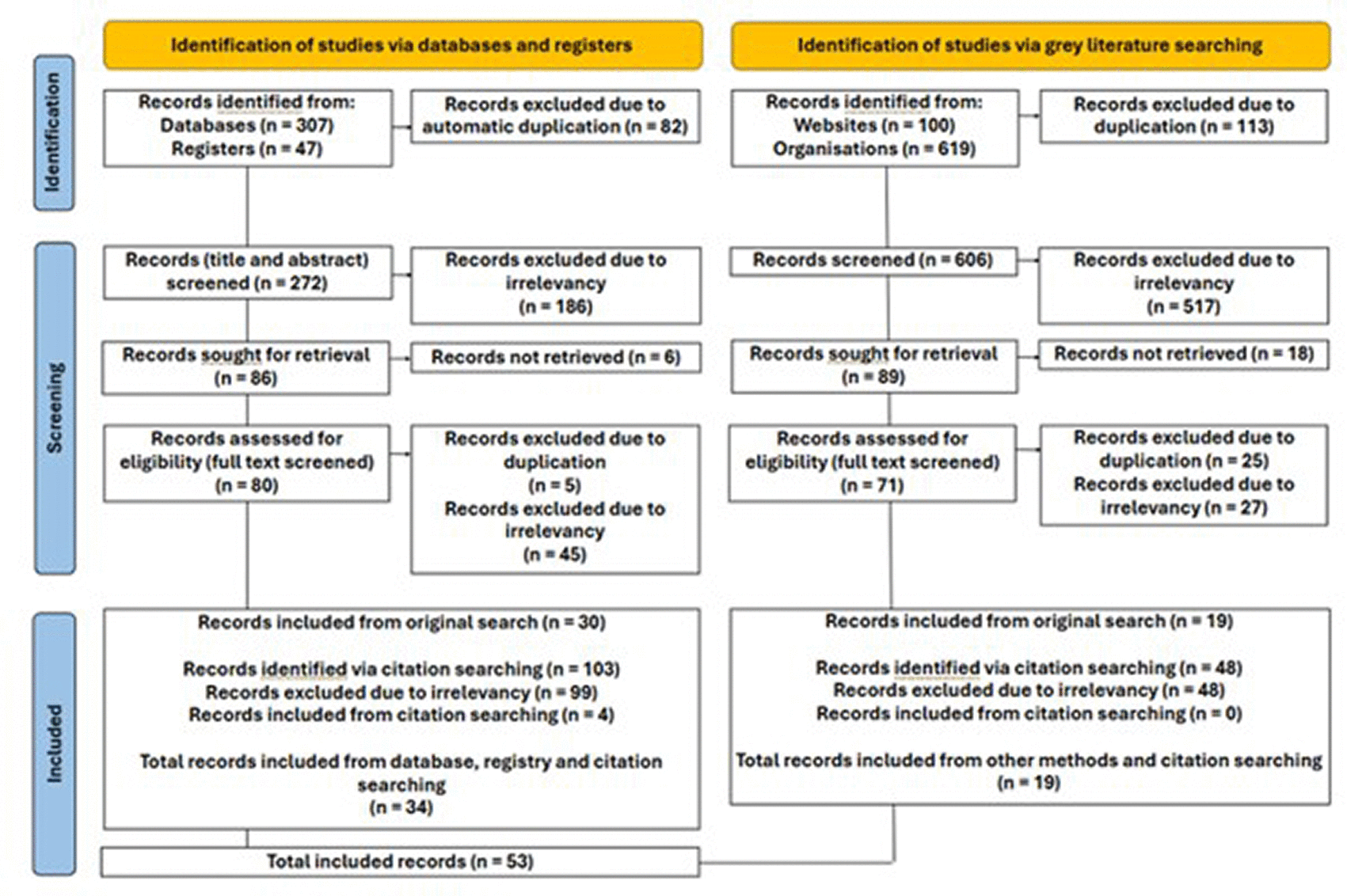
These studies represented at least 16 countries and involved a total of 4,903 participants of varying MS phenotypes (relapse remitting and progressive), ages (range of mean 27–62 years), and disability levels (range of mean Expanded Disability Status Scale scores 2.3 to 6.4). Interventions spanned multiple rehabilitation domains, including physical activity/exercise, virtual reality, behavioural change, psychological therapies, cognitive rehabilitation, hippotherapy and voice rehabilitation (See Supplementary File Table 1, with referencing of relevant studies).
3.2.1 Collection of AEs (See Supplementary File Table 2, with referencing of relevant studies)
Across the 53 studies, reporting of AE collection was limited and varied considerably. Of the 24 (45%) studies describing their method for AE data collection, 11 different modes of AE data capture were identified—ranging from telephone calls, in person assessments, and diaries, to email, video consultations, and online platforms. These methods were described inconsistently. Only seven (13%) studies specified whether they used an open or closed approach to collecting AEs, and the majority provided no indication of the rationale that guided their choice of method(s). This lack of clarity made it difficult to determine whether AE data were gathered systematically or whether methods were appropriate to the characteristics of rehabilitation interventions.
Responsibility for collecting AE data also varied. Four (8%) studies relied primarily on participant -self-report, while seven (13%) used a shared approach between participants and study personnel. Many papers did not indicate who held primary responsibility, leaving uncertainty about the reliability of AE ascertainment, particularly in a population where fluctuating MS symptoms and cognitive challenges may affect recall. Timing of AE capture was similarly under-reported. A minority of studies specified whether AEs were documented at the point of occurrence or retrospectively (n = 14, 26%), with a mixed approach most often used (n = 7, 13%); for most studies, this information was absent. Only 2 (4%) studies referenced the use of structured AE collection frameworks, such as the Food and Drug Administration (FDA) FDA Adverse Event Reporting System (FAERS) or institutional harms policies. Of the 40 studies that included a follow-up- period, only five (9%) explicitly stated that AE monitoring would be continued during those follow-up phases.
3.2.2 Classification of AEs (See Supplementary File Table 3, with referencing of relevant studies)
Classification of AEs was reported infrequently; only one (2%) study used a recognised coding framework (Common Terminology Criteria for Adverse Events), with seven (13%) others using a study-specific approach to their classification. Structured approaches to causality assessment were uncommon, appearing in only three (6%) studies; typically drawing on internal institutional checklists, the National Institute of Health (NIH) scheme, or semi structured qualitative judgement. Severity assessments were similarly inconsistent, with only seven (13%) studies reporting methods for investigating the severity of AEs. Of these, some studies referenced institutional criteria, or bespoke rating scales, while others used descriptive categories such as “minor” or “resolved” without clear methodological grounding. These inconsistent and often absent classification procedures limit the interpretability and comparability of AE findings across MS rehabilitation randomised trials.
3.2.3 Reporting of AEs (See Supplementary File Table 4, with referencing of relevant studies)
The reporting of AEs demonstrated substantial variability. Across the included studies, 17 different terms were used to refer to adverse events, and most studies (n = 45, 85%) did not provide a definition of the term used. “Adverse event” was the most frequently used term (by 41 studies, 77%); 22 studies (42%) applied multiple terms interchangeably when referring to AEs. The lack of definitional clarity created ambiguity regarding how study teams conceptualised and categorised safety related information.
Only a minority of studies reported individual AE counts (n = 8, 15%), wherein the specific instances of AEs are recorded and reported. Separate reporting for intervention and control groups was undertaken by only 13 (25%) studies making it difficult to interpret any potential between group differences in safety outcomes. Statistical analysis methods were described explicitly by only a few studies, with most relying implicitly on descriptive summaries without specifying how these were generated. Only three studies (6%) provided tabular or graphical summaries of the collected AE data. No studies presented time to event data (the length of time from a defined start point, such as treatment initiation), duration of AEs, or AE selection rules wherein criteria are used to determine which unfavourable, unintended, or harmful consequences will be reported. No study provided a lay summary of either the trial results or the AEs.
Only three studies (6%) explicitly reflected on limitations in their AE methodology. Two (4%) highlighted restricted AE collection windows, one including an inability to capture events occurring outside scheduled contact periods.11,12 One (2%) reported not including a data safety monitoring board.13,14 Suggested improvements included incorporating remote or outside of session AE collection methods,11 extending monitoring periods,12 and integrating qualitative enquiry to capture contextual information around adverse experiences.11 These reflections underline the need for more comprehensive AE methodology in MS rehabilitation trials.
This review demonstrates that current AE methodology in MS rehabilitation RCTs is fragmented, inconsistently reported, and frequently insufficient. Key components of AE collection—such as approach, timing, mode, and responsible personnel—were rarely described in any detail. AE classification practices, including causality and severity assessment, were limited, and reporting was marked by inconsistent terminology, limited quantitative summaries, and minimal use of structured analyses. These findings highlight the extent to which recent MS rehabilitation randomised trials fall short of contemporary harms reporting guidance, including CONSORT Harms7 and the updated CONSORT/SPIRIT recommendations.8 Given the variability of MS symptoms and the cognitive challenges faced by many participants, reliance on retrospective self-report or non-systematic methods may lead to underreporting or misclassification of AEs. More structured, transparent, and participant appropriate approaches to AE methodology are needed. A systematic adoption of established frameworks, clear terminology, defined classification processes, and robust reporting practices would substantially strengthen safety evaluation in MS rehabilitation trials.
Across contemporary MS rehabilitation RCTs, the collection, classification, and reporting of AEs were inconsistently described and frequently lacked essential methodological detail. Standardised, transparent AE methodology—aligned with CONSORT Harms 2022 and CONSORT/SPIRIT 2025—is needed to support rigorous safety evaluation, improve interpretability, and strengthen the methodological quality of MS rehabilitation trials.
Declaration of generative AI and AI-assisted technologies in the manuscript preparation process.
During the preparation of this work the author(s) used Microsoft CoPilot (Wave 3) to condense text, proofread and grammar check. After using this tool, the author(s) reviewed and edited the content as needed and take full responsibility for the content of the published article.
Provide sufficient details of any financial or non-financial competing interests to enable users to assess whether your comments might lead a reasonable person to question your impartiality. Consider the following examples, but note that this is not an exhaustive list:
Sign up for content alerts and receive a weekly or monthly email with all newly published articles
Register with NIHR Open Research
Already registered? Sign in
If you are a previous or current NIHR award holder, sign up for information about developments, publishing and publications from NIHR Open Research.
We'll keep you updated on any major new updates to NIHR Open Research
The email address should be the one you originally registered with F1000.
You registered with F1000 via Google, so we cannot reset your password.
To sign in, please click here.
If you still need help with your Google account password, please click here.
You registered with F1000 via Facebook, so we cannot reset your password.
To sign in, please click here.
If you still need help with your Facebook account password, please click here.
If your email address is registered with us, we will email you instructions to reset your password.
If you think you should have received this email but it has not arrived, please check your spam filters and/or contact for further assistance.

Comments on this article Comments (0)