Keywords
Cellulitis, Flucloxacillin, Antibiotic duration, Randomised controlled trial, Non inferiority trial, Primary care, Patient reported outcomes, Health economic evaluation

Cellulitis, Flucloxacillin, Antibiotic duration, Randomised controlled trial, Non inferiority trial, Primary care, Patient reported outcomes, Health economic evaluation
Cellulitis is an acute bacterial infection of the dermis and subcutaneous tissues, most commonly caused by Streptococcus pyogenes and Staphylococcus aureus. It typically arises following disruption of the cutaneous barrier - such as from toe-web tinea infection, venous leg ulcers, or eczema - permitting bacterial entry and proliferation within the dermis and subcutaneous tissue.1 Clinically, cellulitis is characterised by pain, oedema, warmth, tenderness, and poorly demarcated erythema, most often in the lower limbs,2,3 and can be accompanied by systemic manifestations, such as fever and malaise.
In the UK, cellulitis has an estimated incidence of 25 cases per 1,000 patient-years,2,4 equating to 250 cases annually in a general practice population of 10,000 patients. It accounts for 3% of accident and emergency (A&E) attendances.5 As the risk of lower-limb cellulitis increases with age6 and body mass index,1 the condition is likely to pose a continued public health burden amid an ageing population and rising prevalence of obesity.
First-line management in the UK consists of antibiotic therapy, most commonly with a penicillinase-resistant beta-lactam agent such as flucloxacillin.7 Current NICE guidelines recommend oral flucloxacillin 500–1000 mg four times daily for 5–7 days.8 Other national guidelines recommend treatment for 5 days, as long as the patient is starting to show signs of improvement.9 However, evidence suggests that most patients receive prescriptions for seven or more days.7 Notably, prolonged antibiotic use poses important clinical risks. Widespread use of beta-lactam antibiotics, including flucloxacillin, contributes to selective pressure for methicillin-resistant Staphylococcus aureus (MRSA).10 A UK government report11 on antimicrobial resistance (AMR) highlighted the profound clinical and economic consequences of failing to address this global threat, with 700,000 deaths worldwide each year attributed to drug-resistant infections at the time of the report, and an estimated 10 million annual deaths and loss of $100 trillion in global economic output by 2050 without effective intervention.12 Extended antibiotic exposure also increases the risk of adverse effects, such as nausea, diarrhoea, rashes, and disruption of the gut microbiome, which may increase susceptibility to long-term conditions such as diabetes and obesity.13 These risks are particularly pronounced among older adults who are more vulnerable to polypharmacy and adverse drug effects.8 Optimising antibiotic duration is central to mitigating these risks, particularly in primary care, where 75% of antibiotics in England are prescribed14 — a research priority echoed by the James Lind Alliance partnership.15
Despite this, evidence supporting shorter antibiotic courses for cellulitis remains limited. NICE cited two systematic reviews incorporating evidence from three randomised controlled trials (RCTs) in support of their prescribing guidance.16,17 None of these RCTs are particularly relevant to UK primary care prescribing for cellulitis. The first compared 5 versus 10 days of levofloxacin, a fluoroquinolone, in 87 patients referred to a military tertiary care hospital in the United States.18 They reported no difference between groups in clinician-assessed resolution of infection on day 14, however participants were randomised on day 5, those having a more complicated presentation were excluded, and the study was not powered as a non-inferiority study. The other two trials compared 6 days of intravenous tedizolid (with oral step-down if indicated) with 10 days of linezolid in hospitalised patients. Both were large, multicentre non-inferiority studies and found 6-days of once-daily intravenous tedizolid to be non-inferior to 10-days of twice-daily linezolid for early clinical response.19,20
Two further systematic reviews21,22 have considered duration of antibiotic treatment for cellulitis. One conducted a meta-analysis showing no evidence of benefit from longer courses. However, all included studies were conducted in the hospital setting among patients with severe or complicated cellulitis, and all but one compared different antibiotics at different durations rather than the same antibiotic at different durations. The only trial to compare durations of the same antibiotic recruited 248 hospitalised patients with severe cellulitis, all of whom received an initial 6 days of intravenous flucloxacillin. Participants were then randomised to either 6 days of oral flucloxacillin (total 12 days of antibiotic) or 6 days of oral placebo (total 6 days of antibiotic). No difference was observed in ‘cure by day 14 with no relapse by day 28’, but the study failed to recruit to target and was underpowered to conclude non-inferiority.23
In summary, while existing evidence suggests shorter courses may be as effective as longer courses, its applicability to routine practice is limited. Only two trials have compared different durations of the same antibiotic, none have been conducted in primary care where cellulitis is routinely managed, and no study in this setting has evaluated the duration of oral flucloxacillin or similar penicillinase-resistant penicillins. A systematic review of antibiotic regimens for lower limb cellulitis concluded that lower limb cellulitis is likely to be routinely overtreated and highlighted a “profound gap in the literature”, emphasising the need for trials evaluating shorter antibiotic regimens.24
The COAT study is designed to address this evidence gap by assessing the effectiveness and safety of 5 versus 7 days of oral flucloxacillin (500 mg four times daily) for lower limb cellulitis in UK primary care, using the outcome that patients describe as most important for them, and to evaluate the cost consequences of a shorter course from both NHS and patient perspectives.
The primary objective is to assess whether a 5-day course of oral flucloxacillin (500 mg four times daily) is non-inferior to a 7-day course with respect to patient-reported pain between days 6 and 14 post-baseline in adults presenting to primary care with lower limb cellulitis.
Secondary objectives include comparing the impact of an initial 5 versus 7 days of flucloxacillin on total use of antibiotics and analgesics, resolution of cellulitis symptoms, and the occurrence of complications.
We also aim to evaluate the cost-consequences of the 5-day course, compared to the 7-day course, from a National Health Service (NHS) and personal perspective. Specifically, we aim to evaluate changes in resource use including hospital admissions, consultations, and medication use, number of recurrent cellulitis episodes over 12 months and change in health-related quality of life.
Six public contributors with lived experience of cellulitis contributed to the study design. Their input guided the selection of pain as the primary outcome and informed a repeated-measures approach over days 6–14. Public contributors piloted the data collection tools and confirmed that daily reporting was manageable, taking under two minutes, and that the weekly questionnaires took less than five minutes to complete. A wider public contributor reference group supported the development of participant materials, assessed study processes, and will co-produce dissemination materials once trial results are available. Public contributors also encouraged the onboarding of Urgent Treatment Centres (UTCs) and Accident and Emergency (A&E) departments to reflect evolving patient pathways. Two co-applicant public contributors sit on the TMG alongside two further contributors; two independent public contributors sit on the TSC; and one independent public contributor sits on the DMEC.
A pragmatic phase III, multi-centre, randomised, double-blind non-inferiority trial, with internal pilot and parallel health economic evaluation. After informed consent, participants will be randomised 1:1 to receive oral flucloxacillin or placebo, four times daily for 2 days, following completion of a 5-day unblinded flucloxacillin prescription prescribed by the recruiting site as standard of care. Figure 1 provides an overview of the trial design and patient pathway.
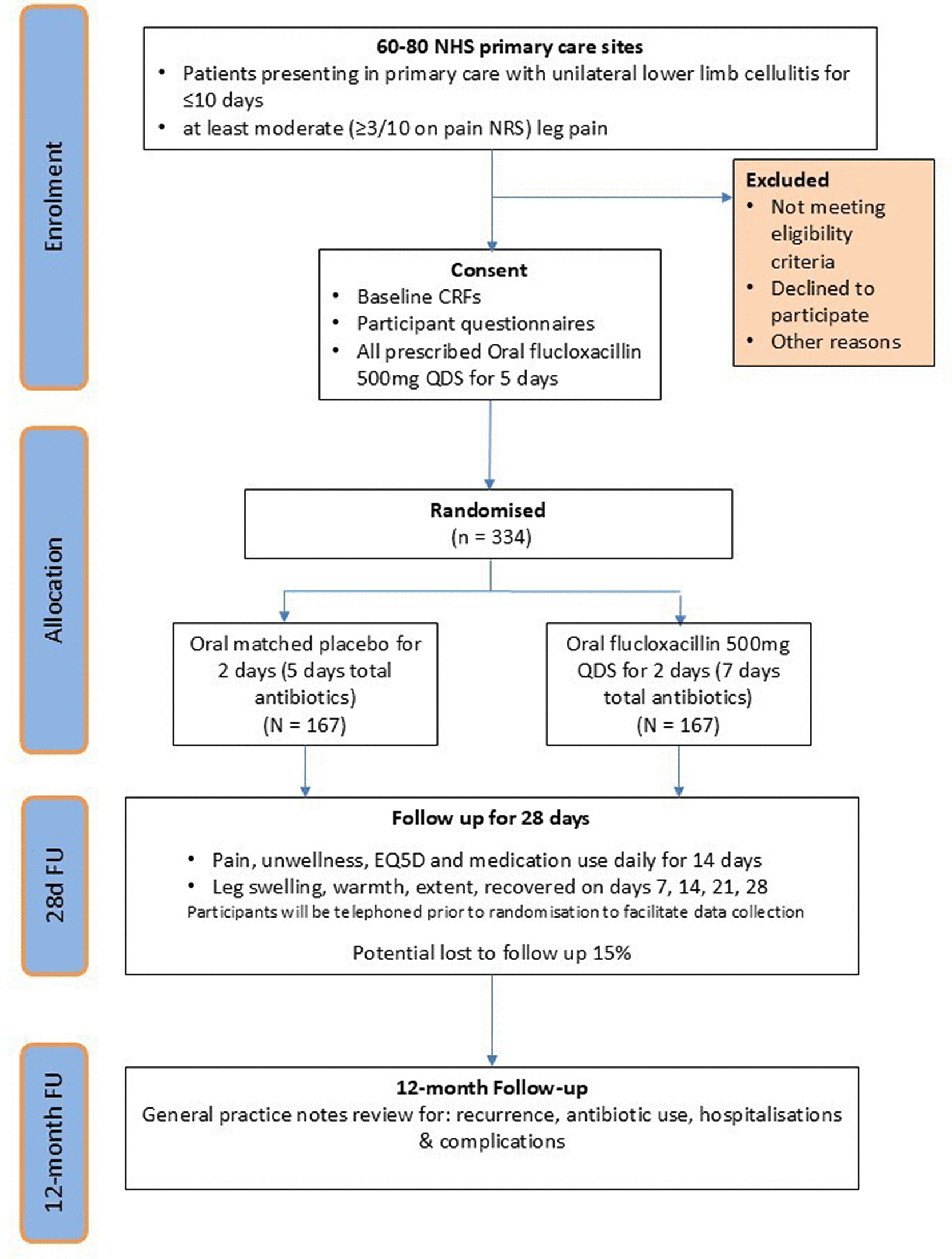
Participants will be recruited from 60–80 NHS primary care sites across England, including general practices, emergency departments, and urgent care centres. Sites will be identified through expressions of interest submitted via National Institute of Health Research (NIHR) regional research delivery networks (RRDNs) and selected based on prior experience with opportunistic recruitment and patient population size and diversity.
Eligible participants are adults (≥18 years) presenting with symptoms of lower-limb cellulitis, including pain, tenderness, skin colour change, and warmth, of 10 days’ duration or less, for whom cellulitis is the most likely diagnosis, and who report a baseline pain score ≥ 3/10 on a 11 point (0–10) numeric rating scale (NRS). The inclusion and exclusion criteria (See Table 1) were developed to reduce the risk of including pseudocellulitis (by including only those with painful, unilateral symptoms for example) and to exclude those at greater risk of being infected with unusual organisms (post-operative or with chronic leg ulceration, for example). Patients with chronic lymphoedema were not excluded, as although these patients have an increased risk of developing cellulitis, and may take longer for their symptoms to improve, there is no clear evidence that they benefit from longer courses of antibiotics.
| Inclusion criteria |
|
| Exclusion criteria |
|
All participants will receive an initial 5-day course of oral flucloxacillin 500 mg four times daily as an unblinded, standard-of-care NHS prescription from their healthcare provider, in line with current NICE antimicrobial prescribing guidance.9
The Investigational Medicinal Products (IMPs) for this study comprise over-encapsulated flucloxacillin 500 mg capsules and matched placebo capsules.
Participants randomised to 5 days of treatment will receive placebo capsules to take four times daily for 2 days. The first dose will be administered according to the participant’s existing dosing schedule, following completion of the 5-day unblinded course. Capsules will be formulated and manufactured to a standard placebo composition (containing microcrystalline cellulose) to match the appearance of the active over-encapsulated capsules for the maintenance of blinding. IMP will be dispatched by the COAT central study team via secure, tracked delivery to the participant’s home or GP practice, timed to arrive before completion of the initial 5-day flucloxacillin course.
Participants in the 7-day group will receive oral flucloxacillin 500 mg four times daily for 2 days, over encapsulated to match the appearance of the placebo capsules, completing 7 days of active antibiotic therapy. Administration and dispatch procedures are identical to those used for the 5-day group.
Modification of dosage or antimicrobial agent is permitted in the event of significant clinical deterioration, as assessed by the participant’s clinician. To minimise the use of additional antibiotic courses for slow resolution of visible inflammation, participants will receive an information leaflet at recruitment clarifying the distinction between residual inflammation and ongoing infection.
IMP will be arranged by MODEPHARMA and supplied in High-Density Polyethylene (HDPE) bottles containing eight capsules, fitted with child-resistant caps, tamper-evident closures, and labelled in accordance with Annex 13 guidelines. IMP will be stored in a locked, temperature-controlled (15–25 °C) facility prior to dispatch.
Adherence to the full treatment regimen (5-day unblinded course and 2-day IMP) will be self-reported by participants via daily questionnaires, recording the number of doses taken and reasons for missed doses. Consistent with the pragmatic design of the trial, full reconciliation of unused medication will not be undertaken. Centralised drug accountability records will be maintained by the COAT central study team, with delegated staff recording the date and quantity of IMP received and dispensed. Participants will be instructed to safely dispose of any unused medication, either by returning it to a local pharmacy or discarding it at home.
Concomitant medications prescribed at the initial consultation, along with any over-the-counter treatments used by participants for cellulitis management (including analgesics and supplementary antibiotics), will be recorded from the first administration of the unblinded flucloxacillin prescription up to day 28.
Participants will be randomised remotely by the COAT central study team at the Southampton Clinical Trials Unit (SCTU) using a centrally located, web-based system (TENALEA). Allocation will be 1:1 to oral flucloxacillin or matched placebo, using permuted block randomisation and stratified by obesity (BMI ≥30) and prior history of leg cellulitis. Randomisation will occur as soon as possible after informed consent, and within 72 hours of the baseline consultation, to ensure the IMP can be delivered before completion of the initial 5-day antibiotic course.
Participants, the central study team (including dispensers), and site staff will remain blinded to treatment arm throughout the study. IMP will be supplied in identical packaging and the active drug over-encapsulated to ensure visual equivalence to placebo. IMP bottles will be marked with a unique pack identifier (ID) for dispensing and traceability. Randomisation outputs generated by ALEA will reference a blinded pack ID, omitting treatment information to prevent disclosure of the assigned arm.
Primary outcome: pain over days 6–14 post-baseline assessment
Participants will self-report pain daily from days 6 to 14 post their initial baseline assessment, using the 11-point Numeric Rating Scale for Pain (NRS; 0–10).25 The time window for the outcome is based upon time since their initial presentation, which is when most participants will start their initial course of antibiotics, and is designed to capture the period when treatment differs between the two randomised groups (most participants will complete their 5-day initial course on day 6). Data will be collected by a daily diary, completed either online or on paper according to participant preference. Where neither method is feasible, the participant may provide their scores by telephone to a member of the central study team.
Patient and Public Involvement (PPI) played an integral role in the selection of the primary outcome. Public partners identified pain as the outcome of greatest relevance to individuals with cellulitis, noting that the condition is often severely painful and that improvement of pain is more meaningful than the resolution, or early recurrence, of other symptoms. There is no core outcome set for cellulitis, however pain is also the most frequently reported patient-centred outcome in trials of cellulitis interventions.26 The Numeric Rating Scale (NRS) for pain was selected as it has evidence of validity and responsiveness to change.25
Key secondary outcome
Total antibiotic consumption
Total antibiotic consumption, defined as the total number of days between days 0 and 28 on which one or more antibiotic doses are taken, will be evaluated as a key secondary outcome. Although participants in the intervention group will receive fewer initial antibiotics, this does not necessarily equate to reduced overall antibiotic consumption. Demonstrating non-inferiority of the intervention with respect to pain alone is insufficient to justify its recommendation; evidence of additional clinical or public health benefit is required. In the trial, the anticipated benefit is a reduction in antibiotic exposure, which confers important individual and societal advantages as outlined in the introduction. While the study is not powered to detect statistically significant differences in this outcome, the intervention is unlikely to be considered for adoption if the point estimate indicates greater antibiotic use in those randomised to an initial 5 days compared to those randomised to an initial 7 days of antibiotics.
Additional secondary outcomes
• Use of additional antibiotics, defined as any reported use of antibiotics other than the initial 5-day course of flucloxacillin and 2 days of IMP, collected up to day 28 post-baseline assessment.
• Patient-reported wellbeing, assessed using a categorical scale ranging from “extremely unwell” to “not at all unwell,” recorded daily on days 1–14 and on days 21 and 28 post-baseline assessment.
• Health-related quality of life, measured using EQ-5D-5L27; index values and individual dimension scores (mobility, self-care, usual activities, pain/discomfort, anxiety/depression) collected daily over days 1–14, and on days 21 and 28. The EQ Visual Analogue Scale (EQ-VAS), a 0–100 visual analogue scale assessing overall health status, will be collected at baseline and day 28.
• Severity of both leg swelling and leg redness, self-reported by participants on days 7, 14, 21, and 28.
• Time to self-reported recovery, assessed on days 7, 14, 21, and 28 post-baseline assessment.
• Time to self-reported onset of recovery, assessed on days 7, 14, 21, and 28 post-baseline assessment.
• Hospital admissions, primary care consultations, antibiotic treatment for cellulitis, and NHS resource use, identified through medical notes review at 12 months post-baseline assessment.
• Recurrent cellulitis episodes, defined as the number of new episodes occurring within 12 months post-baseline assessment, identified through medical notes review.
• Complications, including lymphoedema, leg ulceration, venous insufficiency, sepsis, or death, occurring within 12 months post-baseline assessment, identified through medical notes review.
• Participant personal expenses and time off work, assessed on day 28 post-baseline assessment.
The sample size was calculated assuming a non-inferiority margin of 1 point on the NRS for pain (0–10). This margin was guided by evidence that mean cellulitis pain scores fall, on average, from 5–7 at baseline to approximately 3 by days 4–6 and 2 by day 7, with an SD of 2.8.26 Pain scores in the 7-day treatment arm were therefore projected to decrease from approximately 2.5 on day 6 to 1–1.5 by day 14. Although no minimal clinically important difference (MCID) has been defined for cellulitis-related pain, published MCIDs for acute pain conditions generally exceed 1 point,28,29 indicating that a 1-point margin is a conservative estimate of a clinically meaningful difference. This threshold was endorsed by the PPI group as an appropriate balance between the potential benefits of reduced antibiotic exposure and the potential harms of increased pain due to inadequate treatment or early relapse. Assuming a standard deviation of 2.8 and a correlation of 0.7 across nine repeated measures, a sample size of 284 participants would provide 90% power to detect a difference between groups using a one-sided alpha of 0.025. To account for 20% of participants not providing sufficient pain scores to derive the primary outcome (one pain score between days 6 and 14), the initial recruitment target was inflated to 354. The sample size was calculated using GLIMMPSE sample size software. After 20 months of recruitment, an assessment of follow-up rates indicated that 92% of participants had provided one or more data points to the primary outcome, with an average of eight data points per participant providing primary outcome data. Given this better than anticipated follow-up rate, and following discussions with the Data Monitoring and Ethics Committee (DMEC), Trial Steering Committee (TSC) and funder, a decision was made to reduce the target sample of recruited participants to 334, based on assuming a loss to follow-up of 15% and the same size for the analysable population.
Potential participants will be identified opportunistically by site staff at the time of presentation to a participating centre or via retrospective review of presentations within the preceding 48 hours. Sites are asked to screen all patients presenting with suspected lower limb cellulitis for trial eligibility, and to keep a screening log documenting each approach, including consent status and reasons for non-enrolment.
To facilitate enrolment, sites will receive a recruitment poster for display in clinical areas, and participating general practices will be provided with a template text message to send to patients with a history of cellulitis, helping to raise awareness of the study ahead of future consultations. Where feasible, prospective participants will be directed to the study website to access information, including a short explanatory video and the Participant Information Sheet (PIS), prior to their consultation. Consent may occur during the baseline consultation or within 48 hours thereafter by a delegated member of the site or central study team. Final eligibility must be confirmed by a healthcare professional who has experience in diagnosing and managing cellulitis in a primary care setting. If a patient is not consented during the initial consultation, the treating clinician may pre-screen for eligibility and record a statement in the medical notes confirming trial eligibility.
An overview of the trial timeline and follow-up schedule is provided in Table 2.
Data will be captured using electronic Case Report Forms (eCRFs) within a validated OpenClinica database managed by the UKCRC-registered Southampton Clinical Trials Unit (SCTU). To facilitate recruitment in a busy primary care setting, site staff will collect a minimal baseline dataset prior to randomisation, including clinical features, eligibility, contact details, and a baseline pain score. After randomisation, participants will self-report remaining baseline measures using diary entry, completed electronically via automated SMS or email links, on paper, or by telephone with the central study team. A daily diary over days 1–14 will capture pain scores, quantity of antibiotics consumed (initial course and additional prescriptions), and a minimal set of secondary outcomes. Additional secondary outcomes will be collected at days 7, 14, 21, and 28. Long-term follow-up will be conducted at 12 months through medical notes review by site staff.
To optimise diary completion, participants will receive a pre-randomisation welcome call from the central study team, in addition to manual text and/or email reminders. Participants can complete diary entries retrospectively for up to 3 days following the scheduled completion date. For electronic diaries, the questionnaire will automatically become unavailable after this period. Participants using paper diaries will be informed at the welcome call that retrospective completion is limited to a maximum of 3 days and will be required to record the date of diary completion on the form. Where electronic diary data remain missing, up to three attempts will be made to collect the data via telephone call.
Unless participants explicitly withdraw from the trial, efforts will be made to obtain follow-up data from all randomised participants, irrespective of adherence to the intervention. For participants who become uncontactable, passive data collection will continue via the 12-month medical notes review where feasible.
SCTU will be responsible for the day-to-day management of data in line with a trial-specific Data Management Plan (DMP). All baseline and outcome data will be recorded in the study database (OpenClinica) and stored in compliance with relevant data protection regulations. Data will be entered into the database via a combination of participant-completed electronic diaries and entry by site staff or the central study team. Where electronic entry is not feasible, or participant diaries are collected via telephone by the central study team, paper Case Report Forms (pCRFs) will be completed and transcribed into the database by a member of the COAT central study team. Investigator sites will receive eCRF completion guidelines to support accurate data entry. The SCTU will regularly review data for completeness and accuracy, with missing or anomalous values generating automated or manual data queries within the eCRF. Where necessary, queries about participant-reported outcomes will be clarified by telephone. Only the PI or authorised delegated personnel, including the central study team, may enter or modify eCRF data. All modifications are captured in the eCRF audit trail. At trial completion, the principal investigator will verify data integrity by electronically signing the eCRFs after the final participant visit and resolution of all queries.
The safety profile of flucloxacillin is well established, and therefore routine reporting of adverse events (AEs) and adverse reactions (ARs) will not be undertaken for this trial. Hospital admissions within 28 days of presentation, and hospital admissions over the subsequent 11 months, will be captured through the diary and medical notes review respectively, and reported as secondary outcomes. Only serious adverse reactions (SARs: adverse events that are both serious and, in the opinion of the reporting investigator, believed with reasonable probability to be due to one of the trial treatments) will be subject to mandatory reporting.
A detailed statistical analysis plan (SAP) will be written, reviewed, and uploaded to ISRCTN prior to the study database being locked. Data will be reported and presented according to the revised CONSORT (Consolidated Standards of Reporting Trials) Statement.30 All results will be reported with 95% confidence intervals, and all models will control for the baseline covariates set out in the primary analysis. No interim analyses are planned.
Primary analysis
The primary analysis will compare pain scores over days 6 to 14 in the two groups using a linear mixed model, controlling for baseline pain NRS and stratification variables and allowing for the clustering of repeated measures within participant over time. The mixed modelling approach will allow participants to contribute data to the model for any days for which they have completed the NRS, with any missing days being treated as missing at random. The structure and pattern of missing data will be explored, and if appropriate, a sensitivity analysis based on data imputed using a multiple imputation model will be presented.
The primary estimand of interest will be a treatment policy estimand, corresponding to an intention to treat (ITT), as this is the basis for the sample size calculation. However, since ITT can be anti-conservative for non-inferiority trials, the analysis will also be conducted per protocol as an important secondary analysis, and findings interpreted cautiously considering any differences between approaches that emerge. A standard per protocol analysis, which excludes those who take additional antibiotics during days 6 to 14, will be carried out. In addition, the ‘on treatment’ estimand, which censors those who take additional antibiotics from the day they start the additional course, will also be calculated.
Key secondary outcome
The total number of days of antibiotic consumption will be compared using either Poisson or negative binomial regression as appropriate to the data, adjusting for the same covariates as the primary analysis.
Additional secondary outcomes
Use of additional antibiotics (as a binary outcome) in the first 28 days will be assessed using logistic regression, adjusting for the same covariates as the primary analyses. How unwell patient felt over days 6–14, and leg swelling and redness over days 7, 14, 21 and 28 will be analysed by repeated measures linear regression models adjusting for baseline scores and other baseline covariates as per the primary analysis. Time until self-reported recovery, and time until self-assessed start of improvement, will be treated as time to event outcomes and analysed using appropriate survival modelling approaches, for example Cox regression. Serious adverse reactions will be summarised by group with frequencies and percentages and compared with Pearson’s χ2 tests.
12-month follow-up analyses
At 12 months, the number of antibiotic prescriptions, primary care consultations, hospital admissions (including A&E visits), complications and recurrent cellulitis episodes will be treated as count outcomes or binary outcomes as appropriate to the distribution and a suitable regression modelling strategy chosen, i.e. logistic regression for binary distribution or Poisson or negative binomial for a count distribution.
Economic evaluation
A cost-consequence analysis will describe and compare resource use (primary, community and secondary care), costs (including intervention and participant costs) and selected outcomes in a disaggregated form over the time horizon of 12 months. Participants will be asked to self-report their personal resource use (e.g. out of pocket expenses such as for over-the-counter analgesics, time off work and travel costs to appointments) until day 28 whilst NHS resource use between baseline and 12 months will be collected via a review of GP electronic medical records.
The EQ-5D-5L descriptive system will be collected daily for the first 14 days and on days 21 and 28 to estimate utility loss associated with an episode of cellulitis. The EQ-VAS, recording self-rated health on a 0–100 scale, will be collected at baseline and day 28. As EQ-5D-5L data will not be collected beyond day 28, this estimate of utility loss will be used to estimate Quality-Adjusted Life Years (QALYs) over the 12 months based on the number of recurrences recorded. The difference between EQ-5D-5L scores during and after an infection will provide a QALY “tariff” for each recurrence.31 These tariffs will be applied to recurrences observed during the trial to estimate QALY gains attributable to recurrence prevention between the 5-day and 7-day flucloxacillin courses.
Mean differences and 95% confidence intervals for healthcare resource use, costs, and EQ-5D-5L scores between treatment arms will be estimated using parametric methods. Sensitivity analyses will be conducted to explore uncertainties, including the impact of missing data on results. Presenting outcomes and costs in a disaggregated format will enable future modelling of antibiotic resistance costs if appropriate. A detailed Health Economic Analysis Plan (HEAP) will be prepared and reviewed prior to database lock.
Day-to-day management of the trial will be coordinated by the SCTU at the University of Southampton (UoS), with oversight provided through established trial governance structures. A multi-disciplinary Trial Management Group (TMG) will oversee the overall conduct and progress of the trial. In addition, an Executive Management Group (EMG), comprising selected co-applicants and core SCTU central study team staff, will meet regularly at key stages to review progress and address emerging operational or strategic issues. The TMG and EMG will meet on alternate fortnights. A DMEC will be established to safeguard participant interests. The DMEC will review follow-up data, protocol adherence, and any emerging evidence of treatment effect or harm approximately every six months via remote videoconference. The committee will operate independently of the sponsor and funder and will provide recommendations to the TSC. The TSC will meet approximately every 6–12 months to provide overall oversight of the trial, including reviewing the final protocol and Statistical Analysis Plan (SAP), monitoring trial progress and data quality, advising on dissemination plans, and making any final decision on early termination if recommended by the DMEC. The TSC will comprise experts in primary care, dermatology, medical statistics, and health economics, together with two public contributors. DMEC and TSC charters are available upon request.
The trial is being conducted in accordance with the principles outlined in the World Medical Association Declaration of Helsinki. Ethical approval for the study was granted by the North East – Tyne & Wear South Research Ethics Committee on 16 June 2023 (ref: 23/NE/0021) and the Health Research Authority (ref: IRAS 1006161).
Protocol amendments will be approved by the trial Sponsor and the funder’s delegate before submission to regulatory authorities. Amendments will be reviewed by the TMG, DMEC, and TSC where appropriate. Protocol modifications approved by REC will be communicated to trial sites by email from the SCTU, as the Sponsor’s delegate, and revised documentation will be made centrally accessible via the trial website. Trial registries will be updated where necessary, including explanations for the amendments. Current protocol V4, 16 Dec 2024.
Written informed consent will be sought only after participants have received a full explanation of the study, been provided with the PIS, and given sufficient opportunity to consider participation (up to 48 hours, reflecting the acute nature of cellulitis and the need for timely treatment initiation). Consent may be received face-to-face on paper by delegated site staff or remotely via eConsent facilitated by the COAT central study team, according to participant preference and local procedure. Participants will be free to withdraw consent from the trial at any time, without giving a reason and without their medical care or legal rights being affected. Copies of the consent form are openly available in the Figshare repository for extended data.32
Findings will be disseminated through peer-reviewed publications, conference presentations, relevant patient groups, and engagement with NICE and Public Health England groups responsible for antimicrobial prescribing guidelines. Public contributors will support the development of patient and public focused dissemination materials.
Provide sufficient details of any financial or non-financial competing interests to enable users to assess whether your comments might lead a reasonable person to question your impartiality. Consider the following examples, but note that this is not an exhaustive list:
Sign up for content alerts and receive a weekly or monthly email with all newly published articles
Register with NIHR Open Research
Already registered? Sign in
If you are a previous or current NIHR award holder, sign up for information about developments, publishing and publications from NIHR Open Research.
We'll keep you updated on any major new updates to NIHR Open Research
The email address should be the one you originally registered with F1000.
You registered with F1000 via Google, so we cannot reset your password.
To sign in, please click here.
If you still need help with your Google account password, please click here.
You registered with F1000 via Facebook, so we cannot reset your password.
To sign in, please click here.
If you still need help with your Facebook account password, please click here.
If your email address is registered with us, we will email you instructions to reset your password.
If you think you should have received this email but it has not arrived, please check your spam filters and/or contact for further assistance.

Comments on this article Comments (0)