Keywords
Medicines optimisation, medication review, primary care, general practice, potentially inappropriate prescribing, patient-centred care, cluster randomised controlled trial, electronic health records, process evaluation.

Medicines optimisation, medication review, primary care, general practice, potentially inappropriate prescribing, patient-centred care, cluster randomised controlled trial, electronic health records, process evaluation.
Medicines are a key intervention used by health services, and many patients have complex multi-drug regimens.1 Used appropriately, this can improve clinical outcomes,2 but there are risks of adverse consequences (e.g. hazardous prescribing,3 reduced quality of life4). Medicines optimisation aims to ensure safe and effective medicines use,5 with medication reviews a critical part of the process and delivered at scale across NHS primary care.
Review structure and content vary depending on the clinical information available, the complexity of the case and medication regimen, and degree of patient involvement.6 Clinical guidelines vary in how they recommend reviews are conducted: the World Health Organisation (WHO) and Scottish polypharmacy guidance describes a 7-step model.7,8 Welsh guidance recommends the NO TEARS model.9 Neither approach is underpinned by robust evidence of effectiveness. Guidance from the Royal Pharmaceutical Society10 and NICE,11 and the 2020 NHS England contract,12 do not specify a particular approach.
Medication reviews can improve specific clinical outcomes in certain patient groups (e.g. diabetes,13 heart failure14). Some complex interventions (e.g. combining informatics and education) may reduce problematic prescribing (e.g. inappropriate prescribing and prescribing errors).15,16 However, a systematic review by ourselves found isolated medication reviews, as advocated by current policy, lacked standardisation and had minimal impact on outcomes,17 and a review of early implementation of NHS England’s national policy of Structured Medication Reviews found they were not consistently patient focused with pharmacists reporting limited training and support to deliver patient-centred care.18 Patient-centred care supports shared decision-making and is associated with improved treatment adherence, and patient health outcomes, including satisfaction and health status.19 Lack of evidence underpinning medication reviews is also reflected in NICE guidance on medicines optimisation, which highlights a need for further evidence in this area.11
To address these concerns, a literature review and consultation with an expert working group were used to develop the Bristol Medication Review model,17 describing a comprehensive structured approach to medication review which emphasises patient-centredness. This has been combined with accompanying supporting materials to provide an easy-to-use Toolkit, aiming to support development of knowledge/skills, facilitate planning and delivery of reviews,20–22 and to address recognised barriers to implementation (e.g. complexity, poor layout of materials, lack of evidence).23
The aim of the BRISMED trial is to evaluate how the Bristol Medication Review (BRISMED) Toolkit compares with standard general practice care, in terms of clinical effectiveness (measured by potentially inappropriate prescribing [PIP]), and acceptability to patients and practitioners.
The trial will be a multicentre, open-label, cluster-randomised controlled trial, with two parallel groups ( Figure 1). The intervention will take place at the general practice-level. Practices are organised within small groups called Primary Care Networks (PCN), which share certain staff, resources and policies; PCNs thus constitute the appropriate clustering unit for this study. Practice randomisation and recruitment will occur at the PCN level. The cluster design is required to minimise contamination arising from the practice-level delivery of the intervention, which may influence care across all patients within practices. Practices will either undertake usual general practice care (control group) or receive the BRISMED Toolkit to support medication reviews (intervention group). The Toolkit will be made available to all practices in the intervention arm at the start of the 12-month intervention delivery period, with the same period used for all practices. Primary and secondary outcomes (prescribing metrics, service use) will be determined at the end of the intervention delivery period using routinely collected anonymised patient-level data from general practitioner (GP) electronic health records (e.g. prescribing, diagnoses, consultations), accessed via the secure data processing environment (ORCHID) of the nationally representative Oxford RCGP Research Surveillance Centre (RSC) network.24
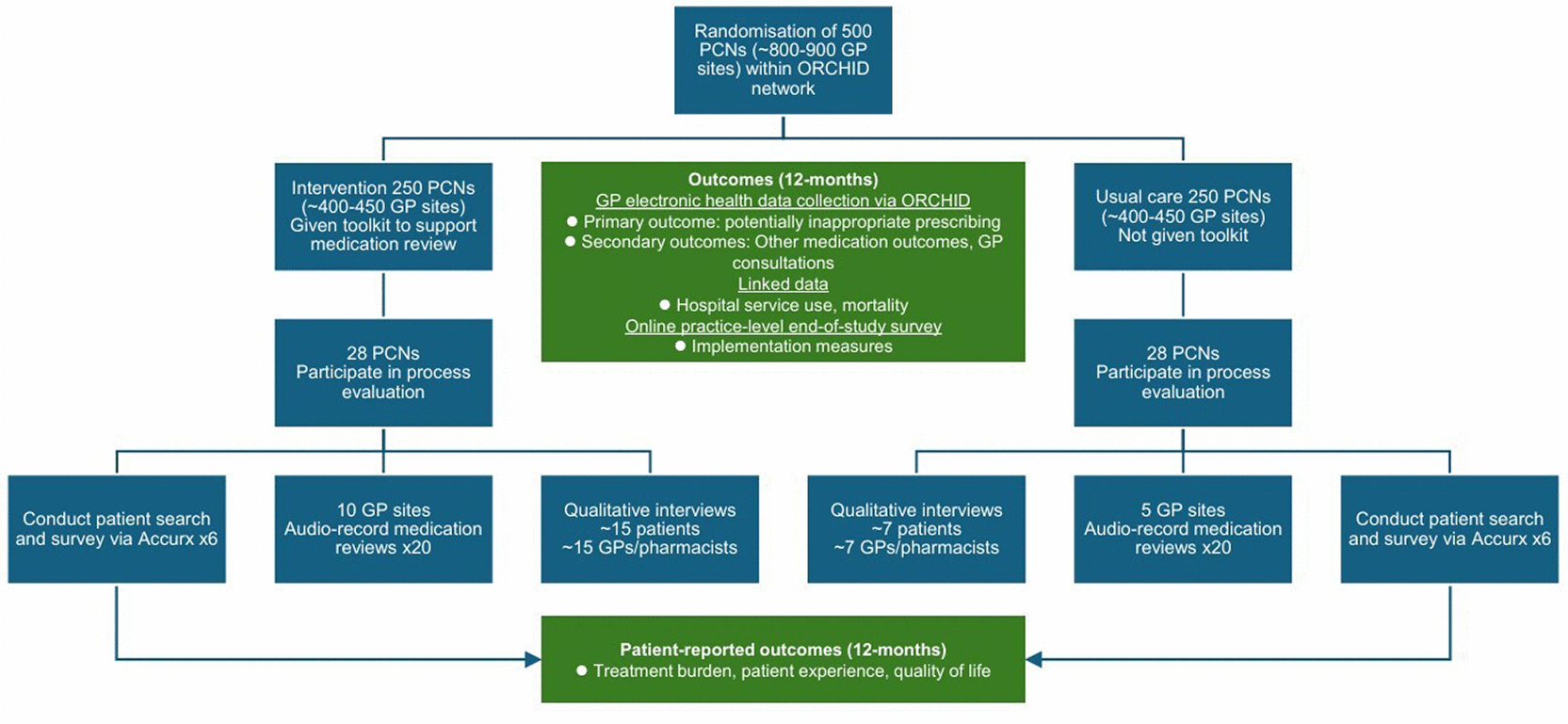
A parallel mixed-methods process evaluation will be undertaken in a subset of practices to examine intervention implementation, acceptability, and highlight possible reasons for the trial findings, and to inform any subsequent roll-out in practice. A cost consequence analysis will also be undertaken.
General practices using EMIS or SystmOne clinical systems, and contributing to the secure data processing environment (ORCHID) of the nationally representative Oxford RCGP Research Surveillance Centre (RSC) network,24 will be eligible to participate in the trial. Practices will only be included if they have contact details for at least one nominated practice representative (e.g. GP lead, practice manager or research lead) to enable delivery of the intervention, and have not explicitly opted out of participating in the BRISMED study.
A subgroup of practices will be eligible to participate in the embedded mixed-methods process evaluation if they have Accurx text messaging technology with ability for bulk text messaging enabled (required to administer patient surveys).
All patients aged ≥18 years who have not registered an opt-out of sharing their data with third parties via the NHS opt-out system will be included in the main trial analysis. Patient consent to participate in the main trial will not be specifically sought because this is a practice-level intervention and participating practices already contribute anonymised routine data to the RSC network. The study, including the use of anonymised routinely collected electronic health record data for evaluation of the intervention, has received NHS Research Ethics Committee approval (reference 24/WS/0031). Details of which patients will be included in the process evaluation and the consent processes are provided below.
We will randomly sample 500 PCNs from the RSC network of >1800 practices and randomly allocate 250 to intervention and 250 to control. PCNs within this network comprise fewer practices than that typical of elsewhere in England (generally around 4 to 6); the proposed sample corresponds to approximately 800–900 practices in total. The RSC network will liaise with intervention practices to “push out” the intervention and promote adoption. Practices will not be explicitly “signed up” to participate; this is designed to reflect “real world” practice, acknowledging not all intervention practices may fully engage.
A subset of 28 practices from each trial arm will be recruited to participate in the process evaluation, detailed below. Practices will be purposively sampled across PCNs in both trial arms in relation to list size, performance on the national GP Patient Survey, availability of practice-based pharmacist, training status, and socioeconomic status to ensure maximum variation. Principal Investigators at practices agreeing to participate will be required to sign a research agreement with the research sponsor (University of Bristol).
Although clinicians and/or patients will not be recruited for the purposes of the main analysis, they will be recruited to participate in elements of the process evaluation (see Process evaluation for details).
As discussed above, randomisation will be undertaken at the PCN rather than individual practice level to reduce inter-arm contamination risk, with 250 PCNs per trial arm (approximately 400–450 practices). Randomisation will be generated using a computer algorithm. Practices will already be part of the RSC network, and so randomisation can only occur after recruitment.
Allocation concealment
Allocation will be concealed at the point of enrolment so that it cannot influence participation. As practices participating in the RSC network will be included in the study by default, allocation status can be considered concealed, as practices will already be recruited. Practices expressing interest in the embedded process evaluation will not be informed of their trial allocation status prior to agreeing to participate in this element of the study.
Blinding
Given the nature of the study, it is not possible to blind practices, or indeed patients, to randomisation status after randomisation. However, we expect the majority of patients will be unaware that the practice is participating in a trial. All statistical analysis will be conducted in a blinded manner, where possible. Analyses that cannot be conducted in a blinded manner (for example, those that require knowledge of patients receiving a BRISMED medication review) will be carried out last.
This is a practice-level intervention that was informed by the COM-B (Capability, Opportunity, Motivation–Behaviour) model of behaviour change, which conceptualises behaviour as the result of interactions between these three components.20 The Bristol Medication Review (BRISMED) Toolkit comprises components designed to facilitate more effective, thorough, and patient-centred medication review, including a) a model (the Bristol Medication Review model17) for delivering a structured medication review; b) guidance on use of the model in clinical practice; c) a pre-review (“primer”) information document to empower patients to be more involved in their review (based on our previous work22); d) training materials for clinicians (based on the Bristol Medication Review development work and drawing on our IMPPP intervention training materials21); e) templates for recording data in GP clinical systems aligned with the Bristol Medication Review model; and f ) recommendations for practices on implementation. Access to the Toolkit will be through a website, with login details only provided to intervention practices. It will be left to individual practices how they implement the model (e.g. remote vs in-person; type of clinician conducting review; characteristics of patients invited to review, review frequency). The intervention makes no specific recommendations with respect to case-finding, and participating sites will continue to identify patients who require a medication review in accordance with local policies. As a result, patient selection for medication review is expected to follow usual care processes in both arms, with no systematic differences introduced by the intervention. Additional details of the intervention are provided in Appendix 1.
Although guidance exists describing approaches to medication review, implementation is variable and there is no single established or standardised approach for undertaking medication review in current UK general practice. The nature of usual care is thus uncertain, but likely to comprise a combination of structured medication reviews delivered by practice-based pharmacists and some GPs, and brief, opportunistic, largely unstructured reviews conducted predominantly by GPs during routine consultations for other purposes. There is likely to be substantial variability in training, clinical approaches to review, use of informatics templates, and strategies for implementation. Medication reviews are generally recommended to be carried out at least annually for patients receiving long-term medications.
Primary outcome
The primary outcome of the trial is the proportion of patients in a GP practice experiencing at least one indicator of PIP, based on the STOPP criteria (Screening Tool of Older Persons’ potentially inappropriate Prescriptions) and START criteria (Screening Tool to Alert to Right Treatment).25 This will be determined on the date at which the 12-month intervention delivery period ends. STOPP/START criteria will be determined using coded routine health record data. However, some criteria cannot be assessed where required clinical information is not routinely coded, although based upon previous work, we anticipate capturing the majority of criteria. The final list of criteria to be operationalised will be prespecified prior to the analysis and documented within a separate technical document referenced within the Statistical Analysis Plan. Additional analyses of the primary outcome will include a subgroup analysis of patients receiving ≤6 regular medicines. This a priori subgroup analysis is proposed as there is evidence from our previous IMPPP trial that patients with fewer medicines may have greater benefit.21
Secondary outcome (main analysis)
A number of a priori secondary outcomes will be measured at the study end date, including number of long-term medicines, medication regimen complexity, all-cause adverse drug reactions, all-cause mortality, health service utilisation (hospital admissions, GP consultations), and NHS costs (see Table 1 for details).
| Outcome measure | Outcome | Data source |
|---|---|---|
| Primary outcome | ||
| Potentially Inappropriate Prescribing | Binary data a | ORCHID |
| Medication related measures | ||
| Repeat medicines | Count data b | ORCHID |
| Medication regimen complexity index | Continuous | ORCHID |
| Medication-related (ADR) admissions | Count data b | NHS England |
| Other health service utilisation | ||
| Unplanned hospital admissions | Count data b | NHS England c |
| Primary care consultation rate | Count data b | ORCHID |
| Outpatient utilisation data | Count data b | NHS England |
| A&E attendance data | Count data b | NHS England |
| Other outcomes | ||
| Rates of all-cause mortality | Count data b | NHS England c |
| Medication review | Count data b | ORCHID |
| Patient reported outcomes | ||
| Medication Treatment burden | TBC d | Patient survey |
| Patient experience of review | Categorical | Patient survey |
| Quality of life (EQ-5D, EQ-VAS) | Continuous | Patient survey |
| Medication adherence | TBC d | Patient survey |
| Other process measures | ||
| Usage of the BRISMED Toolkit | Categorical | Website logs, practice survey, ORCHID e |
| Interim safety analysis outcomes | ||
| Adverse Drug Reactions | Count data b | ORCHID |
| Unplanned hospital admissions | Count data b | ORCHID |
| Rates of all-cause mortality | Count data b | ORCHID |
Secondary outcomes (process evaluation)
Additional a priori secondary outcomes will be measured in a sub-group of practices participating in the process evaluation. These will include patient-reported (via electronic survey) quality of life, treatment burden, medication adherence and patient experience of care (see Table 1).
Sample size calculations are presented separately for the main cluster randomised trial and the nested process evaluation due to differences in outcomes and units of analysis.
Sample size for main trial
Based on baseline pilot data from the IMPPP trial21 and previous data on the prevalence of STOPP/START indicators,25 we expect 40% of patients to be eligible for review, with a primary outcome rate of 20%. Previous work in UK general practice suggests an Intraclass correlation coefficient (ICC) on the GP practice scale ranging from 0.01 to 0.04.26,27,28 A Cochrane review found a mean risk reduction of 21% in PIP.29 Based on an upper estimate of ICC of 0.04, mean PCN size 20,593 patients (SD 15,229), and 40% eligibility for review, 250 PCNs per arm provides 93.3% power (alpha = 5%) to detect a meaningful (but relatively conservative) 15% relative reduction in primary outcome. Of those on medications, 76% of individuals will be receiving up to 6 regular medications; this makes no meaningful difference to the power to detect an effect within this subgroup.
Sample size for nested process evaluation
With practices undertaking ~5000 reviews per year (~40% review rate from an average of 12,514 patients), surveys sent to half of patients receiving a review, and a survey response rate of 10%, we can anticipate ~250 responses to the quality of life (QoL) survey per practice (see Process evaluation: Patient-reported outcomes surveys for details). The coefficient of variation in RSC/ORCHID practice list size is around 0.68. The DREAMeR medication review trial found a baseline EQ-VAS of 70 (SD 16),30 and we estimate an ICC on the GP practice scale of 0.11.37 Based on an effect size of 5 points on the EQ-VAS, 28 practices per arm (total 56) will provide us with 80.8% power.
Sample size calculations have been carried out on the PCN scale for the main study which is the unit of randomisation. Sample size calculations for the process evaluation are carried out on the GP practice scale, but with only one GP practice per PCN randomised to the process evaluation to maintain independence within a PCN.
The analysis and reporting of this trial will be undertaken in accordance with Consolidated Standards of Reporting Trials (CONSORT) guidelines, as extended to cluster trials. The statistical analyses will follow a pre-defined Statistical Analysis Plan agreed with the Trial Steering Committee and Data Monitoring Committee. The main primary outcome comparative analyses between randomised arms will be conducted on an intention-to-treat (ITT) basis without imputation of missing data.
Primary outcome analysis
Primary outcome will be a binary variable representing the presence or otherwise of at least one indicator of PIP based on the STOPP/START criteria. The primary analysis will use random effects binary logistic regression on the PCN scale to explore the proportion of PIP at the end of the intervention delivery period by arm using the ITT principle. A random effect will account for clustering by PCN. Adjustment will be made for baseline STOPP/START criteria (i.e. start of intervention delivery period). This will be a test for superiority focussing on the estimate, 95% CI and p-value from the regression model. An interaction term will be added to the analysis model to derive the effect size within subgroups.
Secondary outcome analyses
Analysis of the secondary outcomes will use the same method as for the primary outcome analysis. Poisson, ordered logistic, or linear models will be used as appropriate, depending on coding of the outcome.
Additional analyses
Subgroup analyses of the primary outcome will include a subgroup analysis of patients receiving ≤6 regular medicines, as well as other individual demographic characteristics (age, sex, ethnicity, socioeconomic deprivation).
We will explore analyses on the individual level for the primary and some of the medication-related secondary analyses (e.g. medication count, medication regimen complexity index).
Sensitivity analyses
Different methods to parametrise the primary outcome (e.g. count of STOPP/START criteria, binary within different sections of the STOPP/START criteria) will be explored as part of sensitivity analyses.
We will consider using a Target Maximum Likelihood Estimation (TMLE), a semi-parametric approach, where distributional assumptions are relaxed on the ITT analysis.
In addition to the primary ITT analysis, we will carry out an “as-treated” analysis stratifying individuals into those that have received either: BRISMED medication review, “usual care” medication review or no medication review. To adjust for non-compliance, we will use either instrumental variable (e.g. Complier Average Causal Effect [CACE] analysis) or principal strata approaches.
Missing data
Missingness in routinely collected data is expected to be low for key variables related to prescribed medications, diagnoses, age and gender. Where a drug or disease is not coded in the medical record, it will be assumed to be genuinely absent rather than a recording omission. We will explore the nature of missingness for other patient-level data, such as ethnicity, socioeconomic deprivation or patient-reported measures.
Missingness in our primary and secondary outcomes could be related to either patients leaving a practice or dying. Given the large dataset size, we will assess the nature and extent of missingness and consider using analytical approaches such as Full Information Maximum Likelihood Estimation (FIML) or two-stage maximum likelihood technique to address missingness if appropriate.
Design overview
A parallel mixed-methods process evaluation will be conducted to examine patient and practitioner experience of medication review alongside implementation, fidelity, acceptability, and mechanisms of impact of the BRISMED Toolkit. The evaluation will use quantitative and qualitative methods across a subset of 56 practices from separate PCNs.
Practice selection
Using an anonymised practice-level dataset, the lead statistician will randomise 56 interested practices (1:1) to the intervention arm of the process evaluation, limited to one per PCN. Only one practice per PCN will be included to maintain independence and maximise variation in practice context. Practice participation will be confirmed via written agreement.
Patient-reported outcomes surveys
Electronic surveys will be administered via batch text message or the NHS App within all 56 participating practices. Relevant patients will be identified by searching the electronic health record. Two sets of surveys will be administered: a survey of patients’ experience of medication review, and a survey to assess quality of life (including medication adherence and treatment burden). The patient experience survey will be repeated at 3, 6, 9 and 12 months after the start of the intervention delivery period, delivered to all patients receiving a medication review in the previous two weeks. The quality of life survey will be repeated at 9 and 15 months after the start of the intervention delivery period, delivered to all patients receiving a medication review between 3 and 6 months previously. Surveys will additionally capture sociodemographic and clinical information, but will not be linked to routinely collected electronic health record outcome data from the main trial.
A minimum response rate of 10% is anticipated.31 Although there are risks of digital exclusion and response bias, smartphone usage is widespread even in older patients.32
Survey data will be analysed using random effects regression models (linear, logistic or Poisson models, as appropriate) for each participant by arm, using the ITT principle. A random effect will account for clustering by GP practice. Quality of life measures will also be used in the economic evaluation.
Qualitative interviews
Semi-structured interviews will be conducted with ~22 patients (15 intervention, 7 control) and ~ 22 GPs and pharmacists (15 from intervention arm, 7 from control arm). Interviewees will be sent an invitation letter and information sheet. Informed consent will be obtained verbally and audio-recorded immediately prior to the interview. Verbal consent rather than written consent will be obtained because interviews will be conducted remotely by telephone or video call. Patients will be approached within one month of medication review to minimise recall bias, whereas clinician interviews will be undertaken towards the end of the intervention delivery period to avoid influencing views of the study and intervention.
Participants will be purposively sampled to capture diverse perspectives across both trial arms. Patients will be identified from those expressing interest in an interview when completing the patient experience survey, and practitioners through the practice research lead. Sampling will consider patient characteristics captured through the patient experience survey (e.g. age, gender, ethnicity, education level, medication count), clinician characteristics captured through a pre-interview “expression of interest” screening questionnaire (e.g. age, gender, ethnicity), and practice characteristics (e.g. list size, area-level deprivation, level of Toolkit engagement). More participants will be drawn from the intervention arm to enable a better exploration of implementation, acceptability, and mechanisms of impact of the BRISMED Toolkit, whereas a smaller sample will be drawn from the control arm to enable contextual comparison with usual care.
Clinician interviews will explore views/experiences of conducting reviews, identify what drives review content/delivery, and (for intervention arm) examine experiences of using the BRISMED Toolkit. Patient interviews will explore views and experiences of the review in terms of content, delivery and outcomes, including perceived preparedness, patient-centredness, shared decision making and acceptability. Topic guides will be used to ensure consistency across the interviews.
Interviews will be audio recorded and transcribed verbatim. Data will be analysed thematically,33 with data collection and analysis conducted in parallel, to allow emerging themes to inform subsequent interviews. Comparisons will be undertaken within and across datasets, to identify key themes, deviant cases, and differences/similarities in the views of patients and clinicians.
Observations of medication review
A subset of medication reviews will be audio-recorded in intervention and control practices to examine how reviews are conducted in practice and assess fidelity, content, and delivery. Clinicians in 15 practices across both arms will record 20 consecutive (i.e. unselected) reviews over a 2-week period. Potentially eligible patients and clinicians will receive an invitation letter and participant information sheet. Consent will be sought prior to participation. Patients may complete either a paper or electronic consent form with the clinician undertaking the review before proceeding with audio-recording. Electronic consent is available to facilitate consent where medication reviews are conducted by telephone.
A purposive subsample of 40 reviews across both arms will be selected for detailed qualitative coding and analysis, based on evidence of BRISMED Toolkit use (in intervention practices), inclusion of medication changes and variation in interactional dynamics, including patient engagement, and instances of differing or conflicting views. Alongside data from the patient/practitioner interviews, this will provide detailed understanding of how reviews are conducted in practice. Findings will be used to understand variation in implementation and support interpretation of trial outcomes.
Practice engagement/fidelity
A practice-level electronic survey will be sent to all practices following intervention delivery to capture data on usual care and engagement with the BRISMED toolkit. Intervention implementation will also be assessed by clinical coding of medication reviews attributed to the BRISMED Toolkit informatics template, using routinely collected electronic health record data. In addition, log file data from the BRISMED intervention website will be used to examine engagement with further elements of the Toolkit, including completion of training and use of other resources. Descriptive analyses will be undertaken to categorise practices according to the level of adherence to the intervention, enabling additional sensitivity analyses to be undertaken to assess the impact of variation in implementation on the trial outcomes (see Statistical analysis for details).
The health economic analyses will follow a pre-defined detailed approach presented in a separate Health Economics Analysis Plan. We will conduct a cost consequence analysis.34 This approach is recommended for interventions (such as BRISMED) that have multiple effects,35 and a combination of numerous health and non-health benefits that may be difficult to measure in a common unit.36 The initial cost of implementation is compared to subsequent NHS savings and changes in patient reported outcomes, constructing a table of mean costs and outcomes/effects with differences between the trial arms. We will record direct costs to the NHS of implementing the BRISMED Toolkit, as well as indirect costs (productivity losses, additional GP consultations, unplanned admissions). We will report costs alongside consequences such as quality of life and patient experience. Routine data will allow us to compare costs of long-term medicines and subsequent care use between arms.
Patient and public involvement (PPI) has informed the study design and will continue throughout the study. Two PPI co-applicants will be members of the Trial Management Group contributing to study oversight and decision making, alongside a wider lay PPI advisory group. A lay advisor will be a member of the trial steering committee.
The PPI advisory group will contribute across multiple stages of the study. During set-up, PPI input will inform refinement of patient-facing materials including participant information sheets, topic guides and patient and practice surveys. PPI contributors will also advise on the acceptability and burden of patient reported outcome measures, including timing and content of surveys. During the intervention delivery, PPI advisors will advise on issues related to practice engagement with the Toolkit and patient engagement with the surveys. During the analysis and interpretation phase, PPI contributors will support interpretation of findings, particularly in relation to the patient experience, treatment burden and perceived impact of medication reviews. PPI advisors will also play a key role in dissemination, contributing to the development of lay summaries and supporting communication of findings to patient and public audiences.
Medication review involves starting, stopping and otherwise changing medicines, and there is risk involved in this activity. This is a standard part of clinical practice, and we consider the safety risks posed by implementing the BRISMED Toolkit, over usual practice, to be very low. A pragmatic interim safety analysis will be conducted at 3 and 6 months within process evaluation practices only, to assess rates of GP coding of adverse drug reactions, all-cause unplanned hospital admissions, and death between the two trial arms.
For the interim safety analysis, we will use a similar approach to the main analysis, with a random effects Poisson regression model used to explore rates of safety measures within each PCN, with total person-years from the medication review until the end of the safety analysis period used as an offset term. Given the large numbers of events involved, and the fact that medication reviews by their nature include explicit identification of potential safety concerns, local site principal investigators will not be asked to review events to attribute seriousness, intensity, relatedness and expectedness.
If local investigators feel strongly that an event could be related to the use of the BRISMED Toolkit, they will still be able to submit a spontaneous safety report, including full details in medical terms and case description; timing of event; action taken; outcome; intensity and seriousness criteria; causality (i.e. relatedness to trial/intervention); and whether the event would be considered expected or unexpected. Reporting and follow-up of events will be undertaken in accordance with standard operating procedures of the research sponsor.
Adverse event data from both the interim safety analysis and any spontaneous reports will be presented to the independent Data Monitoring Committee.
This study will be conducted in accordance with Good Clinical Practice guidelines and the UK Policy Framework for Health and Social Care Research. The research Sponsor is the University of Bristol (reference 2023–1503). The sponsor and funder will have no role in the study design, writing of papers, or the decision to submit papers (including this protocol) for publication. Monitoring and auditing will be in accordance with the Sponsor’s policy. Protocol review has been undertaken and approved by NHS West of Scotland Research Ethics Committee 1 (reference 24/WS/0031). The study sponsor has reviewed the study procedures and ensured all indemnity and insurance requirements for the trial were in place prior to commencement. The current protocol version is 7.0 (01/06/2026); protocol amendments will be approved by the REC/Sponsor as required. The full trial protocol and Statistical Analysis Plan can be accessed through the Open Science Framework repository for the BRISMED study.37 The completed SPIRIT checklist and Appendix 1 (Overview of the intervention) are available as Extended Data in the same repository. Trial oversight will be undertaken by the independent Trial Steering Committee and Data Monitoring Committee. The trial is registered with the ISRCTN registry (reference ISRCTN12979016, registration date 3/6/2024).
Data will be collected and retained in accordance with UK data protection legislation, with data storage conforming to the University of Bristol data security policy. Electronic data will be kept on password protected, encrypted servers. Written data will be stored in a secure filing system. Personal identifiable data will be kept separate to clinical and other trial data. The Chief Investigator will manage access rights to data. Use of ORCHID data will be undertaken in line with standard procedures, with data analysis and processing undertaken within the ORCHID secure data environment. Once completed, limited anonymised trial data (including practice-level but not patient-level primary and secondary outcome data) may be made available for sharing with other researchers once appropriate governance approvals are in place. Essential study documents (e.g. consent forms) and anonymised data will be stored for the period of time specified by local and/or national clinical trial policies. Interview recordings will be deleted once analysis is complete and findings have been published, with transcripts retained in line with data management procedures. For recordings of medication reviews, transcripts will be retained, while audio files will only be retained for future research where explicit consent for storage and data sharing has been provided; otherwise they will be deleted after analysis and publication of findings.
Findings from the study will be disseminated to healthcare professionals, care commissioners and policymakers, patients and the public, participating practices, and academics, using a structured stakeholder engagement approach to maximise reach and impact. This will include collaboration with national professional bodies (e.g. RCGP, Royal College of Pharmacy) commissioners and policy organisations (e.g. NICE, NHS England/DHSC) and established professional and academic networks to support translation into practice and policy. Outputs will include scientific journal publications and conference presentations (including co-presentations with PPI contributors), plain English information leaflets and infographics (as well as common non-English translations) and other visualisations co-produced with PPI contributors, policy briefing documents, and printed and electronic promotional materials. Participating practices will be kept informed via study communications. Free access to the BRISMED Toolkit will also be provided for practising clinicians once data analysis is complete.
Medication reviews are a key part of the medication optimisation process,10 but evidence to support their effectiveness is limited, with clinical approaches variable and unstandardised.17 The BRISMED trial addresses this important knowledge gap by evaluating a comprehensive, structured approach to medication review.
Drawing on the COM-B model of behaviour change,20 we anticipate achieving change in practice by modifying the clinicians’ capability, opportunity and motivation. Capability will be modified through improved knowledge and skills supported by a clear review model plus relevant training. Opportunity will be addressed through flexible alignment with usual practice, and provision of guidance and resources to aid implementation. Motivation will be modified through education, regular updates and prompts, acknowledgement of continuing professional development, and financial reimbursement of training time.
The trial design is highly pragmatic which will ensure efficiency, allow large numbers of practices to be involved, and enhance the generalisability and relevance of findings to current clinical practice. The intervention roll-out is designed to align closely with real-world practice, where the availability and engagement with such resources is likely to be highly variable across sites. The use of routine data allows objective assessment of the primary and key secondary outcomes in an extremely large patient population. The approach to patient surveys is also expected to yield the largest every study of patient experience of medication review. The embedded process evaluation will be invaluable for assessing implementation and for interpreting the effectiveness or otherwise of the intervention, as well as underlying mechanisms of impact. The intervention being evaluated is readily scalable and easily implemented within routine practice with virtually no changes or adaptations necessary. Key limitations include the potential for poor engagement by practices, and that certain outcomes are only determined in a subgroup of practices.
Findings from the BRISMED trial will be generalisable to the wider UK population and potentially beyond, and regardless of results are likely to provide valuable insights into medication review implementation which will usefully inform practice and policy.
Provide sufficient details of any financial or non-financial competing interests to enable users to assess whether your comments might lead a reasonable person to question your impartiality. Consider the following examples, but note that this is not an exhaustive list:
Sign up for content alerts and receive a weekly or monthly email with all newly published articles
Register with NIHR Open Research
Already registered? Sign in
If you are a previous or current NIHR award holder, sign up for information about developments, publishing and publications from NIHR Open Research.
We'll keep you updated on any major new updates to NIHR Open Research
The email address should be the one you originally registered with F1000.
You registered with F1000 via Google, so we cannot reset your password.
To sign in, please click here.
If you still need help with your Google account password, please click here.
You registered with F1000 via Facebook, so we cannot reset your password.
To sign in, please click here.
If you still need help with your Facebook account password, please click here.
If your email address is registered with us, we will email you instructions to reset your password.
If you think you should have received this email but it has not arrived, please check your spam filters and/or contact for further assistance.

Comments on this article Comments (0)