Keywords
Theory of change, Health system delivery, Drug use, Perinatal

Theory of change, Health system delivery, Drug use, Perinatal
Use of substances during and after pregnancy has long term negative consequences for mothers, their babies and families.1,2 Women who use drugs in the perinatal period can have complex health and social needs including histories of abuse, mental health problems, poor physical health, experiences of drug-related violence and crime, social exclusion, homelessness and poverty. Both during and after pregnancy they are at significantly increased risk of poor outcomes including risk of relapse and death by unintentional overdose or suicide.3–5 Suicide is the leading cause of direct maternal deaths (deaths directly related to pregnancy and birth) in the UK from six weeks to one year following childbirth with drug and alcohol related deaths accounting for 20% of all deaths in this period.3
Babies whose mothers use opioids during pregnancy are at additional risk as they may be smaller and have neonatal opioid withdrawal syndrome (NOWS) and/or neonatal abstinence syndrome (NAS), with symptoms such as irritability, crying, poor sleeping and feeding. Babies of mothers who use drugs are also more likely (than babies of mothers who do not use drugs) to be removed from their mothers’ care and taken into the care system.6
Poor maternal outcomes are linked to lack of antenatal care. Women who use drugs and their babies often require additional support during and after pregnancy, yet they are at risk of falling through gaps in services. The ‘inverse care law’, described nearly 50 years ago by Tudor Hart7 describes how ‘the availability of good medical care tends to vary inversely with the need for it in the population served’. This circumstance applies to pregnant women and mothers who are dependent on drugs. The UK and Ireland triennial Confidential Enquiries into Maternal Deaths and Morbidity3 found that inadequate engagement with antenatal care services is associated with increased risk of maternal death. This report also found that only around half of the women whose deaths were related to alcohol and substance use received the recommended level of antenatal care. Lindquist et al found that the most deprived women in the UK were 60% less likely to receive antenatal care compared to the least deprived women.8
Provision of care for women who use substances and their babies in the UK is complex, involving a network of universal and targeted services delivered by multiple agencies including statutory and third sector organisations. Maternity care is a universal service available for all pregnant women from the first point of contact, usually around 10 weeks of pregnancy through to at least 10 days post birth and potentially extending to six weeks postnatal. Midwives provide most maternity care within a multidisciplinary team including obstetricians, neonatologists and anaesthetists. Maternity care is NHS funded and set in the context of other universal NHS services, including General Practitioner (family doctor) and Health Visiting (public health nurses with a primary focus on the child from prebirth up to school age). Women who use drugs will also routinely receive targeted social services, funded by Local Authorities,9 including social work and drugs services. Third sector organisations may also be involved providing a wide range of services such as, rehabilitation, parenting and peer support. However, third sector funding is often precarious and as a result projects may be short term and unequally distributed across health or local authority regions. Despite policy support and intent for integration of services,10 many agencies have different funding arrangements, management and governance systems, philosophies and priorities often leading to women experiencing fragmentation of care pathways and gaps in services.
At the same time women who use drugs may struggle to access and engage with maternity services. They often have histories of trauma, domestic violence, social or geographical isolation, lack of financial or social support, coupled with previous negative experiences with services.11,12 Maternity services may not always be easy to engage with: delivering standardized care pathways with inflexible appointments planned at predetermined intervals, lack of continuity of care, resulting in women having to repeat their history multiple times and providing few opportunities to personalise care and develop trusting relationships.13 Lindquist et all found that women from low socio-economic groups may feel that they were not listened to, or spoken to in a way they could understand, or treated with respect.8 Although maternity services are universal, women who use drugs may view NHS maternity services as a form of surveillance, from which they fear judgement. In particular, the fear of removal of their baby may discourage disclosure of pregnancy and timely engagement with maternity services.
The Stepping Stones Study (NIHR130619)14 aimed to explore service provision for women who use drugs or are in treatment for using drugs in pregnancy and up to a year after giving birth to determine how best to meet their health and social needs and those of their babies. The study involved a mixed methods review of psychosocial interventions for women who use drugs in the perinatal period, a scoping review of UK practice guidance and a longitudinal study of four UK perinatal services and women’s experiences of care. Drawing on findings from the study we worked with an expert group including peer researchers with the aim to co-produce recommendations for optimal perinatal services for women who use drugs or are in treatment for drug use during and after pregnancy using Theory of Change.
Most initiatives and interventions in healthcare are complex interventions, namely interventions with multiple interacting elements implemented in complex health/social care systems. Theory of change (TOC) is used to provide a framework to logically explain why and how an intervention or programme is anticipated to work to bring about desired outcomes.15 Using TOC the multiple layers of interacting interventions, processes and contexts that reflect complex interventions in the context of health and social care settings can be described.16 This paper reports the development and outputs of the Stepping Stones TOC for improving service provision to women who use drugs or are in treatment for drug use during and after pregnancy.
We used a co-production approach to develop a TOC. This approach centres Patient and Public Involvement. Two peer advisers with lived experience of substance use treatment worked with the study team from the start and throughout the project, attending Expert Advisory and Co-production Group (EACPG) meetings, supporting the researchers to consult women with lived experience of substance use. They contributed to the development of the TOC that sets out key requirements for the optimal care services, a rationale for how/why key requirements will work, and intended outcomes. We integrated experiential knowledge with primary and secondary research information produced by the Stepping Stones study, in a series of co-production workshops. The Peer advisors involvement continued through the dissemination phase with participation in workshops and seminars.
We used the term co-production17 to describe our approach of working with a wide range of stakeholders in the EACPG, to contribute to and shape the Stepping Stones study. Our approach was adapted from the Co-production Star18 that comprises a set of principles: sharing power, including a wide range of perspectives and skills, valuing and including all sources of knowledge, reciprocity and relationships. We aimed to make the EACPG as representative of those who plan, deliver and use services as possible, including health and social care practitioners (midwives, public health, health vising, social work), service commissioners and policy makers, staff of third sector organisations that support women and families affected by substance use, and peer advisors. Overall, the group comprised 25 members and 10 members of the Stepping Stones research team. Embedded in the wider co-production work was the focussed task of developing the TOC that outlines the hypothetical causal pathway for optimal services and care in the perinatal period for women who use or are in treatment for use of drugs, with the aim of identifying processes and aspects of care that are effective, important to women and relevant and useable for staff. Terms of Reference, setting out the process and purpose of the group were agreed in the first meeting and reviewed at intervals through the project.
Theory of change is generated by first articulating (intended/anticipated) impact and medium-term outcomes, followed by backwards and forwards mapping to identify processes, activities, and interventions necessary to achieve outcomes (and impact) along with supporting logic and underpinning evidence for what is anticipated to work and why. While the overarching problem of poor outcomes for women who use drugs is clearly recognised there may be different understandings and perspectives on causal and modifiable factors underpinning the problem. Therefore, we also articulated ‘the problem’ to ensure consensus on the current context and that we included perspectives of those with lived experience. The TOC diagram provides a visual representation of the anticipated causal pathway, from problem through intervention to anticipated outcomes and impact.
The setting for this TOC was maternity and social services for women in the perinatal period in the UK.
Co-Production workshops
The group met approximately every three months through the lifetime of the 30-month project. The first two meetings were concerned with research framing, group working arrangements, identifying relevant new members, agreeing terms of reference, discussing study plans and materials, reviewing search protocols for the literature reviews, and learning about TOC. Subsequent meetings focussed on developing the TOC. The meetings were chaired by an independent chair; however, the co-production of TOC was facilitated by members of the research team.
All meetings were online using MS Teams and lasted approximately two hours. The stages in development are described in Table 1. We used iterative design cycles of discussion, proposing ideas, re-discussion and refining. Break out ‘rooms’ and Google Jamboards were used to facilitate discussion and inclusion of all members of the group. Between meetings members were asked to reflect and consult more widely with relevant stakeholders including women with lived experience of drug use. Members of the research team used the discussion notes and Jamboards to synthesise workshop outputs and to draft stages of the TOC diagram.
In developing the TOC the group was asked to draw on a wide range of knowledge and sources of evidence including primary and secondary research evidence, clinical knowledge and experiential knowledge. Woman’s voices were included in two ways – firstly by involvement of peer advisors and their wider engagement with women with lived experience of drug use, and secondly through the emerging research from the Stepping Stones study.
The Stepping Stones study produced primary19 and secondary data20 that was presented to the EACPG, discussed, and incorporated into the TOC as it became available. Primary data involved case studies in four sites (a London borough, a northern English city, a city in central Scotland and a semi-rural area of southwest Scotland, gathering longitudinal interview data with 36 women who used drugs or who were in treatment for drug use, during and/or after pregnancy). Written informed consent was obtained from all participants. Women were interviewed up to five times, resulting in 131 interviews in total. Focus groups and some individual interviews were undertaken with staff from a range of professions involved in the care of women who use or are in treatment for drug use in the perinatal period (midwives, drugs workers, health visitors, psychiatrists, social workers, mental health nurse, paediatricians, representatives from voluntary organisations) in each of the sites (79 participants in total). Secondary data involved a systematic review of interventions for women who use drugs in the perinatal period, and a Scoping Review of UK clinical and best practice guidance for care of women who are dependent on drugs during the perinatal period.20 Emerging evidence was presented to the EACPG at the start of each meeting, informing discussion, supporting and at times challenging the experiential knowledge of the group.
The TOC diagram is presented in Figure 1. This brings together all the elements of our findings as recommended by the Checklist for Reporting Theory of Change16 supporting evidence is presented in Extended data.21 We summarise findings below under the headings of 1. The context – articulating the problem, 2. Long term impacts, 3. Short/medium term outcomes, 4. Assumptions about processes of change, 5. Key requirements (preconditions, activities and interventions).
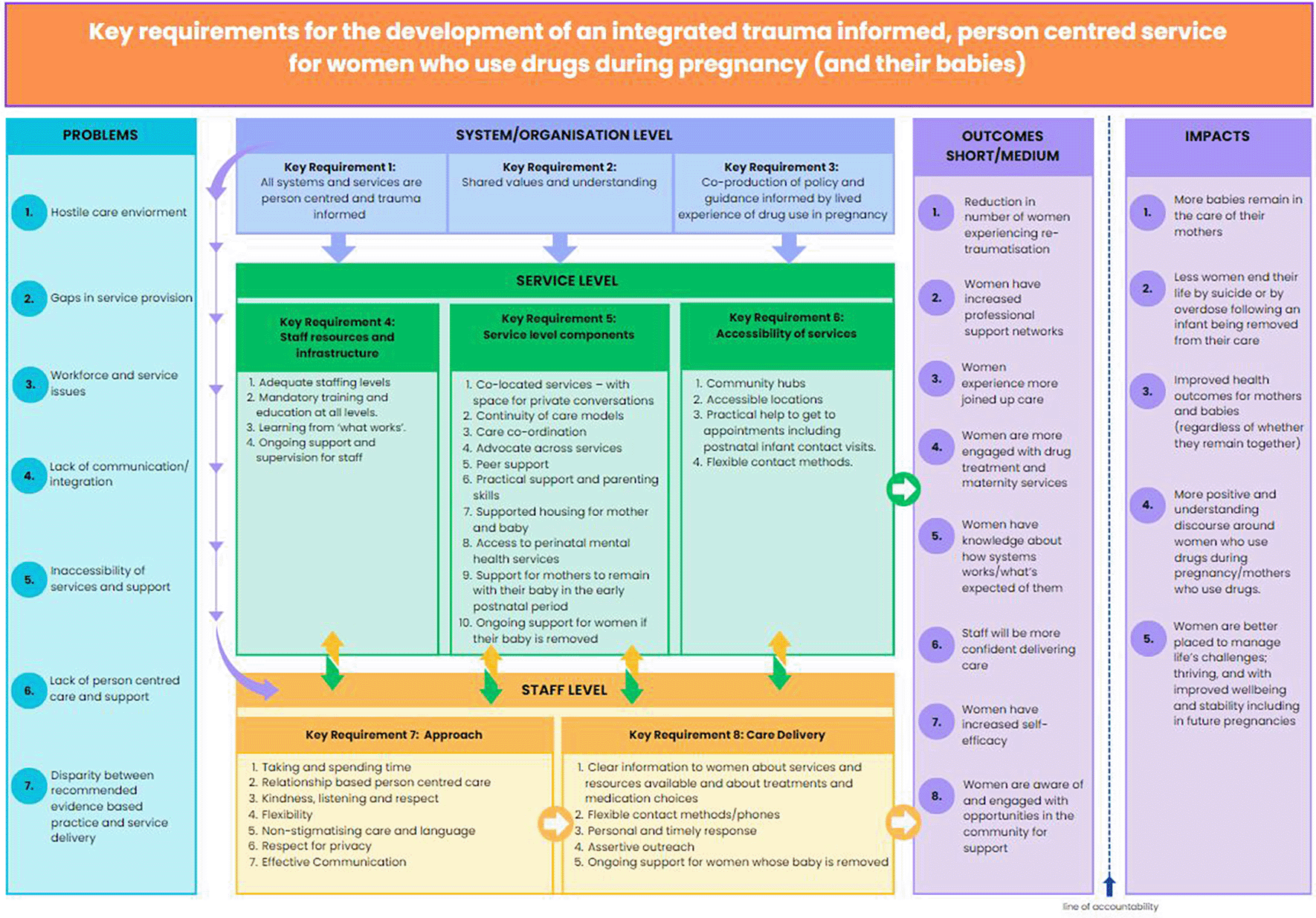
The context of the need to develop a T0C for improved care pathways for women who use drugs or who are in treatment for drug use in the perinatal period in the UK, are the well documented,3 poorer physical and psychological health outcomes for mothers and babies, including death by suicide or accidental overdose. However, the EACPG group was asked to consider and agree the causal links leading to these poorer outcomes and to make distinctions between wider societal causal problems (the floor of accountability) and problems relating more directly to current maternity and social care pathways. Wider issues such as housing, poverty and domestic violence were described as having significant impacts on the woman and outcomes but were less directly within in the control of maternal and social services and were therefore deemed below the ‘floor of accountability’.
Individual problem ‘statements’ arising from Stepping Stones interviews or the EACPG, were grouped into seven themes; Hostile care environment and delivery; Gaps in service provision; Workforce and service issues; Lack of communication and integration between services; Inaccessibility to services and support; and Lack of person-centred care and shared decision making and Disparity between recommended evidence based practice and service delivery. Table 2 defines each problem and provides examples.
The following five impacts were agreed, whilst also recognising the ‘ceiling of accountability’ (i.e. impacts that may not be achieved by an optimal care model alone, but require wider societal change): More babies remain in the care of their mothers; Improved health outcomes for mothers and babies, regardless of whether they remain together; Less women end their life either by suicide or by overdose following a child being removed from their care; Women are better placed to manage life’s challenges; thriving, and with improved wellbeing and stability including in future pregnancies; More positive and understanding discourse around mothers who use drugs/women who use drugs in pregnancy.
We identified eight short- or medium-term outcomes that were more directly related to maternity and social care pathways. A short-term outcome was defined as an outcome experienced during the perinatal period while medium term outcomes would be experienced as a result of better care and extend beyond the perinatal period.
Six short term outcomes; reduction in number of women experiencing re-traumatisation, women have increased professional support networks, women experience more joined up care, women are more engaged with drug treatment and maternity services, women have more knowledge about how systems work and what is expected of them, and staff will be more confident in delivering care. Two medium term outcomes; women have increased self- efficacy, and women are aware of and engaged with support opportunities in their communities.
Initially a linear model (problem, activities, interventions and outcomes) was drafted for simplicity, and this was revised and redrafted through discussion and as more evidence emerged. For example, an early draft hypothesised co-location of services as an option to address problems of communication and integration and accessibility of services, with the hypothesis that this would make it easier for women to engage with services and experience more joined up care, resulting in women becoming more engaged with drug treatment and maternity services. This initial idea was reinforced as evidence from the mixed method review emerged to support a one-stop-shop model of care, and primary data from the longitudinal interviews with women also found that multiple appointments in different locations created barriers to engagement (including costs and time for travel, the logistics of managing multiple appointments and the physical demands of making multiple journeys whilst pregnant and following the birth).
In general, however, there was not a linear flow of causal links from problem theory to outcome, reflecting the complexity of care pathways in the various social and institutional contexts. Aspects in one area could impact across multiple other areas. For example, organisational culture could contribute to a hostile care environment with services organised in ways that mitigated against accessibility for women who live complex lives. Organisational level attributes can also impact the provision of adequate staffing, and prioritisation (or not) of training of staff. An example discussed was that continuity of midwifery care from specialist midwives was generally viewed very positively by women (and the EACPG), yet much good work could be undone when women then experienced stigmatising and negative attitudes from wider members of the maternity/social care team, or when casual or careless breaches of confidence could re-traumatise women. We found that there were wider organisational and service level requirements to create the contexts (infrastructure and resources) in which staff were enabled to provide optimum care, and for interventions and activities to have their intended effect.
As the TOC developed it became clear that most of the key requirements for good care must be developed and supported at strategic, organisational and service levels rather that at the level of individual staff members. For example, for staff to practise relational based care, organisational structures such as flexible clinic spaces must be provided, and models of care that enable continuity of care must be developed and supported at service and strategic levels. Staff working within a rigid service infrastructure, that did not facilitate the flexibility needed for person centred care, could not sustain relational based care.
We identified eight key requirements to be fulfilled to achieve the desired outcomes and these are depicted in the overall TOC, Figure 1.
Within each key requirement, there are one or more specific activities or interventions for services and practice that are needed to fulfil the requirement and produce optimum care pathways. Most of the key requirements are targeted at the organisational and strategic level or service level, only two are directed at the level of individual staff. The following section summarises the key requirements, with a description of the specific activities and interventions and supporting evidence being provided in Extended data.21
The TOC suggests that care delivery cannot be improved without strategic level buy-in to agree priorities and ensure resources are available to enable all the other key requirements, activities and interventions. Policy makers, service directors etc. must work together, engaging with the following three key requirements to support subsequent requirements, and ultimately achieve desired outcomes. Without this high level buy in, understanding and consensus, services are more likely to be fragmented with differing priorities and objectives.
Key requirement 1: All systems and services are person centred, and trauma informed.
Everyone involved in perinatal services policy, development and delivery should have a shared understanding of how trauma and addiction impacts an individual. Training about addiction trauma informed care, and the needs of women who use substances during and after pregnancy, and their infants, should be provided for all those with responsibility for planning, funding and prioritising perinatal services including commissioners, policy makers and service providers. Those in strategic planning and leadership positions must work together to plan and deliver effective services that avoid causing further harm or traumatisation.
Key requirement 2: Shared values and understanding.
Our EACPG agreed that people across the spectrum of care including commissioners, policy makers and service leaders must have a shared understanding of the particular challenges faced by women who use drugs or are in treatment for drug use and for the staff providing care. Drawing on evidence from staff focus groups, the group agreed the importance of leadership and strategic planning and that at all levels those who determine policy and strategic service development and implementation must recognise ‘why this population matters’. Training should also recognise the challenges that front-line staff are going through, often working in stressful and challenging environments with short term funding and job insecurity.
Key requirement 3: Co-production of policy and guidance informed by lived experience of drug use in pregnancy.
Our scoping review of policy documents and guidelines20 found that only 13% of documents reviewed had consulted with women with lived experience of use of drugs in the perinatal period. The EACPG felt that this was likely to contribute to disparity between recommended practice and the experience of service delivery for staff and service users, as guidance may fail to take account of the complex needs and experiences of these women.
There are three requirements (Requirements 4–6 below) that target service level provision. These key areas must be supported to enable staff to deliver and sustain optimum care. Activities and interventions within these service level requirements may be adapted to specific service contexts, however service providers managers and service leads must draw on the opportunities offered by Requirements 1–3 (above) to implement the following service level requirements.
Key requirement 4: Staff resources and infrastructure.
This requirement is central to delivery of the remaining requirements, it includes the need for adequate staffing levels, training of staff at all levels in delivering person centred and trauma informed care, ongoing support and supervision of staff providing care for women who use drugs, and finally learning from what works well. All sources of evidence indicated that quality care and services cannot be delivered without supporting infrastructure. We found many examples of staff going to great lengths to support women and their babies, however, overstretched services are not sustainable.22,23 Staff working closely with women who use drugs in the perinatal period may experience vicarious trauma and burn out. Clinical supervision and support built into service structure can improve staff wellbeing, improve reflexive practice and reducing workforce turnover. Our evidence also indicated that lack of training or inconsistent training meant that many staff with whom women came into contact through the perinatal period, including intrapartum care midwives, postnatal ward staff, and GP receptionists, were often ill informed about drug use and its association with trauma, abuse, poor mental health, extreme social circumstances and the additional impact of stigma. This lack of knowledge sometimes resulted in staff being unsympathetic and women experiencing judgemental attitudes. Much good work could be undone by stigma and ill-informed comments.
Key requirement 5: Service level components and interventions.
This requirement includes services and interventions that are needed to support women who use/are in treatment for drug use during the perinatal period. These include items that reduce the fragmentation of care such as co-located services and continuity of care models. It also includes services that make it easier for women to navigate the perinatal maternity and social care journey, providing cross service support through roles such as care co-ordinators, advocates, and models of peer support. Finally, there are interventions that enable and support women in looking after their baby, including practical parenting support and skills, support for mothers to remain with their baby in the early postnatal period, supported housing for mother and baby. Additionally important for supporting women is access to perinatal mental health services, and crucial ongoing support for women if their baby is removed from their care.
Key requirement 6: Accessibility of services.
This requirement focusses on the ‘where aspects of care and service provision’. Much of our research highlighted the difficulty experienced by women in accessing services and in attending multiple appointments or contacts with their baby in hard-to-reach locations. This requirement is about making it as easy as possible for women to succeed in navigating services. This could be particularly difficult for women in rural areas but also applied to women in more urban areas who could require several bus journeys to travel to e.g. contact visits. Aspects within this requirement included Community Hubs (linking with Key Recommendation 5 -co-located services), accessible locations for services, practical help to get to appointments and flexible contact methods.
In the context of services meeting requirements 1–6 staff, would be enabled through training, support and infrastructure to provide optimum care and support to women who use drugs/are in treatment for drug use in the perinatal period. Our final Key requirements are focused on ways of working and behaviours, essentially how staff enabled through requirements 1–6 should work.
Key requirement 7: Approach.
This includes relational aspects of care such as taking and spending time, person centred care, kindness and listening, flexibility, non-stigmatising care and respect for privacy. All these ‘soft’ aspects of care are crucial in engaging and retaining women with services. However, they cannot be achieved without the preceding requirements of training, support adequate staffing, and enabling staff roles and models of services.
Key requirement 8: Care delivery.
Finally, this concerns staff taking up the opportunities and resources from Requirements 1–6 and using them to provide optimal care for woman and their babies. These elements include provision of clear information for women about services and resources available and about treatments and medication options and choices, staff using flexible contact methods such as texting and providing women with personal and timely responses, use of assertive outreach recognising that retaining women with services in the perinatal period is crucial in improving outcomes and finally providing women whose babies have been removed with ongoing support.
A perinatal service for women who use drugs or are in treatment drug use must operate across several complex systems (maternity, social work, mental health, drugs services), each with their own priorities and ways of working. Using co-production and a TOC approach we have developed an evidence -informed theoretical framework for optimal services for women who use drugs or are in treatment for drug use during the perinatal period. In developing the TOC we have drawn on experiential professional knowledge, lived experience and extensive secondary and primary data to produce an overarching model of requirements, making explicit the strategic, and service and staff level resources, interventions and attitudes that are required to develop and sustain services that more effectively meet the needs of this vulnerable population of women and babies.
Using the TOC it becomes clear that adding services in one area may not be effective if the whole system of care is not considered. We found that most of the recommendations were directed at organisational/strategic and service level with fewer recommendations at individual staff level. This is in recognition that staff are only able to provide optimum care when service infrastructure, resources, training, and shared values enable them to do so. Staff, no matter how dedicated, cannot bring about sustained improvement without the necessary senior level commitment, shared understanding and infrastructure to support them.
Our findings support others’ finding of the limitations of focusing on individual staff attitudes as the source of women’s experiences of stigma and discrimination, that can be addressed by raising awareness. While, based on their seven year ethnographic study of perinatal services for women who use/are in treatment for drug use in North Carolina, Nichols et al.24 recommend that staff use ‘reflective practice’ to identify instances of interactional discrimination; they also argue that ‘compassionate and unbiased care cannot occur in the absence of structural support’ and call for research that examines institutional practices and policies. Other authors have also pointed to stigma and discrimination deriving more widely than the health care systems in which they are enacted.12,25,26
While implementation of the TOC will require consideration of local contexts, geographical, infrastructures and analysis of local needs, the key requirements of the TOC are relevant to any setting. In all cases we argue that high quality services require: high level buy in with shared values and understanding of the complex needs of this population, implementation of multidisciplinary team training to address organisational culture and improve support to women, including training in trauma informed care for all staff who may come into contact with women who use drugs or who are in treatment for drug use, and ongoing support for staff recognising the emotional work involved. Services must be integrated, primarily in how they are experienced by women and not merely as an administrative process. From all sources of evidence, we found that, co-located, one stop shop services were viewed as effective and valued by women. Services must also be accessible, for example in community hubs and the co-located model also facilitates this.
More attention is required to support women to engage with services which can often appear hostile to them. Services could provide non- judgemental support such as advocacy or peer support models to help women navigate care systems and improve care co-ordination. All women who need it should have access to specialist perinatal mental health care. Crucially, services must work together to provide ongoing support for women whose babies have been removed from their care.
There is considerable research on treatments and interventions as well as guidance and protocols pertaining to this population. Many of the elements within this TOC are already widely recommended for practice and implemented in some areas. For women in more vulnerable circumstances, e.g. where there was a lack of any family support or problems with homelessness or unsafe accommodation, the options for support, specifically designed to support the multiple needs of mothers with drug use and their babies (including supported accommodation), should be available. While the Stepping Stones Study found examples of good practice in this area including residential family treatment services and third sector community services for women who have lost care of their babies, these services are often oversubscribed and/or subject to short term and fragile funding arrangements. Additionally important for supporting women is access to perinatal mental health services. While there have been many recent developments in the provision of specialist perinatal mental health care across the UK,27 there is still considerable variation in access to perinatal mental health services and this is even more so for women with multiple disadvantages, including addictions. The Maternal Mental Health Alliance has already identified key recommendations for delivering perinatal mental health services across the UK, many of which (such as addressing short and long-term workforce issues, making equity a priority, enabling women’s experiences to shape change, joining up the care women and families receive, and delivering a trauma informed approach to perinatal mental health care) resonate entirely with the findings and recommendations from this study.
At a service level, there remains a lack of a supportive intervention(s) for women who have their babies removed from their care.27 The act of removal is likely to add to the trauma experienced by these women which may exacerbate further drug use, poor self-care, and mental health problems. A specific programme of support should be developed, tailored for, and delivered to these women, ideally spanning the period prior to the decision to remove the child being communicated to the women as well as beyond. The TOC highlights the importance of a system wide approach to development and delivery of services, tackling the many different (bio-psycho-social) problems the women experience and with support systems that enable and encourage them to engage. Staff who are working to deliver services to women who use drugs or who are in treatment for drug use and their babies during the perinatal period cannot develop and deliver effective, caring, person centred and safe services without the training, infrastructure and strategic level support necessary to ensure sustainability of services in the context of wider maternity and social care systems with competing priorities during times of financial pressures on all health services.
The EACPG recognised the impact of wider societal factors that negatively impact on these women, such as, poverty, poor housing societal judgement, violence. While perinatal care has the potential to support positive change it has to be acknowledged that societal and political change is required and that these problems were outwith the scope of the TOC.
The TOC drew on a wide range of sources of evidence and experiential knowledge from professionals and women with lived experience – but we were not able to take every possible view into consideration – some positive examples of excellent practice may have been missed. However, this study was conducted in several service areas across the UK and drew on wider services via the EACPG, and there was a general consistency in both women’s and staff’s experiences of service delivery.
Outcome measures have not yet been developed to assess the short- and medium-term outcomes for women in the TOC, these must be developed in partnership with women who have lived experience of use of drugs during and after pregnancy.
The perinatal period is an opportunity for services to make a positive impact by providing supportive and enabling care acknowledging the primacy of infant safety and wellbeing. Yet too often services are fragmented and fail to meet women’s needs. Women who use drugs during and after pregnancy often have complex lives, characterised by history of long term and ongoing trauma. Yet during and after pregnancy they are often expected to navigate a multitude of inflexible appointments, assessments and services that appear to be designed to meet the requirements of the services rather than the needs of the women. Consideration of a whole service approach is necessary to deliver safe, person centred services to women who use or are in treatment for drug use and their infants.
The study adhered to the Declaration of Helsinki. NHS Research Ethical approval for the Stepping Stones Study was obtained from the North of Scotland Research Ethics Committee, NHS Grampian Reference Number 22/NS/0047 Date: 09/05/2022. All participants gave written consent to study participation and publication of findings. Written informed consent obtained from all participants.
Provide sufficient details of any financial or non-financial competing interests to enable users to assess whether your comments might lead a reasonable person to question your impartiality. Consider the following examples, but note that this is not an exhaustive list:
Sign up for content alerts and receive a weekly or monthly email with all newly published articles
Register with NIHR Open Research
Already registered? Sign in
If you are a previous or current NIHR award holder, sign up for information about developments, publishing and publications from NIHR Open Research.
We'll keep you updated on any major new updates to NIHR Open Research
The email address should be the one you originally registered with F1000.
You registered with F1000 via Google, so we cannot reset your password.
To sign in, please click here.
If you still need help with your Google account password, please click here.
You registered with F1000 via Facebook, so we cannot reset your password.
To sign in, please click here.
If you still need help with your Facebook account password, please click here.
If your email address is registered with us, we will email you instructions to reset your password.
If you think you should have received this email but it has not arrived, please check your spam filters and/or contact for further assistance.

Comments on this article Comments (0)