Keywords
Behavioural intervention; diet; Sri Lanka; adolescents; schools; dietary change; non-financial reward; pre-commitment device

Behavioural intervention; diet; Sri Lanka; adolescents; schools; dietary change; non-financial reward; pre-commitment device
Sri Lanka has made significant progress in health and social indicators, including a marked decrease in communicable diseases and a reduction in poverty from 46.7% in 2002 to an estimated 14.3% in 2019. Despite these achievements, including a high literacy rate (95.7% in 2012) and economic growth, malnutrition in all its forms -- undernutrition, nutrient deficiencies, and rising obesity rates -- remains a persistent public health challenge, with minimal improvements from 2006 to 2016. In 2016, 20.5% of children were reported as underweight, only marginally lower than the 21.1% in 2006 and 22.8% in 2000. Obesity among early adolescents rose from 0.5% in 2008 to 5.5% in 2017 (World Health Organization, 2008; Jayatissa R. et al., 2019). Data from the Family Health Bureau of Sri Lanka report an upward trend in overweight prevalence among grade 10 students between 2008 and 2018, increasing from 1.8% to 9.1% in boys and from 1.4% to 7.6% in girls (Family Health Bureau, 2020). These trends are expected to persist as Sri Lanka undergoes a rapid nutrition transition and lifestyle changes, driven by globalisation, urbanisation, and economic development (Popkin et al., 2020).
Dietary behaviours among school-aged children reflect these shifting nutrition patterns. A 2016 survey by the Medical Research Institute of Sri Lanka involving 8,100 school children (aged 6–12) found that 51.5% consumed bread products while only 38.3% and 31.9% consumed green and yellow vegetables, respectively (Jayatissa R. et al., 2017). In the same survey, 25.9% of students reported consuming soft drinks and 64.4% consumed biscuits or cakes the day before. Similarly, the 2016 Global School-based Student Survey reported that 27.0% of students usually drank carbonated soft drinks one or more times per day (World Health Organization, 2016). Although healthy eating guidelines have been introduced in and around schools by the Ministries of Health and Education, compliance with these guidelines remains weak (Weerasinghe et al., 2015).
Adolescence is a critical developmental period marked by major social transitions, brain maturation, and the acquisition of social-emotional skills that shape education, health, and earnings in adulthood (Dahl et al., 2018; Grigorenko, 2017). It coincides with increased vulnerability to environmental stressors and risks associated with the onset of lifelong disease (Casey et al., 2008). Shifts in dietary behaviours often occur during adolescence, marked by lower consumption of fruit and vegetables, increased consumption of fast food and sugary beverages, and more frequent breakfast skipping (Brown, 2016; Barr et al., 2014; Han & Powell, 2013; Niemeier et al., 2006). Increased exposure to obesogenic food environments makes adolescents particularly vulnerable given their high nutritional requirements for physical and cognitive development. Poor diets during this phase can impair development and increase disease risk, with potential long-term consequences for later life economic, cognitive, and social well-being (Atanasova et al., 2022; Kusuma et al., 2022; Mikkilä et al., 2005; Segal et al., 2021). These effects disproportionately affect females and the poor (Segal et al., 2021).
To date, behaviour change attempts to promote healthier diets in LMICs have mostly focused on educational interventions (Yeager et al., 2018). While effective for younger children, these interventions are not effective for adolescents due to developmental factors specific to this life stage (Yeager et al., 2018). Adolescents are especially sensitive to status and social norms and thus respond more strongly to rewards from risky behaviour, a tendency shaped by their current social, biological, and cognitive development (Yeager et al., 2018). A systematic review confirms significant associations between social norms and food intake among adolescents (Stok et al., 2016). In contrast to traditional educational approaches, behavioural interventions – those that reshape physical, social, and psychological environments while preserving individual choice (Thaler & Sunstein, 2008) – have proven particularly effective, outperforming traditional microeconomic and psychological intervention approaches. These interventions are especially impactful for food-related decisions, with effect sizes 2.5 times larger than in other domains (Mertens et al., 2022).
Given that children and adolescents spend at least a quarter of their waking hours in schools and consume at least one-third of their daily calories there, schools play a critical role in shaping nutritional literacy and lifelong healthy eating patterns. This makes them a key setting for interventions aimed at promoting healthy eating habits (Wang et al., 2015; Bramante et al., 2019). Meta-analyses indicate that the most effective behavioural interventions – those using defaults, incentives, pre-commitment devices, or social reference points – are the most effective in encouraging healthier food-related behaviours among both children and adults (Mertens et al., 2022; Cadario & Chandon, 2020), even in school settings (Chambers et al., 2021). In contrast, those interventions using education provision are the least effective interventions, with only 29% of studies reporting some effectiveness. This limited effectiveness may be explained by the greater cognitive demands of educational interventions, which may misalign with adolescents’ cognitive developmental stage and are most associated with cognitive biases (Brigden et al., 2019; Cadario & Chandon, 2020).
Despite promising results, the evidence is based primarily from studies on primary school children in high-income countries, with little evidence on adolescents, particularly in LMICs such as Sri Lanka. Most of the studies are short-term, and those with longer follow-ups typically report effects that are not sustained. Another limitation is the brief duration or low frequency of interventions, which reduces their potential for sustained dietary and obesity-related changes. Additionally, existing research often focuses on narrow outcomes, the majority of which focus on fruit and vegetable selection and consumption, without considering the broader dietary impact of the intervention (e.g., if children select the healthier option at school, would they continue consuming the healthier foods outside the school).
This paper describes the protocol for an intervention study that aims to assess the feasibility and long-term effectiveness of a school-based behavioural intervention. A cluster randomized-controlled trial will be conducted among school-going adolescents aged 11–14 to improve diet healthiness (via quality and diversity) as well as certain anthropometric outcomes such as BMI, weight, and waist circumference, with the aim to contribute towards preventing obesity, type 2 diabetes, and cardiovascular disease.
Our study incorporates PPI at the design, conducting, reporting, and dissemination stages. We have already identified experts and individuals from Sri Lanka to be part of our PPI group. We have already had preliminary consultations in relation to the research design. The next step is to present detailed participant recruitments sheets and consent forms as well as the data collections questionnaires to ensure cultural and context appropriateness. We also plan to engage the PPI group in helping to translate our findings into ‘plain English’ (including in local languages) as well as assist in dissemination among the parents, adolescents and school administration. Additionally, we will conduct scientific dissemination workshops, one in Colombo and one in London.
The study design is a three-arm cluster randomised controlled trial (RCT), conducted in public schools located within Colombo and Gampaha districts of Western Province, Sri Lanka. A total of 244 eligible schools will be selected based on predefined inclusion criteria and randomly allocated to one of three study arms in a 1:1:1 ratio: two intervention arms (Arms A and B) and one control arm (Arm C) by the statistician of Imperial College London using simple randomization. This randomization will be done using Stata and randomly selecting a ‘seed’. Randomisation and allocation are conducted at the school level to prevent contamination between arms due to potential interactions among students or staff. Imperial College staff will be responsible for the randomization and allocation, while the Sri Lanka staff will be responsible for the implementation of the interventions. The statistician will be blinded to intervention assignment. Within each participating school, a single class with students aged 11–14 will be randomly selected, and all eligible students in that class will be invited to participate. The trial will evaluate the effectiveness of two school-based behavioural interventions in improving diet quality and diversity as the primary outcome and anthropometric measures (BMI and waist circumference) as secondary outcomes. The measurement tools and behavioural interventions will be designed with consultation from participants, their parents and/or their schools.
We calculated the sample size of our cluster randomized trial using Stata’s test for comparing two independent means in a cluster design. We estimated a conservative effect size of 0.2 (Cohen, 1988), and an Intra Class Correlation (ICC) of 0.16 based on data on a diet quality index measure for adolescents in Sri Lankan schools (Williams, 2017 and Williams et al., 2019). Using a significance level of 0.05, power of 0.80, and assuming 30 children in a cluster (i.e., one class per school), the minimum sample size required was 74 schools/classes per treatment arm. For the three-arm design (2 treatments, 1 control) this results in 222 schools/classes. To account for potential school/class dropout, we added 10%, leading to a final total of 244 schools/classes, involving 7,326 children.
The study will recruit students from a randomly selected class within each of the 244 participating public schools located in Colombo and Gampaha districts. Eligible schools must (a) be public institutions within these two districts, (b) have classes with adolescents aged 11–14 years, and (c) have children with South Asian ancestry. Schools will be excluded if they (a) are located within a 3 km buffer zone of ongoing or planned community intervention sites, to prevent potential overlap of intervention impacts, or (b) do not provide institutional consent.
Schools will be randomly selected for a staggered, controlled intervention with cluster randomization at the class-school level. From a list of 931 schools in Colombo and Gampaha districts provided by the Ministry of Education, 353 primary-only schools and 210 schools within the 3 km buffer zone of community interventions were excluded, leaving 368 eligible schools.
Within each selected school, one class comprising students aged 11–14 will be randomly chosen. All students in the selected class will be invited to participate, provided they meet individual eligibility criteria. Students will be excluded if they (a) have cancer or another serious illness expected to reduce life expectancy to less than 12 months; (b) have parents who are unable or unwilling to give consent; (c) are themselves unable or unwilling to give assent; or (d) are unable to provide answers. Consent will be collected by the school staff/research staff. The written consent by parents and assent by students will be collected after a full explanation has been given, an information leaflet offered, and time allowed for consideration, but before data collection begins.
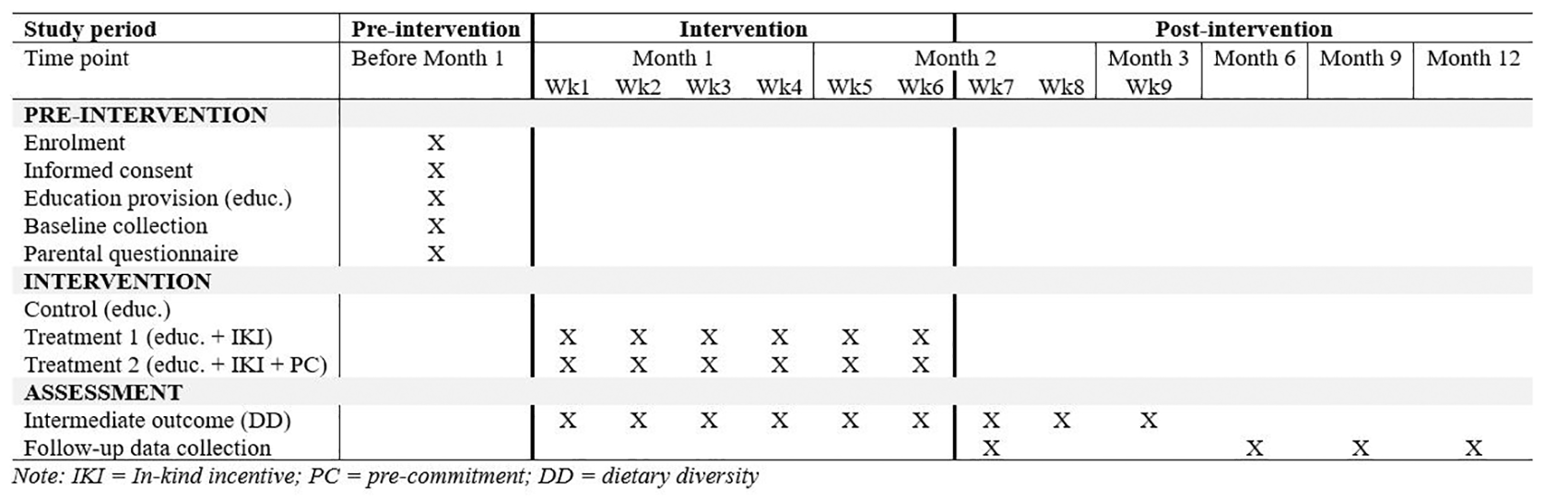
Figure 1 provides a descriptive timeline for participant enrolment, interventions and assessments.
Pre-intervention education on healthier diets
Before starting the interventions, all the selected school children and at least one parent per child will be invited to participate in an educational program designed to improve nutritional literacy. This program will focus on the impact of diet on health, emphasizing healthy and affordable diets, with a particular aim to empower socio-economically disadvantaged children and families to make healthier diet choices.
Arm A: Intervention – non-financial rewards
In this intervention arm, the aim will be to assess whether the pre-intervention education program and in-kind (non-financial) incentives can improve the children’s diet diversity. Following their exposure to the pre-intervention education on healthier diets, each week during the six-week intervention period, each child will complete the dietary diversity measure. Each week, if the child’s response shows an improvement compared to their baseline, they will accumulate some points based on our proposed scoring system. At the end of the intervention period, their dietary intake will be assessed using Intake24 and metabolite assessment (i.e. urine samples). Children who show improvement based on these more objective measures will be eligible for a chance to earn the reward. Those who do have objective diet improvement will not be eligible for a chance at the reward. Among eligible children, those with more accumulated points will have higher chances of winning the in-kind reward through a class-level draw. Finally, the scoring system is not intended to incentivize data collection itself but to serve as an intermediary outcome that, when consistent with more objective dietary data, will serve as input for a chance to win the reward.
Arm B: Intervention – non-financial reward & pre-commitment device
This arm will investigate whether pre-committing to a healthy diet enhances the effectiveness of the 6-week in-kind, non-financial, reward intervention, as described in Arm A. The reward component will remain the same as in Arm A. In this arm, after receiving the pre-intervention education, the child-parent dyad will commit in the first week to improving the child’s diet over the next six weeks. During the subsequent five weeks, weekly reminders will be provided to reinforce this commitment. The child will receive a weekly reminder at school, while the parent will receive a weekly text message reminder about the commitment made.
Arm C: Control group
The control group will receive the pre-intervention nutritional education program but will not be exposed to any behavioural interventions.
School teachers will be trained to implement the interventions. Additionally, they will be supported and reminded of important elements of the study such as to improve adherence of the students to the study.
The data collection for children will take place at school (1) once before the intervention (baseline data collection), (2) once at the end of the intervention period (week 7), and (3) three times after the intervention ends (post-intervention data collection) at month 6, 9, and 12. Frequent follow-ups are important for tracking habit formation, allowing us to see when habits change and also when they revert back. For Intake24, two measurements, about a week apart, will be collected at each collection moment. Data collection for parents consists of a parental questionnaire, which will be collected when parents come to the school, after having given consent.
The socio-demographic data will be collected using an interviewer-administered child questionnaire and a parent/guardian questionnaire. The child questionnaire will include a component to capture the time and risk preferences of the child, which will be used to characterize any heterogeneity in the interventions’ effects.
Impact evaluation will include primary outcome measures, dietary quality and diversity measures, and secondary outcome measures, including anthropometrics (BMI and waist circumference) and nutrition literacy/knowledge. Such measures will be used to enable the understanding of the dynamics between changes in behaviours and their impact on these weight-related outcomes.
For all three of the arms, we will collect an intermediate outcome using an adapted version of the dietary diversity tool utilised in a previous school-based study in Sri Lanka (Seneviratne et al., 2021). This tool is additional used to monitor adherence to dietary change.
Dietary quality & dietary diversity
Diet quality and diversity will be assessed using both an adapted self-reported interviewer-led dietary recall tool (Intake24) and urine samples. A 5–10 ml first void urine sample will be collected to analyse global metabolite profiles, sodium, potassium and nitrogen (mmol/dl), which will be used to validate the dietary intake data (Garcia-Perez et al., 2017). The revised Food Based Dietary Guidelines for Sri Lankans (Ministry of Health, 2021) will be used to determine whether a diet meets the threshold for quality and diversity.
Anthropometric measurements (BMI and waist circumference)
Anthropometric measurements will be taken as follows: height will be measured in a standing position, barefoot, using a Shorr Board portable stadiometer, recorded to the nearest 0.1 cm (formerly Shorr Productions, LLC, USA). Waist and hip circumferences will be measured using an inelastic tape measure, recorded to the nearest 0.1 cm. Additionally, we will record weight and use these measurements to generate BMI, BMI Z-score, height-for-age Z-score, weight-for-age Z-score, and weight-for-height Z-score.
Nutrition literacy/knowledge
Nutrition literacy/knowledge will be collected via the Healthy Diet Knowledge Assessment questionnaire such that even if no dietary or anthropometric change is seen, it will still be possible to observe if the educational component of the study led to an improvement in nutrition knowledge.
This study has been registered on 29 August 2025 with ISRCTN, registration number: ISRCTN11340383. The trial has not yet commenced, and initiation is pending the securing of new funding.
Primary analyses will assess whether the school-based behavioural change intervention leads to differences in the primary outcomes -- diet quality and diversity -- between children in treated (Arms A and B) and control (Arm C) schools. A difference-in-differences approach will be used to estimate the average treatment effect, adjusting for clustering, fixed effects, and relevant baseline covariates including but not limited to age, gender, and waist circumference. All statistical analyses will be conducted using the most current version of Stata. Subgroup analyses will examine whether the intervention effects vary by individual characteristics and explore potential mediating influences such as social, psychological, economic, and environmental factors, and peer effects. Predetermined subgroups (e.g., sex) will be tested for interaction effects. Subgroup-specific treatment effect estimates and corresponding p-values will be reported only if interaction terms are statistically significant. Secondary analyses will explore differences in secondary outcomes, including physical (e.g., BMI), biochemical (e.g., urinary biomarkers), and knowledge-based indicators (e.g. nutrition literacy).
An analysis will be conducted to assess any differences between self-reported dietary intake measures (Intake24 and dietary diversity tool) and an objective measure (metabolite profiling). This analysis is important for validating the dietary intake assessments and identifying any discrepancies due to errors, omissions, or intentional misreporting. Additionally, the use of both measures will enable us to explore a conceptual question: whether individuals intentionally misreport the subjective measure to receive incentives, even when non-compliant.
All continuous variables will be summarised with descriptive statistics: non-missing sample size (n), mean, standard deviation, median, and range (maximum and minimum). Categorial variables will be reported as frequencies and percentages based on the non-missing sample size. Data will be organized by school, treatment arm, subject, and when appropriate, by visit number. Summary tables will present results for each treatment group (Experimental, Control) with annotations indicating the total sample size and any missing observations. Data will be stored in full compliance with relevant national legislation and with international guidance on best practices. Data will be held on a secure server in a linked anonymised format. Linked anonymised data will be available to statisticians, research assistants and work package leads. Fully anonymised data will be available to all partners.
As the trial involves a school-based behaviour change intervention, participants and intervention staff cannot be blinded. The trial aims to adhere to established procedures to maintain separation between staff that deliver the intervention and staff that take outcome measurements. It is important to use both objective and self-reported measures in behaviour change interventions. Self-reported measures provide a detailed and granular account of consumption and are easy to implement, but they are also prone to biases (e.g., social desirability bias, recall bias, and underreporting total energy intake). These biases can persist even in experimentally controlled settings, making it essential to triangulate them with objective metrics. Therefore, metabolite profiling will be used to validate the Intake24 dietary recall tool and identify any misreporting or omissions. Additionally, using both measures allows us to explore whether individuals intentionally misreport dietary intake to receive incentives, even when non-compliant.
In the literature, several studies focus on anthropometric outcomes (such as BMI, waist circumference and weight) as primary outcomes. However, when designing interventions to foster behavioural change, it is more appropriate to focus on behaviours rather than secondary outcomes such as BMI or weight, especially in short-term interventions where insufficient time may prevent meaningful BMI changes. Instead, observing changes in behaviours allows for assessing whether behavioural changes persist, and thus if individuals, including children, are on the path to long-term weight loss or the prevention of overweight or obesity-related behaviours Enright et al. (2020). As such the secondary outcomes for this trial will include weight, BMI, and waist circumference. Using these secondary outcomes alongside the primary outcomes will enable us to understand the dynamics between behavioural changes and their impact on these weight-related outcomes. This information will also guide, for example, the design of reinforcing mechanisms to ensure meaningful and sustained changes in behaviours over time.
Additionally, Enright et al. (2020) highlight in their review the challenges of assessing the long-term impacts of behaviour change interventions due to missing data and insufficient reporting. They emphasize the importance of collecting longitudinal and triangulated data on diet and BMI to understand the mechanisms that hinder or enable the translation of behaviours into longer-term BMI changes, and to identify which intervention features are most conducive to sustained changes in food behaviour.
The study is sponsored by the Imperial College London and has been approved by the Imperial College Research Ethics Committee (Ref No: 6696130) on 25 September 2023, and Ethics Committee, University of Kelaniya – Sri Lanka (Ref No: P/12/01/2024) on 04 April 2024. The trial will follow Consolidated Standards of Reporting Trials (CONSORT) guidelines for cluster RCTs and upon recommencement of study and prior to recruitment of participants, the study will be registered in the Sri Lanka Clinical Trials Register with any modifications logged immediately. This protocol follows Standard Protocol Items: Recommendations for Interventional Trials (SPIRIT) guidelines (see SPIRIT checklist available at: https://osf.io/j8wkc).
Any changes to the protocol will be communicated with the steering committee, trial registration committee and ethical approval committees, in advance by principal investigators.
The trial protocol, which includes the statistical analysis plan, is available online here: https://imperialcollegelondon.app.box.com/s/zu1j7qgg5hkfmpea10onjelo6l8t9dd8
Provide sufficient details of any financial or non-financial competing interests to enable users to assess whether your comments might lead a reasonable person to question your impartiality. Consider the following examples, but note that this is not an exhaustive list:
Sign up for content alerts and receive a weekly or monthly email with all newly published articles
Register with NIHR Open Research
Already registered? Sign in
If you are a previous or current NIHR award holder, sign up for information about developments, publishing and publications from NIHR Open Research.
We'll keep you updated on any major new updates to NIHR Open Research
The email address should be the one you originally registered with F1000.
You registered with F1000 via Google, so we cannot reset your password.
To sign in, please click here.
If you still need help with your Google account password, please click here.
You registered with F1000 via Facebook, so we cannot reset your password.
To sign in, please click here.
If you still need help with your Facebook account password, please click here.
If your email address is registered with us, we will email you instructions to reset your password.
If you think you should have received this email but it has not arrived, please check your spam filters and/or contact for further assistance.

Comments on this article Comments (0)