Keywords
Preterm infant, neonatal sepsis, length of stay, parenting, feasibility study, infection control, baths, neonatal nursing

Preterm infant, neonatal sepsis, length of stay, parenting, feasibility study, infection control, baths, neonatal nursing
Annually in England >55,000 babies (10% of all live births) require admission for specialist care in a neonatal unit.1 Neonatal sepsis is one of the most commonly treated conditions during neonatal admission and contributes significantly to neonatal mortality.2 Sepsis also contributes to neonatal morbidity; studies exploring outcomes following sepsis in preterm infants have identified an increased risk of neurodevelopmental disability in this population.3
The risk of sepsis can be increased by pathogenic bacteria on the skin.4,5 Human skin hosts a multitude of microorganisms, including bacteria, viruses, and fungi, which together play an essential role in the functioning of a healthy immune system.6 Colonisation of the skin begins in the womb and continues to develop during the birthing process itself, followed by immediate skin to skin contact with mothers.7,8 For babies admitted to a neonatal unit, natural skin colonisation takes place in a hospital setting where babies are exposed to environmental pathogenic organisms.9 Preterm and unwell term babies are at higher risk of harmful skin colonisation following (for example) maternal sepsis, an immature skin barrier, and/or frequent skin-disrupting procedures such as cannulation, lumbar puncture, and the use of adhesives to secure medical devices such as nasogastric and ventilation tubing.9–11 Frequent handling by healthcare professionals and antibiotic use can also increase a baby’s risk of acquiring harmful pathogenic organisms.4
Bathing is a routine intervention for well babies globally and an important infection control measure preventing harmful skin colonisation and subsequent infections.12 The evidence for bathing babies who are born preterm or unwell is unclear. Limited single centre studies in the US and Korea compared skin flora from a total of 77 hospitalised preterm infants randomised to bathing every 2 versus every 4 days, and reported babies could be bathed every 4 days without increasing skin flora colony counts or harmful colonisations.13,14 It is unknown whether a substantial decrease in bathing cycle frequency impacts on this finding; a survey of UK neonatal units in 2021 found variation in clinical practice highlighting that some units bath babies daily /three times a week (25% n = 14), and some infrequently/never (23%, n = 13).15
Determining optimal bathing frequency in neonatal units could not only improve short-and long-term outcomes for infants; it could facilitate parental engagement in their baby’s care. This is an essential element of effective discharge preparation which occurs throughout the infants stay.16,17 Delayed discharge results in further family disruption, increases an infant’s risk of infection, and places unnecessary financial burdens on parents and the NHS.18
The aim of this feasibility randomised controlled trial is to determine the feasibility (identifying primary outcome measures, recruitment, retention, and acceptability) of a neonatal swaddled bathing intervention for newborn infants admitted to a neonatal unit.
The primary objective is to determine whether the intervention is feasible and acceptable for infants, parents, and healthcare professionals. Secondary objectives are to: develop and test data collection procedures for the bathing intervention, develop processes for collecting data on parent-preparedness for discharge, inform sample size calculation for a larger trial, identify potential confounding factors.
The need for this study was identified by nurses who discussed rising rates of neonatal skin colonisation and barriers to bathing babies. We then spoke to numerous families on the neonatal unit about their experiences of bathing their baby; none of the parents identified (n = 4) had bathed their baby and were not aware this was an option. We therefore developed the study to address both concerns over sepsis and parental engagement in their baby’s care. We contacted parents whose babies had previously received neonatal care, an adult who was born preterm, and parent representative charities (Bliss, EiSMART) who worked alongside the healthcare professional team to develop the funding application and to refine the research question and methodology. The study team meet regularly for guidance and feedback on all aspects of the study and will continue to meet to support data analysis and dissemination. Compensation for parental involvement in the study is provided.
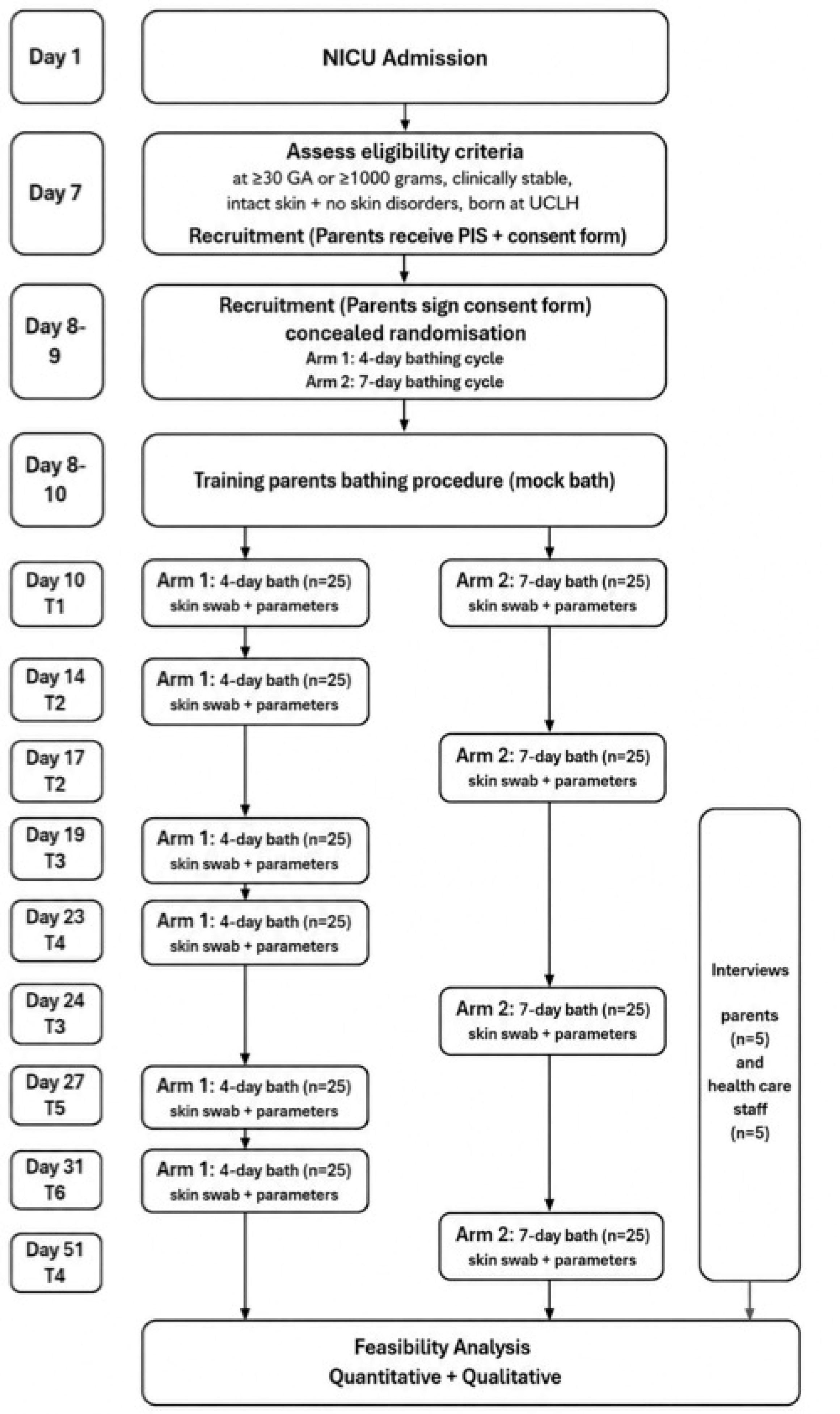
This is a parallel group, open-label, single centre, randomised controlled feasibility trial. A study flow chart is presented in Table 1. The protocol has been reported using the Standard Protocol Items: Recommendations for Interventional Trials (SPIRIT) statement.19,20 The study results will be reported using the CONSORT 2025 guidance for reporting randomised trials (CONSORT).21
The study was retrospectively registered with the International Standard Randomised Controlled Trial (ISRCTN) Clinical Trial Registry (ISRCTN10089507; https://doi.org/10.1186/ISRCTN10089507) on 04.03.2026. The trial opened in January 2026 and is currently recruiting until June 2026.
Participants will be recruited from a single tertiary level neonatal unit in an NHS Hospital Trust in London. The neonatal unit has 28-cots and provides intensive, high dependency, and special care to infants and their families, alongside transitional care. The unit receives more than 800 admissions annually.
All potential participants will be screened by a member of the study team to determine their eligibility for the study based on the meeting the following criteria ( Table 1). Participants will not be eligible for the study if they meet the criteria ( Table 2).
For the embedded qualitative study to determine acceptability, inclusion criteria are:
Parents
Healthcare professionals
Eligible families will be identified and approached by the study team in the first few days following birth and subsequent admission to the neonatal unit (day 1). Parents will be provided with a participant information sheet (PIS), the study will be explained, and all questions answered ( Figure 1). It will be explained to parents that although their baby might be eligible at the time of consent, the bathing intervention would only be conducted if their baby is clinically stable at each timepoint. Eligibility will be assessed by the study team in collaboration with the parents and clinical team. It will be emphasised that opting not to participate in the study will not affect their baby’s care in any way. The study will be presented at handover, at grand rounds, and during clinical teaching to raise staff awareness. Posters will be placed around the unit to raise parent awareness.
Embedded qualitative study
To gain insight into the acceptability of the study to parents and healthcare professionals, optional participation in a semi-structured qualitative interview will be offered. The study team will explore this opportunity with parents during the initial study introduction, and interested parents will be contacted by the study team towards the end of their recruitment period to arrange an interview.
Presentation of the study to the healthcare professionals will include information around the qualitative interviews. An email invitation containing the PIS will then be sent to all healthcare professionals on the neonatal unit, asking those who have experienced the study whether they would be willing to participate in an interview. Healthcare professionals willing to participate will contact the research team, who will then assess eligibility and arrange an interview. Interview recruitment will start at the mid-point of recruitment to ensure that professionals have adequate exposure to the study.
For parent(s) where English is not their first language, translation services offered by the Hospital will be used to introduce the study to ensure all families have an equal opportunity to understand and participate in the study. Study information will be available in the recently identified top languages spoken on the unit (Spanish, Arabic, Turkish, Somali, Romanian).
Written informed consent will be obtained by a member of the study team. Parents will be given at least 24 hours to consider the study and ask any questions prior to providing consent. It will be recorded in the patient’s electronic health record system when the participant information sheet (PIS) has been given to parents, and if the family are enrolled in the study.
As part of the study parents will also have the option to consent to the bath being given by the study team if they are unable to be on the unit for any reason when the intervention is due. Parents who do not wish their baby to be bathed without them present will not be excluded from the study. Any parent(s) or legal guardian who loses the capacity to consent during the study period will no longer be eligible for the study.
Embedded qualitative study
Parents who have agreed to be contacted will be approached to arrange a qualitative interview. Parents will complete a separate consent form prior to the start of an interview should they still wish to take part. Eligible healthcare professionals will be asked to provide written consent prior to the start of their interview.
The study team will explain that participants are under no obligation to enter the study, and they can withdraw at any time without having to give a reason. Not participating in, or withdrawing from, the study will not affect their baby’s clinical care (parents) or appraisal of their clinical performance (healthcare professionals).
A sample size of 25 infants per arm (n = 50 total) is possible within the allocated budget.22 This will allow us to determine the feasibility of the study, progression onto a full RCT, and the subsequent sample size required for the trial. Convenience sampling will be used to explore the acceptability of the intervention to parents and neonatal healthcare professionals. We will recruit five neonatal healthcare professionals, and five parents.
Participant randomisation will be undertaken centrally by the study team using the sealed envelope online programme on day 8 or 9. Parents will be informed which study arm they have been allocated to and plans for the first bath made for day 10. This will be documented in the patients notes to inform the clinical team. Due to the nature of the intervention, the study team, parents, and clinical team will not be blinded to the randomisation arm. Only the laboratory team and the statistician will be blinded to study groups.
Babies (n = 50) will be randomised to a swaddle bath (a developmentally supportive bathing technique developed for preterm infants) every 4 (arm 1, n = 25), or every 7 (arm 2, n = 25), days. A study diary at the cot-side for parents and healthcare professionals will help keep track of when baths are due. After each bath, the diary will be updated.
Ten minutes prior to the agreed bath time, the baby’s vital signs will be recorded to ensure that the baby is clinically stable. Prior to the bath, two swabs will be taken from the baby’s skin (one from the axilla and one from the groin) and labelled as the pre-intervention swabs. Water for the bath will be taken from a filtered tap (fitted with a medical grade point-of-use filtration device) in the neonatal unit. Taps designated for baby baths will be restricted to those with a microbiological safety assurance (i.e. water quality is free of Pseudomonas aeruginosa) performed in-house by the Environmental Research Laboratory.
Bath water temperature will be maintained at 36.5–37 degrees centigrade throughout, measured using a bath thermometer. Babies will be bathed on the neonatal unit next to their cot. Babies will be undressed and swaddled using a soft cloth or thin blanket prior to the bath and lowered into the bath water with the swaddle in place. The swaddle will be partially removed once wet to enable washing the baby. Babies will have their hair washed and dried prior to having a bath, if appropriate, while they are swaddled. The duration of the bath will be determined by baby behavioural cues for distress. Once the bath has finished, the parent or the research nurse/clinical team member will lift the baby out of the bath and place them in a warm dry towel on the parent’s chest if possible, or otherwise onto a warm towel in the cot. The baby will be dried and redressed. The baby’s vital signs will be monitored 10 minutes after the bath, to ensure that the baby has experienced no adverse effects from the intervention. If the baby becomes too distressed during the bath, the intervention can be stopped early.
Thirty minutes after the bath, the baby’s vital signs will be monitored to ensure on-going clinical stability. Two further swabs will be taken from the baby’s skin (axilla and groin). Swabs will be labelled as the post intervention swabs, combined with the pre-intervention swabs, which will be stored in the fridge on the neonatal unit or taken directly to the local laboratory.
If a participating baby is not eligible for a bath due to parental, clinical, or study team concerns about their clinical stability, the bath will be missed at that time-point, but the baby will remain in the study. The baby will recommence bathing interventions at the next timepoint if their clinical stability has improved. Similarly, if parents are not happy for the research or nursing team to bath their baby in their absence, the bath will be missed at that timepoint. The baby will remain in the study, and recommence bathing at the next time point, when the parents are present.
A training video has been developed to support the bathing intervention, for both parents and neonatal staff. The video highlights the correct swaddle bathing technique, filmed with consent from a family of twins on the neonatal unit, their parents, and an occupational therapist.
The primary objective of this study is to determine the feasibility and acceptability of the bathing intervention in infants admitted to a neonatal unit, in preparation for a full RCT which will explore the impact of bathing on skin colonisation in infants admitted for neonatal care. Secondary outcomes will measure candidate clinical outcomes. To determine the feasibility and acceptability of the bathing intervention the study will measure the outcomes listed in Table 3.
Participants will be given a unique participant identification number following consent and randomisation which will be used on study samples, study documents and for data entry. Data will be entered directly from the infants’ electronic medical records into the study data base hosted by REDCap.23 Data will be collected and entered by the study research nurse as per the delegation log. The Environmental Research Laboratory will share the swab results (an excel file) with the research nurse to be entered in REDCap via NHS email.
Qualitative interviews will be recorded on the virtual hosting platform (MS Teams). This data will be downloaded, checked against the recording for accuracy by a member of the study team, and imported into Data Safe Haven (DSH), the UCL service which provides a technical solution for storing, handling and analysing identifiable data and which is certified to the NHS ISO27001 information security standard. Any identifiable information will be removed at the time of transcription. Audio recordings will be deleted following transcription.
We will monitor for adverse events (AEs) which have a causal relationship with the intervention during the bathing intervention, and for 10 minutes after the bath to ensure these are related to the bath and not to any other cause related to prematurity. No AEs will be recorded outside of this observation period. During the observation period for the AEs (10 mins) the baby’s vital signs will be monitored (temperature, heart rate, respiratory rate, oxygen saturations, oxygen requirement if receiving supplementary oxygen). Any AEs which require minimal intervention e.g. extra clothing for low temperature, increased oxygen for low oxygen saturations (desaturation), stimulation for bradycardia, vomiting with no treatment, will be recorded and reported in the infants’ medical notes and the study database. Each adverse event (AEs) will be assessed for severity, causality, seriousness and expectedness.
Serious adverse events (SAEs) will be deemed as requiring intensive care support (and therefore prolonging hospitalisation) such as increased respiratory support, increased cardiovascular support, increased thermoregulatory support. SAEs will also include any incidents related to the bath itself, such as slips on wet floors, dropping a wet baby, or dropping a full or empty bath. SAEs will be monitored for 24 hrs after each bath, for all baths in the intervention. All serious adverse events will be recorded in the medical records and the CRF, the REDCap study database and the sponsor’s SAE log. The AE and SAE logs will be stored in the TMF and may be subject to Sponsor monitoring and auditing. All SAEs (except those specified in the protocol as not requiring reporting to the Sponsor) will be reported to the Sponsor within 24 hours of becoming aware. Where the SAE is unexpected and thought to be related to the intervention, the Chief Investigator will report this to the Nottinghamshire REC within 15 days.
The primary feasibility outcomes will be analysed using descriptive statistics (counts, proportions and where appropriate 95% confidence intervals). The secondary outcomes will be analysed using descriptive statistics (mean, median, standard deviation and range where appropriate).
Qualitative interview data will be analysed using thematic analysis.24 Two researchers will independently code the data before reviewing codes together to increase analysis validity and minimise lone researcher bias.25 The codes will then be grouped together into broader themes which reflect the content of specific areas of discussion, before the generation of a thematic map which represents any relationships between the themes/codes.24 The themes will be analysed in relation to other study findings and the wider literature around parental involvement in neonatal trials.
Study progression to a full RCT will be dependent upon: 1. feasibility of recruitment (100% go, 50–99% amend, <50% stop), 2. feasibility of retention (>80% go, 70–79% amend, <70% stop), and 3. Intervention implementation (strongly feasible judged by findings go, feasible amend, possible stop).
The study has been approved by the Nottinghamshire NHS Research Ethics Committee (ID: 25/EM/0205).
Findings will be disseminated through various means to reach all intended audiences (parents, health professionals, professional organisations). Parent participants will be asked during consent if they would like to receive a copy of the results and will be contacted at the end of the study if so. Study updates will be shared on the study teams’ professional social media accounts. Results will be submitted for publication in a peer reviewed journal and submitted to relevant conferences for presentation. We will work with relevant professional organisations (e.g. the Neonatal Nurses Association26) to develop a study webinar to share information.
This is the first study to explore optimal frequency of bathing preterm infants in neonatal settings in the UK. It is limited by its small sample size and single centre approach, however it will provide sufficient information to determine whether a larger multicentre RCT would be achievable in this population, to determine whether there is a link between bathing frequency and subsequent neonatal sepsis.
Provide sufficient details of any financial or non-financial competing interests to enable users to assess whether your comments might lead a reasonable person to question your impartiality. Consider the following examples, but note that this is not an exhaustive list:
Sign up for content alerts and receive a weekly or monthly email with all newly published articles
Register with NIHR Open Research
Already registered? Sign in
If you are a previous or current NIHR award holder, sign up for information about developments, publishing and publications from NIHR Open Research.
We'll keep you updated on any major new updates to NIHR Open Research
The email address should be the one you originally registered with F1000.
You registered with F1000 via Google, so we cannot reset your password.
To sign in, please click here.
If you still need help with your Google account password, please click here.
You registered with F1000 via Facebook, so we cannot reset your password.
To sign in, please click here.
If you still need help with your Facebook account password, please click here.
If your email address is registered with us, we will email you instructions to reset your password.
If you think you should have received this email but it has not arrived, please check your spam filters and/or contact for further assistance.

Comments on this article Comments (0)