Keywords
procalcitonin, sepsis, antimicrobial stewardship, intensive care, implementation science

procalcitonin, sepsis, antimicrobial stewardship, intensive care, implementation science
ADAPT-Sepsis demonstrated that procalcitonin (PCT)-guided care safely reduced antibiotic duration in ICU patients treated for sepsis.1 Subsequent meta-analysis supports reductions in antibiotic exposure with no increase in mortality,2 and economic evaluations suggest PCT-guided care may be cost-effective.3 International guidelines now suggest using PCT alongside clinical assessment to support antibiotic discontinuation decisions,4 while updated NICE guidance is awaited.5
Despite this, UK implementation remains uncertain. In a 2018 survey, almost 75% of UK clinicians reported rarely or never using PCT,6 although subsequent qualitative work found broadly positive views towards PCT-guided antimicrobial stewardship.7,8 Following publication of ADAPT-Sepsis, we surveyed current UK practice relating to PCT-guided antibiotic discontinuation and explored clinician and organisational readiness for routine adoption of this.
Patients and the public were not involved in the design, conduct, choice of outcome measures, recruitment or reporting of this study, which surveyed healthcare professionals about their current practice and readiness to implement the findings from ADAPT-Sepsis.
Participants received study information on the survey's opening page; by completing the questionnaire, consent was implied.
Formal ethical review was not required. The NHS Health Research Authority and University of Manchester research ethics decision tools both indicated that this anonymous survey of healthcare professionals, on matters within their professional competence, fell outside the scope of review.
An anonymous electronic survey (via Qualtrics, hosted by The University of Manchester) was distributed via professional mailing lists (Intensive Care Society, UK) between March and June 2025. Questions explored current use of PCT and CRP in sepsis, local stopping protocols, and readiness to implement PCT-guided antibiotic discontinuation (full survey available).9 Organisational readiness was assessed using the Organisational Readiness for Implementing Change (ORIC) instrument.10 Analyses were performed using complete available responses, missing responses were excluded and not imputed. All questions were optional and survey data was handled and stored in line with the University of Manchester data protection and confidentiality policies. Reporting is guided by the Improving the Quality of Web Surveys: The Checklist for Reporting Results of Internet E-Surveys (CHERRIES) checklist.9,11
Ninety-nine survey responses were received, of which 13 were excluded (either blank or contained only geographical information with no further answers). Eighty-six respondents from 30 UK healthcare organisations were therefore included in the analysis. Most respondents worked in intensive care (87%), were doctors (69%) or pharmacists (19%), and were based in England (81%) ( Table 1 and Table 2).
| N = 861 | |
|---|---|
| Current role | |
| Doctor | 59 (69%) |
| Pharmacist | 16 (19%) |
| Nurse | 4 (4.7%) |
| ACCP | 3 (3.5%) |
| Other | 4 (4.7%) |
| Doctor grade | |
| Consultant | 47 (80%) |
| Resident | 10 (17%) |
| SAS doctor | 1 (1.7%) |
| Other | 1 (1.7%) |
| Main area of practice | |
| Intensive care | 75 (87%) |
| Anaesthesia | 2 (2.3%) |
| Medicine | 2 (2.3%) |
| Emergency medicine | 1 (1.2%) |
| Other | 6 (7.0%) |
| Hospital type | |
| Teaching Hospital | 48 (56%) |
| District General Hospital | 35 (41%) |
| Other | 3 (3.5%) |
Percentages are calculated using the total number of respondents as the denominator (N = 86). Respondents could select more than one option.
| ICU specialties | N = 861 |
|---|---|
| Medical | 79 (91.9%) |
| Surgical | 76 (88.4%) |
| Trauma | 50 (58.1%) |
| Vascular | 41 (47.7%) |
| UGI surgery | 39 (45.3%) |
| Neurosciences | 30 (34.9%) |
| Burns | 19 (22.1%) |
| Thoracic | 19 (22.1%) |
| Transplant | 18 (20.9%) |
| Other | 12 (14.0%) |
| Cardiac surgical | 10 (11.6%) |
| Missing | 1 (1.2%) |
Almost half of respondents reported measuring PCT occasionally in selected patients (42/85, 49%) ( Table 3). Daily measurement in every patient was reported by 4/85 respondents (4.7%), with a further 4/85 (4.7%) reporting daily measurement in selected patients only. Overall, 24/85 respondents (28%) reported rarely or never measuring PCT. By contrast, most respondents reported measuring CRP daily in every patient (46/86, 53%). PCT was usually reported to be a special request rather than part of a routine blood test panel ( Table 3).
Most respondents (51/73, 70%) reported that their service had no agreed protocol using defined PCT thresholds to guide antibiotic discontinuation in sepsis ( Table 4). Nearly half reported wishing to increase their use of PCT thresholds to guide discontinuation (36/73, 49%), while 21/73 (29%) were uncertain and wanted further information. Only 2/73 (2.7%) reported wishing to decrease their use of PCT thresholds in this context ( Table 4).
| Overall N = 861 | Teaching Hospital N = 481 | District General Hospital N = 351 | Other N = 31 | |
|---|---|---|---|---|
| CRP threshold used to stop | ||||
| Yes | 2 (2.5%) | 1 (2.1%) | 1 (3.1%) | 0 (0%) |
| No | 77 (95%) | 46 (98%) | 29 (91%) | 2 (100%) |
| Don't know | 2 (2.5%) | 0 (0%) | 2 (6.3%) | 0 (0%) |
| Missing | 5 | 1 | 3 | 1 |
| PCT threshold used to stop | ||||
| Yes | 22 (30%) | 12 (29%) | 10 (34%) | 0 (0%) |
| No | 51 (70%) | 30 (71%) | 19 (66%) | 2 (100%) |
| Don't know | 0 (0%) | 0 (0%) | 0 (0%) | 0 (0%) |
| Missing | 13 | 6 | 6 | 1 |
| Desire to change use of PCT thresholds to STOP antibiotics | ||||
| Yes, increase my use of PCT measurement in this context | 36 (49%) | 22 (51%) | 13 (46%) | 1 (50%) |
| No, stay the same | 10 (14%) | 5 (12%) | 5 (18%) | 0 (0%) |
| I am not sure, I need more information to decide | 21 (29%) | 10 (23%) | 10 (36%) | 1 (50%) |
| Yes, decrease my use of PCT measurement in this context | 2 (2.7%) | 2 (4.7%) | 0 (0%) | 0 (0%) |
| Other | 4 (5.5%) | 4 (9.3%) | 0 (0%) | 0 (0%) |
| Missing | 13 | 5 | 7 | 1 |
60/86 respondents (69.8%) completed all 12 ORIC items ( Figure 1). On a five-point scale, the mean overall ORIC score was 3.42 (SD 1.03), with mean change commitment and change efficacy scores of 3.31 (SD 1.06) and 3.50 (SD 1.05), respectively, indicating favourable readiness.
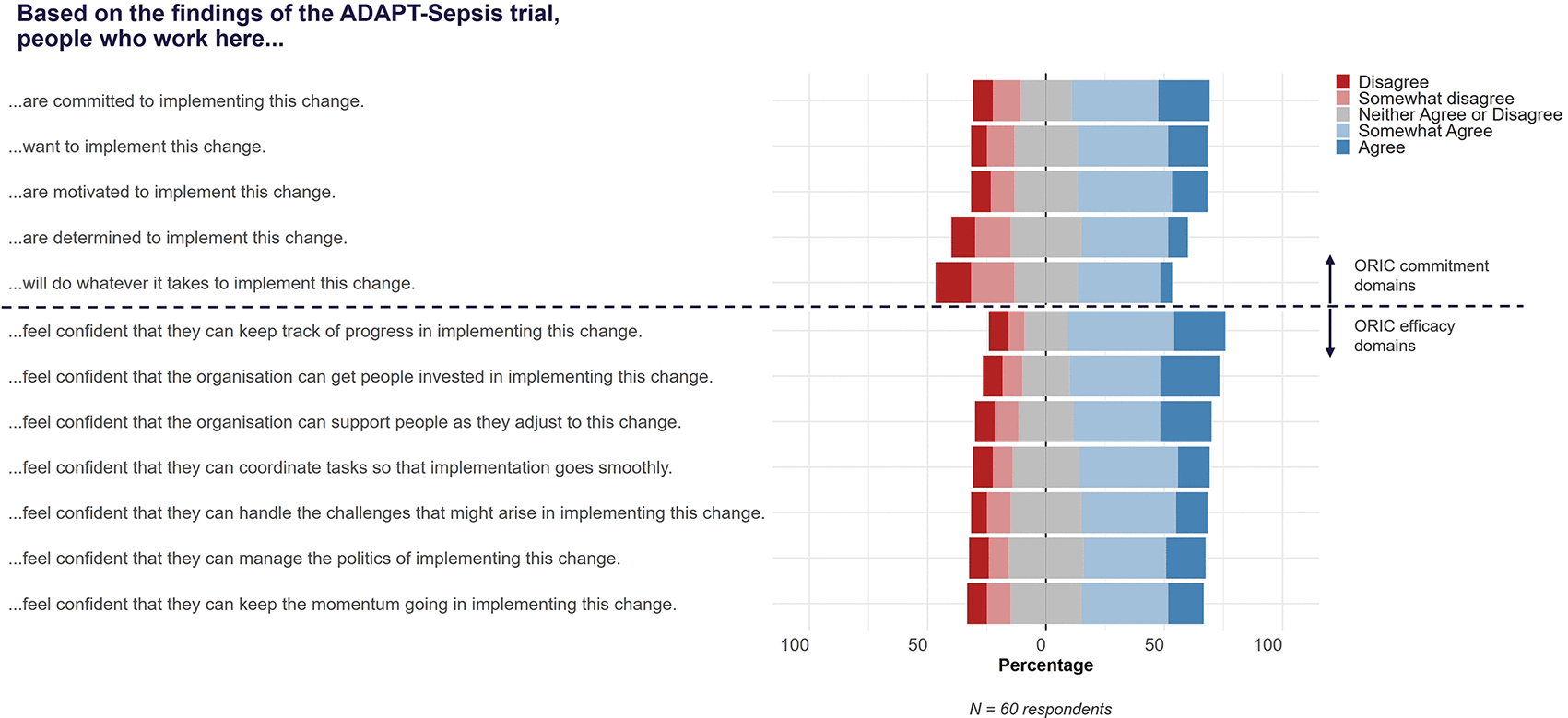
Organisational Readiness for Implementing Change (ORIC) is a validated measure of an organisation's readiness to implement a new intervention, comprising two domains: change commitment (the shared willingness to implement the change) and change efficacy (the shared belief that the organisation has the capability to implement it successfully). Data include the 60/86 survey respondents who completed all 12 ORIC items in full.
To our knowledge, this is the first national survey of UK practice and organisational readiness for PCT-guided antibiotic discontinuation after ADAPT-Sepsis.1 Data were collected shortly after ADAPT-Sepsis and before publication of the subsequent systematic review and meta-analysis, capturing practice early in evidence translation.
Compared with a 2018 survey of 380 NHS healthcare professionals, fewer respondents reported ‘rarely or never’ using PCT, falling from 73.8% to 28%, suggesting increased use over time.6 However, consistent with the previous survey, PCT was still usually measured selectively rather than routinely, and agreed stopping protocols were uncommon. Together, these data suggest variable practice and limited routine protocolised use.
Nearly half wished to increase their use of PCT thresholds to guide antibiotic discontinuation, whilst almost a third wanted more information. Previously identified enablers include clear guidance, local protocol and further education which may support translation of recent trial evidence into routine care.2,8
This study is subject to several limitations. Participation was voluntary and therefore susceptible to selection bias, multiple responses may have come from individual respondents or hospital sites, and respondents’ familiarity with ADAPT-Sepsis was not accurately assessed. The denominator of clinicians who had access to the survey (and therefore the response rate) is unknown. Furthermore, the survey was conducted in 2025 and preceded publication of a systematic review showing no increase in mortality with PCT-guided care.2 Clinician views may have changed in light of this new evidence.
In conclusion, whilst PCT-guided antibiotic discontinuation can safely reduce antibiotic duration in patients with sepsis, current use is unlikely to be routine. Insights here suggest health professionals are open to increased use of PCT-guided discontinuation. However, the ORIC scores for implementation of this innovation, whilst favourable, do not indicate strong readiness on the part of individuals or organisations. Further adoption and spread will need active support to bridge the challenging journey from research to practice. Barriers to implementation must be identified and addressed and approaches that facilitate implementation activated. Only with such translational support will the benefits identified by research impact patient care.
Microsoft 365 Copilot (GPT-5) and Anthropic Claude (Opus 5) were used to assist with proofreading and to suggest wording changes for clarity. The tools were not used to generate data, perform analyses, or draw conclusions. All data synthesis and analysis were performed by the authors, who take full responsibility for the content of this manuscript.
Provide sufficient details of any financial or non-financial competing interests to enable users to assess whether your comments might lead a reasonable person to question your impartiality. Consider the following examples, but note that this is not an exhaustive list:
Sign up for content alerts and receive a weekly or monthly email with all newly published articles
Register with NIHR Open Research
Already registered? Sign in
If you are a previous or current NIHR award holder, sign up for information about developments, publishing and publications from NIHR Open Research.
We'll keep you updated on any major new updates to NIHR Open Research
The email address should be the one you originally registered with F1000.
You registered with F1000 via Google, so we cannot reset your password.
To sign in, please click here.
If you still need help with your Google account password, please click here.
You registered with F1000 via Facebook, so we cannot reset your password.
To sign in, please click here.
If you still need help with your Facebook account password, please click here.
If your email address is registered with us, we will email you instructions to reset your password.
If you think you should have received this email but it has not arrived, please check your spam filters and/or contact for further assistance.

Comments on this article Comments (0)