Keywords
Children, young people, cerebral palsy, chest health, outcomes, measurement instruments, systematic review

Children, young people, cerebral palsy, chest health, outcomes, measurement instruments, systematic review
Respiratory illness is the primary cause of morbidity and early mortality in children with CP. 1 While children with CP are not often born with intrinsic lung disease, a combination of primary neuro-respiratory interactions, condition-specific co-morbidities, and wider determinants of health have a cumulative impact on respiratory health across the lifespan.2–4 Many of these factors are modifiable, providing an opportunity to implement preventative models of care along a continuum from respiratory health to disease.5 Strategies include anticipatory monitoring, timely decision-making and early interventions, all of which rely on the measurement of meaningful and feasible outcomes, considered important to children with CP and their families.6
In research, outcome measures are used to evaluate the effects of interventions (e.g. in clinical trials) or help understand the natural progression, lived experience, and real world patterns of a health condition (e.g. longitudinal observational studies).7,8 In routine clinical care, outcome measures prompt timely decisions, inform management approaches and evaluate their impact in the real-world.9 Within the context of respiratory health in children with CP, previous systematic and scoping reviews have highlighted inconsistency in both the outcome and its associated measurement selection, with additional concerns raised about validity, reliability and feasibility of measurement instruments used.10–16 This has restricted the synthesis of comparable studies, reduced methodological quality, and presented barriers to research participation in children more severely affected by their CP.17
To address this challenge, we developed a core outcome set (COS), defined as a minimum set of standardised outcomes, to be measured in research and/or routine clinical care.18 COS development incorporated the views of children, young people, families, community-based professionals and researchers, to ensure the selection of outcomes was meaningful and relevant across a heterogeneous population of children and young people with CP. 19 The study reached consensus on twelve comprehensive outcomes and three core outcomes, which were 1) views of the child, young person and/or parent/carer, 2) chest infections, and 3) swallow safety. While this COS provides researchers and clinicians with a shared understanding of what outcomes are most important, methods of measuring each outcome may vary in selection, based on relevance, psychometric properties and feasibility.18 This is particularly important to address, given that previous CP research has often prioritised methodological measurement rigour over feasibility, such as lung function measures, which may be inaccessible to children with more complex needs, including those at greatest risk of morbidity and mortality.17
While, to date, our work has informed ‘what’ to measure, the next stage in this methodological process is to establish ‘how’ best to measure the COS, referred to as a core outcome measurement set (COMS). Developing a COMS involves identifying existing outcome measurement instruments (OMIs), evaluating their measurement properties, and determining their feasibility to implement with the intended population of children and young people with CP, residing in a community setting. Consistent use of agreed COMS can enhance the quality, relevance, and comparability of research needed to advance evidence-based practice.20 This protocol outlines the process for identifying, appraising, and recommending OMIs for each core outcome considered essential for assessing chest health in children and young people with CP.
Our aim is to systematically identify OMIs, critically appraise their measurement properties and where the evidence permits, recommend a feasible and acceptable COMS for evaluating three core outcomes: 1) child, young person and/or parent/carers views, 2) chest infections, and 3) swallow safety in children and young people aged 1-18 years with CP, within the community setting. The COMS will be used in both research and routine clinical care. This will be achieved through four objectives:
I. To identify OMIs used to assess (1) child, young person and/or parent/carer views; (2) chest infections and (3) swallow safety in children and young people with CP.
II. Assess the face validity and contextual appropriateness of each OMI in relation to the core outcome definitions and the scope (population, health condition and context).
III. For OMIs with established face validity and contextual appropriateness, identify, extract and evaluate the quality of psychometric properties (validity, reliability and responsiveness) in children and young people with CP.
IV. Assess the feasibility, acceptability and interpretability of implementing the OMIs in research and routine clinical care.
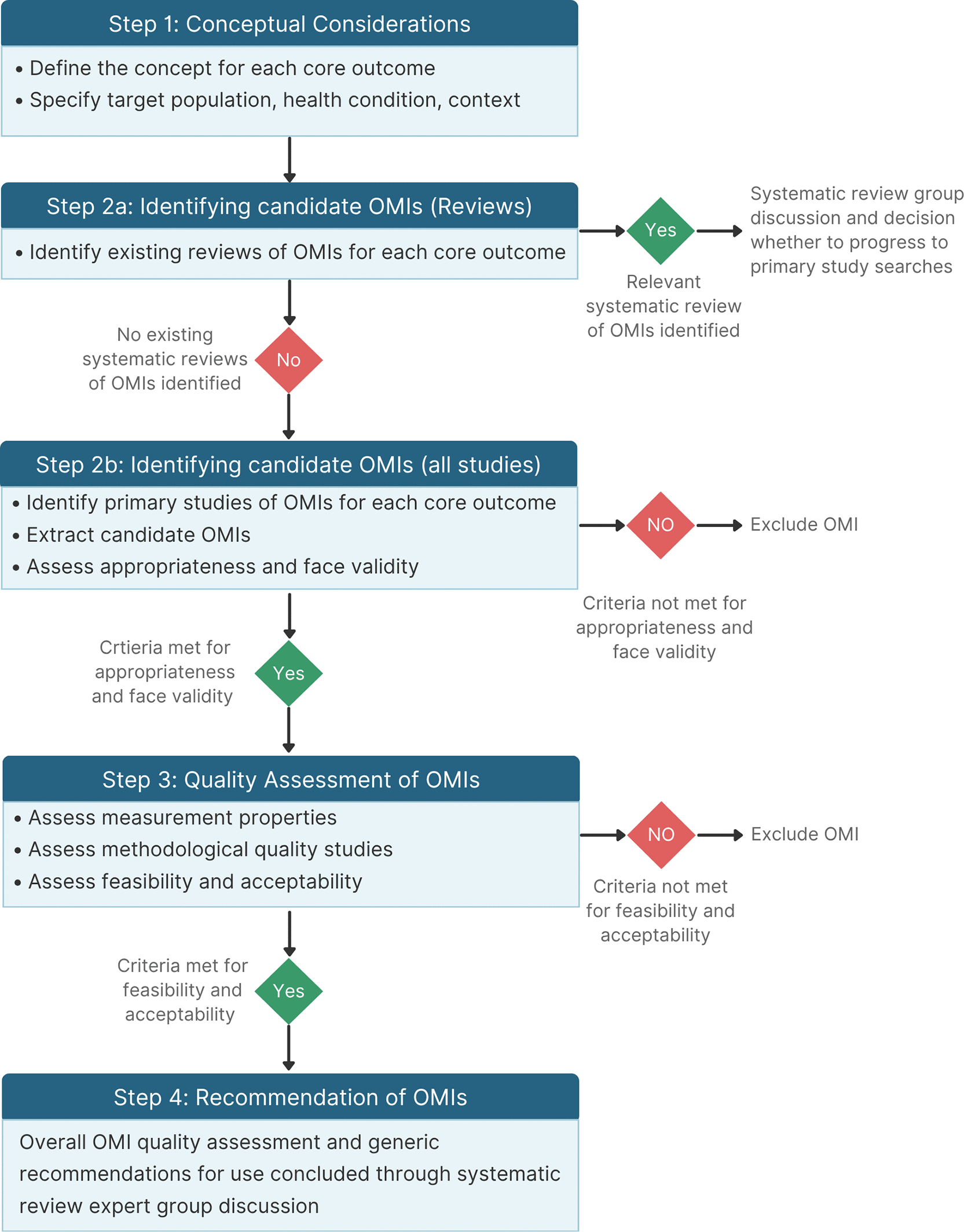
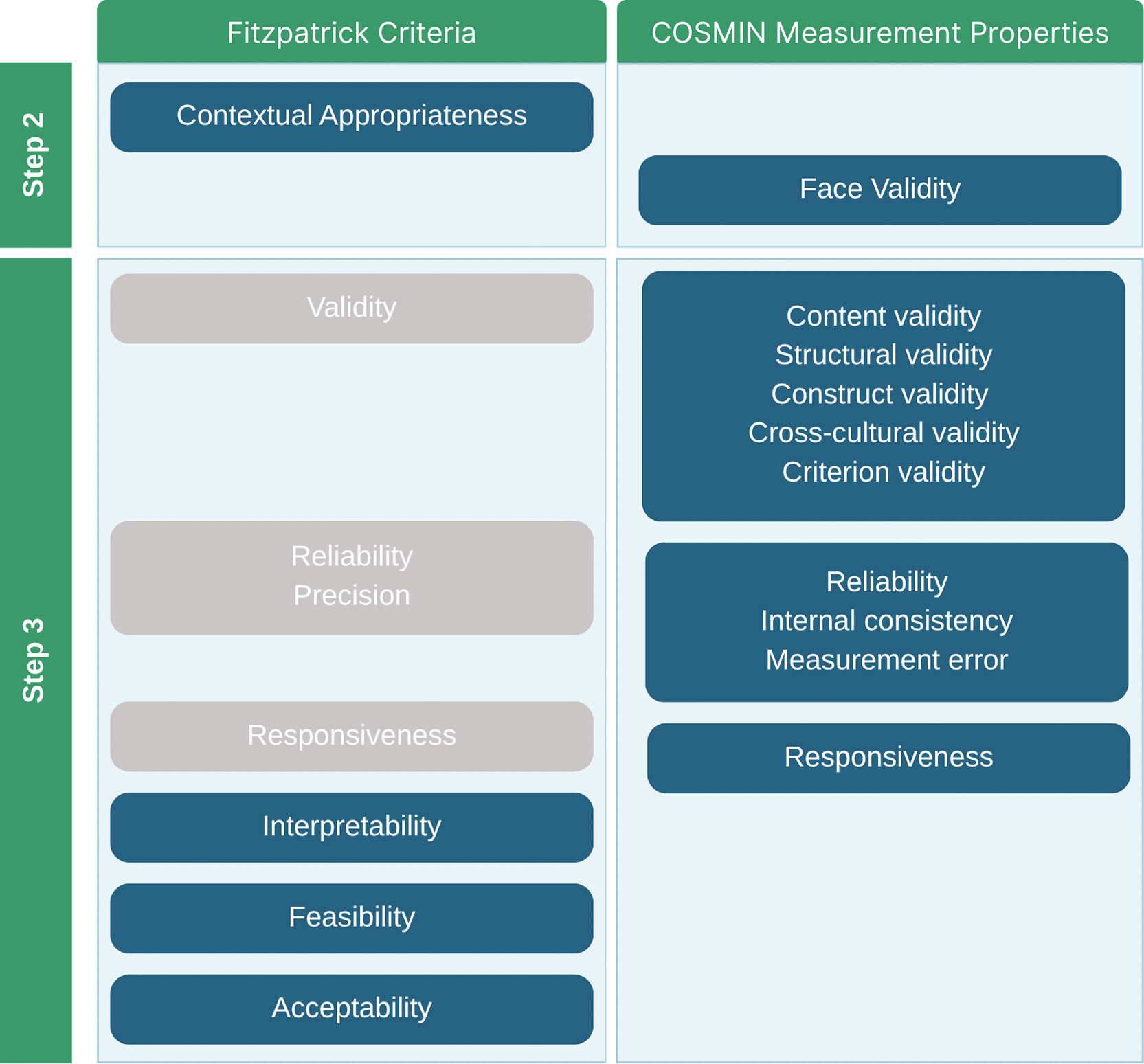
The review methodology is underpinned by a collaborative four-step framework developed by Consensus-Based Standards for the Selection of Health Measurement Instruments (COSMIN) and Core Outcome Measures in Effectiveness Trials (COMET).20,21 While this four-step COSMIN-COMET framework provides a rigorous approach to assessing specific psychometric properties of validity, reliability, and responsiveness, the framework is less attentive to the real-world applicability in children with CP. This is particularly important within this COS scope due to its dual application in research and routine clinical care. Moreover, the feasibility and accessibility of some OMIs may vary according to a child’s communication, cognitive, and motor needs.17 To address this, contextual appropriateness, interpretability, acceptability, and feasibility have been adopted from Fitzpatrick et al., as additional criteria for evaluating OMI properties.22 The COMET-COSMIN method is illustrated in Figure 1 and the criteria for evaluating OMIs are presented in Figure 2.
This protocol has been registered on Prospero (ID CRD420261477691) and published as part of a broader study protocol in the COMET database in line with the COS-Standardised Protocol Items guidelines (https://www.comet-initiative.org/Studies/Details/2590).23 The full systematic review will be reported using PRISMA-COSMIN guideline.24–26 Ethical approval was not required for this systematic review protocol because it proposes to use data from previously published studies and does not involve the recruitment or direct involvement of human participants.
Nine public research partners will contribute to the review as members of the systematic review expert group. The group includes two young people and seven parent/carers with lived experience (NGi, HM, JM, KB, GU, AW, TDeM, SMcG, MD). Collectively, members bring varied experiences of CP and associated chest health, reflecting differences in age, severity and geographical location across the UK and Europe. All members have contributed to the development of the COS definitions, constructs and scope, which informed the conceptual definitions used in Step 1. They have also contributed to the screening process, to identify relevant sources of evidence in Step 2. Focused involvement of public research partners will include assessment of the contextual appropriateness and face validity of candidate OMIs (Step 2), and assessment of their feasibility, interpretability and acceptability (Step 3). All members will also contribute to the overall quality evaluation and development of generic recommendations for OMIs (Step 4). Contributions will be reported for each step of the process using a modified version of the GRIPP2 short form (refer to Extended Data Table 1).27
Nine professionals with clinical and/or research expertise in chest health, childhood-onset disability and COS methodology will contribute to the systematic review expert group (RKL, NS, NG, KvH, MM, DS, JL, HS, JML). The group represents a range of disciplinary perspectives and methodological expertise relevant to the review. Professional members will contribute to the identification and screening of relevant reviews and studies and assessment of the contextual appropriateness and face validity of candidate OMIs (Step 2). Members will also contribute to data extraction and critical appraisal of measurement properties (Step 3). All members of the review expert group will contribute to the overall quality evaluation and development of generic recommendations for OMIs (Step 4) (refer to Extended Data Table 1).
Step 1 defines each outcome, its associated constructs to be measured, and the scope for intended use. These components provide the conceptual foundation for identifying and evaluating relevant OMIs, in line with COSMIN guidance.21 Three outcomes were agreed in our previous COS study: child, young person and/or parent/carer views, chest infections, and swallow safety. Their associated constructs refer to the specific aspects of each outcome that can be measured20 and were informed by the previously published reviews underpinning this COS.17,28 These have shaped the conceptual definitions which will be formally reviewed and refined through systematic review expert group discussion ( Table 1).
The COMS scope describes the target population, health condition and context for eligible OMIs that evaluate one or more of the agreed core outcomes. This scope aligns with the previously developed COS scope, defined as children and young people aged 1–18 years with CP or similar neurodevelopmental conditions.23 OMIs will be included if used within community settings, either as part of research or routine clinical care. Their purpose may be to measure the effect of an intervention intended to improve chest health or to monitor the progression of chest health in the absence of intervention. OMIs may be generic, condition-specific, or domain-specific and may be administered through performance-based assessment, observation, clinician-reported, patient-reported, or parent/carer-reported formats. The COMS scope and constructs collectively inform a COMS eligibility criteria, in which relevant studies will be identified and evaluated against ( Table 2).
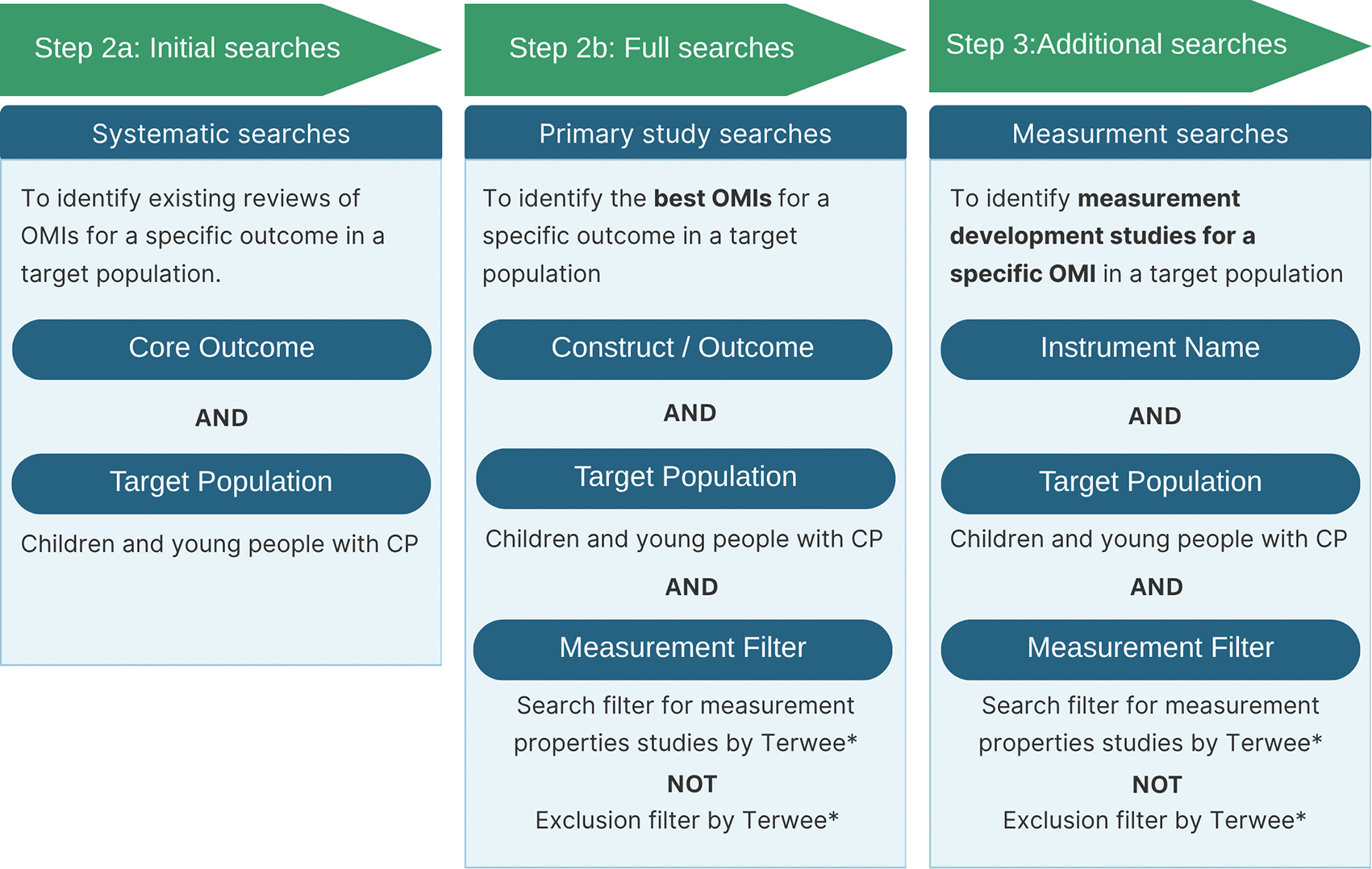
Step 2 outlines a three-staged search strategy to identify OMIs for each core outcome, that have been validated to some extent, drawing on multiple information sources including systematic reviews, primary studies and the systematic review expert group.21 Search concepts were informed by COSMIN methodology and refined with members of the systematic review expert group and an information specialist within the lead author’s institution. Searches will be presented in a PRISMA flow diagram and reported in accordance with PRISMA guidelines (Extended Data Figure 1).29
Existing systematic reviews
The first stage of searching aims to identify existing systematic reviews that evaluate OMIs related to one or more of the core outcomes. This will involve a structured search of the COMET database, COSMIN database, Cochrane Library and PROSPERO register, utilising available database filters and search terms related to the outcome and target population ( Figure 3). All retrieved studies will be uploaded to Endnote and deduplicated before being transferred to Covidence for title and abstract screening, and if eligible, full text screening, by two independent reviewers. Reviews will be included if they report on an OMI aligned to one or more of the core outcomes, target population and health condition. Discrepancies will be discussed between reviewers and resolved with a third research team member if required. Where an up-to-date systematic review of OMI’s for one or more core outcomes satisfies all COMS eligibility criteria, it will progress to systematic review expert group discussion to determine if there is a need to conduct additional primary study searches.30 The justification for this decision will be explicitly documented.
Identification of Primary studies
If no eligible systematic reviews are identified, systematic searches will be conducted in PubMed, EMBASE and CINAHL, and PsycINFO, to locate primary studies of candidate OMIs. Search terms will be developed for each core outcome and combined with search terms for the target population (including health condition) and COSMIN-developed measurement filter.31 An example search strategy for each outcome is referenced in Supplementary Information (refer to Extended Data Table 2). The child, young person and/or parent/carer views outcome will also include an additional patient-reported outcome/patient-reported experience measure filter, informed by the Patient-Reported Outcome Measurement Group, University of Oxford, given its focus on a specific instrument type.30 All retrieved studies will be imported to Endnote and deduplicated being before transferred to Rayyan (Rayyan.ai) for title and abstract screening, and if eligible, full text screening, by two independent reviewers. Discrepancies will be discussed between reviewers and resolved with a third research team member if required. Eligible studies will report (i) at least one OMI linked to a core outcome, and (ii) be used with children and young people with CP (mean age <19 years). This search will be supplemented by citation screening of eligible studies, a previous scoping review17 and unstructured searches in International Consortium for Health Outcomes Measurement (ICHOM) and Patient-Reported Measures Outcomes Information System (PROMIS).
Contextual Appropriateness and Face Validity
Relevant OMIs will be extracted from all eligible studies, using a standardised, piloted data extraction form that aligns with the COMS scope and outcomes criteria, in Microsoft Excel. This will be completed by one reviewer trained in COSMIN methods and checked by a second reviewer to avoid missing any relevant information or errors. Data extraction will include OMI characteristics (name, reference, version, language, core outcome of interest, type of measure, administration details) (refer to Extended Data Table 3a) and study characteristics (author, date, target population, health condition, context) (refer to Extended Data Table 3b). This information will be presented in a table of candidate OMIs and reviewed by the systematic review expert group to identify any additional OMIs used in practice that were not captured through database searches.
Each OMI will then be assessed for contextual appropriateness as to whether the OMI is suitable for the COMS scope (population, health condition and context), and face validity as to whether the items of the OMI appear relevant to the core outcome(s) specified (refer to Extended Data Table 3c).20,22,32 This assessment will focus on perspectives of clinicians working with children with CP and children, young people or parents/carers with lived experience within the systematic review expert group. This step functions as a preliminary screening process to determine whether each OMI and its items adequately reflect the core outcome and the real-world context in which the OMI will be used.22 OMIs judged to have adequate appropriateness and face validity for >85% of its items will inform a selection of OMIs that will progress to psychometric evaluation in Step 3.30 Measures that represent observable, countable clinical events, such as the frequency of chest infections, will be recorded as clinical event data, and not be subject to psychometric evaluation in Step 3 as they involve no indirect interpretation.
Identification of Measurement Development Studies
Step 3 outlines the process for assessing the quality of measurement properties for all candidate OMIs with agreed appropriateness and face validity for one or more of the core outcomes.21 For each OMI, measurement property studies will be identified from the existing searches and supplemented using citation screening, online databases, such as the PROQOLID database of Clinical Outcome Assessments (COAs) or additional searches using the population, name of the instrument and measurement properties filter ( Figure 2).31 Studies will be included if they report an original instrument development, an updated development study, or if they describe an OMI that has been adapted, extended, or culturally validated. All included studies will undergo appraisal for risk of bias, data extraction and quality evaluation of published measurement properties.30
Measurement properties
Data for nine measurement properties will be extracted from eligible studies, including content validity, structural validity, construct validity (hypothesis testing), cross-cultural validity, criterion validity, reliability, internal consistency, measurement error, and responsiveness.30 This will be completed by one reviewer trained in COSMIN methods, using a standardised, piloted data extraction Microsoft Excel form recommended by COSMIN, which will be checked by a second reviewer to avoid missing or erroneous information ( Table 3). The studies within each paper will be assessed for methodological quality, using the COSMIN-informed Risk of Bias Checklist, and rated: very good, adequate, doubtful and inadequate. The measurement property results will be assessed against the COSMIN-informed criteria for good measurement properties and rated using sufficient (+), indeterminate (?), insufficient (-) or inconsistent (+/-). Predefined criteria to evaluate the quality for psychometric property against can be found in the COSMIN Manual (refer to Extended Data Table 4).30 Where no information is available, this will be recorded (?).
Consistent with COSMIN-COMET recommendations, content validity will be the first measurement property to be examined, using available empirical evidence to judge comprehensibility, comprehensiveness, and relevance of an OMI. This will be assessed by two reviewers, including one reviewer with lived experience. OMIs with poor or insufficient evidence of content validity will not progress for further psychometric evaluation.21 Subsequent evaluations will include appraising available information on structural validity and internal consistency, reliability, measurement error, construct validity, cross-cultural validity, criterion validity, and responsiveness. The overall quality of an OMI will be evaluated through discussion with the systematic review expert group, and rated using a modified Grading of Recommendations Assessment, Development and Evaluation (GRADE) approach (high, moderate, low, very low).30
Feasibility, acceptability and interpretability of an OMI will also be considered in line with real-world application (refer to Extended Data Table 5a-c).22 This considers practical aspects of administering an OMI, how acceptable it is for respondents to complete and how meaningful the scores are. Information will be gathered from multiple sources, including the OMI manual, primary development studies, or a review from appropriate respondents (clinical or people with lived experience). Where no information is available, this will be recorded.30
Findings from Step 3 will be presented in a summary table of evidence for each OMI within each of the three core outcomes of interest ( Table 4). Information will summarise:
• Overall methodological quality of studies
• Overall quality of measurement properties
• Overall quality of OMI using GRADE
• Findings for feasibility, acceptability and interpretability
This will be shared with the systematic review expert group for discussion. Each OMI will be considered for recommendation for one or more of the core outcomes, including recommendation for use, recommendation against its use, or no recommendation, to inform the final COMS.
Dissemination and implementation are essential to promoting consistent uptake of the COMS in research and routine community clinical care. A targeted and multi-faceted dissemination strategy will be developed in partnership with the systematic review expert group, tailored to needs of families, clinicians and researchers and journal editors. For each core outcome, we will present its definition and recommend OMI(s), accompanied by methodological guidance to support implementation and use in in both research and practice. Our dissemination strategy includes a peer-reviewed publication, presentations at international conference such as International Clinical Trials Methodology Conference, clinician- and researcher-focused workshops, webinars, and tailored communication materials co-developed with the systematic review expert group. We will further disseminate findings through established research networks, special interest groups, charitable organisations specific to the population and health condition, and journals with a focus on the scope of this COMS. Future steps include the evaluation of the COMS uptake in clinical research.
This protocol describes a systematic review to identify, evaluate and, where possible, recommend OMIs for measuring three core chest health outcomes in children and young people with CP in the community setting: (1) child, young person and/or parent/carer views, (2) chest infection(s), and (3) swallow safety.23 A strength of this protocol is the inclusion of a systematic review expert group comprising researchers, clinicians and people with lived experience. Their perspectives will inform each stage of the review, balancing methodological rigour with the real-world considerations to ensure that the findings are relevant to children and young people with CP. Where possible, the group will identify OMIs that can be used consistently across research and routine clinical care in this field. This may improve the quality and comparability of reported outcomes, facilitate aggregation of findings, and enable clearer interpretation of treatment effectiveness, strengthening the cumulative value of research to inform best-practice guidance.21
Microsoft Word (version 2512) Editor tool was used by the lead author (RKL) to assist with spelling, grammar, and clarity during the preparation of this manuscript.
Ethical approval is not needed because this review uses information that has already been published. Findings will be reported using recognised guidance for systematic reviews and published in an open access journal. A plain English summary will also be shared with children, young people, families and professionals.
• De Mano, Teresa (Public) Lived Experience Research Partners Group, Portugal.
• Bell, Kayleigh (Public), Lived Experience Research Partners Group, UK.
• Giles, Nathan (Public), Lived Experience Research Partners Group, UK.
• Malyon, Hugh (Public), Lived Experience Research Partners Group, UK.
• McGoldrick Kolawole, Sarah (Public), Lived Experience Research Partners Group, UK.
• Melluish, Julia (Public), Lived Experience Research Partners Group, UK.
• Walker, Alice (Public), Lived Experience Research Partners Group, UK.
• Uddin, Gemma (Public), Lived Experience Research Partners Group, UK.
• Day, Marie (Public), Lived Experience Research Partners Group, UK.
Provide sufficient details of any financial or non-financial competing interests to enable users to assess whether your comments might lead a reasonable person to question your impartiality. Consider the following examples, but note that this is not an exhaustive list:
Sign up for content alerts and receive a weekly or monthly email with all newly published articles
Register with NIHR Open Research
Already registered? Sign in
If you are a previous or current NIHR award holder, sign up for information about developments, publishing and publications from NIHR Open Research.
We'll keep you updated on any major new updates to NIHR Open Research
The email address should be the one you originally registered with F1000.
You registered with F1000 via Google, so we cannot reset your password.
To sign in, please click here.
If you still need help with your Google account password, please click here.
You registered with F1000 via Facebook, so we cannot reset your password.
To sign in, please click here.
If you still need help with your Facebook account password, please click here.
If your email address is registered with us, we will email you instructions to reset your password.
If you think you should have received this email but it has not arrived, please check your spam filters and/or contact for further assistance.

Comments on this article Comments (0)