Keywords
psychological and motivational support

psychological and motivational support
Pulmonary Hypertension (PH) is a progressive disease, characterized by an increase in pulmonary vascular resistance and pulmonary arterial pressure.1 PH is an umbrella diagnosis encompassing a range of conditions classified into five clinical subgroups: pulmonary arterial hypertension (Group 1); PH due to left heart disease (Group 2); PH due to lung disease/hypoxia (Group 3); chronic thromboembolic pulmonary hypertension (Group 4); or PH due to unclear or multifactorial mechanisms (Group 5).1 Current estimates suggest a global PH prevalence of approximately 1%,2 increasing with age. Prevalence in those aged over 65 may be up to 10%.2 The causes of PH are diverse and almost always associated with deteriorating symptoms and increased mortality, irrespective of underlying aetiology.1 Symptoms vary and commonly include exertional dyspnoea, fatigue, weakness, angina, presyncope, and syncope. Depending on the extent, severity and duration of symptoms, PH can have a considerable impact on health-related quality of life (HRQoL).3 People are restricted in their ability to engage with daily living and physical activity,4 and may experience psychological distress,5 including anxiety and depression.6
The Supervised Pulmonary Hypertension Exercise Rehabilitation (SPHERe) trial (n = 153) was a multi-centre RCT, testing the clinical and cost-effectiveness of a remotely supervised online group exercise-based rehabilitation programme for all clinical groups and severities of PH, versus a control group receiving best practice usual care. The trial protocol,7,8 intervention development and design,9 and clinical results10 are published elsewhere. The SPHERe intervention group were offered a one-to-one online consultation, eight online group exercise sessions, six online psychological and motivational support sessions, and an unsupervised home exercise plan with exercise bike and home exercise circuit. The control group received a 30-minute one-to-one online advice session with a trained practitioner to discuss individualised activity at home. Intervention delivery was online from a single, central trial delivery hub at Atrium Health Coventry, a not-for-profit social enterprise delivering rehabilitation services (sub-contracted to University Hospitals of Coventry and Warwickshire NHS Trust). Whilst safe and well tolerated, the SPHERe intervention was not superior to usual care for improving exercise capacity measured with the incremental shuttle walk test (ISWT) at four months (adjusted mean difference 0.54 meters; 95% CI –25.0 to 26.0; p = 0.97). Likewise, there was no benefit of the SPHERe intervention at four or 12 months on patient reported outcomes of HRQoL.
The SPHERe trial included an embedded qualitative process evaluation, described herein, to explore participant and practitioner experiences of the trial and contextualise clinical findings. The aim was to better understand barriers and enablers to taking part in the trial. We incorporate the trial clinical results to inform interpretation and implications for future research and clinical practice.
Forty trial participants (20 intervention and 20 usual care) and five practitioners who delivered the intervention were interviewed.
On recruitment to the SPHERe trial, participants were given the option to be approached later for an online interview, at four months post-randomisation, after completion of the intervention and primary outcome data collection. We aimed to interview a purposive sample of around 40 trial participants informed by intervention allocation, participant age, sex, ethnicity and PH sub-group; plus, a sample of five practitioners delivering the intervention.
Participants who consented to be approached at a later date were sent a SPHERe interview information leaflet via email or post. An experienced qualitative researcher and ES; PhD in Clinical Exercise Physiology contacted participants via email to ask if they were still interested in taking part, answer any questions they may have, and to arrange an interview appointment. Participants who agreed completed a consent form prior to interview including consent to publish anonymised interview quotations. Confirmation of consent was also taken online or by telephone by the qualitative research team, before the interview. The five intervention practitioners were all employed by Atrium Health (with an honorary contract with UHCW NHS Trust) and, after providing written informed consent, were interviewed by ES after all trial participants had finished the intervention period. Consent included publication of anonymised interview quotations. Practitioners were not identifiable from these data.
Procedures for data collection and analysis were similar for participants and practitioners. The topic guides were developed by two members of the research team (KS/experienced qualitative researcher) (Supplement). KS has a long-track record in qualitative and mixed method research and interview questions were pilot tested during the trial feasibility phase, and no changes were required.
Participant and practitioner consent and interviews were digitally recorded separately via Microsoft Teams or via an encrypted voice recorder (Olympus DS-700, using the secure Mitel MiCollab Software as a desktop-phone). Recording format varied according to interviewee preference. Recorded data were pseudo-anonymised and transcribed verbatim externally, via the University of Warwick approved Egress Software (Appen) transcription service. Semi-structured interviews with participants and practitioners were conducted between December 2021 and March 2024.
Qualitative data were analysed with QSR NVivo (12 pro) software applying the framework method. ES undertook the framework analysis and KS checked themes/categories. Interview transcripts were not returned to participants for checking. Framework analysis allowed us to understand experiences throughout the study and explore whether participants had engaged with interventions.
Our patient partner group contributed to study design, the funding application, and intervention development, and regularly attended trial management group and oversight committee meetings throughout the trial. Further, they were integral to feasibility testing the SPHERe intervention.9 Prior to commencing the trial, eight participants piloted all components of the intervention, initially in the centre-based setting, and subsequently online further to enforced protocol amendments during the covid-19 pandemic.8
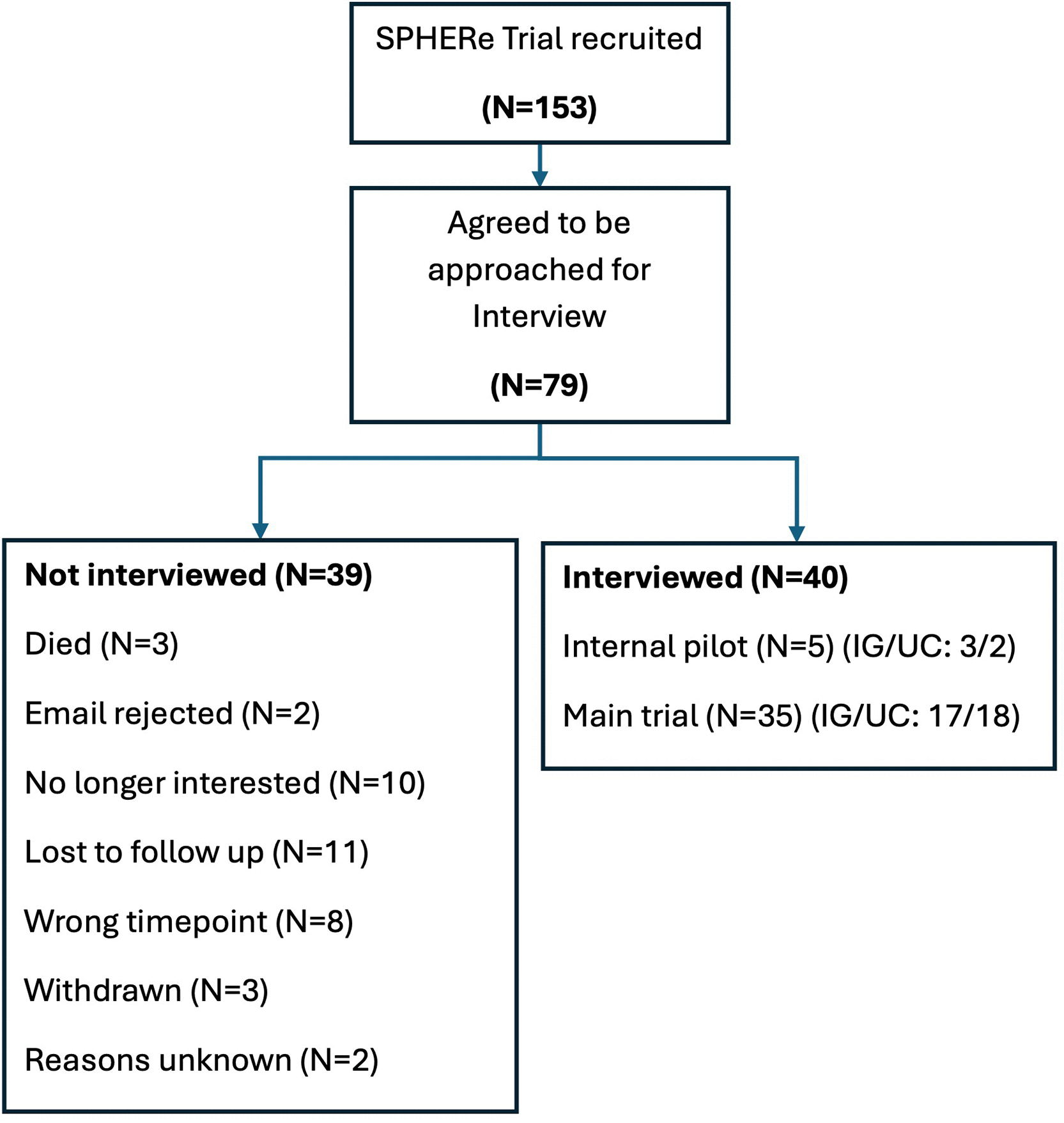
Of 153 participants recruited to the SPHERe trial, 79 (52%) consented to be contacted for an interview. Of these, 40 (51%) were interviewed (26% of randomised sample) ( Figure 1). Five participant interviews were conducted in the pilot phase of the trial, and 35 interviews were conducted after completion of intervention delivery and four-month follow-up.
We interviewed more female participants than males (55% vs. 45%), reflecting the sex distribution of the recruited sample ( Table 1). Participant ages ranged from 23 to 84 years, (mean 65 [SD 14] years). Most interviewees were older than 65 years and the sample was predominantly White (98%). Given the low numbers in each PH sub-group, analysis was categorised as A (PH Groups 2 or 3) and B (PH Groups 1 and 4) according to clinical diagnosis. We did not interview any participants from Group 5, those with PH due to unclear mechanisms. The majority of participant interviewees were recruited from UHCW NHS Trust, reflecting the distribution of main trial recruitment. Participant interviews lasted between 6 and 49 minutes (mean 19:04 [SD 9:47] min). Usual care interviews were generally shorter than intervention interviews.
Five practitioners were interviewed, four males and one female. Interviews lasted from 16 to 39 minutes. Practitioners were experienced clinicians with professional backgrounds in clinical exercise physiology (n = 3), clinical exercise specialist in rehabilitation (n = 1), and research physiotherapist (n = 1). One practitioner delivered the usual care control intervention only, to avoid contamination bias, but acted as back-up practitioner at online rehabilitation classes to assist any participants having log-on/IT issues.
Participant quotations are identified by “P” plus their study number, study arm (IG, intervention group; UC, usual care group) supplemented with their PH sub-group and age range. Practitioners are indicated by “PR” and their unique study number. A summary of the themes is presented in Table 2 with supporting evidence provided after the summary for each theme.
i) Home Setting
Most of the interviewees appreciated the online delivery which allowed them to participate at home. They could continue with their own schedule and fit the intervention into a routine habit around other commitments. The flexibility and freedom which came with this online design also enabled participants to take part in the trial in the first place.
“I certainly wouldn’t have travelled 30 or 40 miles a time once a week, to do half an hour of exercises. That, wouldn’t have happened.” P205 (IG, subgroup A (3), ≥65 years)
“I thought this was the perfect study for me to be part of. It was something that I could do at my own pace … But I’m self-employed, which means I can choose my own hours.” P225 (IG, subgroup B , <65 years)
“The online classes was fine to fit in, because I’m at home and kind of, just gave me a structure to that day … Fitting it in was fine, especially when the weekly classes ended, and you were to keep doing it yourself. The first few weeks after that it was fine, it had become a habit.” P226 (IG, subgroup B, <65 years)
ii) doing it daily
“Tuesday … I’m doing me exercises, Wednesday I’m doing the bike. And so … you’ve got a plan, and you stick to it, but you can modify that if somebody comes round or whatever, you don’t have to do it you know. So you’ve got to work it in with your diary.” P200 (IG, subgroup A, ≥65 years)
iii) support from trial teamx
Most valued by participants was the support and encouragement of the trial team and the explanation and structure which came with it.
“And what helped me, just encouragement I think, the way the programme was explained, the way it was supported, the continuity, like, the consistency. For me, just the confidence in the team, how they explain it and if they take time to do this for the right results, then I felt confident to take part in it.” P222 (IG, subgroup A, <65 years)
iv) own mindset and values
A driving force for most interviewees was their own mindset and the willingness to participate.
“I suppose my motivation, that was … the thing, really, that I wanted to take part.” P239 (UC, subgroup A, <65 years)
“I am a believer in exercises. I mean, no matter what you get these days, the first thing they say is “Oh, you must maintain your energy. Keep doing the exercises.” So, I am keen on exercises.” P233 (IG, subgroup A, ≥65 years)
v) have the time (as retired)
Being retired and having the time to do the intervention daily was reported as an enabler to participation.
“I can fit things in ‘cause I’m retired.” P227 (IG, subgroup A, ≥65 years)
vi) Positive group experience
The exchange of experiences within the group was helpful for most participants. They felt safe and motivated to do the exercises in the group sessions because everyone was in in the same situation but with different levels of ability. The group support sessions provided a framework for a sense of belonging and of knowing that they were not alone living with this rare condition. A few valued the peer support and learned from one another within the group. Others gained interesting and valuable experiences from people with the same circumstances and found it helpful to compare themselves within the group and put oneself into context.
“It’s good to see other people and understand where they’re coming from, and to be brutally honest, from my point of view, because … I’m not as severe as some of those guys, it does help me, my mentality, to think … that I am one of the fittest.” P203 (IG, subgroup B, <65 years)
“I enjoyed that too, and it made me realise … I felt quite lucky that I’ve got the health I’ve got, compared to some, you know. And it as interesting to get to know people in other parts of the country.” P214 (IG, subgroup B, ≥65 years)
“Well, I suppose we have been supporting each other, because there was one guy suggested a book. So, it was helpful, because the other participants, or in one case, you got a recommendation for a book.” P236 (IG, subgroup B, <65 years)
“I found that helpful and encouraging from the point of view to hear what other people have to say and like, there was one lady who said that music helps her, you know.” P229 (IG, subgroup A, ≥65 years)
“I understand all about breathing from the diaphragm, and when you get breathless, you know, calming down, and I knew quite a lot of what (L: Practitioner) was saying, and explaining how to breathe … and I enjoyed also putting my input in on how I dealt with it as well, and helping others who were also in the group.” P225 (IG, subgroup B, <65 years)
“I enjoyed it that it was in a group session, and everybody was in the same position, everybody had issues with their breathing. So, you didn’t feel silly if you were … breathing heavier than maybe what you would do if you were doing the same exercises.” P217 (IG, subgroup A, <65 years)
“It’s just the chat that helps, I suppose. ‘Cause it was, before you do anything like this, you don’t know where you are, and you are alone … Seeing people with the same problems, which is helpful … it was good to know other people had the same problems that you had.” P205 (IG, subgroup A, ≥65 years)
“It’s always nice to know that whatever symptoms you have, if other people are experiencing something similar. It’s nice to have someone to talk about it.” P233 (IG, subgroup A (2), ≥65 years)
Some participants reported mental health benefits after taking part such as being more confident or having a shift in mind set.
“I actually, like, even going up a hill, I do a bit more than I used to after the trial, I think it helped my head, sort my head out and at first, I used to stop if I got breathless but now, I know, I realise I can keep going and it’s okay. You know, I got that from the support sessions.” P212 (IG, subgroup B, ≥65 years)
“We would chat and connect … it changed everything for me, my whole … mindset shifted. The other thing I got as well to be honest was just recording it. I learned to write down my feelings and how things affected me and I hadn’t been doing that, everything was in my head and it, the overwhelm. And sometimes when you put pen to paper and write it down in a structured way, I think I just find it very, very calming. Easier to cope.” P222 (IG, subgroup A, <65 years)
vii) Positive aspects of exercise
The actual exercises were valued by most of the participants, even though they were described as challenging. The exercises were also enjoyable and the fact that they were tailored was interpreted as a positive.
“The exercise part of it I, enjoy is the wrong because they’re hard at times and building up harder. But then I do feel sort of, I don’t know, as though the harder it is the, more I can get out of it … I can see the reason for it, I can actually feel some benefit from it.” P204 (IG, Subgroup A (2), ≥65 years)
“I found quite a lot of them challenging. But, … I managed to do them all, even though I was absolutely shattered after we’d done the group session, absolutely shattered, and that finished me off for the rest of the day.” P217 (IG, Subgroup A (2), <65 years)
“Cause you can either sit up, sit down or stand up. And then on the days where I did have to sit down … he was just supportive. He was, like … okay, now today, he was showing everyone the best way we could get exercise, even though we couldn’t stand up and do it. We had to sit down and … it was just so adaptable, which was really nice.” P225 (IG, Subgroup B (1), <65 years)
viii) Positive results from exercising/exercises
Positive physical changes were frequently mentioned. An improvement in walking distance was reported by most of the participants as was an improvement in their general fitness, strength and mobility, breathlessness and energy.
“I was really impressed that, you know, after six months … so in March 2023, was when I had my first walk test, and I did 350 metres. And then in August, I did 410.” P225 (IG, subgroup B,<65 years)
“It’s definitely improved my fitness. And I really thought that this course was really good, and it did really help me with my fitness.” P228 (IG, subgroup A, ≥65 years)
“The exercise helped. I think it’s strengthened.” P236 (IG, subgroup B, <65 years)
“I did feel better than I did when we started, it does ease your movements slightly if you, do the exercises all the time… every day. What I did notice was, whereas before I couldn’t pick things up off the floor, if I’m holding on to something I can actually reach the floor now, so I would say it’s improved … my mobility the gentle exercises and to do them regularly did, help.” P229 (IG, subgroup A, ≥65 years)
“In the pulmonary hypertension point of view, I’ve not been feeling as breathless in the evening, which is what I was doing.” P236 (IG, subgroup B, <65 years)
“People tell me I’m much better with my breathing when, I have a conversation with someone.” P219 (IG, subgroup B, ≥65 years)
“So during the eight weeks, I felt like I had more energy in me to do the exercises when it came.” P226 (IG, subgroup B (1), <65 years)
“Just doing household chores, just having the energy, I have more energy now.” P222 (IG, subgroup A, <65 years)
i) Time to take part
Time related reasons were among the most common barriers to taking part. Social commitments in retirement, being busy, or having hospital appointments led to interruptions and lack of compliance with the intervention.
“The only thing that would stop me doing it again would be finding time to do it.” P228 (IG, subgroup A, ≥65 years)
“If you’ve got hospital appointments and nurse, doctors, etc, and family commitments that you can’t do it, well, I couldn’t do it every day, if I did one thing, I couldn’t do that as well … I just try to fit it in is when I haven’t got medical appointments and things.” P229 (IG, subgroup A, ≥65 years)
ii) Being unwell/having a health condition
Some participants felt their participation was hindered, and proper implementation of the trial was affected due to ill health. This included acute pain or a poor health in general.
“I think your health hinders you and your confidence more than anything else. I could have foreseen as a barrier at that point … other than my own health.” P222 (IG, subgroup A, <65 years)
“I haven’t done them every day. I think I’ve, sort of, aimed to do them every other day. It was, pain was a barrier.” P236 (IG, subgroup B, <65 years)
Some experiences of being in a group were perceived as challenging. Some people in the group did not interact much so that others felt obliged to reply.
“I think that’s why I lost interest … it wasn’t, sort of, very lively. The one woman couldn’t get out of the chair, and the other woman was falling asleep. I used to think, “Oh, gosh, you know, I’ve got to do this class.” I didn’t feel enthusiastic about it.” P204 (IG, subgroup A, ≥65 years)
“But there tends to be, probably I’m speaking too bloody much, there tends to be an absolute silence from the other members of the group.” P204 (IG, Subgroup A (2), ≥65 years)
“People could be maybe not letting as much out as they can because they are in a group. It’s not the easiest of things to do in a group. I mean, so they might do better having a one to one on it.” P200 (IG, Subgroup A (2), ≥65 years)
For some participants, the exercises were not challenging enough.
“I used to teach Keep Fit. I knew all the exercises that he was giving me … And I knew that, I could do them. So, I didn’t find them difficult at all.” P215 (IG, subgroup B, ≥65 years)
“To me I could have done a bit more but I still understood it that it’s not gauged to all these keep-fit addicts in lycra … it’s gauged at people that … who may be 60, 70, 80, who need to just do the exercises.” P200 (IG, subgroup A, ≥65 years)
Some participants reported that there were no barriers to taking part in the group sessions.
“Nothing would hinder me to do this.” P206 (UC, Subgroup B (1), <65 years)
“I don’t think there was anything that hindered me.” P205 (IG, subgroup A, ≥65 years)
“No, I found it fine. I suppose if people worked in an office, then it would be more difficult for them. But no, I found it absolutely fine. There is no barrier, or anything at all.” P217 (IG, subgroup A, <65 years)
Participants in the trial were required to travel to an outcome assessment NHS centre for face-to-face clinical assessments. They completed an incremental shuttle walk test and study questionnaires were filled out on site. The distance to the centre was a barrier for some participants, whereas, living closer to the hospital for the trial outcomes assessments was an enabler for others.
“I was interested in, also doing the study. But at the time, there wasn’t any places locally to me who were involved … in this trial. So unfortunately, I had to wait a year … until it actually became available at my local hospital. And then as soon as I had a call to say it was at my local hospital, I jumped on the opportunity to take part.” P225 (IG, subgroup B, <65 years)
“It is a bit far from my house, and I can’t drive that long myself, so my husband had to take a day off, whenever … I had to come. So, it was a bit … Not too far, but somebody like me, I can’t drive that long.” P230 (UC, subgroup B, <65 years)
Most of the usual care interviewees were positive about their single 1:1 session with a trained SPHERe practitioner and found it helpful.
“She was very helpful in sort of, guiding me to what sort of activity, etcetera, I should be doing. She rang up, and just talked me through activities, and how to look out for warning signs, and how to make the best of my health, really.” P239 (UC, subgroup A, <65 years)
Talking to a healthcare professional and getting advice on how to exercise safely with PH gave participants confidence and in some cases reassurance of their existing exercise routine.
“Yeah, that was good advice, about exercise and things. I think when, when you get a condition like this, you’re scared to exercise, in case you might make things worse.” P209 (UC, subgroup B, <65 years)
“She was really useful. She gave me the advice about saying the sentence, which did really (?) help me judge how far I could exercise … Because the consultant … said, “Don’t push it too far, ‘cause it could damage your heart. But if you don’t exercise, it could reduce the, your heart’s function.” So, he’d, kind of, scared me a little bit about pushing it too far. So, she was really nice, and she gave me some tips, like saying the sentence on how far I could push myself safely.” P220 (UC, subgroup B, <65 years)
“Yes, I went back and got the exercises from the rehab clinic which I probably wouldn’t’ve thought of before without being prompted in that meeting, so … it did have its benefits.” P216 (UC, subgroup B, <65 years)
“… at that time I was only thinking about getting a walker but she [SPHERe 1:1 practitioner] did mention that it would really help me if I get it. And after getting it, it was a very, very big help that I had the walker. ‘Cause even now, when I’m not feeling too well, but with the help of the walker, I’m able to do a little bit of walk. So, that was very helpful, that the lady encouraged me to use the walker.” P230 (UC, subgroup B, <65 years)
Some reported they did not gain any additional information from the 1:1 session, as they were already working out/exercising elsewhere.
“He asked me what sort of exercise, what exercise I was doing, how far I walked, and… Well, one thing, another, what exercises. And he was quite surprised, actually, at what I was doing, as far as exercise was concerned. So, he was, he was quite happy to, you know, let me carry on as I was going, because he thought that was enough.” P208 (UC, subgroup A, ≥65 years)
“… it [the 1:1 session] wasn’t of any real importance. Purely because I’m limited by my heart condition as to what I can do anyway. So, I work with the, the trainers at the gym, the heart gym, to sort out my exercise. So, whatever exercise I was, sort of, advised about as well doesn’t really matter, because they are the main guidance … to what I can do, or not do.” P238 (UC, subgroup A, <65 years)
One participant found the 1:1 session useless, and did not follow the advice that was given.
“I work full time, by the time I come home, I’m too tired” P213 (UC, subgroup B, <65 years)
Another was overwhelmed with information.
“And I got to a point where I just stopped reading. There was just no more I could take in.” P234 (UC, subgroup A, ≥65 years)
It was clear that sometimes there were more fundamental adjustments or support needed before participants could think about the content of the 1:1 session.
“I’m still trying to come to terms with the condition, and the life changes that’s now being forced upon me. You think, every dream, every hope I had, has all gone out the window.” P234 (UC, subgroup A, ≥65 years)
Participants in the usual care group reported that the general contact with the trial team was sufficient. They did not expect any more contact as they were in the usual care group. However, some wished they had more contact with the practitioners and more exercise advice.
“It was, fine … the contact was enough, really.” P209 (UC, subgroup B, <65 years)
“No, because I’ve only seen people twice, and one phone call … all I’ve done is two ten-minute walks and been advised to use an exercise bike three times a week … so I suppose more contact would have been nice. But … not too much more.” P231 (UC, subgroup B, <65 years)
“Maybe a little bit more advice about how to do the exercises, before you got sent away with them. I don’t think there’s a lot else really … because I came in for interviews, and I knew you were always at the end of the phone if I really needed you.” P207 (UC, subgroup A, ≥65 years)
All practitioners reported dealing with IT issues that impacted on participants’ ability to set up and join the online sessions. The practitioners had to assist and solve these technological problems.
“There were some IT issues that were a problem. Just with getting people who, quite often, obviously were an older age group, and maybe not quite so familiar with using Zoom, and Teams, and all that sort of thing. So, for them, at times, it was, … a bit of a challenge.” (PR1)
Practitioners admitted that the weekly SPHERe requirements were a lot for participants. It was especially hard to adhere because people had multiple other health conditions as well as PH.
“What was required of them, was probably the biggest hurdle.” (PR3)
“I think there was a lot, if, … I’m honest. I think because they had the online sessions, they had a home exercise programme as well, and a bike. … The only other challenges … were because, some of these people had multiple health conditions, some people didn’t have the continuity of, or get the continuity from the sessions as they would … some people had to maybe miss some sessions or they’d miss their home exercise because they were just unwell … it was just a challenge health-wise like that really.” (PR4)
Most practitioners thought that their training was sufficient to deliver the trial, particularly the training in how to deliver an exercise class (PR2,PR4,PR5). One practitioner, who was less experienced in caring for people with PH, felt that more basic information about the condition would have helped them feel better prepared (PR1). Another practitioner admitted that more training for the support sessions would have been beneficial but acknowledged that an in-depth psychology course would be unrealistic (PR3).
“My only concern to begin with, was would I know enough, so that when I’m speaking to the people I would actually understand what they were telling me. But it was actually better than I anticipated, so, what, having done that bit of background research myself, that, it was sufficient…. But maybe that could have been included as part of the formal training, for me.” (PR1)
“The only issue for me, as an exercise physiologist, the exercise was absolutely fine, but some of the support sessions were quite in depth … And a lot of topics sometimes came up, that I’ve, I felt like they were a little bit out of my skill set to deal with … I don’t think how much more training would have … Like I say, without doing an, an in-depth, kind of, psychological course.” (PR3)
Practitioners thought that the content of the group support session was not always relevant to participants’ needs and should have been more tailored. They thought that most benefit of the support sessions was gained from the exchange of stories between like-minded participants and learning about coping strategies from one another.
“Some of the content I don’t think was that helpful to people … they either already knew it or were far down the line. But the main thing people got from those support sessions was the fact of talking to others … in the same boat as them really.” (PR4)
“Particularly because pulmonary hypertension is … quite rare, so a lot of participants … had never met somebody else … with the same condition. They, then, were really happy … to share their experience … and learn from … the other people in the group. And to learn … their coping strategies.” (PR5)
Most of the practitioners thought that participants preferred the group exercise over the support sessions (PR1/PR4/PR5). But they acknowledged that discussion amongst support sessions was also useful for participants. One practitioner stated the support sessions were preferred and another felt that both sessions were equally preferred and beneficial for participants. (PR3/PR2).
“I think they enjoyed the exercise sessions. And it would depend on what the topic was, for the support session… I think maybe the exercise session was perceived as more valuable. Maybe they still like the fact of just coming together as a group, and … having a bit of a chat, as well. I don’t know. But probably gained bit more, I think, from the exercise, in this particular instance.” (PR1)
“It very much gave them a platform to talk about their … stresses, and their worries. This (Support Session) would give them the opportunity to come with … similar peers, with similar, kind of, health concerns, life concerns, whatever it might be. And giving them the chance to say … this worked for me, this didn’t work for me … I think very much support sessions … I think (loss of audio) enjoyed the exercise, but I feel like they got more out of the support.” (PR3)
Informing participants about being randomised to the usual care group and seeing their disappointment was a challenge for several practitioners (PR5/PR3). For some practitioners, the 1:1 consultation with specific advice was difficult for them.
“Hard to tell them you are in the usual care group especially if you see the effort of coming a long way to participate.” (PR3)
“The disappointment of the control participants. Sometimes they desperately wanted more than you were allowed to give. So, ethically … as somebody who’s used to working with patients. I’m used to trying to help everybody. So, trying to stop myself from doing too much, that, I found that difficult.” (PR5)
The Supervised Pulmonary Hypertension Exercise rehabilitation (SPHERe) multi-centre RCT showed that remotely supervised online group exercise-based rehabilitation, with psychosocial and motivational support, was safe and well tolerated, but not superior to a single online one-to-one advice session, for improving walking distance and HRQoL over 12 months. This embedded qualitative study explored participant and practitioner experiences of the trial and interventions, identifying barriers including ‘finding time’, ‘being ill’ and ‘challenges of being in a group’, and enablers such as a ‘shared experience’, ‘sense of belonging’ and the positive aspects of being in a group. Overall, the SPHERe intervention was well received and appreciated by most participants.
Most people interviewed for this process evaluation perceived they had benefitted in some way from the online rehabilitation intervention whether it be improved fitness, breathlessness, walking, general health, or mental health. Likewise, almost all participants suggested they would recommend the trial to others. The clinical results do not support these findings. However, whilst the overall conclusion of the trial was no clinical benefit, individual patient data showed that the response to the intervention was highly heterogenous with some people achieving considerable benefit, some no benefit, and others deteriorating. Heterogeneity of response is a consistent feature of rehabilitation trials in PH11 indicating that treatment response is dependent on complex clinical, physiological, and psychosocial features associated with PH, many of which are unmodifiable with rehabilitation interventions. It may also be that there is a risk of selection bias whereby those who felt they had benefited were more likely to agree to be interviewed for the process evaluation.
Our findings of perceived benefit in physical and mental health are supported by Zhang et al who identified the importance of focusing on mental health and quality of life in people with PH, rather than clinical outcomes and longevity.12 They advised consideration of the physical, intellectual, emotional, social and spiritual components of any PH treatment paradigm. In SPHERe, the rehabilitation intervention targeted physical inactivity, whilst also addressing intellectual, emotional and social health. In an international survey of rehabilitation experience in PH, respondents rated education, supervised structured exercise, and psychology input as the most important components of a multi-disciplinary rehabilitation service,13 all of which were addressed by the SPHERe intervention. Similarly, reviews identified the importance and priority of addressing psychosocial and behavioural health needs.14,15 In the SPHERe trial, most of the interviewed participants perceived greater benefit from the exercise sessions compared to the support sessions. Practitioners had the same sentiment, perceiving the exercise classes to be more beneficial than the support sessions, although some felt the combination of both worked well. This finding is different to the REGAIN trial16,17 – a similar intervention in a post covid-19 condition population – which found participants valued both exercise and support sessions equally.18 Preference for exercise or support sessions is likely personalised, thus goals will vary, and treatment should be individualised.19 It is important to tailor interventions according to individual preferences including setting and type of exercise.20 In the SPHERe trial the exercise sessions were perceived as challenging but enjoyable and the attention to personalisation and individualisation was appreciated.
SPHERe participants appreciated being able to engage in the intervention from home. This online remote format provided flexibility and freedom to take part within existing life schedules. This is supported by a previous trial20 which showed PH participants preferred home based rather than gym or facility-based programmes. The flexibility which came with the online sessions, avoiding the need to travel, and the safety and comfort of completing sessions at home, were mainly considered to be enablers in both the SPHERe trial and previous research.20 Another enabler in the SPHERe trial was the positive group experience from the online sessions. Support groups are important to allow the sharing of experiences, comparison to others, and perceptions of support, especially for people living with rare diseases.21 Participants stated that a ‘positive group experience’ and in particular ‘shared experience, support and social comparison with likeminded affected people’ was an enabler to engagement. This is in agreement with other studies which found group support to be an important aspect of peoples’ experience.22 The support and ‘shared experiences with like-minded people’ and the ‘social comparison’ were perceived as enriching, as was the exchange of information. This corresponds to previous work23 which reported the most common reasons to join a support group were to better understand the condition (42%), and to meet people with similar conditions (32%). Another study concluded that PH patients should be encouraged to participate in support groups to allow people to seek validation and normalisation of their symptoms.24
Most of the SPHERe participants indicated there were no major barriers to taking part in the trial or interventions. For those who did have barriers, time related reasons, being unwell/in pain, distance to the follow up centre, challenging group experience, and exercise not being challenging enough were cited. In existing literature, barriers to exercise are varied. Cascino et al (2020) identified self-reported barriers to exercise in a United States PH cohort as: ‘don’t have the energy’; ‘already exercise at home, or in the community’; ‘time constraints’; and ‘cost’.25 In another trial, the most mentioned barriers to exercise were fatigue, dyspnoea, frustration at physical limitations, and pain in addition to travel and distance.13 It is clear that there are complex reasons for non-attendance in rehabilitation programmes for people with PH, a reflection of the complexity and severity of the disease.
Information technology (IT) issues was the primary barrier for practitioners in the SPHERe trial. This supports the findings of Willemsen et al (2023)26 in which practitioners reported ‘stressful experiences’ especially at the beginning of online sessions due to technical difficulties. They recommended having two researchers, (as was protocol in the SPHERe trial), one being responsible for hosting, and the other as an assistant for technical issues. They noted that if the study population was older or not very digitally literate, the online design might not be suitable.26 In another study27 PH physicians identified the most common barriers to exercise as patient ill health, poor patient motivation, and lack of patient understanding regarding exercise benefits. The most common external barriers were identified as limited-service availability, limited geographic access to exercise facilities, and a low availability of qualified allied health staff. SPHERe practitioners also identified ‘poor health’ and ‘having different comorbidities’ as a prominent barrier to regular exercise in our trial cohort.
Most practitioners felt that the intervention training was adequate, although one felt more training on psychological support would be helpful. This dovetails with studies highlighting the importance of additional training for professionals working with PH.20,28 Healthcare professionals providing exercise prescription support for PH patients need specialist training and education. In using intervention such as SPHERe, the training of health professionals would be an important consideration. Babu and Morris (2020) argued that PH support groups should be run solely by clinical psychologists.29 This may be considered as protectionism, and in reality, as clinical psychologists are a scarce resource, other professionals would need to be trained to deliver support sessions.
This process evaluation was completed before the clinical results were known, thus providing an independent appraisal of participant and practitioner experience. A further strength is that the data analysis followed the COREQ criteria.30 ES undertook the initial analysis and then discussed findings with the qualitative research team to confirm themes. Supporting quotations are provided from a diverse range of participants to demonstrate transparency and trustworthiness, and we elicited a diverse range of views. However, our sample only included two non-white participants thus is not representative of the wider UK population living withPH, thus results should be interpreted with caution.
This qualitative process evaluation showed that participants and practitioners found the online SPHERe intervention to be acceptable and enjoyable. Participants also reported a wide range of perceived physical and mental health benefits associated with both the exercise sessions and the psychological and motivational support sessions. These qualitative findings are not supported by the clinical results of the SPHERe trial which reported there to be no benefit of the SPHERe intervention compared to usual care on outcomes of physical function, HRQoL, and clinical status. This may be partly explained by the highly heterogeneous response seen in the intervention and usual care groups, and the heterogeneity in baseline physical function, disease severity, and PH aetiology. Multicomponent rehabilitation interventions delivered live, online in groups are acceptable to participants and practitioners but may not be the most appropriate strategy for people with PH.
Ethical approval for the process evaluation was received by the West Midlands Coventry & Warwickshire Research Ethics Committee (19/WM/0155) and Health Research Authority on 13th July 2019. All participants provided written informed consent, and no participants withdrew their consent for data analysis post-interview.
Provide sufficient details of any financial or non-financial competing interests to enable users to assess whether your comments might lead a reasonable person to question your impartiality. Consider the following examples, but note that this is not an exhaustive list:
Sign up for content alerts and receive a weekly or monthly email with all newly published articles
Register with NIHR Open Research
Already registered? Sign in
If you are a previous or current NIHR award holder, sign up for information about developments, publishing and publications from NIHR Open Research.
We'll keep you updated on any major new updates to NIHR Open Research
The email address should be the one you originally registered with F1000.
You registered with F1000 via Google, so we cannot reset your password.
To sign in, please click here.
If you still need help with your Google account password, please click here.
You registered with F1000 via Facebook, so we cannot reset your password.
To sign in, please click here.
If you still need help with your Facebook account password, please click here.
If your email address is registered with us, we will email you instructions to reset your password.
If you think you should have received this email but it has not arrived, please check your spam filters and/or contact for further assistance.

Comments on this article Comments (0)