Keywords
Cardiac rehabilitation, digital health, heart failure, ischemic heart disease, Pakistan, low- and middle-income countries, implementation science

Cardiac rehabilitation, digital health, heart failure, ischemic heart disease, Pakistan, low- and middle-income countries, implementation science
Cardiovascular disease (CVD) remains the leading cause of death worldwide, with more than 80% of CVD-related mortality and disability occurring in low- and middle-income countries (LMICs).1 Pakistan bears a disproportionately high burden, with an age-standardised CVD incidence of 918 per 100,000 and a death rate of 358 per 100,000.2 In 2019, CVD accounted for 23% of all deaths in Pakistan, with the number of individuals living with CVD more than doubling between 1990 and 2019, increasing from 4.5 to 9.8 million.3 Global burden of Cardiovascular diseases remain the leading cause of global disease burden, with the highest age-standardised disability adjusted life year (DALY) rates in low and low-middle socio-demographic index setting.4 Depression and anxiety frequently co-occur with CVD and are particularly common among patients in Pakistan, with reported depression rates of 31.3% in men and 53.8% of women.5 A recent systematic review and meta-analysis confirmed that depression and anxiety are highly prevalent among cardiac patients globally.6–9 The coexistence of CVD and common mental disorders is associated with poorer clinical outcomes, reduced treatment adherence, and diminished health-related quality of life.6
Cardiac rehabilitation (CR) is a Class I guideline-recommended intervention for people with ischaemic heart disease (IHD) and heart failure (HF).10–15 It comprises structured exercise training, risk factor and self-management education, and psychosocial support. Cochrane systematic reviews show that CR reduces the risk of hospitalisation and improves health-related quality of life HF.16,17 Despite this robust evidence base and strong clinical recommendation, CR services in LMIC setting, including Pakistan, are virtually absent. An international survey reported CR capacity is critically limited in LMICs, with only one CR place for every 66 patients with IHD, compared with one place for every 3.4 patients in high-income countries.18 Key access barriers include lack of established programmes, inadequate referral systems, transportation difficulties, and limited awareness and knowledge of CR among healthcare professionals.2,3
Home-based cardiac rehabilitation offers a promising solution to overcome many of these barriers, and digitally supported delivery is one form of home-based CR. For example, the REACH-HF (Rehabilitation EnAblement in Chronic Heart Failure) home-based cardiac rehabilitation model programme, developed and evaluated in the UK, demonstrated clinical improvements in disease-specific health-related quality of life through home-based delivery.19–21 Its digital adaptation, D:REACH-HF, has subsequently shown high feasibility, acceptability, and usability in UK National Health Service (NHS) settings.21 Following an Early Value Assessment, the UK National Institute for Health and Care Excellence (NICE) has approved D:REACH-HF for adoption in the NHS. The platform enables remote clinician monitoring of patient-entered data, supports structured self-management, and facilitates flexible home-based rehabilitation, features that make it particularly well suited to resource-constrained settings, such as Pakistan. The ongoing Affordable Cardiac Rehabilitation: An Outreach Inter-Disciplinary Strategic Study (ACROSS), funded by the National Institute for Health and Care Research (NIHR) Research and Innovation for Global Health Transformation (RIGHT) programme, seeks to co-develop and evaluate a culturally adapted, affordable home-based rehabilitation programme for people with heart disease and co-existing depression or anxiety in Pakistan and Bangladesh.22 Patient preferences for remote delivery appear to vary by setting. In the UK, most pulmonary rehabilitation service users preferred face-to-face programmes and only a minority found web-based delivery acceptable,23 whereas a recent survey in Pune, India, reported high willingness to participate and a preference for home-based over supervised centre-based rehabilitation,24 suggesting that home-based models may be acceptable in South Asia.
Two questions must be answered before such a programme can be adapted for Pakistan: whether are patients willing to participate? and do they have the devices, connectivity, and confidence needed to do so? Where digital confidence is lacking, facilitated support, as provided by trained facilitators in D:REACH-HF,21 may enable engagement, but whether such support would be acceptable in Pakistan is unknown. As part of the ACROSS programme, this survey therefore aimed to: (i) estimate the proportion of adults with IHD or HF willing to participate in a digital home-based cardiac rehabilitation programme; (ii) assess their digital readiness; (iii) identify sociodemographic and clinical characteristics associated with willingness; (iv) understand the most likely model of intervention, including preferred delivery format, daily time commitment and programme language; (v) explore, through an open-ended question, participants’ wider views on using a digital programme, including reasons for willingness or unwillingness not captured by the closed questions; and (vi) map these findings onto patient-level constructs of the Consolidated Framework for Implementation Research (CFIR) to identify likely facilitators of and barriers to implementation, to inform the subsequent ACROSS co-design phase.
Initial involvement: Patients were first involved at the piloting stage, when six people living with IHD or HF at PIC (five inpatients, one outpatient) tested the draft questionnaire, consent and interview procedures. No members of the public or patient advisory group were involved.
Development of the research questions: The research team developed the research questions within the ACROSS programme,22 informed by barriers patients had reported to PIC staff for not attending hospital-based rehabilitation: distance, travel and follow-up costs, and lack of physician referral.
Design and conduct of the study: Pilot feedback led to three changes. A female participant with no formal education or smartphone wished to take part from home using her son’s phone, so we added “at home digitally, with the support of a family member” as a delivery option, which became the most preferred format (66%). Female interviewers joined the team, as female participants were comfortable only with female interviewers, and interviews were allotted 25 to 30 minutes so participants could ask questions.
Choice of outcome measures: Patients were not involved in choosing the primary outcome (willingness to participate), but pilot feedback added the family-supported option to the delivery-format question.
Recruitment: Patients were not involved in recruitment, although female interviewers were added to make taking part acceptable to women.
Dissemination: Participants will receive a plain-language summary, and patients, family members and health workers will be involved in the subsequent ACROSS co-design phase.
Pilot participants did not meet International Committee of Medical Journal Editors (ICMJE) authorship criteria and are thanked in the Acknowledgements.
This single-centre, interviewer-administered cross-sectional survey was conducted in the inpatient and outpatient departments of the Peshawar Institute of Cardiology (PIC) and in the surrounding community within the PIC catchment area, Khyber Pakhtunkhwa, Pakistan, between April and June 2026. Adults aged 18 years or older with a diagnosis of IHD or HF (confirmed as described under Recruitment) who were able and willing to provide verbal informed consent were eligible for inclusion. Exclusion criteria were inability to communicate in Urdu or Pashto, cognitive impairment preventing informed consent, or being too clinically unwell to complete the interview.
The study is reported in accordance with the “Strengthening the Reporting of Observational Studies in Epidemiology (STROBE)” statement for cross-sectional studies.25
This study was approved by the Institutional Review Board of the Peshawar Institute of Cardiology (IRB reference IRC/26/287; PIC Ethics Committee reference HEC/24/273) and by the University of Glasgow College of Medical, Veterinary and Life Sciences Ethics Committee (application number 200250286).
All participants gave verbal informed consent before any data were collected. All participants were adults aged 18 years or older; no minors were enrolled, so assent procedures were not required. Before each interview, the researcher read the participant information sheet and a standardised consent statement aloud in the participant’s preferred language (Urdu or Pashto), explained that participation was voluntary and that declining or withdrawing would not affect their medical care, and answered any questions. Participants were then asked whether they agreed to take part and whether the interviewer could record their consent on their behalf. For those who agreed, the interviewer recorded the participant ID, date, mode of interview (face-to-face or telephone), interviewer name and the consent decision in REDCap before the interview began. Only participants who gave an affirmative verbal response were enrolled. The consent statement and participant information sheet are available as extended data (Appendices A and D).
Verbal rather than written consent was chosen for four reasons. First, literacy of the majority of the participants had no formal education, and written consent would have required many of them to sign or thumb-print a document they could not read. This can be intimidating and could have discouraged or excluded the older, less educated participants whose views were most important to capture. Reading the information aloud and recording verbal agreement allowed the same process to be used for everyone, regardless of literacy. Second, mode of interview where we planned that may be some of the interviews were conducted by telephone, where written consent was not feasible, and a single verbal procedure ensured that consent was obtained in the same way for face-to-face and telephone participants. Third, risk and confidentiality: this was a minimal-risk, non-interventional survey that collected no personally identifiable information, and a signed consent form would have been the only document linking a participant’s name to the study. Recording consent against an anonymous participant ID avoided creating such a record. Fourth, data management: all responses were entered directly into REDCap.
Trained researchers based at Pakistan Institute of Living and Learning (PILL) and Peshawar Institute of Cardiology (PIC), Peshawar identified potentially eligible adults in Peshawar within the Peshawar Institute of Cardiology catchment area. In the hospital stream, potentially eligible inpatients and outpatients were identified from ward lists/clinic schedules and the diagnosis of IHD or HF was confirmed from the hospital medical record. In the community stream, potential participants were identified through researches, and diagnosis was verified from discharge summaries or prescriptions, or self-reported. Community recruitment was undertaken to include people living with IHD or HF who were not attending tertiary cardiology services and would therefore be missed by a clinic-based sample. Eligibility was confirmed by a researcher. Participants from both recruitment streams completed the same standardised questionnaire, administered by the same research assistants. Recruitment source was pre-specified as a covariate in all analyses because the community stream deliberately targeted people not attending tertiary cardiology services, who were therefore expected to differ systematically from clinic attenders in age, education and digital access.
To estimate, with 95% confidence and a margin of error of ±5%, the proportion of eligible patients willing to participate in digital cardiac rehabilitation (CR), anticipated to be 84% on the basis of previous research,26 the minimum required sample size was 207 participants. To allow for 10% non-response, the target sample size was increased to 230 participants. Recruitment continued throughout the pre-specified data-collection period, resulting in 310 participants being enrolled, exceeding the target sample size.
The survey questionnaire was adapted from an instrument used to explore access to, and preferences for, pulmonary rehabilitation in Pune, India,26 with additional items to assess digital readiness adapted from the Global RECHARGE instruments33 and the D:REACH-HF feasibility study21 and refined with patient input during piloting. The questionnaire comprises five sections: (i) sociodemographic characteristics (age, gender, education, employment, residence, household income, and preferred language); (ii) clinical characteristics, including cardiac diagnosis and functional impact; (iii) mental health screening using the validated Urdu versions of the Patient Health Questionnaire-9 (PHQ-9) for depression and the Generalised Anxiety Disorder-7 scale (GAD-7) to assess symptoms of depression and anxiety, with severity categorised using standard cut-offs (PHQ-9: none 0–4, mild 5–9, moderate 10–14, moderately severe 15–19, severe 20–27; GAD-7: none 0–4, mild 5–9, moderate 10–14, severe 15–21); (iv) willingness to participate in a home-based cardiac rehabilitation programme, including preferred mode of delivery, time commitment, and reasons for declining participation; and (v) digital readiness, including ownership of digital devices, internet access, self-rated confidence in using digital technology, previous use of health-related apps, and availability of support from family member or carer. Sections (ii) and (iii) were not part of the Indian instrument and were added to reflect the aims of the ACROSS programme, which focuses on people with heart disease and co-existing depression or anxiety.22 All items were closed-ended except the final question. Willingness was a single item with response options yes, no or unsure. Preferred delivery format (six pre-specified options) and reasons for declining were multiple-response (‘select all that apply’) items, asked of willing participants and of unwilling or unsure participants, respectively; formats were not ranked. Daily time commitment was a single-choice item and preferred programme language a multiple-response item. Device ownership, internet access and previous use of health-related apps were recorded as yes/no, confidence using a smartphone was self-rated on a four-point scale from very confident to not at all confident, and availability of family or household support was recorded as yes, no or not sure. The survey concluded with an open-ended question: “Is there anything else you would like to share about your views on using a digital programme for your heart health?”. All questionnaires were administered face-to-face (271) and some by telephonic (39) by trained research assistants in the participant’s preferred language (Urdu or Pashto), who read each question aloud and entered responses directly into REDCap; participants did not self-complete the questionnaire. Responses to the open-ended question were recorded and translated into English by researcher. The full questionnaire is available as extended data on the Open Science Framework (Appendix B; https://doi.org/10.17605/OSF.IO/Y8XN6) under the umbrella of the ACROSS Project https://osf.io/2tp6d/overview. Data were collected using REDCap27,28 in accordance with a pre-specified data management plan (extended data, Appendix C).
The primary outcome was willingness to take part in a digital home-based cardiac rehabilitation programme, asked as a single item (response options yes, no or unsure) and analysed as a binary outcome (willing versus unwilling or unsure). Secondary outcomes were preferred delivery format (selected by willing participants from a range of digital, non-digital and hybrid options, so that willingness to take part in a digital programme did not preclude selecting a non-digital format), reasons for declining, digital readiness indicators, daily time commitment and preferred programme language, which together were used to understand the most likely model of intervention.
Quantitative questionnaire responses were analysed using Stata version 19.5.29 Categorical variables are summarised as frequencies and percentages, and continuous variables as mean and standard deviation (SD) or median and interquartile range (IQR), as appropriate. Willingness to participate in digital CR is reported as a proportion with a Wilson 95% confidence interval (CI). Associations between willingness to participate and categorical variables were assessed using the Pearson χ2 test. Fisher’s exact test or the Fisher-Freeman-Halton exact test was used when expected cell counts were fewer than 5. Univariable and multivariable logistic regression analyses were undertaken to identify predictors of willingness to participate. Results are reported as odds ratios with 95% CIs. A single multivariable logistic regression model was fitted, adjusted for a pre-specified set of covariates: recruitment source (community outreach versus PIC clinic), age (per 10-year increase), sex, any formal education versus none, area of residence (urban versus rural), diagnosis (heart failure versus ischaemic heart disease), household income category, and the presence of moderate or severe symptoms of depression or anxiety. Self-rated digital confidence and availability of family support were not entered into the model. Digital confidence is likely to lie on the causal pathway between age, education and willingness, so adjusting for it would attenuate the associations the model was intended to estimate. Family support was excluded because willingness was almost universal among participants who had it (216 of 217), which risked quasi-complete separation and unstable estimates. The model included 10 terms (eight covariates, with household income entered as three indicator terms) against 56 participants who were unwilling or unsure, giving 5.6 events per variable. As this is below the conventional threshold of 10, the adjusted estimates should be interpreted with caution. A post hoc exploratory analysis examined preferred delivery format by depressive (PHQ-9) and anxiety (GAD-7) symptom severity.
Responses to the open-ended question were analysed using inductive qualitative content analysis,41 with codes grouped into themes following the approach described by Braun and Clarke,30 in NVivo version 15.31 We used content analysis rather than reflexive thematic analysis because the responses were brief, interviewer-recorded answers to a single optional question, which did not provide the depth of data required for reflexive thematic analysis. Only 27 of the 310 participants (9%) responded to the optional open-ended question; of these, two contained no analysable content and were excluded, leaving 25 coded responses. The coding framework was developed inductively from the data rather than specified a priori: the 54 data extracts were assigned 22 descriptive codes, which were grouped into six themes. Initial coding was undertaken by one researcher (B.A.K.); codes and their grouping into themes were then reviewed against the coded extracts and the full dataset, and discussed and refined with second researcher (Z.Z.), before themes were defined and named. The full coding framework, with anonymised illustrative quotations, is available as extended data (Appendix E).
To translate the survey findings into implementation-relevant considerations for the subsequent ACROSS co-design phase (objective 1), quantitative and qualitative findings were mapped onto the Consolidated Framework for Implementation Research (CFIR). Because the survey captured only patient perspectives, mapping was restricted to the five CFIR constructs that can be assessed from patient-level data alone: relative advantage, adaptability, complexity, cost, and patient needs and resources. Constructs were rated using the CFIR Index (version 3.1) barrier-to-facilitator scale (−2 to +2).32–34 For each construct, B.A.K. and a Z.Z. judged from the survey evidence whether the construct was likely to help (positive score) or hinder (negative score) implementation of a home-based digital CR programme in this setting, and how strongly; disagreements were resolved by discussion. Constructs relating to the implementing organisation and the clinical workforce could not be assessed or rated from this survey and are listed separately as questions to be assessed in the subsequent ACROSS co-design study.
Between April and June 2026, Almost 400 people were approached, of whom all were eligible and 310 consented and were enrolled: 240 (77%) through Peshawar Institute of Cardiology and 70 (23%) through community outreach. Participant characteristics are summarised in Table 1. The mean age was 55.3 years (SD 15), 246 participants (79%) were men, 207 (67%) lived in an urban area and 143 (46%) had no formal education. IHD was the diagnosis in 224 participants (72%) and HF in 86 (28%). Pashto was the preferred spoken language for 247 participants (80%). PHQ-9 and GAD-7 screening identified at least mild depressive symptoms in 179 participants (58%) and at least mild anxiety symptoms in 185 (60%).
In total, 254 of 310 participants (82%, 95% CI 77% to 86%) reported they were willing to participate in a digital home-based cardiac rehabilitation programme ( Table 2). Willingness to participate in digital home-based CR was higher among participants recruited through community outreach than through PIC clinics (97% vs 77%, p < 0.001), among those with higher household income (72% for ≤PKR 50 000 vs 97% for >PKR 100 000, p < 0.001), with more formal education (67% for no formal education vs 99% for graduate or above, p < 0.001), among men than women (84% vs 73%, p = 0.047), among younger participants (95% aged 18–44 years vs 72% aged ≥60 years, p < 0.001), among urban than rural residents (86% vs 75%, p = 0.020), and among those with no or mild depression or anxiety symptoms compared with moderate or severe symptoms (p < 0.001 for both). Willingness did not differ by diagnosis (80% for ischaemic heart disease versus 87% for heart failure, p = 0.135). Among the target population of participants with at least mild symptoms, 112 with depressive symptoms and 120 with anxiety symptoms were willing to participate; among those with moderate or more severe symptoms, willingness was 20 for depressive symptoms and 18 for anxiety symptoms ( Table 2).
Willing participants were asked to select all the delivery formats they would be willing to use from six options; formats were not ranked, and percentages below are of the 254 willing participants and sum to more than 100%. The most frequently selected formats were supported and home-based: 168 (66%) selected home-based digital delivery with support from a family member, 74 (29%) a paper-based manual with health-worker support, 71 (28%) an application or website with health-worker support and 63 (25%) a hybrid of home digital delivery plus hospital visits. Supervised group formats were chosen by few participants, whether at hospital (17, 7%) or at a local community centre or mosque (15, 6%). Preference in this population therefore favoured being guided through a programme by family members or health workers; none of the six formats offered involved unsupported, independent use.
Among the 56 participants who answered no or unsure to the willingness question about their participation in digital cardiac rehabilitation, the dominant reasons were relational and attitudinal rather than logistical. A preference to see a doctor in person (46, 82%) and distrust of digital health programmes (27, 48%) together accounted for the great majority of declines, whereas practical barriers such as cost (3, 5%), lack of time (1, 2%) and family disapproval (5, 9%) were comparatively rare. Preferences and reasons for declining are shown in Figure 1. For both questions, participants could select all options that applied, so percentages within each panel sum to more than 100%. Because the delivery-format question was asked only of willing participants and the reasons question only of unwilling or unsure participants, the two panels have different denominators and should not be compared with each other.
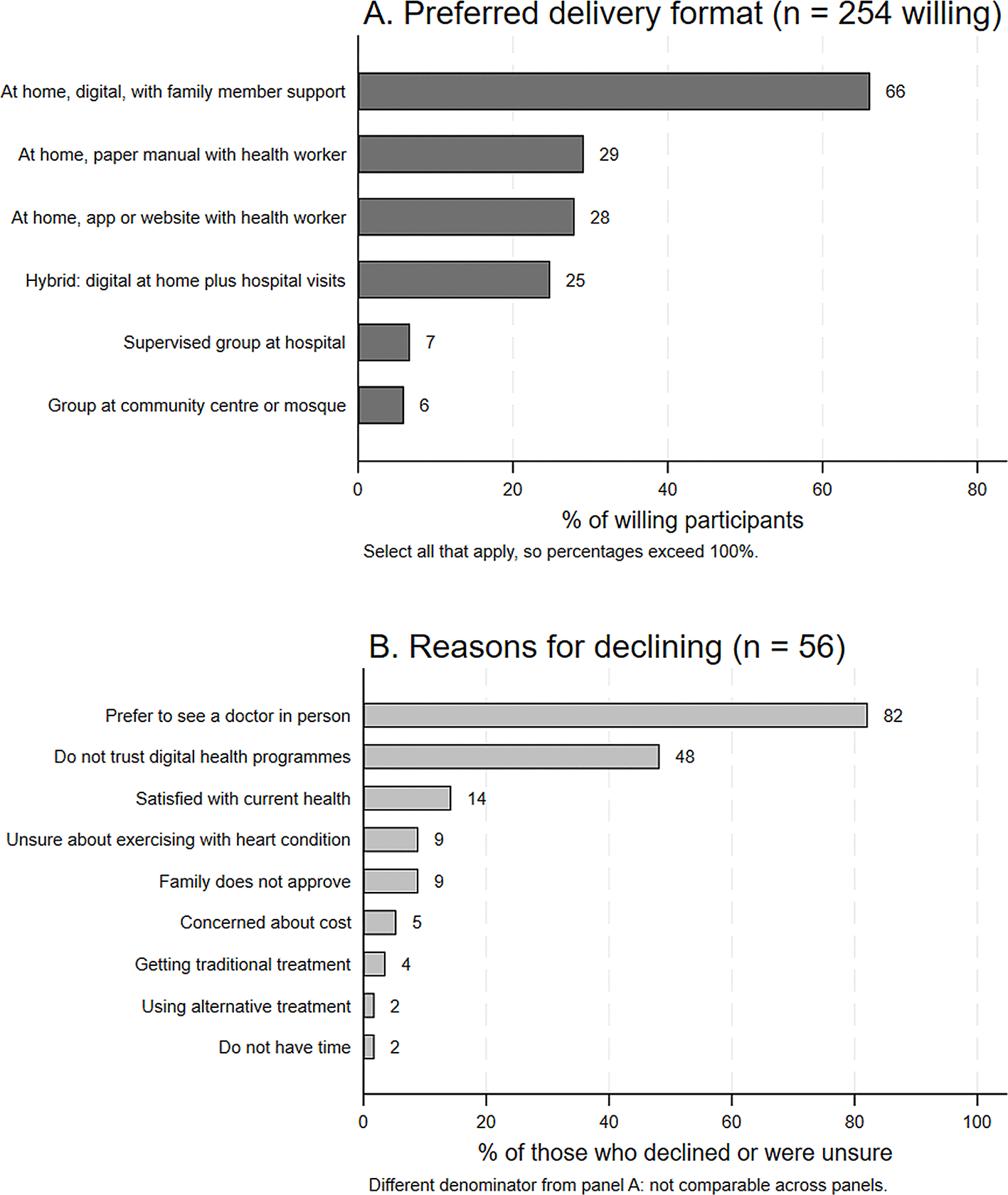
Panel A shows preferred delivery formats among the 254 participants willing to take part. Panel B shows reasons given by the 56 participants who were unwilling or unsure. Both questions allowed participants to select all options that applied, so percentages sum to more than 100%. The two panels have different denominators and are not directly comparable.
In post hoc exploratory analyses among the 254 willing participants, conducted separately for depressive (PHQ-9) and anxiety (GAD-7) symptom severity ( Figure 2), the proportions selecting an app or website with health-worker support and selecting a paper-based manual with health-worker support were lower with increasing severity of either symptom, whereas the proportion selecting home-based digital delivery supported by a family member was higher. Because more than one format could be selected, these proportions are not mutually exclusive, and none of the formats involved independent, unsupported use.
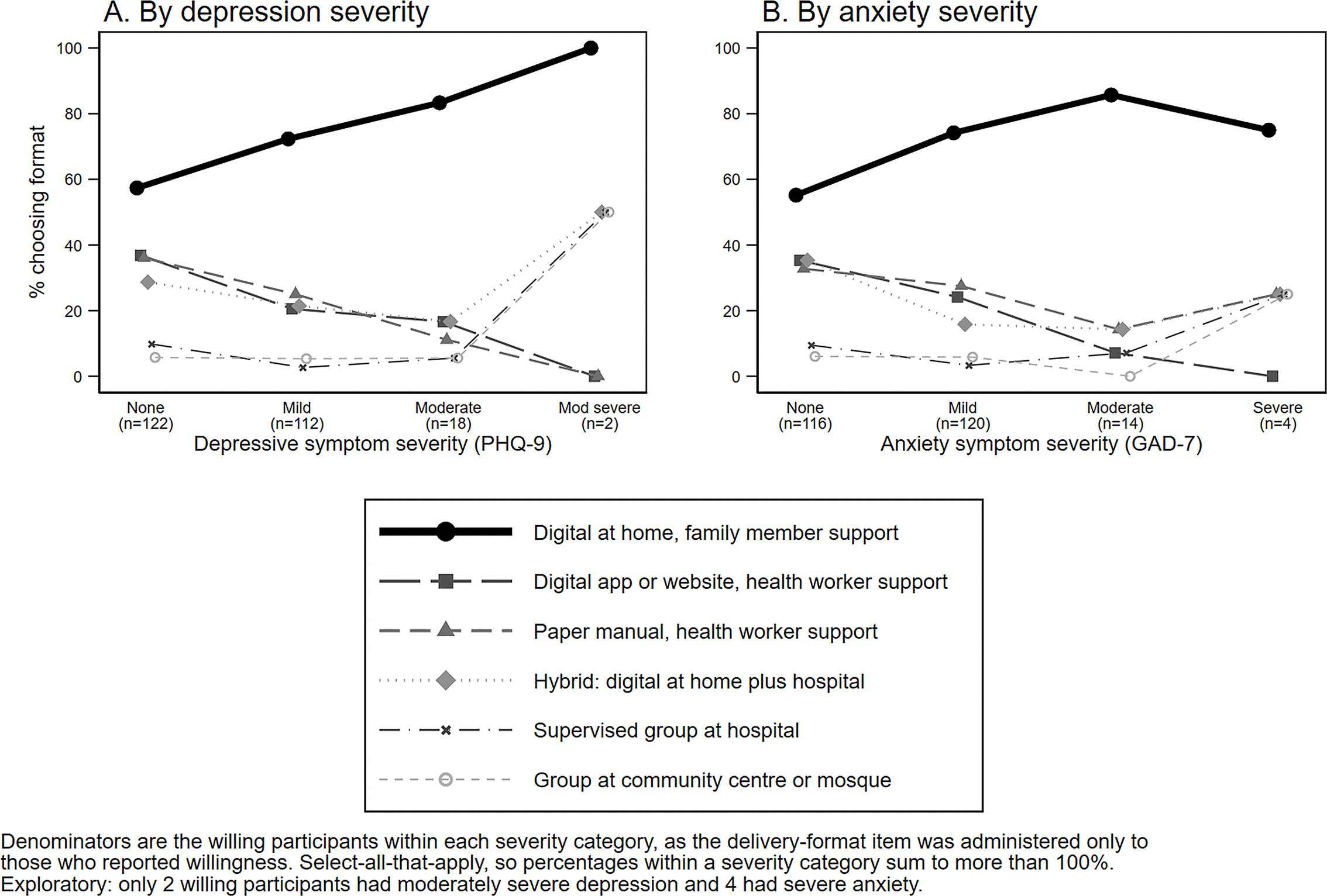
Panel A shows preferences by depressive symptom severity (PHQ-9) and panel B by anxiety symptom severity (GAD-7). Denominators are the willing participants within each severity stratum. The question allowed selection of all options that applied, so percentages sum to more than 100%. This analysis is exploratory: only two willing participants had moderately severe depressive symptoms and four had severe anxiety symptoms, so the values at the right-hand end of each panel rest on single individuals.
Digital readiness was substantially lower than willingness ( Table 3). In total, 169 participants (55%) owned an internet-enabled smartphone and 142 (46%) had regular internet access, leaving 168 (54%) without regular connectivity. Only 21 participants (7%) owned a computer or laptop and 2 (1%) owned a tablet; 157 (51%) rated themselves as very or somewhat confident using a smartphone, and 34 (11%) had ever used a health-related application.
Willingness was strongly associated with digital access and confidence. It was 95% among smartphone owners versus 66% among non-owners (p < 0.001), 96% among those with regular internet access versus 70% among those without (p < 0.001), and 96% among those confident using a smartphone versus 67% among those who were not (p < 0.001). Ownership of a basic mobile phone was not associated with willingness (81% versus 82%, p = 0.71). The strongest single correlate was family support: 217 participants (84%) reported having a family member who would be willing and able to support their use of a digital programme (as reported by the participant; family members themselves were not asked), and willingness in this group was 99%, compared with 40% among those without such support and 50% among the six participants who were unsure (p < 0.001).
Among the 254 willing participants, 216 (85%) reported a family member willing and able to support them (these are 216 of the 217 participants with family support described above, expressed here as a proportion of willing participants to describe programme requirements) and, in response to a separate item, 220 (87%) said someone in the household could help them use a digital programme ( Table 4). Of the 253 who answered the question on time commitment, 157 (62%) were prepared to commit 30 minutes to 1 hour daily, 85 (34%) less than 30 minutes and 11 (4%) 1 to 2 hours. Urdu was the preferred programme language for 133 participants (52%), Pashto for 106 (41%) and English for 18 (7%); participants could select more than one language, giving 257 responses from 254 participants.
In unadjusted analyses, community recruitment (OR 9.87, 95% CI 2.34 to 41.60), age (OR 0.53 per 10-year increase, 95% CI 0.42 to 0.68), any formal education (OR 8.59, 95% CI 4.03 to 18.32) and urban residence (OR 1.99, 95% CI 1.10 to 3.59) were each associated with willingness. Female sex (OR 0.52, 95% CI 0.27 to 1.00) and heart failure versus ischaemic heart disease (OR 1.71, 95% CI 0.84 to 3.49) were not.
In the single multivariable model, only two associations remained statistically significant. Each 10-year increase in age was independently associated with lower odds of willingness (adjusted OR 0.68, 95% CI 0.50 to 0.93) and any formal education with higher odds (adjusted OR 2.90, 95% CI 1.13 to 7.43). Community recruitment (adjusted OR 1.49, 95% CI 0.25 to 8.88), female sex (adjusted OR 0.92, 95% CI 0.40 to 2.12), urban residence (adjusted OR 1.33, 95% CI 0.63 to 2.79) and diagnosis (adjusted OR 1.98, 95% CI 0.80 to 4.87) were not independently associated with willingness. Unadjusted and adjusted estimates are shown in Figure 3, which illustrates the effect of adjustment on each predictor and shows that the large crude association with community recruitment reflected the younger and better-educated composition of the community sample rather than an independent effect of recruitment route.
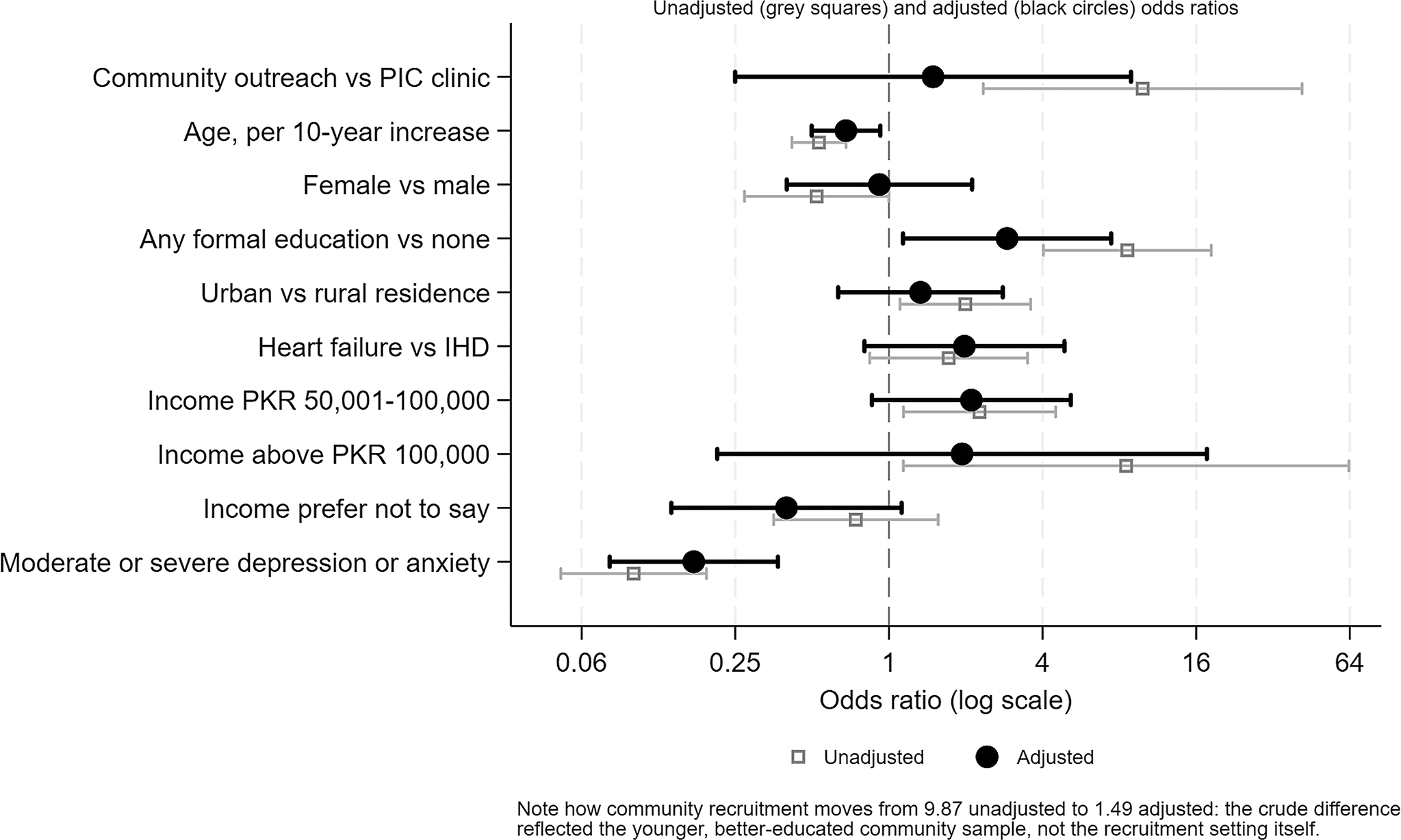
Unadjusted (open squares) and adjusted (filled circles) odds ratios with 95% confidence intervals on a logarithmic scale. The crude association with community recruitment (odds ratio 9.87) attenuates to 1.49 after adjustment, reflecting the younger and better-educated composition of the community sample.
Six themes were developed from qualitative content analysis of the 25 coded free-text responses. (1) Design and comprehension needs: willingness was conditional on content being delivered in Urdu or Pashto, with visual aids and, for older participants, audio or voice-over support. (2) Family as the gateway to digital health: many participants described accessing a relative’s device and needing a family member to teach and supervise their use of it, reframing digital rehabilitation as a household rather than an individual activity, and offering a potential way of overcoming some of the barriers to digital adoption described in theme 3. (3) Barriers to digital adoption: structural barriers (no device or internet), capability-related barriers (low digital literacy), sociocultural and gender barriers (restricted permission for females to own or use a phone) and age- or belief-related barriers coexisted with stated willingness rather than negating it. (4) Preference for non-digital and hybrid modalities: a subgroup preferred paper-based materials, a paper-plus-digital hybrid, or in-person hospital care outright, adding context to, rather than independently confirming, the closed-question preferences for paper-based and hybrid formats ( Figure 1), which came from the same participants. (5) Aspiration for accessible home-based care: the recurring motivation across the dataset was avoiding the cost and difficulty of hospital travel while retaining some involvement of doctors or other health professionals and scope for independent self-management - a theme in keeping with the separate closed-question finding that 82% of unwilling or unsure participants cited a preference to see a doctor in person as a reason for declining. (6) Content priorities: participants specified diet and heart-healthy nutrition, graded exercise guidance, medication reminders and community-level preventive awareness as the content they most wanted. The full coding framework and illustrative quotations are provided as extended data (Appendix E).
Of the five CFIR constructs that could be rated from patient-level data, two were facilitators and three were barriers ( Table 5). Relative advantage (+1) and adaptability (+1) were rated as facilitators: Participants overwhelmingly preferred home-based formats and no single delivery format dominated, supporting a flexible design. Complexity (−1), cost (−1, driven by access rather than programme fees), and patient needs and resources (−1, a mixed picture) were rated as barriers, reflecting?? roughly half of participants without confident digital access. Constructs concerning the implementing organisation and the clinical workforce could not be assessed from patient data and are deferred to the subsequent ACROSS co-design study. In practical terms, these ratings indicate that a home-based programme is likely to be seen as advantageous and can be adapted to varied preferences, but that the complexity of digital delivery and the costs of devices and data are likely to be the main obstacles to uptake, which the co-design phase will need to address.
| Construct | Score* | Direction | Key evidence |
|---|---|---|---|
| Relative advantage | +1 | Facilitator | 82% willing; 66% preferred home-based digital delivery with family support |
| Adaptability | +1 | Facilitator | Preferences spread across paper, app, and hybrid formats; multilingual/visual needs identified |
| Complexity | -1 | Barrier | Willingness fell from 97% (very confident) to 52% (not at all confident) with digital confidence |
| Cost | -1 | Barrier | 45% own no smartphone, 54% lack internet access; cost itself rarely cited (5%) as a reason to decline |
| Patient needs and resources | -1 | Mixed/barrier | 85% have willing family support, but ~half lack device, connectivity, or confidence |
In this cross-sectional survey, most (82%) of the 310 respondents with IHD or HF recruited from a tertiary cardiology centre and its surrounding community in Peshawar, Pakistan reported their willingness to take part in a digital home-based cardiac rehabilitation programme. The majority of willing participants expressed a preference for a digital programme, most commonly supported by a family member (66%), although paper-based and hybrid formats were also selected. Willingness to participate varied across participant subgroups, with higher levels among younger, more educated, urban, and digitally confident participants, and lower levels among those with more severe symptoms of depression and anxiety. Although willingness to participate was high, digital readiness was substantially lower. Only 55% owned an internet-enabled smartphone and 46% had regular internet access, revealing a clear gap between interest in digital rehabilitation and the capacity to engage with it. However, 70% of all participants reported having a family member willing to support their use of a digital programme, and willingness in this group approached 100%. For many participants, access to home-based digital cardiac rehabilitation may therefore depend on support from household members rather than on individual digital resources or skills. This gap between willingness and readiness is also an intervention point: rather than excluding people who are not yet digitally ready, a programme could seek to increase digital readiness, for example through device or data provision and brief digital-skills support for patients and their family members. Family support was reported by participants themselves; we did not ask family members about their own willingness or capacity to help, and expectations of intergenerational support may differ between generations and settings, so this should be explored directly with family members during co-design. The household role identified here may not be unique to digital rehabilitation and could apply to rehabilitation more generally in this setting, but digital delivery adds a specific dependence on family members’ devices and skills.
The closest comparator for our findings is a recent survey from the Pune region of India, assessing barriers and facilitators to pulmonary rehabilitation26,35; (see Extended Table 1). Like ours, it was conducted in a South Asian LMIC setting to inform the design of a new rehabilitation service, and its questionnaire formed the basis of our instrument, so willingness and delivery-format preferences were captured with comparable items. Willingness to participate in the rehabilitation programme described in each survey (digital home-based cardiac rehabilitation in Peshawar; pulmonary rehabilitation in Pune) was similar across the two settings, with 82% of participants in Peshawar reporting willingness to participate, in comparison with 87% in Pune.26 In both studies, participants preferred a home-based model over a supervised facility-based group programme. In our survey, respondents were offered a choice of six delivery formats and could select more than one; formats were not ranked. The consistency of these findings suggests that preferences for home-based rehabilitation may extend across cardiorespiratory populations in South Asia. However, because our survey asked about willingness to take part in a digital home-based programme, which itself implies home-based delivery, the framing of the question may have favoured home-based formats. The comparable results of surveys support the applicability to wider population of South Asian cardio-respiratory patient populations. By contrast, surveys from Uganda36 and Sri Lanka37 also reported high willingness to participate in rehabilitation (92% and 80%, respectively), but participants expressed a preference for supervised, centre-based programmes.36,37 Patient preferences for rehabilitation delivery therefore appear to vary across LMIC settings and should be established locally when designing and implementing services.
An important finding was the association between mental health symptoms severity and willingness. Willingness fell from 93% among participants with no depressive symptoms to 29% among those with moderately severe symptoms, and more than half of the sample screened positive for at least mild depressive or anxiety symptoms, consistent with the high prevalence of cardiac and mental health multimorbidity reported globally and in Pakistan.38 Although our data cannot show whether integrating mental health assessment and support would increase willingness, the high prevalence of symptoms and the lower willingness among participants with more severe symptoms support embedding such assessment and support within future cardiac rehabilitation services in Pakistan rather than treating it as an optional referral pathway. Among willing participants, what varied with depressive and anxiety symptom severity (each examined separately) was not the preference for home-based care, but the degree of support participants wanted: as symptoms became more severe, preference for an application or a paper manual with health-worker support fell while preference for family-supported digital delivery rose ( Figure 2). For participants with a greater symptom burden, an accompanied rather than an independent route into rehabilitation may be more acceptable, although the small numbers in the most severe strata mean this must be treated as hypothesis-generating.
Language preferences differed depending on whether participants were asked about their preferred spoken language or the language of the programme. Although Pashto was the preferred spoken language for the large majority of participants (80%), Urdu was the most frequently preferred language for programme delivery among willing participants (52%), followed by Pashto (41%) and English (7%). These findings are not contradictory: Urdu is the national language of Pakistan and widely used in education, health information and mass media, whereas Pashto is the majority mother tongue of Khyber Pakhtunkhwa but not in other provinces. The high prevalence of Pashto in this study therefore reflects recruitment from a single catchment area (Peshawar, Khyber Pakhtunkhwa), and language preferences might differ at other ACROSS sites, where Saraiki or Punjabi in Punjab, Sindhi in Sindh, Balochi in Balochistan might predominate. Developing the programme initially in a single provincial language could consequently limit its transferability and require substantial retranslation before evaluation at other ACROSS project sites.
This study combined a quantitative survey, adequately sized to estimate the primary outcome with the pre-specified precision (±5%), using validated Urdu-language measures of depressive and anxiety symptoms with qualitative analysis of participants’ own words and implementation-science mapping, which enabled us to identify programme design requirements, a key output of this study, to inform the subsequent co-design work. Recruitment through both hospital clinics and community outreach captured people who are not currently attending tertiary cardiology services and who would have been invisible to a clinic-only sample. Alignment of the questionnaire with the Indian pulmonary rehabilitation survey allowed our findings to be compared with those from another South Asian LMIC setting using comparable items, which is valuable because preferences for rehabilitation delivery appear to vary between LMICs.26
Several limitations should be acknowledged. Recruitment was based at a single tertiary cardiology centre and its catchment area, which may limit generalisability to other regions of Pakistan. Patient needs and challenges are likely to vary between regions, as the regional differences in language preference illustrate. Willingness was hypothetical: stated intention is an imperfect guide to actual uptake, and interviewer-administered data collection may have introduced social-desirability bias, potentially overestimating willingness. Free-text responses were recorded by interviewers rather than written by participants, so they may have been shortened, paraphrased or selectively recorded,39 and only 27 participants (9%) gave a free-text response; the qualitative findings are therefore descriptive and supplementary. In addition, people unwilling to take part in digital CR may have been less likely to agree to complete a survey about it, which could have inflated the estimate of willingness. The multivariable model included 10 terms (eight covariates) against 56 events (5.6 events per variable), below the conventional threshold of 10 events per variable, so adjusted estimates are imprecise and should be interpreted with caution. The exploratory analysis of delivery preference by symptom severity was not pre-specified, involved multiple unadjusted comparisons and rested on very small numbers in the most severe strata. Depressive and anxiety symptoms were identified by screening questionnaires rather than by diagnostic interview.
The comparison with the Indian survey should be interpreted cautiously, as the two studies examined different diseases and the Pune data were collected during the COVID−19 pandemic, which may have heightened the appeal of remote delivery.26 Finally, only the patient perspective was examined; implementation factors relating to healthcare organisations and clinicians in Pakistan and Bangladesh will be assessed as part of the wider ACROSS programme.22
The majority of respondents living with IHD or HF recruited in Peshawar, Pakistan, reported willingness to participate in a digital home-based cardiac rehabilitation programme, consistent with findings from a survey of pulmonary rehabilitation provision in India. Family support emerged as a key facilitator, suggesting that future CR programmes in Pakistan should adopt a multi-format, multilingual, family-supported model, delivered initially in Urdu and English (a programme decision taken on grounds of national transferability rather than a finding of this survey), with Pashto and other regional languages prioritised for addition during co-design, with integrated mental health assessment and support along with opportunities for clinician contact to maximise equitable participation.
Provide sufficient details of any financial or non-financial competing interests to enable users to assess whether your comments might lead a reasonable person to question your impartiality. Consider the following examples, but note that this is not an exhaustive list:
Sign up for content alerts and receive a weekly or monthly email with all newly published articles
Register with NIHR Open Research
Already registered? Sign in
If you are a previous or current NIHR award holder, sign up for information about developments, publishing and publications from NIHR Open Research.
We'll keep you updated on any major new updates to NIHR Open Research
The email address should be the one you originally registered with F1000.
You registered with F1000 via Google, so we cannot reset your password.
To sign in, please click here.
If you still need help with your Google account password, please click here.
You registered with F1000 via Facebook, so we cannot reset your password.
To sign in, please click here.
If you still need help with your Facebook account password, please click here.
If your email address is registered with us, we will email you instructions to reset your password.
If you think you should have received this email but it has not arrived, please check your spam filters and/or contact for further assistance.

Comments on this article Comments (0)