Keywords
Noncommunicable diseases, health promotion, Sri Lanka

Noncommunicable diseases, health promotion, Sri Lanka
Non-communicable diseases (NCDs), including heart disease, cancer, diabetes, and chronic respiratory conditions, have emerged as leading global public health challenges and are responsible for approximately 74% of all deaths (43 million deaths in 2021 with 18 million deaths from an NCD before the age of 70 years) worldwide.1 The economic burden of NCDs is substantial, with projections that the financial impact of these diseases could reach up to $47 trillion between 2010 and 2030, owing to lost productivity and increased healthcare costs. Low- and middle-income countries (LMICs) bear the brunt of this burden, accounting for approximately 85% of premature NCD-related deaths.1
Addressing NCDs is crucial for public health and essential for economic stability and development. The World Health Organization (WHO) highlights that implementing cost-effective “Best Buy” interventions targeting key NCD risk factors (e.g., tobacco and alcohol use, unhealthy diets, and physical inactivity) could save nearly 7 million lives and avert approximately 10 million cases of heart attacks and strokes by 2030. This investment, estimated at just $0.84 per capita annually in low-income countries (LICs) and LMICs, could yield a return of $7 for every dollar spent, resulting in economic gains of $230 billion through increased productivity and reduced healthcare expenditures.1
The increasing NCD burden, especially in LMICs, poses significant challenges to achieving universal health coverage and sustainable development goals. The lack of infrastructure and high out-of-pocket expenses associated with NCD management also increase the risk of impoverishment among affected individuals and families. Consequently, investing in preventive and control measures for NCDs is essential for safeguarding health and promoting equitable economic development across all regions.2 Community-based interventions, particularly those using whole-systems and behaviourally oriented approaches, have demonstrated effectiveness in addressing multiple NCD risk factors across diverse settings.3 In low and middle income countries, such interventions have shown success through grassroots engagement and locally tailored strategies.4–7
The burden of NCDs in Sri Lanka is profound, with chronic conditions such as cardiovascular disease, hypertension, cancer, diabetes, and respiratory diseases contributing significantly to healthcare costs and premature mortality. NCDs account for approximately 83% of deaths nationally, with cardiovascular diseases accounting for 34% of deaths, followed by cancers (14%), diabetes (9%), and chronic respiratory diseases (8%). These conditions result in approximately 120,000 premature deaths annually, with men at a higher risk of early NCD-related mortality (22%) than women (13%). This burden is exacerbated by the ageing population, which increases the vulnerability to chronic diseases. High-risk lifestyle factors, including physical inactivity (30% of adults), inadequate fruit and vegetable intake (73%), tobacco use (nearly one-third of men), and alcohol consumption, exacerbate the NCD crisis.8–10
To combat this, Sri Lanka’s Ministry of Health implemented the National Multisectoral Action Plan for the Prevention and Control of Chronic Non-Communicable Diseases (2023–2027), which focuses on a comprehensive approach to reduce the prevalence of NCDs in Sri Lanka. Key initiatives include the establishment of healthy lifestyle centers across the country and a series of public awareness campaigns aimed at reducing risk factors, such as tobacco use, unhealthy diets, and physical inactivity. The action plan also set a target to reduce premature NCD mortality by 25% by 2025, emphasizing enhanced screening programs, better healthcare access, and multisectoral collaboration to strengthen community health outcomes.11
Given the complex interplay of factors, including lifestyle behaviors, environmental influences, and socioeconomic conditions, affecting NCDs, holistic interventions across multiple levels are key to prevention. Comprehensive policy approaches, public awareness initiatives, and international partnerships are essential to address these drivers. Effective strategies must consider the unique challenges faced by LMICs, including the need for cost-effective and scalable interventions and health system reforms to strengthen primary healthcare.12
By targeting social, economic, and environmental factors, population-based health interventions not only reduce the prevalence of NCDs but also help to mitigate health disparities. A comprehensive approach that integrates strategies at the individual, community, and policy levels is essential for sustainable and equitable prevention of NCDs.13–15 These interventions should be tailored to specific populations and include a series of interconnected actions. Challenges, such as the need for qualified health professionals, adequate funding, and systemic changes in society and policy, must be addressed to increase the effectiveness of these interventions.16,17
Building on these experiences, the Health Promotion Bureau (HPB) of the Ministry of Health in Sri Lanka launched a community-driven Happy Village (HV) program in 2017, which was scaled-up in 2019. This initiative empowered communities to improve their physical, mental, social, and spiritual well-being, focusing on NCD prevention. Following a successful pilot phase, the HV program expanded across the country, reaching hundreds of villages through a volunteer-based model. HV continues nationwide as routine government activity and is not the focus of this trial. The “Happy Village Plus” (HVP) project is a government-led enhancement that is layered on top of HV, developed in collaboration with the NIHR Global Health Research Unit for Cardiovascular Disease and Diabetes in South Asia (GHRU). The collaboration focused on embedding evaluability into the pilot design, including site selection, intervention components, and outcome measures.
This protocol paper describes the HVP trial, which takes place in two districts in Sri Lanka. The implementation of the trial was led by the Health Promotion Bureau while GHRU will lead its impact evaluation. This joint approach ensures that the trial can identify the effects of HVP and thereby inform evidence-based national roll-out of the most effective components. HVP was introduced as a pilot prior to potential scale-up. Specifically, this study addresses the barriers and enablers of HVP, identifies effective strategies across diverse communities, maps its integration with other Ministry of Health agendas for synergistic ground-level action, and strengthens collaborations with non-health sector entities to work toward shared community health goals. Additionally, this paper describes the impact evaluation of the HVP trial, which consists of two parts: i) comparing health outcomes across the communities, and ii) a process evaluation examining the implementation of the programme.
The project was planned in a phased manner and is being implemented across four key stages. Stage I involved conducting consensus conferences to analyze the existing HV program and to collaboratively develop a holistic intervention package for the HVP. In Stage II, the HVP project and its specific intervention set was further developed based on insights from the initial analysis. Stage III focused on the implementation of a cluster-randomized trial in the Gampaha and Colombo districts of Sri Lanka. This trial is the pilot for a possible future scale-up. Finally, Stage IV will consist of a comprehensive quantitative and qualitative evaluation of the HVP project to assess the feasibility and effectiveness of the intervention as well as assess its outcomes and inform future scaling. This study was conducted in accordance with the guidelines of the Declaration of Helsinki. The WHO Trial Registration data set for the Happy Village Plus cluster-randomized trial is presented in Table 1.
| WHO Data Set Item | |
|---|---|
| Primary registry & identifying number | Sri Lanka Clinical Trials Registry (SLCTR) – SLCTR/2023/005 |
| Date of registration in primary registry | 19-03-2023 |
| Secondary identifying numbers | N/A |
| Universal Trail Number (UTN) | U1111-1269-1040 |
| Source(s) of monetary/material support | National Institute for Health Research (NIHR, United Kingdom), grants 16/136/68 & 132960 |
| Primary sponsor | Imperial College London. Joint Research Compliance Office 5L10C, 5th Floor Lab Block Charing Cross Hospital, Fulham Palace Road London, W6 8RF (+44) 203 311 0204 (+44) 203 311 0203 |
| Contact for public queries | Dr. Zoey Verdun - Centre for Health Economics & Policy Innovation, Department of Economics and Public Policy, Imperial Business School, Imperial College London. Email: z.verdun@imperial.ac.uk |
| Contact for scientific queries | Dr. Ajith Alagiyawana - Health Promotion Bureau, Sri Lanka, No. 02 Kynsey Road, Colombo 08, Sri Lanka Tel: (+94) 0112 696 124 Email: ajithalagi@yahoo.com |
| Public title | A health promotion intervention to reduce risk factors of cardiovascular disease and type-2 diabetes among adults in selected Grama Niladhari divisions as compared to usual care |
| Scientific title | A population-based health promotion intervention to reduce the risk factors of cardiovascular diseases and type-2 diabetes in Sri Lanka: Happy Village Plus Project |
| Countries of recruitment | Sri Lanka (Western Province - Colombo & Gampaha districts) |
| Health condition(s) studied | Non-communicable disease (NCD) risk factors: poor diet, physical inactivity, tobacco use, and associated cardiometabolic outcomes |
| Intervention(s) | Community-based multicomponent health-promotion package (Happy Village Plus): trained Health Promotion Field Assistants work with village volunteers using advocacy, enabling & mediation strategies; activities include education, environmental changes and local policy advocacy to improve diet, physical activity and tobacco control |
| Key inclusion criteria | Adults ≥18 y, permanent residents (> 12 months) of selected surveillance sites, self-identified South-Asian ancestry, able & willing to consent. |
| Key exclusion criteria | Severely ill; planning to leave site within 12 months; life-limiting cancer/illness (< 12 months expectancy); unable or unwilling to consent; pregnancy at enrolment. |
| Study type | Interventional, cluster-randomised, Single-blinded, parallel-group, community-based trial; six intervention and six control clusters; 12-month follow-up. |
| Date of first enrolment (planned) | November 2022 (Phase 1 rollout) |
| Sample size | Twelve community clusters (six intervention, six control). Exact participant count will depend on the pre-existing South Asia Biobank surveillance cohort in each site and is not specified in this protocol. |
| Primary outcome(s) | Quantitative: proportion of adults with (1) inadequate fruit & vegetable intake, (2) current cigarette use, (3) insufficient physical activity at 12 months. Qualitative: changes in community norms on diet, physical activity, body-image, health literacy and social-network development. |
| Key secondary outcome(s) | Systolic/diastolic blood pressure; fasting blood glucose; total cholesterol; BMI; waist circumference; diet-quality indices including fruit, vegetable & sugar-sweetened-beverage intake. |
| Ethics review | Approved by University of Kelaniya ERC P/29/03/2021; University of Colombo EC-18-094; Imperial College CREC 18IC4698. |
| Individual trial participant data sharing statement | Individual participant data that underlie the results being reported, will be shared after de-identification (text, tables, figures and appendices). The study protocol will also be shared. Data will be available beginning 3 months and ending 5 years following article publication. Data will be shared with investigators whose proposed use of the data has been approved by an independent review committee identified for this purpose, including for individual participant data meta analysis. Proposals should be directed to (anuradhani@kln.ac.lk). To gain access, data requestors will need to sign a data access agreement. |
| Protocol version/date | Version 2.0/Amendment 2 (Sept 2023) |
HVP intervention (Stages I and II) - The HV program operates through grassroots volunteers within their own communities and is facilitated by local healthcare workers under the guidance of the HPB. These healthcare workers employ three primary health promotion strategies (advocacy, enabling, and mediation) to support the Happy Village Initiative.18–20 To aid in this process, the HPB has developed various educational and edutainment materials, including a food panel, a model Happy Village video, a booklet outlining examples of health promotion interventions targeting NCD risk factors, household stickers, short video clips addressing NCD risk factors, and a flash card set. The conceptual framework of the HV project is shown in Figure 1.
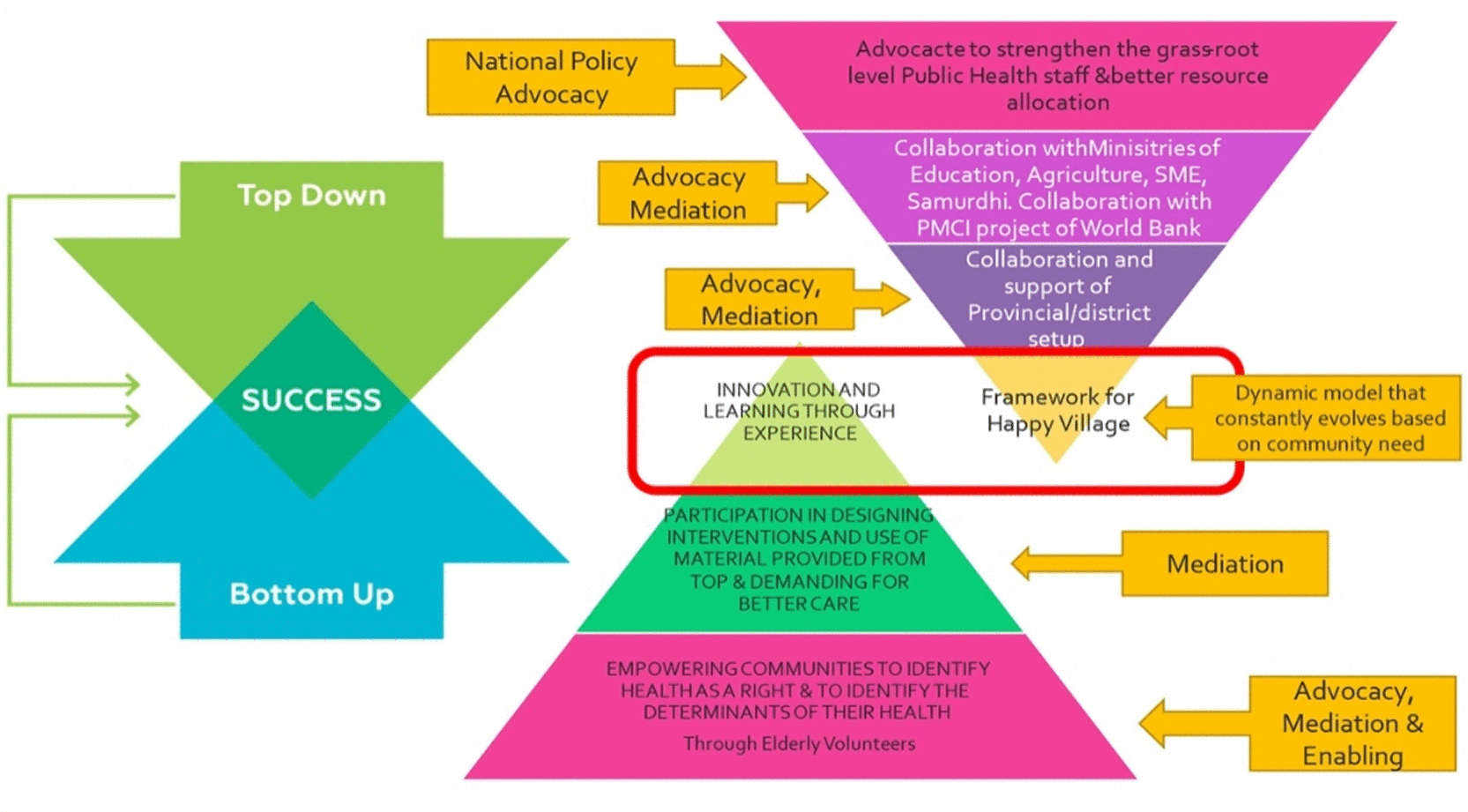
Within a volunteer-centric framework, community volunteers drive the identification of community health issues, exploration of solutions, and implementation of the planned interventions. While each volunteer is responsible for interventions within a specific portion of the community comprising a few household units, the overall intervention remained adaptable and flexible to accommodate emerging circumstances and trends in the community. Happy Village Plus represents an enhanced iteration of the existing Happy Village program, incorporating advancements and refinements to further address NCD risk factors in communities.
The HVP initiative is an extension of the original Happy Village Program, which has evolved through multiple implementation studies and feedback from the field. Happy Village Plus is designed to implement community-based public health interventions aimed at reducing the risk factors associated with noncommunicable diseases in Sri Lankan communities. Building on the foundational HV project, the HVP leverages insights from prior implementations and emphasizes the need for a dedicated health promoter within each community to strengthen the bottom-up approach of the conceptual framework ( Figure 1). Conventionally, public health midwives and inspectors have been the key grassroots public health care workers introduced many years ago to improve maternal and child health and environmental and occupational health, respectively. However, previous research has shown that the growing threat of noncommunicable diseases and the need for lifestyle interventions may require a separate agent that works with communities to advocate on their behalf, mediating the different sectors that can contribute to the well-being of the community through capacity building.
Several health promotion theories guide the program’s approach: the health belief model (HBM) helps explain how individuals assess health risks and preventive actions,18 social cognitive theory (SCT) emphasizes the role of social learning and self-efficacy,21 and the diffusion of innovation (DoI) theory underscores the adoption of health behaviors through community channels.19 Empowerment theory focuses on enabling individuals and communities to gain control over their health outcomes, whereas the social ecological model (SEM) supports a comprehensive approach that considers the influence of individual, community, and policy factors.20,22 HVP is organized using Intervention Mapping within a Social Ecological scaffold; HBM informs individual risk-appraisal and action-planning, SCT informs skill-building and self-efficacy, Diffusion guides networked spread via champions, and Empowerment anchors community governance through Community Action Groups (CAGs) and scorecards. Each construct is tied to a deliverable and a measure ( Table 2); overlapping constructs (e.g., self-efficacy) are reconciled as a single mechanism with common indicators. This theoretical integration helped inform the design and delivery of HVP, and in Stage I, a consensus conference was held to analyze the HV program and develop the HVP intervention.
The HVP initiative employs a structured implementation similar to that of the Happy Village (see Figure 1 and appendix). Health promotion field assistants (HPFAs) act as key links between the top-down component of intervention design and the bottom-up component of community empowerment to influence interventions with their inputs. This is the key to amplifying the public voice in intervention design, resource allocation, and implementation. Six graduates with health promotion degrees have been recruited and trained to serve as HPFAs, with each assigned to a specific intervention site. They completed an intensive two-week in-service program focused on technical skills, practical fieldwork, and collaboration, followed by deployment to their sites and ongoing monthly review meetings to support effective implementation and continuous learning (see Appendix for details). Graduates with health promotion degrees are selected because their experience in community engagement and understanding of health promotion principles are vital for this project. Their training covers sociodemographic and epidemiological analyses, environmental assessments, communication skills, and the use of information, education and communication (IEC) materials.
As newly introduced agents in the communities, HPFAs conduct situational analyses (similar to rapid rural assessments) in their respective areas to foster community engagement and build rapport with community leaders and members, helping them to understand local health needs. The situational analysis consisted of diagnoses of different types: social, behavioural and environmental, educational, and administrative and policy. This information is then presented to the HPB and Medical Officers of Health (MOH) for feedback and support. Within a month of starting the community interventions, HPFAs organize local conferences with formal and informal leaders, including the MOH, to advocate for HVP implementation, discuss feasible interventions, and collaboratively develop action plans.
Leadership and governance are strengthened by integrating the trial within the existing health system, with each HPFA coordinating with the relevant MOH office. Communication was established with regional and provincial health directors to align the HVP initiative with broader health objectives. The trial was implemented in a staggered manner: Phase 1 began in November 2022 across three sites, Phase 2 followed in February 2023 with two more sites, and Phase 3 started in April 2023 at the final site. This phased approach enables a cohesive rollout that aligns the program’s conceptual framework with practical, community-driven health promotion strategies, effectively addressing NCD risk factors through evidence-based interventions and active community engagement.
Cluster randomized trial in the Gampaha and Colombo districts in Sri Lanka (Stages III and IV).
A 12-month, community-based, two-armed, cluster-randomized study consisting of a variety of interventions was conducted (Stage III). The effectiveness of these interventions will be evaluated using individual-level baseline and post-intervention follow-up data (Stage IV).
Sri Lanka consists of four administrative levels in a descending hierarchical structure: provinces, districts, divisional secretariat (DS) divisions, and Grama Niladhari (GN) divisions. The trial is conducted in the Colombo and Gampaha districts of Sri Lanka’s Western Province, which has the highest burden of NCDs in the country. Each district, comprising 13 DS divisions, has a total population of 2.3 million, according to the 2012 Census. The trial is conducted within surveillance sites (GN divisions) managed by the Global Health Research Unit (GHRU) within districts that host primary medical care institutions with healthy lifestyle centers (HLCs). The GHRU established a parallel surveillance system under the South Asia Biobank (SAB) project to monitor health patterns and determinants in South-Asian countries.
Defining the Scope of the Pilot
Since 2018, the GHRU has conducted a separate cohort study in four South Asian countries, including Sri Lanka.23 As part of this study, 100 surveillance sites were randomly selected from both rural and urban GN divisions, ensuring representation of Sri Lanka’s population distribution across its 25 districts and nine provinces, with 12 sites in Colombo and 10 in Gampaha.
The original study design included 100 surveillance sites (50 intervention and 50 control) across Sri Lanka. For the initial phase, a pilot was planned in a subsample of sites to refine the intervention package and evaluation methods before national roll-out. The districts of Colombo and Gampaha were selected for this phase because baseline individual-level SAB data were already available, ensuring feasibility and methodological consistency. The quantitative evaluation will draw on the GHRU’s established surveillance dataset to assess the impact of HVP interventions within these pilot sites.
Power calculations and sample size
Power calculations were undertaken to ensure that the full study across 100 sites would be adequately powered. Using the cluster sample command in Stata, we estimated the required sample size for a cluster-randomised trial with the primary outcome defined as the proportion of adults consuming five or more daily servings of fruit and/or vegetables. According to the most recent Sri Lankan STEPS survey, 27.5% of adults (combined average for men and women) met this criterion. Assuming an intra-cluster correlation coefficient (ICC) of 0.1, a two-sided significance level of 0.05, 80% power, 50 clusters per arm, and an effect size of 30% (increasing from 27.5% to 35.9%), the required sample was estimated at 352 adults per cluster, corresponding to 17,600 adults per arm. These calculations informed the overall trial design. The pilot was implemented primarily to assess the feasibility of intervention delivery and data collection procedures; therefore, no additional power calculations were undertaken specifically for the pilot sites.
Pilot sites selection and random allocation
This cluster-randomised pilot study was conducted in six pairs of surveillance sites (six intervention and six control), selected from the 12 sites in Colombo District (three rural, nine urban) and 10 sites in Gampaha District (eight rural, two urban) originally included in the GHRU cohort. Each site, located in a separate DS division, was paired according to rural–urban status and key demographic characteristics to maximise comparability, resulting in 11 potential pairs. Pairs located within 5 km of each other were excluded to minimise contamination, leaving six eligible pairs. Of these, two urban pairs and one rural pair were drawn from Colombo, and two rural pairs and one urban pair from Gampaha. Clustering was defined at the site level (GN division). Within each pair, one site was randomly allocated to the intervention and the other to the control arm using the random number generator tool Random.org. Pairing ensured that intervention and control sites were drawn from the same district, maintained an even number of sites, and preserved balance across rural and urban settings despite the limited sample. The control sites continued to receive the routine programme; given the absence of existing evidence on the effectiveness of the new interventions, this approach was considered ethically appropriate.
Participant inclusion and exclusion criteria
Individuals eligible for the trial had to be aged 18 years or older, and both males and females were eligible to be involved. Additionally, participants must have South Asian ancestry (self-reported) and have been permanent residents of the site for more than 12 months. Individuals who were severely ill or not planning to remain at the site throughout the intervention, or declining or unable to provide consent, were excluded. Women who were pregnant at the time of the study were also excluded. In the trial registration, we only said we would exclude those individuals who are ‘(a) planning to leave the study site within the next 12 months (b) cancer or other serious illness expected to reduce life expectancy to less than 12 months,’ whereas we now also excluded ‘individuals who are severely ill, not planning to remain at the site throughout the intervention, declining or unable to provide consent will be excluded, or women who will be pregnant at the time of the study’ to have the same exclusion criteria as the individual-level data (SAB).23
The interventions were planned to be implemented over a period of 12 months. The frequency of implementation and the exact individual interventions implemented depended on the input received by the HPFA from their assigned community about their needs or wishes for certain interventions. The set of potential interventions came from two sources: a consensus conference followed by the compilation of an intervention table (Stages 1 and 2) and then communities made the final choices (Stage 3).
First, two consensus conferences were convened with all identified stakeholders, where candidate interventions were reviewed, the pros and cons discussed, and stakeholder preferences recorded. This produced a shortlist tailored to the context. Second, a book based on prior evidence was compiled with an intervention table that summarises interventions shown to work in Sri Lankan communities and how sites adapted them, implemented them and measured the progress. Each Happy Village setting received this book. Third, the final selection was made within the communities. This was done in two ways. First, Health Promotion Field Assistants, six graduates trained in a two-week in-service program, transferred this knowledge to volunteer health promoters. They then worked with communities to choose interventions that matched local priorities and capacity. Second, the intervention table was discussed at community meetings continuously for the community groups to decide which ones they would pick as they progressed. Teams weighed feasibility, resources, and expected benefit when selecting interventions.
Final selections varied by community, so frequency and mix could not be pre-specified. This aligns with the staged design, where Stages 1–2 define the option set and Stage 3 delivers a community-chosen subset. However, in general, the package of interventions consisted of a variety of approaches, such as health education, behaviorally inspired interventions, and skills development, that could address a variety of topics related to diet, physical activity, tobacco, alcohol and more. Additionally, a set of preparatory interventions designed to facilitate the community interventions involved a variety of meetings, training of volunteers, and community mobilization activities.
An embedded implementation analysis from the Happy Village Plus project has been reported separately. That analysis was restricted to the six intervention communities and examined the capacity-building and engagement activities and community interventions implemented during HVP, including the extent to which community-selected interventions aligned with baseline health-related needs. It did not report the randomized comparison between intervention and control clusters or the post-intervention effectiveness outcomes specified in the present trial protocol.24
In Stage IV, primary, secondary, and implementation outcomes are planned to be measured. The outcomes are shown in Table 3.
For the quantitative impact evaluation, the selection of self-reported primary outcomes was guided by data availability. We draw on individual-level data from the SAB surveillance project, which has collected information from over 200,000 individuals across four South Asian countries and provides both baseline and follow-up measurements. The health and lifestyle questions are based on the WHO STEPwise approach to surveillance (STEPS) questionnaire, a widely applied tool in global NCD surveillance.23 Dietary assessment will use Intake24, a self-reported 24-hour dietary recall instrument validated against the doubly labelled water method for measuring total energy expenditure. While some under-reporting has been observed, Intake24 has been shown to provide a reasonably valid, low-cost, and low-burden method for assessing dietary intake.25 Additionally, the adapted version of Intake24 for South Asia has been found to provide good coverage of foods consumed in the targeted South Asian countries, which included Sri Lanka.26
A. HVP intervention data (quantitative)
Activities carried out by each health promotion field assistant were documented via a structured questionnaire developed on the KoBo Toolbox platform, ensuring standardized data collection across sites. The data included the site (i.e., community), date, type of intervention (community or process), method of intervention, determinants or behavioral targets, whether an intervention covered advocacy, enabling, or mediation topics, which subtopics covered those topics, whether mediation and with which people or institutions were conducted, whether any IEC materials were used, and the number and type of participants and/or resource people involved. Additionally, the HVP data was reviewed by the data analyst for potential inconsistencies or missing data.
B. GHRU SAB surveillance data: Baseline and follow-up data
The SAB study collected comprehensive demographic, lifestyle, clinical, and environmental data from Sri Lanka and other South Asian countries. The surveillance data included longitudinal demographic, lifestyle, clinical, environmental, and phenotypic data and biological samples.23 The baseline and follow-up data used to assess key HVP outcomes as part of Stage IV have been collected as part of SAB surveillance data collection. Below, we provide a summary of the data. For a more detailed description, see Song et al.23
B.1 Biological samples
Approximately 25 ml of blood was collected from the participants by trained staff. Fasting glucose and cholesterol levels were measured, and some participants underwent an oral glucose tolerance test to confirm diabetes classification. A 10 ml spot urine sample was also collected for biomarker analysis. The samples will be stored for future research on type 2 diabetes, cardiovascular disease, and other chronic conditions.
B.2 Global metabolite profiling
Global metabolite profiling and sodium/potassium levels were measured using urine samples from a subsample of adult participants from both the intervention and control groups. This measure supports the validation of dietary intake using Intake-24. The 24-hour urine collection is conducted following standardized instructions to ensure sample integrity.
B.3 24-hour dietary recall (Intake 24)
Intake24 (https://intake24.org/) is a digital system that collects dietary intake information using multiple-pass recall methods. It has been specifically adapted to the South Asian context. The participants were asked (via an interviewer for SAB) to recall what they ate and drank in the past 24 hours.
B.4 Health and lifestyle questionnaire
An interviewer-administered health and lifestyle questionnaire was used to collect information on behavioral risk factors (smoking, alcohol consumption, physical activity, and fruit/vegetable consumption), medical history, medication use, and socioeconomic status. It was adapted from the extended WHO STEPwise approach to surveillance (STEPS) questionnaire for South Asia.
B.5 Physical measurements
Physical measurements included a) anthropometry (height, weight, waist and hip circumference, and bioimpedance for body fat composition); b) blood pressure; c) cardiac evaluation by ECG to identify arrhythmia, left ventricular hypertrophy, and previous myocardial infarction; d) retinal photography to assess retinal disease, including hypertensive and diabetic retinopathy; and e) respiratory evaluation via spirometry to assess smoking- and environment-related lung injuries.
C. Quantitative data analysis
We will evaluate the extent to which the implementation of such interventions contributed to an improvement across several health outcomes by implementing a difference-in-differences empirical strategy and measuring the difference in multiple health outcomes (after vs. before the interventions) for both the treatment and control groups. This difference corresponds to the average treatment effect.27 Furthermore, subgroup analyses will be conducted. Specifically, we will stratify our samples by sex (male and female), socioeconomic status (income, education, race), and psychological drivers of behavior, where applicable and feasible. Additionally, the analysis will use clustering at the site level and, where appropriate, include time fixed effects. Should we have missing data, we will assess the nature of the missing data to determine whether it appears to be missing at random or systematically related to, for example, participant characteristics or outcomes. Given the structured nature of HVP data collection, we do not anticipate any missing data. For SAB data, any missing values will be examined and the analyses appropriately addressed based on their (potential non-random) pattern.
D. HVP qualitative data and analysis
For the process evaluation in-depth interviews (IDIs), key informant interviews (KIIs), and focus group discussions (FGDs) were conducted, collected through separate surveys at baseline and the end of the study. Topic guides were developed from our conceptual framework (knowledge, attitudes, practices/behaviours, exposure to the intervention, and contextual factors). Guides were drafted in plain language, piloted with a small sample, refined, and then translated into the local languages used by the communities. The interviewers received standardised training on probing, neutrality, and safeguarding. With consent, sessions were audio-recorded, supplemented by field notes, transcribed verbatim, de-identified, and (where applicable) translated back to the analysis language for consistency. The transcripts were analysed using a framework thematic approach. An a priori codebook mapped to the outcomes above was applied and iteratively refined to incorporate the inductive codes. Two analysts double-coded an initial subset, met to resolve discrepancies, and updated the codebook accordingly. Discrepancies were logged, discussed to consensus, and if needed adjudicated by a third analyst, with resulting decision rules added to the codebook. We maintained an audit trail of the decisions and memos. Coded data were charted into an outcome-by-theme matrix to compare patterns across participant types and sites, and the findings were triangulated. Table 4 reports how each of the qualitative data components maps back to the six qualitative outcomes and how they were measured.
For the qualitative baseline study, we will employ a thematic analysis to explore insights into cardiovascular risk factors, diet, physical activity, body image perceptions, NCD-related health-seeking behaviors, and community empowerment within the Happy Village Plus Project in Sri Lanka. The number of in-depth interviews (IDIs), key informant interviews (KIIs), and focus group discussions (FGDs) was guided by expert consultation and monitored during data collection to ensure thematic saturation. FGDs were designed to include 6–8 participants, consistent with methodological guidance to balance diversity of perspectives with group manageability and interaction. Purposive sampling was employed to capture variation across key stakeholder groups. We initially planned for approximately 12–15 IDIs, 8–12 KIIs, and 4–6 FGDs, with recruitment continuing until saturation was reached, defined as no new codes emerging in two consecutive interviews. Ultimately, the dataset comprised 24 IDIs and 12 KIIs across intervention and control sites, along with six FGDs conducted at each site. The types of people recruited for either the interviews or focus groups consisted of community members (e.g. dental Medical Officer, PMCU Medical Officer), HPFAs, public officers related to health (e.g. Public Health Inspectors, Public Health Midwives, medical officers), and public officers not related to health (e.g. Samurdhi Development Officers, community police officers, Agriculture Instructor, Agriculture Research Development Assistant).
We will employ a thematic analysis to explore community perceptions of the Happy Village Plus Project’s acceptability and relevance. Furthermore, the factors that influence the feasibility of implementing the intervention within the community and the main barriers faced during implementation will be discussed. In addition, the key enablers that facilitated the implementation process and contributed to the success of the intervention were identified. To support the development of increasingly effective behavior-change interventions, we need to understand not only how to measure primary outcomes, such as changes in health behavior, but also how the intervention has (or has not) brought about change.
We adopted a qualitative approach to explore network participants’ accounts of the way in which health promotion interventions are viewed as being implemented and operated. We use a deductive method to understand the following concepts: administrative support, resource availability, network coordination, internal network processes, cross-institutional/organizational/departmental cooperation, and perceived benefits for network members. The network developed at the GN level has been captured using a separate tool developed to assess density and centrality at the baseline, midpoint, and end of the intervention.
We will describe the social networks of the intervention and control sites at three defined time points (beginning, mid-time, and end). We will calculate the social network characteristics (centrality and density) of community members, healthcare workers, and non-healthcare workers. These characteristics will be compared between time points to determine the intervention’s effect on social networks. Furthermore, comparisons were made between the intervention and control sites to assess the effectiveness of the intervention in developing social networks in the community.
The study team have developed a plan to disseminate the information to participants, healthcare professionals, the public, and other relevant groups such as policy makers.
The Happy Village Plus Project addresses the growing burden of noncommunicable diseases in Sri Lanka, highlighting the need for innovative, scalable, and community-centered interventions. The project combines community empowerment, policy alignment, and participatory design, integrating both top-down and bottom-up approaches to address the socioecological determinants of NCDs.13,15
The HVP expands upon the original Happy Village initiative, incorporating lessons from previous implementations and featuring a robust hybrid design, including a cluster randomized trial, a quantitative evaluation of health outcomes, and a comprehensive process evaluation. This approach enhances methodological rigor and captures the context-specific factors influencing the effectiveness of health promotion strategies. A significant innovation is the use of health promotion field assistants, trained community-based health promoters who serve as vital links between policy formulation and grassroots execution, ensuring that interventions remain culturally relevant and community owned, with a focus on multiple health promotion theories.19,21
The use of established surveillance infrastructure, such as the South Asia Biobank,23 enhances the project’s efficiency, while aligning with Sri Lanka’s National Multisectoral Action Plan (2023–2027), positioning it for sustainable integration within national healthcare systems. Despite these strengths, the trial and evaluations have limitations, including potential contamination between the intervention and control sites, recall bias associated with self-reported data, and the relatively short 12-month follow-up period. The exclusion of certain demographic groups, such as transient populations and pregnant women, limits the broader generalizability of the findings. The success of the HVP model hinges on maintaining community trust and ensuring consistent resource allocation. If successful, the HVP project could serve as a model for scalable NCD prevention interventions in LMICs, providing a blueprint for policy and primary healthcare reforms.14
Importantly, HVP aligns with global health strategies advocating cost-effective interventions targeting dietary improvements and increased physical activity, echoing the World Health Organization’s recommendations for achieving Sustainable Development Goal 3.4 on reducing premature NCD mortality.1
This study will be conducted in accordance with the guidelines of the Declaration of Helsinki. Written informed consent has been obtained from all participants for data collection and inclusion in the study. Informed consent included permission for the data and samples collected for use in chronic disease research, including data sharing with national and international bodies concerned with the prevention and control of Type 2 diabetes mellitus (T2DM) and cardiovascular disease (CVD) and molecular epidemiological research. Consent was facilitated via videos (available in major South Asian languages) and was supported by bilingual translators. A unique study ID has been assigned to each participant. This study protocol was approved by the Institutional Review Board (Ethics Review Committee) of the University of Kelaniya, Sri Lanka (ERC: P/29/03/2021). The GHRU cohort study at the surveillance sites also received ethical clearance from the University of Colombo (EC-18-094) and Imperial College London (CREC: 18IC4698). The previously published embedded implementation analysis and the present cluster-randomized trial protocol are separate outputs from the same Happy Village Plus research project and therefore share the relevant ethical approvals.24 A steering committee was responsible for the design, integrity, and progress of the trial. The steering committee is also tasked with implementing any potential protocol modifications, including those that may be recommended by the other relevant subcommittees. The steering committee comprised of staff from Imperial College London, Health Promotion Bureau, Sri Lanka, Faculty of Medicine, University of Colombo, Sri Lanka and Faculty of Medicine, University of Kelaniya, Sri Lanka.
The clinical trial registration number is SLCTR/2023/005, registered at the Sri Lanka Clinical Trials Registry (https://slctr.lk/trials/slctr-2023-005).
Conceptualization: AA, AP, ZV, NW, RB, PK, PKa, AK, MM, DK, FS, GF; Methodology: AA, AP, ZV, DK, MSDW, PKa, AK, GF, MM, FS; Software: IM, IG, DK, TP; Validation: TP, KW, DW; Formal analysis: DK, IM, IG, ZV, MM, MSDW; Investigation: AA, TP, KW, DW, IM, IG, RB; Data curation: IM, IG, DW, ZV, BA, MSDW; Writing - original draft: MSDW, AA, ZV, BA, NW; Writing - review & editing: AA, ZV, AP, TP, KW, DW, IM, IG, RB, PK, BA, NW, PKa, AK, DK, GF, FS, MM, MSDW; Visualization: ZV, DK, IM, MSDW; Supervision: RB, PK, GF, FS, MM; Project administration: AA, RB, PK, MM; Resources: MM, PK, GF, FS; Funding acquisition: FS, MM, GF, PK, AK.
Provide sufficient details of any financial or non-financial competing interests to enable users to assess whether your comments might lead a reasonable person to question your impartiality. Consider the following examples, but note that this is not an exhaustive list:
Sign up for content alerts and receive a weekly or monthly email with all newly published articles
Register with NIHR Open Research
Already registered? Sign in
If you are a previous or current NIHR award holder, sign up for information about developments, publishing and publications from NIHR Open Research.
We'll keep you updated on any major new updates to NIHR Open Research
The email address should be the one you originally registered with F1000.
You registered with F1000 via Google, so we cannot reset your password.
To sign in, please click here.
If you still need help with your Google account password, please click here.
You registered with F1000 via Facebook, so we cannot reset your password.
To sign in, please click here.
If you still need help with your Facebook account password, please click here.
If your email address is registered with us, we will email you instructions to reset your password.
If you think you should have received this email but it has not arrived, please check your spam filters and/or contact for further assistance.

Comments on this article Comments (0)