Keywords
Safer drug consumption facility; supervised injecting; people who inject drugs; harm reduction; community; natural experiment; mixed methods; economic evaluation..

Safer drug consumption facility; supervised injecting; people who inject drugs; harm reduction; community; natural experiment; mixed methods; economic evaluation..
There are ongoing crises of drug-related deaths (DRD) in the UK, North America, and elsewhere. Scotland has among the highest DRD rates globally at 250–300 per million in 2021–2022 (16-fold higher than the European Union average), with the Scottish Parliament declaring it a “public health emergency”.1 Glasgow has the highest DRD rate in Scotland (444 deaths per million) and has recently had the largest HIV outbreak among people who inject drugs (PWID) in the UK for 30 years, associated with public injecting, homelessness, and cocaine injecting.1–3
People who inject in public places are among the most marginalised members of society, owing to high levels of homelessness and socioeconomic deprivation.3,4 Injecting in public places increases the risk of harm, because it involves: unhygienic injecting conditions and reuse of injecting equipment, increasing the risk of skin and soft tissue infections (SSTIs); fear of being discovered by the police/public, leading to rushed injections and increased risk of overdose; and injecting in groups, increasing the likelihood of sharing equipment and thus transmission of blood-borne viruses (BBVs). Public injecting is 4 to 5-fold more prevalent in Glasgow than the rest of Scotland.3
A Safer Drug Consumption Facility (SDCF) for Glasgow was first recommended by the city’s NHS Board in 2016 following a needs assessment of public injecting.5,6 SDCFs provide spaces for people to use illicit drugs where staff can intervene if an overdose occurs. They can also provide additional support and referral to services that help improve health and wellbeing. Several expert bodies (including the Royal College of Physicians and Faculty of Public Health) have called for SDCFs, but these were not initially introduced in the UK due to legal barriers.7–10 Following a statement by Scotland’s Lord Advocate in September 2023 that it would not be in the public interest to prosecute anyone using such a facility, Scottish Government committed £2.3 million per annum (in the first three years) to establish a pilot SDCF in Glasgow.11
SDCFs (also called supervised injecting facilities or overdose prevention centres) were first established in Europe in the mid-1980s in response to epidemics of HIV and overdose among PWID.12 There have been several systematic reviews demonstrating positive impacts, but also highlighting substantial evidence gaps, and heterogeneity in effects depending on the location of the facility and implementation model.13,14 Evaluations have necessarily been observational, as randomised trials are impracticable given a single facility is usually introduced in an area of high public health need.13–15 SDCFs provide an immediate response to drug overdose events and safe acquisition/disposal of injecting equipment12,16,17 and have demonstrated they can reach socially excluded individuals, including those experiencing homelessness, engaged in public injecting and other injecting-risk behaviours.18–26 Uptake by local PWID populations has varied, with studies in Canada and Australia reporting 20% (in the past six months) and 32% (past month) use among their respective populations.21,24 An unsanctioned facility that operated in Glasgow for nine months in 2020–21 found high demand, supervising 894 injection events and responding to nine overdoses.16
SDCFs provide education on safer injecting practices, linkage to a range of harm-reduction services (e.g. naloxone), increased engagement with drug treatment, and referral to broader health and social services (e.g. housing, social work, sexual health).13,18,19,27–31 For example, a cohort study in Vancouver found that frequent SDCF use was associated with a 33% increase in uptake of opioid agonist treatment (OAT).32 There is some evidence that these facilities can also encourage uptake of HIV and HCV testing and treatment.18,29,31 SDCFs have been associated with reductions in the sharing and reusing of injecting equipment, and public injecting.18–21,28,33 In Vancouver, the monthly report of public injection decreased immediately by 5.5% following a rapid expansion of SDCFs in December 2016, associated with an immediate increase (6.4%) in monthly reports of supervised injection service use.30 Studies have demonstrated a reduction in drug-related harms associated with SDCF use, including overdose and SSTIs.13,18,27,34 SDCF use has also been associated with reduced hospital attendances.18,30,34–36 A cohort study from Vancouver found all-cause mortality almost halved among frequent programme users compared to infrequent users.37 Two studies (from Vancouver and Sydney) examining overdose outcomes both observed a greater decline near the facility than in the rest of the city/region.38,39 A recent study from Toronto found significant reductions (by 67%) in overdose mortality rates in neighbourhoods that implemented a SDCF compared to other neighbourhoods, with a 42% city-wide reduction.40 Furthermore, recent findings from the SDCF in Melbourne suggest a 43% reduction in ambulance call-outs within 1 km of the facility, and a 40% reduction in opioid presentations at the nearest hospital.41
Less evidence is available on the wider effects of SDCFs, with a few studies observing both positive and negative impacts on the communities in which they are introduced.27,42 Studies utilising social observation methods have found reductions in public injecting, homelessness, drug-related litter and other public nuisance outcomes in areas in which SDCFs are located.43–45 Furthermore, a repeated community survey in Sydney observed a significant decrease in residents and businesses witnessing public injecting or observing publicly discarded drug litter.46 Recent studies from the United States and Canada have either found no impact or a decrease in crime.47–49
Most economic studies have focussed on the expected health and economic impacts of introducing one or more hypothetical SDCFs in a city where these do not exist,50–54 largely informed by impact and cost data from Vancouver.55 In a systematic review of studies examining the economic impact of SDCFs in North America, all 16 studies estimated considerable financial and health benefits of opening one or more SDCFs.54 SDCF health impact and economic benefits can however vary considerably depending on the local epidemiological context (e.g. overdose rate, BBV transmission, access to harm-reduction services) and characteristics of facilities (e.g. capacity, services offered), and thus further economic analyses using real-world data is warranted.
In summary, while over 200 facilities operate internationally, robust evaluations have generally been lacking with most studies employing uncontrolled designs limiting causal conclusions.13,14 Much of the evidence base relates to SDCFs introduced in Vancouver and Sydney from the late 1990s/early 2000s, but these studies may not generalise to the contemporary UK setting. Evaluation of the SDCF in Glasgow is a requirement of its introduction and will directly inform policy in Scotland. It will also strengthen the international evidence base and create learning to inform implementation decisions in other UK settings.
The SDCF in Glasgow – known as ‘The Thistle’ – opened in January 2025 and provides a hygienic space for people to inject their drugs, involving use and safe disposal of sterile injecting equipment. Located in the east end of Glasgow City, it is situated near to residential properties and businesses. The site is an adaptation of an existing NHS Greater Glasgow and Clyde (GGC) site which already houses the Enhanced Drug Treatment Service, including Scotland’s only Heroin-Assisted Treatment Service. While the facility is expected to primarily serve PWID in Glasgow City, it is not restricted to residents in that locality. It is open 12 hours a day (9 am to 9 pm) for 365 days of the year and staffed by trained health and social care professionals. The facility has a reception and waiting area, a separate private injecting area with 8 individual booths, a recovery area with trained staff, and an aftercare area where service users can interact with staff and representatives from a variety of support organisations. People using the service: i) must be aged 18 years or over, ii) can only inject the drug they bring into the facility, iii) cannot share or sell drugs on site, and iv) cannot help others to make up or inject drugs. Service users must be able to prepare and administer their injection, with staff available to offer advice on safer injection techniques. Following injection, service users are asked to move to the recovery area, where staff are on hand to help and respond to signs of overdose. After recovery, service users may either leave the facility or move to the aftercare area where staff can help provide support or advice in one of the interview areas and offer referral to other services. Two treatment rooms are available where clients can access a range of services, including injecting wound care, BBV testing, and other support (e.g. psychologist, housing, welfare rights and recovery). The service also has a shower and clothing exchange facility available. The service model is anticipated to change over time, in response to evolving needs.
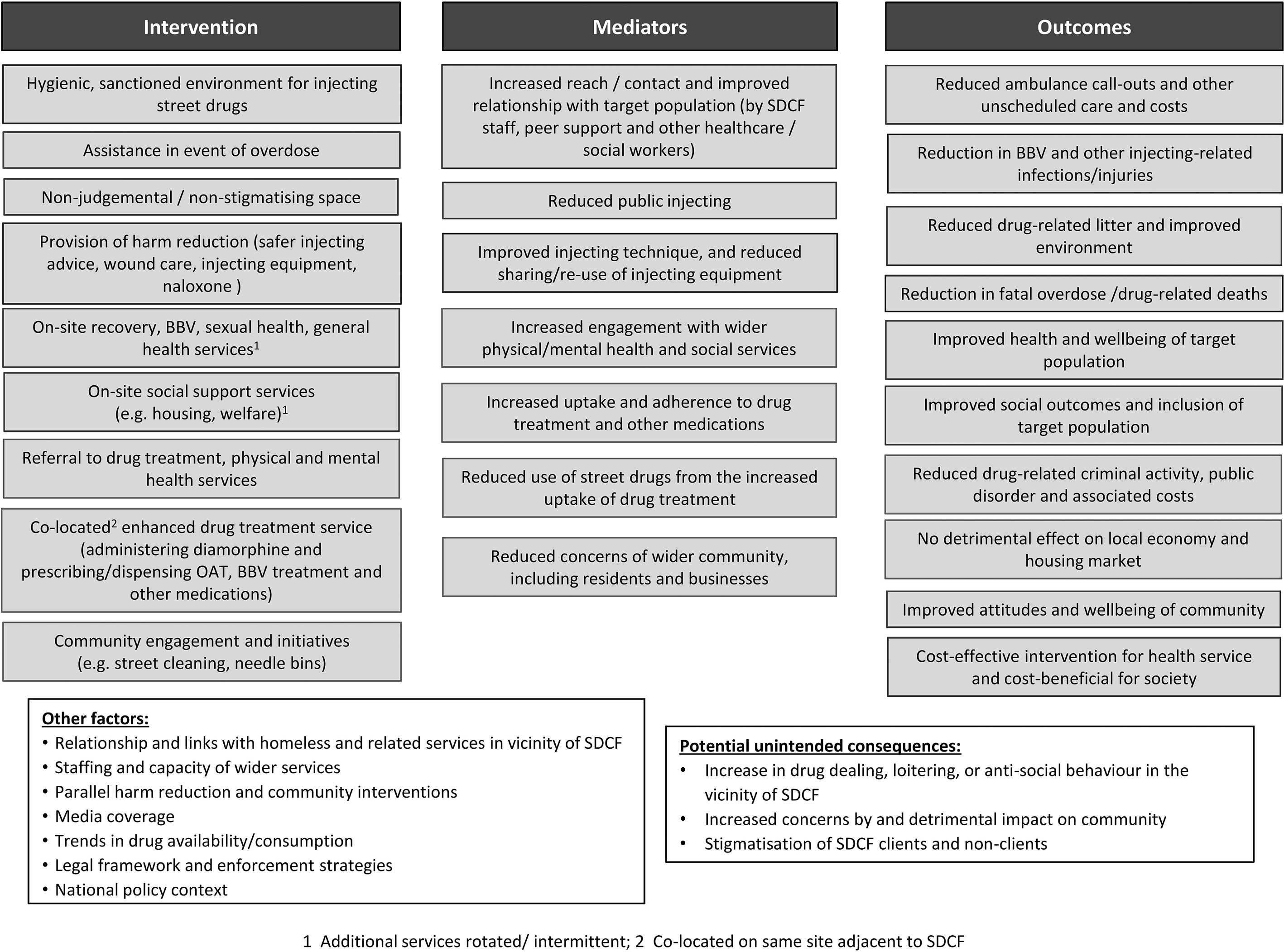
Scotland’s Lord Advocate stipulated that the pilot facility is conditional on there being “careful and rigorous evaluation of the facility and its effects”. This study will thus undertake an independent evaluation to assess the effects of the Glasgow facility on multiple health, social and economic outcomes, capturing impacts on PWID, local residents and businesses, and public services ( Figure 1). We will not focus on any single outcome measure, but rather the evaluation will assess the balance of positive and negative impacts, as well as assessing cost-effectiveness of the facility.
A mixed-methods study will measure the impact of the SDCF on health, social, community, environmental, and economic outcomes. Across four work-packages (WP), a combination of quantitative and qualitative data will be used to: a) study the process of intervention implementation, examining delivery, reach, barriers, facilitators, and context (relating to WP1), b) estimate the effects of the SDCF on health (including overdose) and social outcomes among PWID (WP2) and c) assess the potential adverse or beneficial impacts on the community where the SDCF is located (WP3). In WP4, an economic evaluation will assess the within-study costs and outcomes from an NHS and societal perspective. Further, we will undertake epidemiological modelling to quantify the medium- and long-term health impacts and cost-effectiveness of the SDCF in Glasgow and the contribution of different components of the service to that. We will also explore the anticipated health and economic impacts of implementing SDCFs (involving different service components) in other parts of the UK. As shown in Figure 2, these different components of the evaluation are inter-linked with data collected in some used in others.
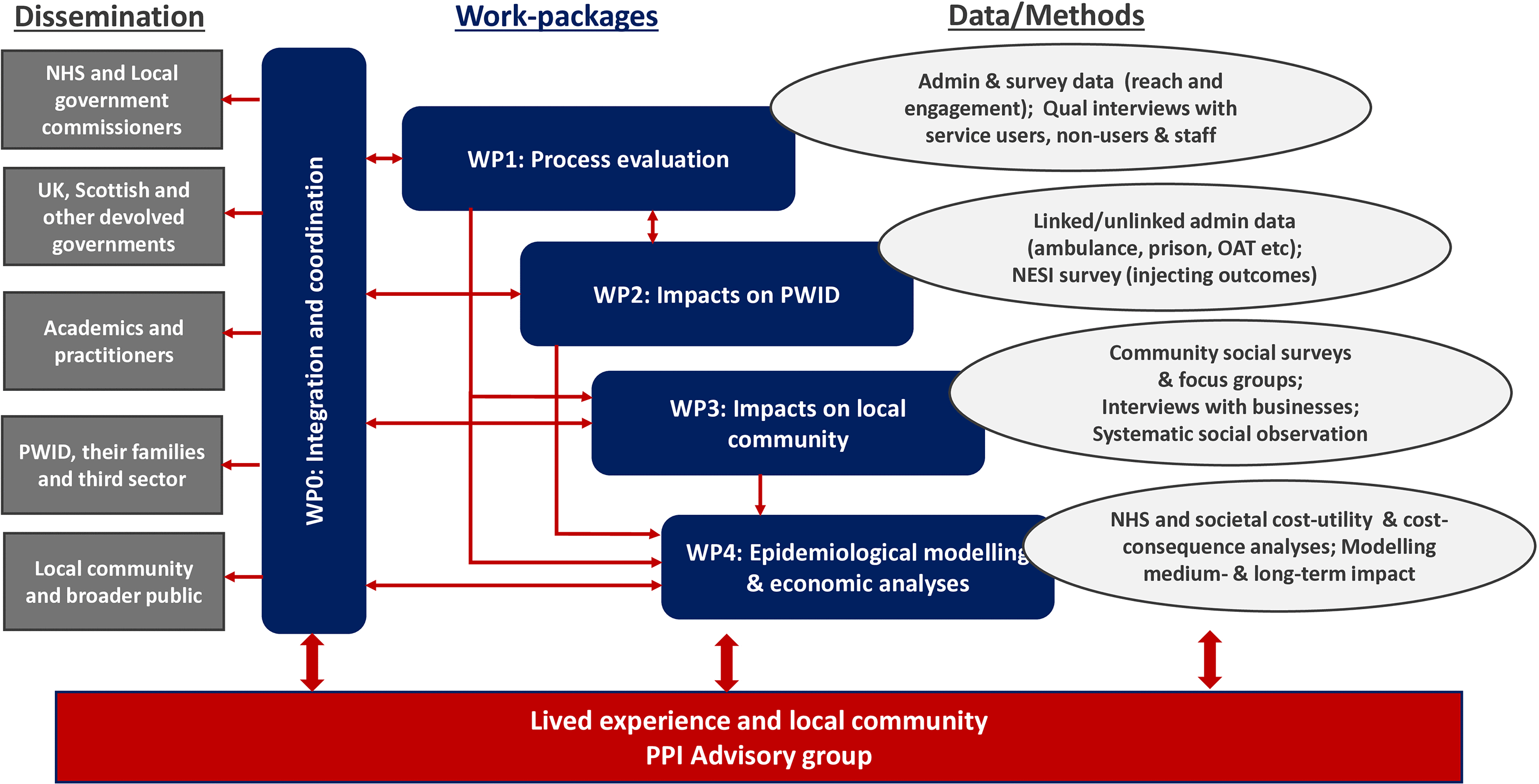
Table 1 provides an overview of the research questions (RQ), data and approaches to addressing these, and key outcomes for each WP. In addition to drawing on the Medical Research Council (MRC)/National Institute for Health and Care Research (NIHR) guidance on complex interventions, natural experiment studies, and process evaluations, we will apply the Practical, Robust Implementation and Sustainability Model (PRISM, an extension of the RE-AIM framework) to ensure that transferability and equity are integral within our evaluation.56–59 Building on our provisional logic model ( Figure 1) and outcome-based framework from a previous NIHR-funded development award (NIHR204582),60,61 we will develop a detailed systems map that illustrates the diverse and interconnected pathways through which effects arise, as well as highlighting potential for stasis/feedback and the role of contextual contingencies which might impede/enable effects. The systems map will inform integration of findings across work-packages, describing hypothesised pathways through which impacts may arise and considering how different intervention components interact together and with contextual factors.
| Evaluation component | Aim/Objectives/Research Questions (RQ) | Data sources/method | Key outcome measures |
|---|---|---|---|
| Overall | Aim: To evaluate the impact of the UK’s first sanctioned SDCF on health, social, community, environmental, and economic outcomes. | See below | |
| WP1: Process evaluation | Objective 1: To study the process of intervention implementation, examining delivery, reach, barriers, facilitators, and context. |
|
|
|
RQ1.1 How is the SDCF in Glasgow implemented and how does the delivery model evolve over time? RQ1.2 Whom does the SDCF reach and what barriers or enablers facilitate access for diverse groups of PWID? RQ1.3 How do PWID, staff, and other stakeholders experience the SDCF? RQ1.4 What are the mechanisms through which different SDCF components result in various health impacts and do these differ across groups? RQ1.5 What are the contextual factors that shape delivery and what are the lessons for implementation elsewhere? | |||
| WP2: Impact on health and social outcomes of PWID | Objective 2: To estimate the effects of the SDCF on health harms (including overdose) and social outcomes among PWID. |
|
|
| RQ2.1 Does the introduction of a SDCF reduce overdose-related ambulance call-outs and other drug-related outcomes in the community in which it is located? RQ2.2 What is the impact of SDCF exposure (and intensity of exposure to the facility) on drug-related and social outcomes, and uptake of harm-reduction services? RQ2.3 What is the impact of the SDCF on injecting risk outcomes and quality of life among PWID? | |||
| WP3: Impact on the wider community | Objective 3: To assess the potential adverse or beneficial impacts on the community where the SDCF is located. |
|
|
|
RQ3.1 What are the impacts of the SDCF on wellbeing, perceptions of safety, and experiences of crime of the local community where the facility is based? RQ3.2 What are the attitudes and perceptions of the local community (including residents and businesses) towards the SDCF and how do they evolve over time? RQ3.3 What are the impacts of the SDCF on the local environment (including drug-related litter and public nuisance)? RQ3.4 What are the impacts of the SDCF on the local economy? | |||
| WP4: Economic evaluation and epidemiological modelling | Objective 4: To assess the within-study costs and benefits from an NHS and societal perspective (cost-effectiveness, cost-utility and cost-consequence analysis). Objective 5: To model the longer-term impact and cost-utility of Glasgow SDCF (separating the effects of different intervention components) on preventing overdose and other drug harms. |
|
|
|
RQ4.1 What is the cost-effectiveness and cost-utility of the SDCF (overall and for its individual components) from NHS and personal social services perspectives in the short-, medium- and long-term? RQ4.2 What is the within-study cost-consequence and cost-benefit of the SDCF (overall and for its individual components) from a societal perspective? RQ4.3 What are the medium- and long-term health impacts of different SDCF components? RQ4.4 What are the anticipated health and economic impacts of implementing different SDCF components (individually and in combination) in other parts of the UK? |
2 Includes drug-related emergency department attendances, drug-related admissions, skin and soft tissue infection (SSTI) admission and deaths.
We will collect qualitative and quantitative data to develop a detailed understanding of intervention implementation, mechanisms of effect, and how the context in which the SDCF is delivered moderates its effectiveness. We will conduct descriptive analyses of data being collected as part of service delivery ( Table 2). We will investigate the SDCF’s reach into its target population by flagging users of the facility within a linked cohort of people already known to be in contact with drug services (described below). We will estimate the proportion of cohort members in Glasgow City and the wider NHS Greater Glasgow and Clyde (GGC) region who use the facility, and explore how this varies according to markers of risk, including previous histories of service use, age, sex, etc. We will triangulate these findings with analyses of repeated cross-sectional survey data from PWID interviewed in 2025–26 and 2027–28 at services providing injecting equipment, referred to as the Needle Exchange Surveillance Initiative (NESI).62,63 We will compare the characteristics of NESI participants who report using the SDCF with those who do not, to explore whether there are particular groups of PWID at high risk of adverse outcomes that do not engage with the facility. We will similarly explore quantitative data collected as part of service delivery (linked to a range of administrative data, such as referral and uptake of OAT) to explore evidence in support of or against different potential mechanisms, based on insights from qualitative data.
| Category | Items |
|---|---|
| Registration screen * | Client reference code (forename initial/surname initial, fourth letter of surname, date of birth), gender, non-registration (left without registering/signing in, under 18 years, other reason) |
| Clients details * | Preferred name, age, disability assistance (wheelchair access, hearing/sight impairment), foreign language, interpretation services, willing to provide details, clinical information (asthmatic, diabetic, epileptic, allergies), personal details (first name, surname, date of birth, current address/postcode, past address/postcode), ethnicity, where heard about service. |
| Session visit | Date, time entered/exited, service user fit to continue (if no, moved to [location in SDCF]), meets service entrance criteria, rules of service explained, drugs intended to use (drug, route, location), injecting equipment provided, injection administration (injected in session, route, location, other drugs consumed and route/location) |
| Medical emergency screen | Interventions (close observation/monitoring only, oxygen supplied, naloxone administered involving type/doses, defib applied, CPR) and Outcome (recovered following monitoring only, treated by SDCF and recovered, treated by ambulance staff but not taken to ED, taken to ED, other, fatal) |
| Risk Assessment | Risks identified (mental health, physical health, child protection, adult protection) and risk outcome (for each item) |
| Interventions/Treatment | User defined list of interventions and treatments (e.g. opioid agonist therapy) |
| Referrals | Referred to (during the session or after the sessions): crisis outreach, immunisation, smoking cessation, GP, GP onsite, housing first, recovery hub, other. |
| Wound assessment | Wound location (body diagram), wound type/history (duration, painful, colour, at injection site, size, etc), possible infection (itemised list), type of treatment/care. |
| BBV test | Date, type and outcome of test (HIV, HCV, HBV) and results given to client |
| Discharge status | Injected and no issues, left against advice, transferred to ED, other/notes. |
* Note, the Glasgow SDCF can be used anonymously, but personal information will also be requested providing the means to confidentially link records for the evaluation. The service will use/adapt an administrative system (neo360) which operates in low threshold services (providing injecting equipment) in Glasgow and elsewhere. Service users will be asked to register to use the SDCF; personal information (name/date of birth/address) will be requested (and at specified subsequent visits) but will not be a requirement for entry. A client reference is recorded (initials/date of birth; noting an alias can be used). Personal details will also be requested for NHS services (e.g. blood-borne virus testing). The NHS Board provides information to service users on use of personal data, including for purpose of the evaluation (see SDCF - Service user information | Glasgow City Health and Social Care Partnership).
We will conduct qualitative interviews with 20–30 users sampled purposively at the facility at 12–15 months, and a further 20–30 users sampled at 34–36 months. In addition, we will undertake non-participant observation to assess how the operation of the facility evolves and inform topic coverage of the interviews. For eligible non-users of the service, we will conduct two waves of qualitative interviews (at 16–18 and 37–39 months), each with 10–20 PWID from a diverse range of sites, including city centre pharmacies and through peer engagement groups coordinated by Scottish Drugs Forum (SDF). We will seek diversity among those interviewed in relation to prior service engagement, gender/wider identity characteristics, age group, homelessness and prior incarceration. For service providers, we will conduct 8–12 qualitative interviews with SDCF staff and support workers (e.g. welfare rights, housing advisers), and a further 8–12 interviews with providers of other relevant services (e.g. police, pharmacies and other providers of harm-reduction services). Interviews will take place on two occasions, in keeping with the above timelines. The sample will be informed by analysis of service information but will be flexible to take account of how the facility evolves. Transcripts will be coded in NVivo using the framework method.64 Analysis will be both deductive and inductive.
Implementation and reach (RQ1.1/RQ1.2): Service protocols will be used to characterise the SDCF and the context in which it was developed. Qualitative interviews with staff will explore expectations and attitudes to the facility, experiences with delivery (including challenges, adaptations, and lessons learned), and how use of the facility is shaped by contextual elements, including the availability of other services for PWID. We will pay attention to the role of culture, exploring if and how the service responds to the needs of diverse communities. To assess reach, ongoing engagement with the facility, and referrals (both to health and other services), we will analyse the survey data of PWID and linked administrative data.
Experiences and mechanisms (RQ1.3/RQ1.4) : To understand the experiences of service users, and to explore mechanisms by which effects on health may occur (including unanticipated and potentially adverse effects), we will iteratively refine our systems map to relate intervention components (e.g. safer consumption location, improved injecting practice, referrals) with potential positive and negative consequences, while paying attention to relevant enabling or hindering factors. We will initially draw on the operational documents, existing literature, and early staff interviews to identify potential pathways to be incorporated into our systems map. These will then be refined to take account of newly suggested mechanisms from qualitative data over time, as well as quantitative data testing if mechanisms are operating (e.g. number and type of referrals made, whether attendance occurs etc.).
Context and transferability (RQ1.5): As per the PRISM model and NIHR guidance on context, we will consider the role of multiple levels of context in shaping the facility. This includes the legislative environment enabling the intervention, the local community and environment in which it is placed, the public and third sector agencies (including police, housing and other NHS services) that interact with the facility, and the NHS and related organisational structures within which the facility is located. We will specifically look for aspects of context that foster or constrain effective service delivery, such as working relationships with other services, features of local housing, job and illegal drug markets, and so on. Furthermore, we will explore factors that may determine the transferability of our evaluation to other settings by carefully characterising the specific characteristics of PWID in Glasgow City and their interplay with context.
We will adopt multiple natural experiment (controlled) study designs subject to different underpinning assumptions to examine the SDCF’s impact on several health and social outcomes among PWID ( Table 3). We will use Scottish national data available from 2010 onwards (allowing a pre-intervention period to examine trends) from unlinked and linked administrative data, and a serial survey of PWID. Results from these multiple sources and approaches will be triangulated to strengthen causal inference.
| Type | Unlinked administrative data | Linked administrative data (virtual cohort) | Serial survey data (NESI) |
|---|---|---|---|
| Health |
|
|
|
| Social |
|
| |
| Service Uptake |
|
|
Testing the impact of the SDCF on drug-related outcomes (RQ2.1): One of the main public health arguments for the facility is the potential to reduce drug overdose. We will use Scottish Ambulance Service (SAS) data on overdose-related call-outs – where naloxone (a medicine used to reverse opioid-related overdoses) was administered – as one of our key outcomes. The grid reference (postcode) of the ambulance call-out is recorded on the SAS data, thus enabling analysis according to locality of the overdose. To assess statistical power for a difference-in-difference analysis, we applied Monte Carlo simulation to a Poisson model comparing the total number of naloxone administered call-outs in the first three years of the SDCF to the preceding five years. We estimate we have 80% power for a difference-in-difference analysis with a minimally important reduction of 7.5% (i.e. six call-outs per month) at the Glasgow City level, using the rest of Scotland as our control (noting the parallel trends assumption on monthly call-outs in the preceding five year period holds). Alternative control areas (Edinburgh and Dundee City combined) will be assessed in sensitivity analyses, although these will have less statistical power. We will also consider areas closer to the facility (within 1,000 m, 1,500 m and 2,000 m), as we would anticipate that if the intervention was able to reduce drug overdoses in the community, then it would do so to a greater degree in closer proximity to the facility. We will undertake similar difference-in-difference analyses on other drug-related (secondary) outcomes, including emergency department attendances, hospital admissions, and deaths, and use a composite outcome (of these measures) to facilitate subgroup analysis by age group and sex. In supplementary analysis, we will conduct controlled interrupted time-series analyses on the same outcomes (e.g. using fortnightly data points), but these analyses will have lower statistical power due to high autocorrelation.
Testing the impact of SDCF use on health/social outcomes (RQ2.2): In contrast to other evaluations of SDCFs, we can draw on the Substance Use and Health Intelligence Linked Dataset (SHIeLD) held at PHS to examine the effect of the SDCF on a broader range of outcomes ( Table 3). This virtual cohort involves ~100,000 people in contact with drug services (e.g. prescribed OAT) across Scotland since 2009, linked using the CHI number (Scotland’s unique patient identifier) to multiple healthcare datasets (e.g. BBV tests, prescriptions, hospitalisations, and deaths), with plans to link to other data held at PHS on unscheduled care (e.g. ambulance call-outs, emergency department attendance) and periods of incarceration from Scottish Prison Service records.65,66 We have information governance approval to link data on clients attending the SDCF in Glasgow to other data held in SHIeLD.
To estimate the causal effect of the SDCF on a range of health and social outcomes, we will use propensity score-matched regression models on individuals in the linked cohort comparing those exposed to the SDCF (intervention group) to controls, stratified by age and sex. The intervention group will be considered in different ways according to: i) location in Glasgow City (based on residence and/or service use), ii) use of the SDCF, and iii) frequent use of the facility (the latter two determined from linkage to SDCF client data). Those in the intervention group will be identified on the date of their most recent pre-intervention engagement with a relevant drug-related service. Using a previously employed approach,67 control participants will be selected using risk-set matching (sampling up to three matched individuals per intervention participant based on that date), with a propensity score being used to condition on socio-demographics, previous service use, and comorbidities. This approach then involves matching by date to compare people who might benefit from the SDCF within the intervention area (intention-to-treat analysis that mitigates confounding by indication) to equivalent people in control areas, as well as a per-protocol analysis comparing those in SDCF contact to control participants. For mortality outcomes, we will conduct survival analysis with time-varying exposure, using doubly robust models (with covariates included in the outcome model).68 For non-fatal outcomes, we will incorporate difference-in-difference models and assess if pre-intervention trends are parallel.69 We will additionally explore falsification dates of exposure (e.g. re-running the matching two years pre-intervention) and falsification outcomes (e.g. admissions for non-injury causes).
Testing the impact of SDCF exposure on injecting risk and quality of life (RQ2.3): Scotland has an established national public health surveillance system (NESI) monitoring drug-related harms and infections among PWID. Since 2008, this has been undertaken through biennial cross-sectional bio-behavioural surveys recruiting PWID at services providing injecting equipment,62,63 involving over 2,000 participants in each survey (with ~250 people currently injecting recruited from Glasgow City). In collaboration with PHS, we propose to enhance recruitment of two surveys in 2025–26 and 2027–28, funding the recruitment of a boosted sample (~500 per survey) in Glasgow City and revising the questionnaire to capture relevant data (e.g. intensity of SDCF use). Fixed-effects analysis will be used to estimate differential trends in key (self-reported) outcomes ( Table 3) in Glasgow City compared to the rest of Scotland. To assess statistical power, we applied Monte Carlo simulation to a logistic model comparing the proportion of NESI participants scoring 3 or higher (max 5) on a composite indicator of risk as our key outcome for the PWID survey (comprising self-reported SSTI, non-fatal overdose (NFOD), sharing injecting equipment, reusing injecting equipment, and public injecting) in the three surveys pre-SDCF ( Table 4) to the two future surveys. With the boosted sample across both surveys in Glasgow City, we estimate we have 80% power for a difference-in-difference analysis to detect a minimally important absolute reduction of 7%, using the Rest of Scotland as our control (noting the parallel trends assumption on the composite indicator holds). The SDCF aims to engage those PWID in Glasgow City who are at particularly high risk of drug-related harms, thus those using the facility may have different characteristics and risk profile to those not attending or attending less frequently. Thus, examining whether intensity of exposure to the SDCF (e.g. proportion of injections at the facility) impacts on outcomes (listed in Table 3) will need to carefully account for the confounding factors which influence use of the facility. Based on previous work, confounders to be used in propensity score matching include age, homelessness, prison history, and cocaine injecting. The rich covariate data available in NESI allow for more detailed adjustment for confounders than in analyses of linked data (above), thereby adding confidence to our findings.
| Rest of Scotland | Glasgow city centre | |||||
|---|---|---|---|---|---|---|
| 2017–18 | 2019–20 | 2022–23 | 2017–18 | 2019–20 | 2022–23 | |
| Total, N1 | 1,803 | 2,071 | 1,747 | 327 | 364 | 299 |
| Injected in the last six months, N2 (% of N1) | 1,250 (69%) | 1,409 (68%) | 1,034 (59%) | 219 (67%) | 251 (69%) | 231 (77%) |
| Injecting-related risk behaviours a | ||||||
| Drugs injected in the last six months, n (% of N2) | ||||||
| Cocaine (powder) | 291 (23%) | 482 (34%) | 612 (59%) | 161 (73%) | 167 (67%) | 196 (85%) |
| Groin primary injection site in the last six months, n (% of N2) | 579 (46%) | 632 (45%) | 361 (35%) | 86 (39%) | 109 (43%) | 69 (30%) |
| Shared injecting equipment in the last six months, n (% of N2) | 343 (27%) | 260 (18%) | 274 (26%) | 75 (34%) | 89 (35%) | 73 (32%) |
| Reused injecting equipment in the last six months, n (% of N2) | 717 (57%) | 583 (41%) | 525 (51%) | 131 (60%) | 143 (57%) | 137 (59%) |
| Injecting frequency, n (% of N2) | ||||||
| Low frequency (less than daily) | 712 (57%) | 455 (46%) | 560 (54%) | 97 (44%) | 93 (37%) | 92 (40%) |
| High frequency (daily of more) | 532 (43%) | 752 (53%) | 462 (45%) | 122 (56%) | 155 (62%) | 138 (60%) |
| Public injecting in the last six months, n (% of N2) | ||||||
| Always or usually | 40 (3%) | 58 (4%) | 38 (4%) | 52 (24%) | 56 (22%) | 51 (22%) |
| Sometimes | 96 (8%) | 119 (8%) | 132 (13%) | 50 (23%) | 51 (20%) | 55 (24%) |
| Did not inject in a public place | 1,108 (89%) | 1,222 (87%) | 849 (82%) | 117 (53%) | 143 (57%) | 122 (53%) |
| Composite of injecting-related risk behaviours, n (% of N2) b | ||||||
| <2 | 898 (72%) | 1,130 (80%) | 770 (74%) | 137 (63%) | 145 (58%) | 142 (61%) |
| 2+ | 302 (24%) | 245 (18%) | 242 (23%) | 76 (35%) | 92 (37%) | 85 (38%) |
| Injecting-related outcomes a | ||||||
| Skin and soft tissue infection in the last year, n (% of N2) | 324 (26%) | 301 (21%) | 264 (26%) | 78 (36%) | 59 (24%) | 77 (33%) |
| Non-fatal overdose in the last year, n (% of N2) | 209 (17%) | 254 (18%) | 237 (23%) | 56 (26%) | 87 (35%) | 82 (35%) |
| Composite of injecting-related risk behaviours and outcomes, n (% of N2) c | ||||||
| <3 | 1,049 (84%) | 1,214 (86%) | 828 (80%) | 153 (70%) | 171 (68%) | 154 (67%) |
| 3+ | 147 (12%) | 129 (9%) | 136 (13%) | 56 (26%) | 57 (23%) | 64 (28%) |
| Social outcomes a | ||||||
| Homeless in the last six months, n (% of N2) | 278 (22%) | 312 (22%) | 283 (27%) | 124 (57%) | 144 (57%) | 159 (69%) |
| Been incarcerated in the last year, n (% of N2) | 226 (21%) | 250 (18%) | 202 (19%) | 76 (35%) | 62 (25%) | 70 (30%) |
| Harm reduction and service use a | ||||||
| Prescribed OAT in the last six months d, n (% of N2) | 621 (77%) | 755 (80%) | 535 (76%) | 130 (79%) | 131 (76%) | 166 (80%) |
| Syringe coverage per injecting episode, n (% of N2) | ||||||
| <100% | 280 (22%) | 477 (34%) | 269 (26%) | 44 (20%) | 90 (36%) | 76 (33%) |
| 100%+ | 953 (76%) | 916 (65%) | 707 (68%) | 172 (79%) | 152 (61%) | 144 (62%) |
| Naloxone access in the last year e, n (% of N2) | ||||||
| Prescribed naloxone | 884 (71%) | 986 (70%) | 805 (78%) | 136 (62%) | 186 (74%) | 180 (78%) |
| Carrying naloxone on day of interview | 118 (9%) | 146 (10%) | 80 (8%) | 14 (6%) | 72 (29%) | 22 (10%) |
| BBV test in the last year f, n (% of N2) | 758 (66%) | 827 (61%) | 671 (67%) | 140 (77%) | 190 (78%) | 184 (82%) |
| Wider health service use a | ||||||
| A&E attendance in the last six months, n (% of N2) | ||||||
| Once | 184 (15%) | 160 (11%) | 151 (15%) | 32 (15%) | 25 (10%) | 42 (18%) |
| 2 or more times | 167 (13%) | 199 (14%) | 197 (19%) | 59 (27%) | 81 (32%) | 39 (17%) |
| Did not attend | 873 (70%) | 1,032 (73%) | 634 (61%) | 125 (57%) | 133 (53%) | 132 (57%) |
| Hospital admittance in the last six months, n (% of N2) | ||||||
| One day or less | 60 (5%) | 50 (4%) | 73 (7%) | 20 (9%) | 10 (4%) | 19 (8%) |
| Two or more days | 210 (17%) | 222 (16%) | 226 (22%) | 57 (26%) | 93 (37%) | 54 (23%) |
| Not admitted | 871 (70%) | 1,098 (78%) | 647 (63%) | 126 (57%) | 131 (52%) | 122 (53%) |
| Accessed other health and social services in the last six months e, n (% of N2) | ||||||
| Mental health | 461 (37%) | 366 (26%) | 290 (28%) | 53 (24%) | 75 (30%) | 39 (17%) |
| Social work | 321 (26%) | 229 (16%) | 253 (24%) | 65 (30%) | 46 (18%) | 55 (24%) |
| Housing | 441 (35%) | 402 (28%) | 362 (35%) | 107 (49%) | 84 (33%) | 111 (48%) |
| Quality of life a | ||||||
| Self-reported health and wellbeing on day of the interview, n (% of N2) | ||||||
| 0–25 (low) | 165 (13%) | 242 (17%) | 143 (14%) | 43 (20%) | 57 (23%) | 53 (23%) |
| 26–50 | 526 (42%) | 611 (43%) | 384 (37%) | 85 (39%) | 110 (44%) | 82 (35%) |
| 51–75 | 401 (32%) | 425 (30%) | 352 (34%) | 70 (32%) | 54 (22%) | 63 (27%) |
| 76–100 (high) | 139 (11%) | 120 (8%) | 119 (11%) | 20 (9%) | 27 (11%) | 23 (10%) |
b Comprised of the following injecting-related risk behaviours (with presence of each factor counted as one and summed): (i) always/usually report public injecting in the last six months, (ii) reused injecting equipment in the last six months, and (iii) shared injecting equipment in the last six months;
c Comprised of the following injecting-related risk behaviours and outcomes (with presence of each factor counted as one and summed): (i) always/usually report public injecting in the last six months, (ii) reused injecting equipment in the last six months, (iii) shared injecting equipment in the last six months; (iv) SSTI in the last year, and (v) 2+ non-fatal overdoses in the last year;
We will assess a range of potential adverse or beneficial impacts on the community in which the SDCF is located. A mixed-methods approach, using data from residents, business owners, social observation, and public data, will measure: a) the impact of the SDCF on community residents’ attitudes, and perceptions of safety and crime; and b) the impact of the SDCF on drug-related litter and public disorder, crime, and the local economy.
Impacts on community cohesion and wellbeing (RQ3.1): Repeated, brief, cross-sectional surveys of ~280 residents in the SDCF area and ~ 720 across three control areas, close to harm-reduction services, are planned. A baseline survey (funded by PHS) was conducted in mid-2024, prior to the SDCF’s introduction. Two further surveys are intended at one and three years after baseline, to assess short- and medium-term effects. Surveys will assess trends in community wellbeing, perceptions of safety, and experiences of crime. The geographical area surrounding the facility (within 1 km, with the area chosen based on walking proximity) provides a sampling frame for the intervention area. Three similar size control areas in East Glasgow have been selected based on similarity in deprivation, housing mix, residential/commercial mix, crime rates, and provision of services (e.g. needle exchange). Multiple control areas will help protect against unanticipated exposures (such as major infrastructure changes) affecting one of the control areas. Following a data collection schedule that varies by time/day, fieldworkers will visit every household on all residential streets within the study/control areas, allowing up to 3 visits in the event of non-response to a door-knock. We anticipate reaching our target sample within the selected areas, but fieldworkers will continue to radiate outwards until the target sample is reached. The fieldworker will invite the adult (≥18 years) answering the door to participate, with the option for another adult occupant to complete if the first adult is busy/unwilling. Participants will complete the ~10-minute questionnaire on a study tablet, with fieldworker assistance as required. If there is no response at the door, fieldworkers will leave a flyer with a QR code allowing residents to self-complete on their own device and in their own time. Participants in the intervention area will be asked if they would be happy to be recontacted to take part in focus groups. Contact details will be collected outside of the survey platform to preserve anonymity.
The key outcome in the community surveys is the Neighbourhood Social Cohesion Scale, a 4-item measure of community cohesion which is used in the UK Household Longitudinal Study70 and intended to capture how people feel about living in an area, including the attractiveness of living in a neighbourhood. The total score is the sum of four variables, producing a scale ranging from 4 “lowest social cohesion” to 20 “highest social cohesion” (mean 14.62, SD 2.74 in the UK study).70 Secondary outcomes include satisfaction with the local area and individual life satisfaction; perceptions of neighbourhood safety and experiences of crime; concerns about drug-related litter, antisocial behaviour, and criminal damage; and attitudes to local services. Based on simulation, we would have 86% power (alpha = 0.05 two-sided) for a 0.82 change in the social cohesion score (0.3SD) within a fixed-effects model comparing either of the two post-intervention waves to baseline, with greater power for combined analyses. We will generate descriptive summaries of demographic profile and outcome measures, stratified by relevant effect modifiers (gender, household composition, and employment status) where possible. We will test for differences in the outcomes between intervention and control areas using fixed-effects regression models (linear regression for continuous outcomes and logistic or modified Poisson regression for binary outcomes), with individuals nested within areas. We will adjust for predefined covariates, including baseline outcome measures and sociodemographic characteristics. We will estimate impacts at 6–12 months and 30–36 months post-SDCF opening, with administration at the same time of year to minimise seasonal variation. We will assess potential differences in impacts across population subgroups (where sample size allows), namely by gender, age group, household composition (e.g. households with children vs without), and tenure (owners vs renters) using interaction terms and subgroup analyses.
Impacts on community attitudes and experiences (RQ3.2): To contextualise survey findings, provide an in-depth understanding of community reactions, and identify potential effects not probed by the survey, we will conduct repeated focus groups with local residents and interviews with businesses. These will explore people’s perceptions and experiences of their community, including awareness of the SDCF, attitudes towards it, and views on the local physical environment (e.g. any unanticipated concerns that have been identified). Three mixed-gender focus groups – comprising young people (aged 18–24 years), adults (aged 25–60 years, including parents of children <18), and older people (aged 60+ years) – will be conducted within the intervention area only, approximately 12–18 months and 30–36 months after the facility is introduced. Sampling from survey participants who have given permission for recontact. Guided by our patient and public involvement (PPI) group, we will employ supplementary local recruitment methods (e.g. adverts to older people’s social groups) to avoid digital exclusion. We will also convene focus groups with community residents opposing and voicing support for the facility and (if possible) local families with members who have lived experience of drug use. Recruitment for these groups will be via existing community groups and their contacts.
Participants in the first round of focus groups will be invited to the second, replacing with alternative survey participants, via community groups, as required. Focus groups will be supplemented by repeated one-to-one interviews with local businesses to explore perceptions of the facility, potential impacts on their business and customers, and any concerns they have. We anticipate conducting 5–8 interviews lasting approximately 25–40 minutes at similar time-points to the focus groups, with diversity sought in terms of size and type of business. Both focus groups and interviews will be audio recorded, transcribed verbatim, and anonymised. Following the Framework approach to qualitative analysis,71,72 inductive and deductive coding will be conducted, with the assistance of NVivo. We will summarise key themes, paying attention to contradictory data.73 Analysis will explore change in attitudes and experiences over time, and we will synthesise across data sources to build a reliable and nuanced assessment of community impacts.
Impacts on the local environment (RQ3.3): Systematic social observation (SSO) will examine visible changes in the environment in the vicinity of the SDCF and two control areas pre- and post- opening of the SDCF. The baseline SSO fieldwork (funded by PHS) was conducted in mid to late 2024, and will be repeated one, two and three years later (at the same time of year). A digital data collection tool has been developed to measure injecting drug use-related litter (representing our key outcome measure in the SSO survey), other drug use-related litter, public drug use, homelessness and loitering. Fieldworkers working in pairs will collect data twice per week over a period of ~20 weeks on designated [consistent] days and times within a 250 m radius of the SDCF and similar size control areas with known prevalence of public injecting in the city. We will test for changes in each of the indicators of the wider drug environment before and after the opening of SDCF using a difference-in-differences design and a controlled interrupted time series (CITS) analysis, comparing the intervention area to each control area. Regression models will be fitted and adjusted for confounding factors that are known to influence public drug use and drug-related litter including weather, police operations and injecting equipment distribution.
Impacts on the local economy (RQ3.4): Potential adverse consequences on the economy will be assessed by comparing property values, empty business premises, and crime statistics (from administrative data) in the intervention area to other parts of Glasgow. Publicly available data from Police Scotland reports frequency of burglaries, other theft, and street-based disturbances at the small area level. Property market value sales data are available at both data zone and intermediate data zone from Registers of Scotland.74 Similarly, information on rental properties (number of adverts, properties available, rent charged) is available using Zoopla data that are accessible from the ESRC Urban Big Data Centre.75 The Glasgow Valuation Roll assesses the market value of all non-domestic properties within the Council area on an ongoing basis and provides an indication of the value of business properties.76 We will conduct synthetic control analyses to assess potential adverse impacts of the SDCF on economic and crime outcomes.77 We will study trends in the outcomes for the area surrounding the facility pre-intervention and create a synthetic control by drawing on other areas within Glasgow weighted to reproduce the pre-intervention trend. We will assess how the outcome trends differ following the SDCF’s introduction. Since synthetic control methods can be statistically inefficient, we will also conduct fixed-effects analyses.
We will evaluate and quantify both within-study costs and outcomes as well as longer-term impacts on drug related harm, quality of life, and cost-effectiveness ( Figure 3). We will adapt an epidemiological and economic model developed as part of other NIHR funded projects (NIHR204582 and NIHR160569) to assess the long-term impact of the SDCF compared to a counterfactual, as well as account for the impact on various outcomes that will not be measured directly by public health surveillance (i.e. HCV and HIV transmission). We will adopt both NHS and broader societal perspectives, designing and conducting analyses adhering to the latest MRC/NIHR guidance on economic evaluations alongside natural experiments.78–80 The use of multiple frameworks (cost-utility analyses, cost-effectiveness analyses, and cost-consequence analyses) is recommended to capture the broad array of health and social impacts of interest to a variety of stakeholders including service users, local community, and policy makers.57
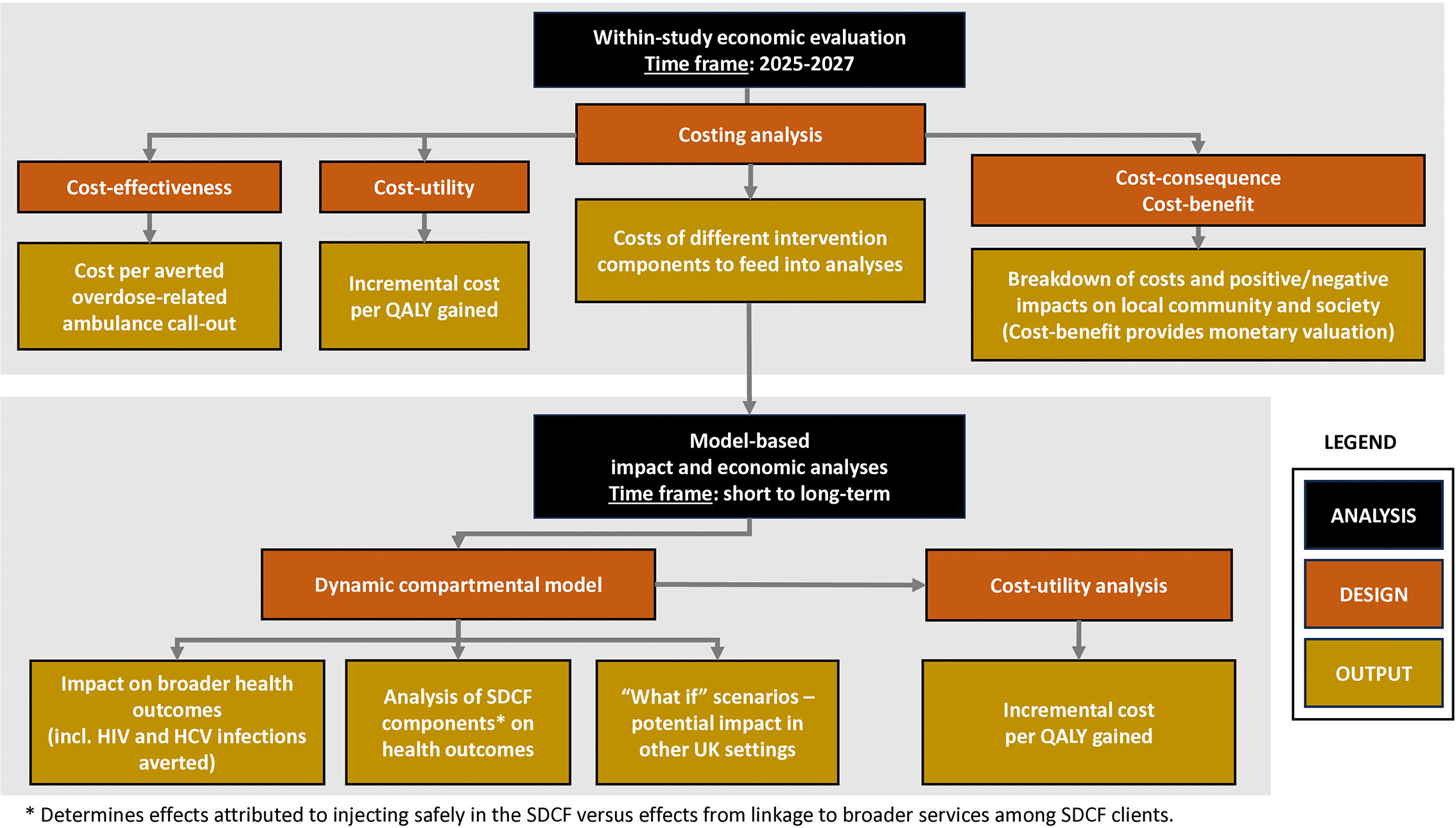
The within-study economic evaluation (RQ4.1/RQ4.2): The natural experiment study has been designed to identify, measure, and value prospective resource impacts and health and social outcomes of the SDCF among PWID in Glasgow. Analyses will compare the SDCF in Glasgow against no SDCF, utilising study data to inform resource use (e.g. SDCF delivery, ambulance call-outs, hospitalisations) and outcomes. A cost-effectiveness analysis (CEA) will be conducted for our key health and social care outcomes using an NHS and personal social services (PSS) perspective. Utilising EQ-5D-5L health utility scores from NESI, a within-study cost-utility analysis (CUA) will be undertaken estimating the incremental cost per quality-adjusted life year (QALY) gained, with distributional consequences (i.e. across population subgroups) assessed.81 A societal perspective cost-consequence analysis (CCA) will also be performed to include the potential broader consequences to capture the impacts on not just service users (e.g. non-fatal overdoses, DRDs), but the wider community, quantifying a more holistic set of costs and benefits for service users, local community, and wider society. Study data on PWID (e.g. ambulance call-outs, hospitalisations, public injecting) and the community (e.g. residents’ wellbeing and perceptions of safety and crime, impacts on drug-related litter, property values) will feed into the CCA. This will initially have a within-study viewpoint, but we will also incorporate outputs from the epidemiological model to report the CCA over a longer timeframe. Those outcomes from the CCA which can be readily monetised can also be presented as a cost-benefit analysis, where appropriate, to enable quantification of the outcomes for decision makers.82,83
Health service cost items include SDCF delivery (e.g. venue, professional time), other services and referrals (take-home naloxone, OAT, BBV tests, SSTI assessment) and drug-related emergency services. Linked administrative data (e.g. emergency care) will be analysed for resource use data and supplemented by resource use questions in NESI and community surveys. The unit costs of drug-related healthcare services will be measured using existing Scottish Health Service cost data. Other unit costs will be obtained from routine sources such as the PSS Resource Unit, PHS, NHS Reference costs, or secondary literature. Costs for other services (e.g. NSP, OAT) and relating to drug-related crime will be obtained from the literature.84
Impact analyses from the epidemiological model (RQ4.3): We will develop a comprehensive mathematical (dynamic deterministic compartmental) model of how SDCF use impacts key health harms, social harms and use of other harm-reduction interventions among PWID in Glasgow. The model will be parameterised and calibrated to Glasgow-specific data (from NESI and linked administrative data) on: i) size estimates and characteristics (e.g. homelessness, polydrug use) of PWID population,85 health outcomes (e.g. overdose-related call-outs, DRDs, HIV/HCV and SSTI) and intervention uptake (HIV/HCV testing and treatment, OAT, NSP coverage, naloxone); ii) estimates of SDCF coverage, intensity and duration of use, by PWID characteristics; and iii) estimates of the impact of the SDCF on health outcomes, referral or uptake of other services, and social outcomes (e.g. incarceration, homelessness).86–88 Other parameters will be drawn from systematic reviews and published studies, such as natural history parameters (HIV and HCV infection) and effectiveness of other interventions.88–91 We will use Approximate Bayesian Computation to generate multiple model fits to available data, enabling uncertainty to be propagated into our model projections.90–92
Model analyses will evaluate the impact of the SDCF during its first three years and over a longer time-period (e.g. 10/20/50 years) if the intervention was continued. Impact will be assessed in terms of lives saved and life-years gained, and adverse health outcomes averted (e.g. overdoses requiring ambulance-calls, DRDs, and new HIV/HCV/SSTI infections) by comparing model projections with the SDCF to a modelled counterfactual that assumes baseline levels of harm-reduction interventions without the SDCF. The model will estimate effects from safe injections within the facility, as well as those generated through increased referral and uptake of other services for those attending the SDCF (OAT, naloxone, NSP, and HCV/HIV testing and treatment); and estimate how important these latter effects and the impact on secondary outcomes (e.g. HIV/HCV/SSTI transmission) are to the overall impact of the SDCF.
Informing roll-out in other settings (RQ4.4): Analyses to inform development of SDCFs in other settings will assess how the population-level impact of the SDCF could vary for settings with different levels of health harms or outcomes (e.g. PWID prevalence and mortality risk, HIV and HCV prevalence), reach and intensity of use of the SDCF (e.g. by people at greatest risk of drug harms) and for variations in the services offered on-site (e.g. OAT). We will consult with people with lived experience, local and national policymakers, and draw on available data from the UK Health Security Agency (UKHSA) to develop these ‘what if’ scenarios. Analysis will also include cost-utility estimates.
Lifetime cost-utility analysis (RQ4.1/RQ4.4): We will also undertake a lifetime cost-utility analysis using the epidemiological model, to account for the long-term impact of the intervention on chronic infections (HIV and HCV). Costs and utility estimates will be obtained from the within-study analyses. The model will assess the incremental cost-effectiveness ratio per QALY saved for the SDCF compared to a simulated counterfactual without the SDCF. We will primarily consider a health service perspective but will also incorporate broader societal effects in sensitivity analyses if the SDCF is shown to affect such outcomes (e.g. reduced incarceration for PWID attending the SDCF). Costs and QALYs will be discounted at 3.5% per annum. The ICER will be compared to the NICE recommended willingness-to-pay threshold (£25,000–35,000 per QALY saved) for the UK to determine cost-effectiveness. Probabilistic uncertainty analyses will be used to estimate uncertainty in the ICER, accounting for uncertainty in the intervention outcomes as well as other cost, behavioural, intervention, and epidemiological inputs. Multiple sensitivity analyses will be performed to determine the effect of uncertainties and model assumptions (e.g. time horizon, discount rate, overdose rate, HIV/HCV prevalence, effects of different intervention components) on the ICER to test which parameters are particularly influential in determining cost-effectiveness, thereby helping inform service design elsewhere. We will further explore whether the cost-effectiveness may differ by intensity of use and characteristics of PWID (e.g. age group, gender, exposure to homelessness, incarceration, and polydrug use).
The ENACT study was designed in partnership with lived experience (JW) and through consultation with SDF’s lived and living experience (LLE) engagement group. Feedback has informed our logic model and research materials/plans, specifically our information governance approach to access personal data, our interpretation of the reach of the service within the city centre, and routes for systematic social observation. There has also been extensive community engagement as part of the SDCF development process organised by our NHS GGC partner (SP), involving local residents and businesses. Learning from this engagement has informed evaluation planning; for example, development of the community attitudes questionnaire drew from common themes emerging from the engagement work. Going forward, patient and public involvement (PPI) activities will be coordinated by a team at SDF and overseen by PPI leads (KH and JN) who have extensive experience in community/public engagement. We will establish PPI advisory group meetings to input into study design and ways of working, and review and develop research materials/tools and dissemination plans/outputs (e.g. lay summaries, posters). These (bi-monthly) sessions will alternate between LLE and community representatives, to ensure a range of perspectives.
The study has been registered with the Research Registry (researchregistry11663).93 Approval has been obtained for all aspects of the study, involving: the NHS West of Scotland (WoS) Research Ethics Committee (REC) for NESI (IRAS Project ID: 353290) and the process evaluation (IRAS Project ID: 361124); the University of Glasgow Medical, Veterinary and Life Sciences (MVLS) College Ethics Committee for the community survey (200240469) and for the qualitative interviews and focus groups with local community members (200250247); and Glasgow Caledonian University School of Health and Life Sciences Ethics Committee for the SSO study (HLS/PSWAHS/23/108). All recruitment of participants to surveys, interviews and focus groups will involve written informed consent. Approval has also been secured from the Caldicott Guardian at NHS GGC and a data protection impact assessment (DP25260092) approved by information governance at PHS to link administrative data on people attending the SDCF with other national data on drug service engagement, healthcare utilisation and periods of incarceration. Our findings will be of direct relevance to the Glasgow SDCF, with respect to its development and continuation, as well as inform the adoption of similar interventions throughout the UK (including if legislative change is warranted). The findings (including preliminary results) of the evaluation will be reported to decision-makers in Glasgow and Scottish Government and other stakeholders throughout the UK through briefing papers, dissemination meetings, national/international scientific conferences and peer-reviewed scientific journals (see Table 5). We will also summarise the implications of our research and share them in forums with people who have living experience of drug use and the wider local community.
| Work-package | Planned peer-review publications | Expected timeline |
|---|---|---|
| WP1: Process evaluation |
| 2027 |
| 2028 | |
| 2029 | |
| WP2: Impact on health and social outcomes of PWID |
| 2028 |
| 2029 | |
| WP3: Impact on the wider community |
| 2026 |
| 2027 | |
| 2028 | |
| 2029 | |
| WP4: Economic evaluation and epidemiological modelling |
| 2028 |
| 2028 | |
| 2029 | |
| 2029 |
This protocol describes the methods being used to evaluate the UK’s first SDCF. While previous international evidence has demonstrated important public health benefits,12,94 scientific uncertainties remain. These include how such an intervention will operate within the UK context, the impacts of this specific facility on the health and wellbeing of people who inject drugs and the local community residing within the area, and whether the service provides value for money. Given the service has been introduced on a pilot basis, a robust evaluation is necessary. Our research programme aims to address these issues and help inform future service provision locally, nationally and internationally.
Our mixed-methods research programme has a number of strengths. We are adopting a comprehensive evaluation approach, informed by relevant theory and previous research, that assesses impacts on both PWID and the local community. Our research harnesses a rich set of datasets from existing public health surveillance, supplemented by new quantitative and qualitative studies, with the research underpinned by patient and public involvement. However, there are a number of important limitations to note. First, the relatively small population of PWID means the sample size for many analyses is fixed and statistical power is limited for some analyses, particularly for studying differential effects across population subgroups. Preliminary models of the hypothetical impact of SDCF demonstrate substantial benefit for people attending these facilities but population-level impact depends on coverage and intensity of SDCF use (Personal Communication: AA). We will therefore evaluate the intervention on the basis of assessing multiple outcomes, particularly the balance between positive and negative impacts, rather than being reliant on primary outcomes. Furthermore, we will contextualise our findings in light of research from other settings and consider the feasibility of statistically combining estimates, such as by using Bayesian methods, as well as employing dynamic mathematical models. Second, the SDCF in Glasgow is situated in an area of greatest need; thus, as with most non-randomised studies, there remains a potential for confounding and reverse causation. Our approach of conducting different sets of analyses that are subject to differing assumptions will help provide greater confidence in our findings. We expect needing to transparently report the full range of estimated impacts, triangulating across data sources when relevant, and instead describe the patterns of impacts. Third, while we have access to many high-quality datasets, there will be relevant outcomes that we cannot assess and where the available data might be subject to important biases (such as crime data being at risk of potentially time-varying reporting bias).
In conclusion, the ENACT research programme aims to provide a robust and comprehensive evaluation of the UK’s first SDCF. Research findings will be communicated to relevant patient, public and policy stakeholders to help inform future decision-making, as well as providing high-quality scientific outputs.
Provide sufficient details of any financial or non-financial competing interests to enable users to assess whether your comments might lead a reasonable person to question your impartiality. Consider the following examples, but note that this is not an exhaustive list:
Sign up for content alerts and receive a weekly or monthly email with all newly published articles
Register with NIHR Open Research
Already registered? Sign in
If you are a previous or current NIHR award holder, sign up for information about developments, publishing and publications from NIHR Open Research.
We'll keep you updated on any major new updates to NIHR Open Research
The email address should be the one you originally registered with F1000.
You registered with F1000 via Google, so we cannot reset your password.
To sign in, please click here.
If you still need help with your Google account password, please click here.
You registered with F1000 via Facebook, so we cannot reset your password.
To sign in, please click here.
If you still need help with your Facebook account password, please click here.
If your email address is registered with us, we will email you instructions to reset your password.
If you think you should have received this email but it has not arrived, please check your spam filters and/or contact for further assistance.

Comments on this article Comments (0)