Keywords
Diagnosis, lichen sclerosus, vulva, women’s health, diagnostic test accuracy study

Diagnosis, lichen sclerosus, vulva, women’s health, diagnostic test accuracy study
 How to cite: Simpson RC, Leatherland R, Gran S et al. Establishing Effective Diagnostic Criteria for Vulval Lichen Sclerosus in adults: A study to develop risk prediction model and subsequent diagnostic test accuracy study (SHELLS) [version 1; peer review: awaiting peer review]. NIHR Open Res 2026, 6:209 (https://doi.org/10.3310/nihropenres.14295.1)
First published: 20 Nov 2026, 6:209 (https://doi.org/10.3310/nihropenres.14295.1)
Latest published: 20 Nov 2026, 6:209 (https://doi.org/10.3310/nihropenres.14295.1)
Disorders affecting the female genital (vulval) area are common and often impact physical, psychological and psychosexual wellbeing.1–4 Vulval lichen sclerosus (LS) is a common inflammatory vulval skin condition.5 Symptoms typically include itching, pain and discomfort in the vulval area. Clinical features include inflammation (redness), pallor (whitening), oedema (swelling), bruising, and splitting of the skin. Subsequent scarring from the condition leads to loss of normal anatomy. Discomfort and scarring caused by LS impacts on normal daily activity and quality of life, which can result in sitting, walking, and passing urine to be difficult, and sexual intercourse to be painful. There is also psychological impact, which can lead to self-harm or suicidal thoughts.2,3,6
LS affects females of all ages with peaks of presentation during prepubertal or peri- and postmenopausal life phases.7 Age-adjusted incidence rate is estimated at 22 per 100,000 woman years, and the likelihood of a LS diagnosis by age 80 is 1.6%.8 One study reported overall prevalence of vulval LS to be up to 3% in postmenopausal women.9 Whilst some features are easily identified, LS can also go ignored or unrecognised by patients10–12 unless picked up incidentally. Presenting symptomatology can differ between children and adults with vulval LS. Paediatric patients present with symptoms of soreness, itching, urinary incontinence and constipation. Adults typically present with itch, irritation and painful sexual activity. Anatomical changes in children are different from adults depending on stage of vulval development.13
LS is a major cause of vulval squamous cell carcinoma (SCC),14,15 with a relative risk of 20-fold compared to women without LS.16 Around 3–5% of those affected with LS will develop vulval SCC. The rates of this type of cancer have increased by 17% since the 1990s.17 Vulval SCC is thought to occur more frequently in those who have neglected or inadequately treated LS.
Teaching of vulval disease in undergraduate and postgraduate medicine is limited, leading to a lack of awareness amongst the wider medical community. Diagnostic delay4 and unsatisfactory clinical experience18 is well described by patients with LS. Patient involvement (PPI) in this research highlighted that misdiagnosis from non-specialists, ill-defined care pathways and social stigma/embarrassment are ongoing issues for people with LS.
LS can usually be diagnosed clinically, i.e. by integrating history with visible clinical signs. Biopsy is not necessary when typical clinical features are present,19 but may be undertaken if there is diagnostic doubt, poor response to treatment, or concerns of pre-malignancy/malignancy. Biopsy should only be performed in a secondary care setting by an experienced operator to minimise false-negative results.
First-line treatment with a superpotent topical corticosteroid, in conjunction with simple vulval hygiene measures, brings disease remission in 70% of adult females over a 3-month period.7,20 Therefore, early recognition and treatment is important as most patients respond well, and disease progression (potentially permanent scarring) can be minimised.
LS is a treatable condition, but due to lack of awareness and education, it can be challenging to diagnose. Patients usually present to non-specialists, particularly primary care. There are no validated diagnostic criteria to guide doctors in what they should be looking for, which means that community diagnosis is delayed, preventing the initiation of early effective therapy.21 Misdiagnosis as thrush by patients, pharmacists and primary care providers, is particularly common.
To support early diagnosis, these groups need a simple method of recognising vulval LS. Effective diagnosis will lead to earlier treatment, and when appropriate, timely referral to secondary care. This will reduce complications of anatomical change and progression to vulval cancer.
An initial eDelphi consensus study has been completed with a group of globally active LS experts (including patient representatives), from 14 countries, >80% of whom have 6+ years of experience with LS patients. The eDelphi identified 17 clinical features ( Table 1) that are considered important for the diagnosis of vulval LS in adults.22 This diagnostic test accuracy study (SHELLS) aims to test the eDelphi diagnostic criteria in a clinical setting. This will inform development of a diagnostic tool to aid triage of the condition.
Study design
SHELLS is a prospective, multi-centre, cross-sectional diagnostic test accuracy study recruiting over 24 months. The protocol was prospectively registered with ISRCTN (76946205). This published protocol is based on Protocol Final V3.0, 04.10.2024. The first recruit was on 02.10.2024, and recruitment is planned to continue until August 2026.
Primary objectives
To test and validate 17 expert-agreed diagnostic criteria (from previous electronic-Delphi consensus study) to establish the best predictors for vulval LS and subsequently develop a diagnostic tool.
Secondary objectives
To develop training resources/manual to support the use of a future diagnostic tool.
Setting
SHELLS will recruit in 15–20 secondary and tertiary care specialist outpatient clinics, with the possibility of extending to community specialist hubs across the United Kingdom.
Inclusion criteria:
Participants are adult females aged ≥18 years who are presenting as a new patient to a specialist clinic (secondary/tertiary care) with a vulval skin complaint. Owing to differences in presentation of LS in girls compared to women, this study focuses only on adult female genital LS.
Exclusion criteria:
People will be excluded if they are not able to provide informed consent, if they have had surgical alteration of vulval skin as part of gender reaffirming surgery, if they are not born with a vulva and/or if it is more than 2 weeks since initial consultation in the specialist clinic. The rationale for the latter is that if patients are started on treatment at their consultation, clinical features are likely to alter as a result, thereby making visible diagnostic criteria less prominent. It is possible that participants have been provided some treatment by their primary care physician prior to referral. As it is not ethical to withhold treatment prior to being seen in clinic, if this is the case we will document prior treatment in the case report form.
Index test
The 17 diagnostic features which were agreed as ‘critical’ or ‘important but not critical’ (see Table 1) by experts and patients during the eDelphi exercise will be used as the index test (i.e the new test). A diagnostic criteria assessment looking for the presence or absence of these features, using experience and clinical judgement, will be performed by an assessor blinded to the reference standard (independent assessor). Blinded assessment is required to provide independent judgement of clinical features without prior knowledge of the working diagnosis, in order to reduce bias when assessing how well the diagnostic criteria perform. Health professionals conducting the blinded assessment are a doctor or nurse experienced in the management of vulval disease. Training material has been developed for the Principal Investigator at each site to confirm the blinded assessor can adequately identify certain clinical features. Blinded assessors are not involved in the routine care of the patient, and it is protocolised that no discussion takes place between the assessor and the clinician or patient.
Reference standard
The specialist’s final clinical diagnosis as recorded in the participant’s medical notes, is the reference standard (i.e. gold standard). This may include, but does not require, a skin biopsy. There is no one specific test for LS, and even skin biopsy is subject to sampling/reporting error. As the specialists involved in recording the reference standard are experts in diagnosing vulval disorders, we have kept this as the reference standard.
The reference standard diagnosis is made following history and examination of the participant by the specialist. They are unaware of the index test results at the time of making their assessment.
Study flow
Study flow is outlined in Figure 1. Consecutive new patients referred with a vulval skin complaint to a specialist vulval clinic will be approached by the usual care team. This will either be by sending the study information plus a letter of invitation in advance, or approaching on the day of their appointment. Those who complete an online expression of interest in advance are contacted by the research team to discuss the study and check eligibility. Written informed consent will be obtained online in advance, or face to face at the time of their appointment. Those who are unsure and request more time to consider their participation will continue with their usual consultation and have the opportunity to participate within 2 weeks.
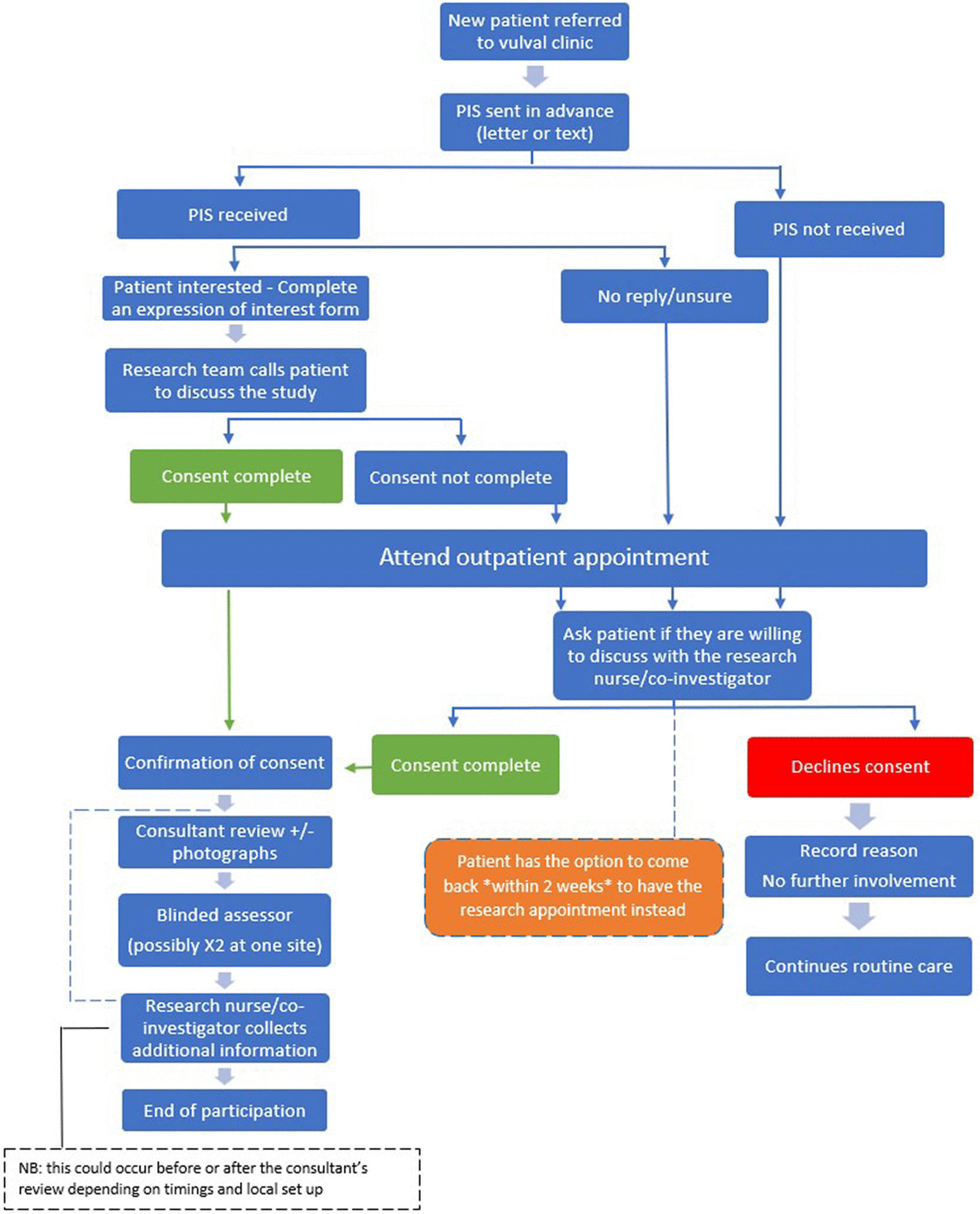
Following consent, demographic and clinical data will be collected by the research team, and the participant will receive assessment from the managing clinician (reference standard) as part of their usual care. Subsequently, an additional assessor who is blinded to the clinician’s diagnosis will examine the patient and record the presence or absence of the eDelphi agreed diagnostic features (index test). Participants are instructed only to give information unless asked, and to not mention their diagnosis.
Optional clinical photographs, if the patient consents, will be taken and used to aid the development of a training manual for future use of a LS diagnostic tool.
All examinations will occur in a single study visit, lasting approximately 30 minutes. All participants are offered a £10 inconvenience voucher following completion of the visit. A summary of data collected during the study is described in Table 2.
|
Data collected
Data management
Data are collected at the time of the diagnostic assessment and from medical records at the specialist outpatient appointment. They are securely entered into the REDCap study database. Case report forms (CRFs) were tested in REDCap by local research sites and the central management team to check for ease of understanding and completion.
Central monitoring of data takes place with data checks, and query resolution is undertaken at the local research sites. Data are primarily entered electronically directly into the database. Where sites use paper CRFs instead, these will be uploaded and transcribed to the database to ensure accurate data entry.
Inter-observer reliability assessment
To assess the interobserver reliability in the diagnostic criteria assessment, the assessment will be conducted consecutively by two independent blinded assessors at one research site. Participants can opt out of this second blinded assessment if they wish.
Sample size and data analysis
Sample size calculation is based upon recommendations by Riley et al.24 using the recommended margin of error of less than or equal to 0.05, for a binary outcome that occurs in half of individuals attending the vulval clinic. This is a prediction for how many variables might end up in the model. Figures reported for frequency of LS in the vulval clinic vary; anecdotal evidence suggests that around half of patients have LS.5,25–27 A sample size of 370 people (185 people with LS and 185 non-LS) is needed to aim for a confidence interval of 0.45–0.55 for the overall outcome proportion of 0.5 and to target a mean absolute error of 0.062 between the index test and reference standard diagnoses. The final recruitment figure of 407 participants includes a 10% increase for missing data.
Analysis will take place via a 3-stage process
1. Sensitivity and specificity of the each of the eDelphi agreed criteria will be calculated.
2. An initial predictive model will be determined through including all identified criteria in a backward multivariable logistic regression model28 with exit criteria p = 0.157.29 Age and active treatment at the time of assessment will be controlled for in the model. Explained variation will be measured by Cox-Snell R-squared, and a calibration plot will assess how well predictions agree with the observed data. Smoothed calibration curves will be plotted using a loess smoother.30,31 Discrimination will be measured using the C statistic.32 A final model will be produced with the criteria that are independently associated with LS. The model will be fitted to the dataset. Thresholds on the calibration plot will be determined. Following discussion with clinical members of the study group, the probability cut off to identify LS will be chosen. The linear predictor using coefficients in the model will be used to estimate the probability of LS.
3. All data for model development will be included for internal validation using bootstrapping. Internal validation is essential to (i) obtain an unbiased estimate of the developed model’s predictive performance, and (ii) adjust (shrink) the developed model for optimisation if necessary. Bootstrapping and uniform shrinkage techniques will be used for analysis.
Missing data are not anticipated as the diagnostic features will be assessed by clinical examination. There will be a ‘yes’, ‘no’, or ‘unsure’ answer recorded in the CRF for each criterion in each patient. However, the sample size is increased by 10% to account for a maximum of 10% missing data. This will be monitored, and if less than 10% data are missing, recruitment target may be reduced accordingly.
Demographic data and participant characteristics will be analysed descriptively.
Inter-observer reliability for assessing the individual diagnostic criteria on 20 cases and 20 non-cases from one of the sites will be calculated using the Kappa statistic. This is additional to the main study outcome and was advised by an external test evaluation expert group. A value of Kappa >60% will be considered acceptable as ‘good’ agreement between observers.33 At the site where these data are collected there will be two independent assessors.
Minimising bias
Consecutive new patients who present with a vulval skin complaint are approached to avoid selection bias. The diagnostic criteria assessment is performed by an independent assessor blinded to the reference standard diagnosis to avoid detection bias.
The study is designed for the reference standard and index test to be measured on the same day (or within 2 weeks) to minimise risk of change in clinical features between assessments.
All participants will be included in the analysis, and complete data set analysis is planned.
The statistical analysis plan will be shared on the study website before the end of recruitment.
Patient and public involvement
SHELLS has worked with patients and the public to inform prioritisation, design, and acceptability of the study. The topic was a top ten research priority in the Lichen Sclerosus Priority Setting Partnership, which involved over 600 patients internationally.34 Two UK patient support groups and patient representatives from a national society (the British Society for the Study of Vulval Disease) were involved in the funding application stage. Protocol design and patient-facing information was developed in consultation with a further national group (Patient Advisors for Vulval Research).
The study will continue to work with its study advisory group, which includes patients, to develop the final diagnostic tool for accessibility, contribute to dissemination activity, and act as research champions, spreading awareness for the study. An outline of important PPI contributions is described in Table 3.
Dissemination strategy will be guided by stakeholders and is planned to target practising clinicians, academics, commissioners, and patient groups. We anticipate publication in scientific journals and conference presentations with multidisciplinary reach, particularly aiming to target primary care where patients with LS will initially present. Important groups to reach are also cervical screening nurses, colposcopists and midwives as they are in a position where they have sight of vulval skin as part of their daily roles.
Links to commissioning groups, as well as those who develop primary care teaching programmes will be developed, as the results have potential to inform education and policy.
We will build social media presence to support dissemination through patient groups, influencers in the women’s health space, as well as specific sectors of the beauty industry where LS may also be incidentally identified.
SHELLS is a diagnostic test accuracy study that aims to improve the diagnosis of vulval LS by a range of healthcare professionals, patients and maybe even the public, through the development and testing of expert-agreed diagnostic criteria in a clinical setting.
Future benefits of timely LS diagnosis through using a diagnostic tool will potentially enable earlier access to treatment. In turn, associated sequelae from LS scarring and vulval cancer development may be minimised.
• There may be spectrum bias in this study, as those referred to clinics are likely to have a more severe and symptomatic condition. Therefore, diagnostic accuracy could be overestimated. However, LS can range in its severity, and it can sometimes be asymptomatic which may balance out the diagnostic accuracy.
• For this research, specialist settings are feasible environments in which the reference standard can be obtained and the sample size recruited within the time and resources available. However, whilst this study has a good representative spread across specialist clinics in the UK, further testing of the diagnostic criteria will be beneficial, particularly in non-specialist areas such as primary care or the beauty industry where the criteria can be used to detect LS earlier. This is also relevant as this research aims to enable patients to self-diagnose themselves outside of healthcare settings.
Ethical approval has been granted (REC 24/LO/0290) in May 2024 by London – Camberwell St Giles Research Ethics Committee. This study is non-interventional, and as such, no risk of harm to participants is anticipated because of participation. All study investigators are required to have an up-to-date Good Clinical Practice certificate.
The study will be conducted in accordance with the ethical principles that have their origin in the Declaration of Helsinki, 1996; the principles of Good Clinical Practice and the UK Department of Health Policy Framework for Health and Social Care, 2017. All study staff and investigators will endeavour to protect the rights of the study’s participants to privacy and informed written consent, and will adhere to the Data Protection Act, 2018.
Provide sufficient details of any financial or non-financial competing interests to enable users to assess whether your comments might lead a reasonable person to question your impartiality. Consider the following examples, but note that this is not an exhaustive list:
Sign up for content alerts and receive a weekly or monthly email with all newly published articles
Register with NIHR Open Research
Already registered? Sign in
If you are a previous or current NIHR award holder, sign up for information about developments, publishing and publications from NIHR Open Research.
We'll keep you updated on any major new updates to NIHR Open Research
The email address should be the one you originally registered with F1000.
You registered with F1000 via Google, so we cannot reset your password.
To sign in, please click here.
If you still need help with your Google account password, please click here.
You registered with F1000 via Facebook, so we cannot reset your password.
To sign in, please click here.
If you still need help with your Facebook account password, please click here.
If your email address is registered with us, we will email you instructions to reset your password.
If you think you should have received this email but it has not arrived, please check your spam filters and/or contact for further assistance.

Comments on this article Comments (0)