Keywords
mental health, rural health, coastal communities, place-based, health inequalities, research infrastructure, co-production, capacity building, learning health system, pre-protocol

mental health, rural health, coastal communities, place-based, health inequalities, research infrastructure, co-production, capacity building, learning health system, pre-protocol
Health research activity in England does not consistently follow the distribution of health need. A national study of recruitment to health research between 2013 and 2018 evidenced substantial geographical variation and lower recruitment in areas with higher prevalence of the conditions examined.1 This limits opportunities to shape and participate in research, and diminishes the evidence available for settings with different populations and service constraints.
Rural and coastal communities remain under-represented in health and social care research.2 These places are heterogeneous: rurality or proximity to the coast does not imply uniformly poorer mental health. However, some rural and coastal communities experience substantial mental health needs alongside deprivation, isolation, environmental exposures, workforce shortages, and restricted access to support.3,4 Travel distances, limited public transport, and digital exclusion can make services harder to reach, and difficult to deliver.4–6 Research must address variation within these places as well as differences from better-served settings.
Lincolnshire is a predominantly rural county with a long coastline and small urban centres; around 70% of its population lives in villages or small towns.7 Several neighbourhoods are in the highest-need national decile of the Small Area Mental Health Index, which combines indicators of service use, depression, prescribing, and mental health-related benefit claims.8 The age-standardised suicide rate for Lincolnshire in 2022–2024 was 14.9 per 100,000, compared with 10.9 in England.9 Long travel distances, workforce pressures, and digital exclusion create further barriers to conventional service delivery models – and these barriers are compounded for coastal services by seasonal population changes and temporary accommodation.3,5 Despite this profile of need, Lincolnshire has historically had low recruitment to mental health research and limited and fragmented infrastructure for conducting applied mental health research.1 Addressing this gap requires attention to the availability and accessibility of research opportunities, alongside how acceptable and relevant people find taking part.
The National Institute for Health and Care Research (NIHR) Mental Health Research Groups programme supports areas with high mental health need, limited research capacity, and low historical research recruitment. It seeks locally relevant research alongside sustainable capability to lead further research beyond an initial five-year award.10
The Lincolnshire Unit for Mental Health Research (LUMHR) developed from the NIHR-funded Guiding Lincolnshire’s Mental Health Research project (GLiMHR), which established a regional partnership and involved 520 people with lived experience, carers, professionals, community organisations and researchers in setting priorities for mental health research.11 The four highest-ranked priorities concerned rural and coastal access, suicide prevention, earlier support and community wellbeing, and maintaining wellbeing and preventing relapse. These shaped our three LUMHR themes of Connect, Prevent, and Respond ( Table 1). A parallel rapid review of international literature found only 20 publications on rural or coastal mental health research priorities, with particularly little evidence about coastal communities.12
This pre-protocol sets out the programme’s shared commitments and research approach before all interventions and study designs have been specified. It is intended to help researchers, communities, and system partners understand, scrutinise, and contribute to LUMHR, and assess its relevance elsewhere. Study-specific protocols will define questions, methods, outcomes, analysis plans, and approvals as the work develops. Extended data 1 provides supporting detail on methods, involvement, and capacity development.
Patients and members of the public were involved before LUMHR was established, through its predecessor, the GLiMHR project. Its priority-setting process involved 520 stakeholders, including people with lived experience of mental health difficulties and carers, alongside professionals, community organisations, and researchers.11 Their priorities informed the programme’s three themes and initial research agenda.
Research inclusion tackles structural barriers that hinder certain groups from contributing to, participating in, or delivering research; engagement concerns dialogue and sharing; involvement focuses on using skills to shape research; participation concerns providing research data.13 Individuals may move between these roles, with consent and clear parameters of their contribution and decision-making. A living strategy will guide practice, grounded in the UK Standards for Public Involvement and NIHR INCLUDE guidance.14,15 The approach also draws on participatory principles of shared problem definition, reciprocal learning, and community influence.16
Two public Co-Investigators and the Lived Experience Advisory Panel (LEAP) provide programme-wide leadership and challenge. Every-One, a local co-production charity, supports facilitation and community relationships. Population Champions advise on groups whose needs or perspectives may be overlooked. The Living Experience Forum contributes to Respond, while the LiL leadership subgroup will shape citizen-science activity. A Public Engagement Co-ordinator supports work across themes, with the Inclusion Lead and theme leads responsible for translating commitments into study practice. Public contributors also participate in independent programme oversight.
As individual studies develop, public contributors will help refine research questions and study procedures, identify outcomes that matter to participants, assess the relevance and burden of candidate measures, and shape recruitment approaches and participant-facing information. They will also help interpret findings and agree the formats, messages, and routes for sharing results with participants and linked communities. These study-specific choices are not all fixed at this programme pre-protocol stage and will be documented in subsequent protocols.
GLiMHR’s public-involvement evaluation identified strong public voice but narrower reach and opportunities to influence some stages of research.11,17 Activity was often online or centred on Lincoln. LUMHR will therefore work through community venues and trusted organisations, offer non-digital participation, and make practical adjustments where needed. The Accessible Information Standard will guide adjustments relating to communication and information needs.18 Reaching beyond established mental health networks is a priority. Community organisations will be recognised and resourced for their contribution, and teams will consider demands on contributors’ time, travel, and emotional wellbeing.
For important decisions, teams will state whether public contributors decide, share decisions, advise, or are informed, and explain constraints. Payment, expenses and support will follow relevant guidance and agreed programme arrangements.19 Training and development will be reciprocal, with routes into peer research, co-applicant roles and leadership where desired. Feedback will explain what changed, what did not and why. Differences of view and advice not adopted will be recorded rather than treated as evidence of failed involvement. Extended data 1 sets out practical arrangements.
Formative review will examine who contributes and who remains absent, opportunities to influence decisions, contributor experience, and reciprocal benefit. Public accounts and examples of decisions will complement proportionate records of reach and activity. The approach will be agreed with contributors and aligned with wider evaluation requirements, avoiding a separate fixed measurement schedule at this stage.
LUMHR aims to establish sustainable, place-based capability to generate and use applied mental health evidence in rural, coastal, and small urban communities, including areas experiencing deprivation. It will develop locally grounded research with applicable relevance for regions facing similar mental health challenges and inequalities.
LUMHR has six objectives:
1. Generate evidence about mental health need, access, outcomes, and their structural and contextual influences in research-underserved settings.
2. Build durable partnerships and infrastructure through which academic, clinical, community, and lived-experience expertise can shape and lead research.
3. Develop or adapt provisions across prevention, access, and crisis support, assess their feasibility, and establish the evidence required for further evaluation or implementation.
4. Address inequities in access to support and research opportunities, including those associated with geography, service fragmentation, social disadvantage, and digital exclusion.
5. Develop researchers, and research-active professionals and citizens, including leaders able to secure external grants, programmes, and fellowships.
6. Connect service data, citizen-generated evidence, and practice knowledge to inform decisions, evaluate resulting changes, and identify further research questions.
LUMHR covers the Lincolnshire geography served by the Integrated Care System at establishment: seven district areas within the county, with 768,364 residents recorded in the 2021 Census.20 An Integrated Care System brings NHS, local-government, and other partners together to plan health and care. NHS and local-government arrangements are changing; the programme’s geographical remit will therefore be described separately from organisational boundaries. Analyses will distinguish resident, registered, and service-using populations, and use denominators appropriate to each question. The programme is all-age, with Population Champions advising on inclusion. Community venues and engagement space on the East Coast will support activity beyond the main university and service centres.
A socio-ecological framework locates mental health within interacting individual, interpersonal, community, organisational, and system and policy influences ( Figure 1).21 Two dimensions guide questions across these levels: where needs and resources are distributed, and how behaviour and practices may change within those conditions.
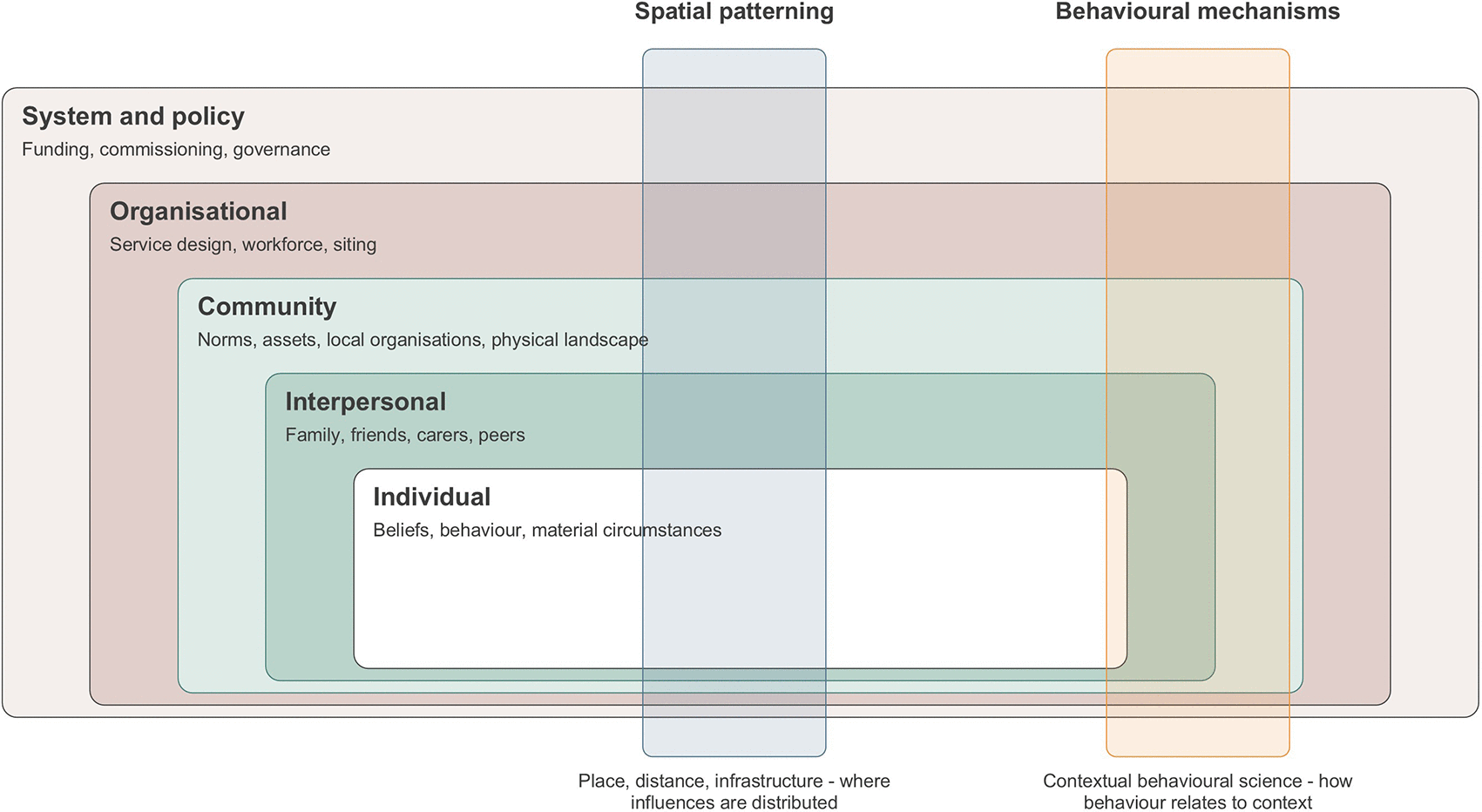
LUMHR considers mental health across five interacting levels: individual, interpersonal, community, organisational, and system and policy. Spatial analysis examines how needs, resources, and influences are distributed, including natural and built environments, transport, and connectivity. Behavioural hypotheses are considered alongside structural and material influences across the five interacting levels.
Geospatial analysis will examine the distribution of need, service provision, transport, and environmental conditions across the county. These include relevant natural and built features, such as coastal location, rurality, and housing.22 GLiMHR analysis found that referrals to urgent assessment declined with distance from the service, illustrating why geography matters to access.23 Spatial associations will be interpreted alongside service and community knowledge.
Contextual behavioural science provides one resource for developing hypotheses about how behaviour relates to circumstances.24 For example, a new referral route may require changes both in people’s expectations of support, and in staff practices. Such explanations will be considered alongside material constraints, including transport, service capacity, and poverty. Individual economic circumstances, including changes in employment, income or financial security, will be considered separately from area-level deprivation where relevant data are available.25
LUMHR adopts a learning health system orientation: information from research and practice should inform decisions, whose outcomes generate further learning and improvement.26 Responsible research and innovation will guide this process from question development onwards.27 Teams will identify an approach’s intended purpose and expected value, the people who use or are affected by it, and potential harms, costs, and inequalities. This includes public contributors, practitioners, managers, commissioners, and those who maintain or administer services and technologies. Their input will shape design, testing, and decisions about further use.
Connect, Prevent and Respond share an iterative research approach and an observatory that connects evidence across themes. Public involvement, research inclusion, capacity development, responsible innovation, and knowledge mobilisation run throughout. Table 2 summarises the work packages.
The four stages are iterative ( Figure 2): projects may enter or revisit stages according to the available evidence. Evidence synthesis, public involvement, and consideration of implementation run throughout.
• Generate and integrate insight. Combine existing (published and grey) research, linked health records, geospatial analysis, and community evidence to understand needs, access barriers, protective resources, and priorities.
• Co-design or contextualise approaches. Develop or adapt candidate approaches with communities, services, and other users. Specify their intended purpose, theory of change, core components, and components that may be adapted to context.
• Test feasibility and identify evidence gaps. Examine acceptability, feasibility, safety, fidelity, and study procedures, with process evaluation and early economic evaluation where appropriate. Early signals of cost, benefit or harm inform further investigation.
• Learn, adapt, and decide. Appraise the strength and applicability of existing and newly generated evidence. Options include refinement, combination, or stopping; further synthesis or primary research; and externally funded definitive or multicentre evaluation. Approaches supported by sufficiently robust evidence may proceed to contextual adaptation and evaluated implementation, with wider use considered where justified. Implementation and regulatory requirements will be considered during development.28
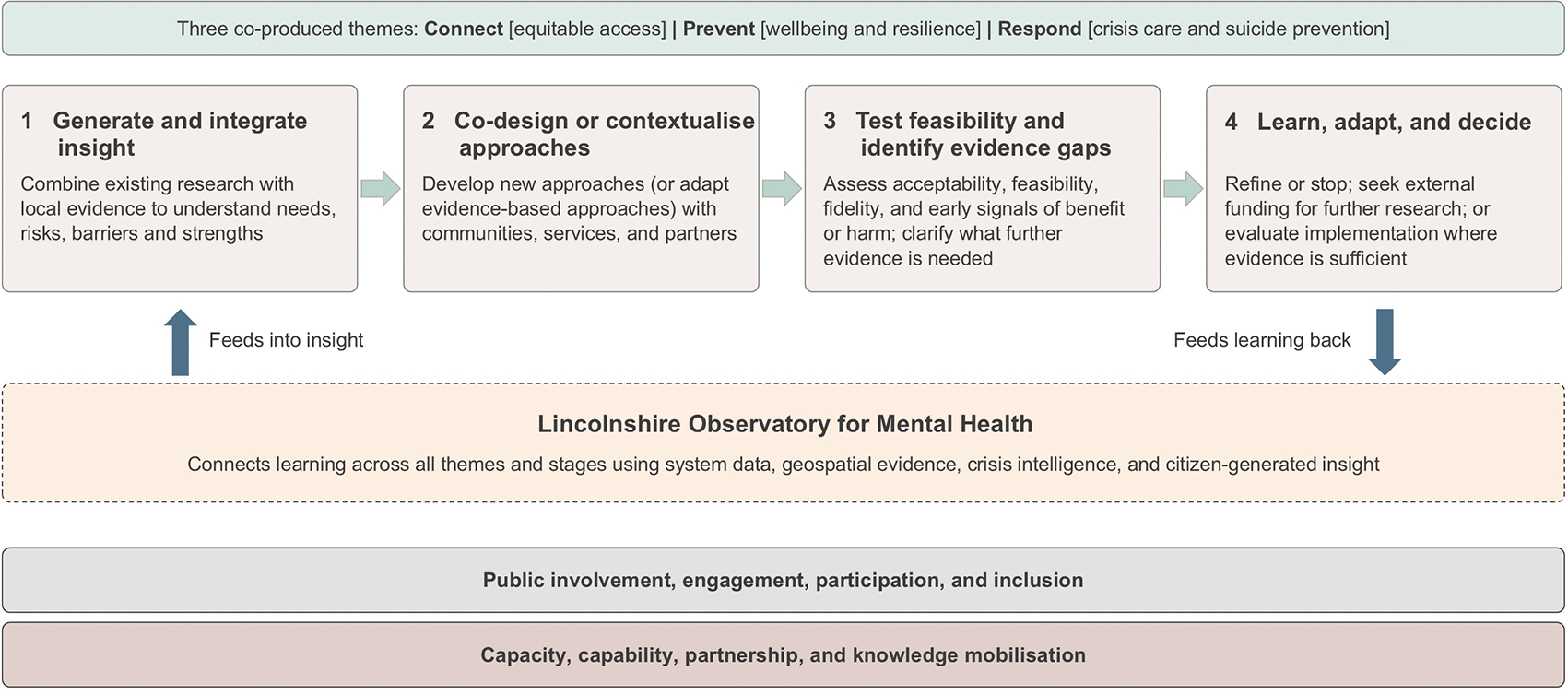
The three LUMHR themes (Connect, Prevent and Respond) share four iterative stages: generating and integrating insight; co-designing or contextualising approaches; testing feasibility and identifying evidence gaps; and learning, adapting, and deciding. The Lincolnshire Observatory for Mental Health connects evidence and learning across themes and stages. Public involvement, inclusion, responsible innovation, capacity development, partnership, and knowledge mobilisation support the programme throughout.
Progression criteria will be specified in study protocols and proportionate to the question, uncertainty, and potential consequences. Theme teams will prepare recommendations for the LUMHR Executive Team, drawing on methodological, clinical, economic, implementation, and public perspectives, with independent advice where warranted. Decisions and their rationale will be recorded. Approval to undertake further research will remain distinct from partner organisations’ decisions to adopt, commission, or discontinue a service. The detailed allocation of decision authority will be confirmed through programme and study governance.
The theme descriptions outline the initial research questions and approaches; study-specific protocols will follow.
Connect addresses the highest-ranked GLiMHR priority: improving access in rural and coastal areas where transport, workforce shortages, isolation, and digital exclusion can restrict support. It will examine where recorded need, service provision, and access differ, and how services and communities understand these patterns.
Generating and integrating insight (WP1.1). Subject to approvals, analyses will use linked electronic health records from primary, secondary, and emergency care from 2019 onwards, with ambulance attendance data added where available and authorised. Individual-level records will remain in the data controller’s secure environment; researchers will submit analytical code for execution there and receive disclosure-controlled outputs. Small-area analysis, including at Lower-layer Super Output Area level where appropriate, will examine differences hidden in district averages. Area-level indicators will describe deprivation, rurality, coastality, transport, digital exclusion, and mental health need.6,8 Sparse counts, inconsistent recording, and linkage limitations may require aggregation or restrict analysis.
Electronic health records capture recorded contacts and conditions, but not all underlying need.29 Low service use may reflect barriers, and utilisation-based measures can reproduce existing inequalities.30 These limitations apply to all analyses using these records. Records may nevertheless support indicators of potentially unmet need, provided the assumptions linking recorded morbidity, expected care, and observed care are explicit.31 The programme will examine recording and coverage differences, define denominators explicitly, and interpret results alongside qualitative and citizen-generated evidence. For example, low recorded contact in a distant community would prompt investigation of service accessibility and local accounts before being interpreted as low need. Combining sources may reveal blind spots but cannot recover all unrecorded need or make a self-selected panel representative.
Methods will follow the research question: analyses will describe recorded mental health needs, service contacts, and pathways, including geographical differences in need and access. Appropriately designed longitudinal and comparative studies, including geospatial analysis, will explore explanations for these patterns and evaluate changes in services or support. For causal questions, directed acyclic graphs may help make assumptions explicit and guide study design and adjustment.32 Predictive modelling, including machine learning, will be considered where it is clear what needs to be predicted, for whom, and to inform which decision. Models will be compared with meaningful simple benchmarks.33 Internal validation will separate model development and tuning from performance assessment, using resampling appropriate to the data structure. Validation in later periods or other settings will be pursued where suitable data are available.34 Evaluation will examine calibration and predictive performance across population groups. Statistical prediction will not be interpreted as evidence that changing a predictor changes an outcome.35
Co-design and contextual adaptation (WP1.2). Mapping, community accounts, and a rapid review of access interventions will inform structured workshops. The Levesque framework will help examine both service characteristics and people’s ability to recognise need, seek, reach and engage with support.36 Behavioural frameworks such as COM-B may clarify how capability, opportunity, and motivation affect a proposed change.37 Candidate approaches may involve referral routes, outreach, or changes to service delivery; selection will reflect evidence, local priorities, and organisational constraints. The resulting theory of change will specify what is expected to change, through which mechanisms, and under what conditions.
Feasibility and next steps (WP1.3). Selected approaches will be examined using mixed-methods feasibility studies, process evaluation, and provisional health economic analyses to examine resource use, implementation costs, and the feasibility of a future full economic evaluation.28,38 Studies will test delivery, acceptability, recruitment, outcome measurement, and relevant progression criteria.39 Frameworks such as RE-AIM, Normalisation Process Theory, and the Theoretical Framework of Acceptability will be used where they answer a defined question.40–43 Findings will inform intervention refinement and the design of further evaluation. External funding will be sought where stronger evidence of effectiveness, safety, or cost-effectiveness is needed; sufficiently supported approaches may be considered for evaluated implementation.
Prevent addresses earlier support, community wellbeing, and maintaining wellbeing over time. Living in Lincolnshire (LiL), a longitudinal citizen-science panel, will provide a continuing way for people to contribute evidence and influence research.44,45 Its emphasis includes strengths, everyday circumstances, and wellbeing outside formal service contact.
Generating and integrating insight (WP2.1). The theme establishes LiL to enable people across Lincolnshire to shape research questions and designs and participate in collecting data and interpreting and disseminating findings, with efforts to include people and communities under-represented in research. LiL will initially recruit 384 members during years 1–2, followed by expansion and refreshment. This target was informed by a standard survey benchmark for reasonably precise estimates: around 384 completed responses would give a margin of error of approximately ±5 percentage points at 95% confidence under simple random sampling. Scotland’s Our Voice Citizens’ Panel similarly linked panel size to survey precision.46 For LiL, this provides a guide to planning and growth, with findings interpreted considering open recruitment and who responds, without assuming population representativeness or that margin of error. Composition will be benchmarked against relevant population characteristics; targeted recruitment will address important gaps; attrition and recruitment routes will be reported; and weighting or stratified estimates will be used only where underpinning assumptions are defensible. The methodology for developing a place-based citizen science panel will be published, to support the development of similar panels in other areas.44,45
Citizen science is a distinct research methodology.45,47 It has identified diverse self-management strategies used by people both within and outside mental health services.48 The LiL panel differs from a conventional cohort in that members may contribute to the research process, provide and analyse research data, and be involved in dissemination. A citizen leadership subgroup, initially envisaged as 12–15 members, will work with researchers to develop the core dataset and prioritise questions, and participate in interpretation. Repeated measures of wellbeing and, where relevant, recovery will sit alongside questions about protective resources and members’ priorities. The panel will examine issues that service records capture poorly, including non-use of services, and how wellbeing is sustained in everyday life. The boundaries between involvement in LiL and research participation in a specific LUMHR study will be explained clearly, with appropriate consent and governance for each activity. Data products will follow FAIR principles,49 with access arrangements reflecting consent, governance requirements, and disclosure risk.
Co-design and contextual adaptation (WP2.2 and WP2.3). One strand concerns personalised support, potentially including just-in-time adaptive interventions that adjust support to a person’s changing circumstances.50 Their purpose, decision rules, and delivery options will be specified through co-design, with low-connectivity, offline, or human-supported routes considered from the outset. A second strand will identify locally valued community initiatives, such as peer groups or wellbeing hubs, and examine how they may support wellbeing. Mapping, evidence review, and explicit theories of change will inform which approaches warrant further development or evaluation. Co-design will consider research evidence alongside lived experience, including findings that challenge initial expectations.
Feasibility and next steps (WP2.4). Studies will examine engagement, acceptability, safety, practical delivery, and outcome measurement for selected approaches. Evaluation designs will reflect intervention characteristics, delivery settings, and available comparators, drawing on LiL and other observatory evidence where appropriate and where the data permit. Process evaluations and provisional health economic assessments will examine delivery, resource requirements, implementation costs, and the feasibility of future evaluation. For digital approaches, intended use will determine relevant regulatory, technical, and clinical requirements before testing or deployment. Decisions about further research, externally funded trials or implementation will follow the common evidence appraisal process.
Respond addresses suicide prevention and support for people experiencing mental health crisis, including those poorly served by existing provision. The initial work will establish shared operational definitions of crisis and related outcomes, map services and pathways, and combine research evidence with local experience to identify priorities.
Generating and integrating insight (WP3.1). A mental health crisis component of the observatory will build on existing surveillance partnerships and complement public-health monitoring of suicide deaths. Subject to access and data quality, it will examine self-harm, suicide attempts and other crisis presentations in primary care, ambulance, emergency, and mental health records. It will consider crises not preceded by recorded specialist contact and gaps in coverage, timeliness, or linkage. Service and pathway mapping will identify existing provision and possible unmet needs. The Living Experience Forum, an established local group contributing to suicide prevention, will help interpret findings. A prototype dashboard and reporting process will be evaluated with intended users.51 Surveillance outputs will support agreed service and research questions; the dashboard will not provide automated individual-level risk scores or decisions.
Co-design and contextual adaptation (WP3.2 and WP3.3). Two complementary strands will be developed. The first concerns short-term support for people experiencing crisis, particularly those poorly served by existing provision. Candidate models include peer-run respite, crisis cafés with out-of-hours provision, mobile outreach, or hub models, and supported digital contact, but selection will be informed by evidence review and co-design.52 A second strand will examine the training and continuing support needs of staff delivering services who encounter distress outside specialist mental health roles, including housing, welfare, pharmacy, emergency services, youth work, and schools. Priority settings and training models will be selected after needs assessment and evidence review. Where an established approach is adapted, its core components will be identified and retained while context-dependent delivery is co-designed. Evaluation may draw on Kirkpatrick’s levels,53 implementation outcomes and observed practice, recognising that satisfaction or knowledge gain alone does not establish benefit.
Feasibility and next steps (WP3.4). Selected approaches will undergo feasibility studies examining safety, acceptability, recruitment, retention, fidelity, and delivery, with process evaluation, cost evaluation, and study-specific progression criteria. Relevant implementation frameworks may help explain differences between settings.40,54 Findings will inform refinement, further synthesis, or externally funded evaluation, including work with other centres where needed. Implementation will depend on the wider evidence base as well as local feasibility and resource implications. Trauma-aware facilitation, support for public contributors and researchers, safeguarding procedures and clear clinical escalation arrangements will apply during design (WP3.2 and WP3.3) and testing. Research activity will remain distinct from services’ responsibilities to respond to imminent risk.
The observatory will connect learning across the whole county and all three themes. It is a shared analytical and interpretive function. Linked electronic health records will remain in approved secure environments; LiL and crisis data will retain their relevant consent and governance arrangements. Common definitions, metadata, reusable code, aggregate outputs, and joint interpretation will support work across sources. Linkage between sources will occur only where justified and authorised - the observatory’s value will depend on the questions it can answer and decisions it can inform.
Partners and public contributors will help define questions, interpret findings, and identify their implications. For example, a geographical pattern of crisis contacts could prompt joint examination of access, local support, and service pathways, followed by a decision to investigate further or evaluate a change. Professional Research Leads and other embedded roles will connect this work to service teams and organisational decisionmakers. For selected outputs, teams will document who considered the evidence, what decision followed, who was responsible for action, and what subsequent learning or outcomes could be assessed. Responsibility for commissioning and service changes will remain with the relevant NHS organisation, including the Integrated Care Board where applicable, local authority or community organisation. These arrangements make the learning health system ambition concrete without assuming that information alone produces change.26
Longitudinal service and community evidence may support evaluation where reliable baselines, appropriate comparisons, and sufficient coverage are available.55 The design must address confounding, changing recording, and differences in participation. LiL will not provide population prevalence estimates by default, and linked records will miss some unmet need. Sustaining the observatory will require agreed ownership, analytical staff, refreshed permissions, and recurrent resources. These arrangements will be developed with partners alongside the research programme.
Capacity development is a central purpose of LUMHR.10,56,57 GLiMHR identified research activity dependent on individual initiative, with limited protected time, mentoring, and coordination. LUMHR will develop shared arrangements that help people enter research, progress, and lead work across organisations. Success will involve retained skills, stronger partnerships, and locally led grants and fellowships, as well as participation in training. Capability may develop differently across professions, organisations, and communities.
The programme supports postdoctoral researchers, a cross-sector fellow and Professional Research Leads with protected time in partner services. The Leads will bring questions and knowledge from practice into study development, support interpretation of evidence, identify implementation constraints, and connect findings to clinical and organisational decisions.58 These functions complement their own research development. Their contribution will depend on sustained links with service teams and managers, alongside mentoring and opportunities to lead research.
Doctoral studentships, including routes for system leaders, will connect research development with partner priorities. Peer-research training, paid internships and progression opportunities will support professionals, people with lived experience and community partners. Academic careers are one possible route; increased capability to ask questions, contribute to studies and use evidence within existing roles is also valued. Planned opportunities and numbers from the funded programme are summarised in Extended data 1.
Mentoring, cross-institutional supervision, placements, and specialist training will support progression. A planned Research Navigator will help people find methods support, governance advice, training, and funding opportunities. Development plans will include leading studies, building collaborations, publications and applications for fellowships and grants. Small awards and pump-priming may support progression towards larger collaborative studies and programmes. Partnerships with experienced research centres will support the development of independent local leadership.
Capacity development will consider individuals, teams, organisations, and the wider partnership.57 Internal learning will examine access to protected time, opportunities to lead, continuity of roles and the extent to which skills and relationships become embedded in partner organisations. Attention will be given to professions, communities, and locations with fewer existing opportunities. The detailed approach to measurement will be aligned with NIHR reporting and evaluation requirements.
The Co-Leads hold programme leadership and accountability, alongside the responsibilities of host institutions, sponsors, and partner organisations. The Executive Team oversees strategy, resources, risks, and research progression; theme leads coordinate studies; and operational arrangements support delivery. LEAP provides public leadership and a direct route to raise concerns. An independently chaired Steering Committee scrutinises quality, direction, and public value, with international advice supporting wider relevance. Terms of reference will specify delegated authority, conflicts of interest, and escalation. Extended data 1 summarises responsibilities.
Research progression decisions will draw on appropriate expertise and documented evidence, with independent scrutiny proportionate to the uncertainty and consequences. Programme governance will not replace study sponsorship, ethical review, data-controller authority, or partner organisations’ responsibility for service adoption. Data-driven work will include clinical, methodological, ethical, and public perspectives on acceptable use.
Table 3 summarises the programme logic, linking activities and immediate outputs to intended longer-term contributions.
Internal evaluation will support formative learning and adaptation; revisiting what was achieved, what was not, and why. It is distinct from NIHR’s external accountability, reporting, and evaluation arrangements. Detailed indicators, data sources, and schedules will be agreed once funder requirements are clear, using shared records where possible.
The domains in Table 3 describe the intended contribution of a mature research infrastructure. Research and capability achievements can be assessed directly through studies, leadership, careers, and funding. Earlier benefits may also arise through involvement and partnership working, including contributors’ skills, confidence and influence, and changes in how partner organisations involve communities or use evidence. Service changes require evidence of decisions and their consequences. Population and equity indicators will be interpreted in context, with appropriate comparisons where feasible and recognition that important effects may emerge beyond the award. Assessment will consider LUMHR’s contribution alongside other influences, drawing on accounts from those affected and corroborating evidence where available.
The five-year award is an establishment period. By its end, the ambition is a locally led infrastructure that can develop important questions with communities and services, secure funding to address them, conduct rigorous research and support use of the resulting evidence. This requires both capability embedded in partner organisations and a continuing pipeline of externally funded research.
Elements intended to endure include analytical expertise and governed data infrastructure; public and citizen-science relationships; Professional Research Lead development and research leadership; and routines for using evidence in service and policy decisions. LiL’s continuation will depend on consent, participation, governance, and resources. Partners will need to agree which functions they can own and maintain, their recurrent costs and arrangements for workforce continuity. Reusable code, metadata, procedures, and training resources will support continuity across staff changes. Embedding functions does not remove their need for funding.
Grant and fellowship development is core during the award. The funded programme envisages at least three major follow-on applications in years four and five, arising from access, prevention, and crisis-support work. Their questions and designs will follow the evidence generated, including needs for definitive trials, wider comparative evaluation, or additional synthesis. Collaborations beyond Lincolnshire will support generalisability, methodological development, and larger studies. Income diversification, workforce retention, and continuity of data access will be reviewed with partners, recognising pressures from organisational change and competing service demands.
This programme pre-protocol describes LUMHR’s shared research framework and does not report new participant-level data or analyses from its constituent studies. Ethical approval and research governance are addressed at the level of the relevant study or data use.
The LiL study (WP2.1) received a favourable ethical opinion from a University of Lincoln Research Ethics Committee (reference 2026_23317) on 26th May 2026. This approval covers the research specified in the approved LiL application and supporting documentation; it does not constitute approval for all studies within LUMHR. Each constituent study will have appropriate sponsorship and obtain the required ethical, regulatory, and governance approvals before work begins.59,60 Responsible innovation will continue through study design, conduct, and decisions about use. Teams will revisit intended purposes, affected users, costs, possible harms, and equity as circumstances change.61 Digital and data-based work will consider privacy, re-identification, bias, explainability, maintenance, and accountability for acting on outputs.62 Applicable regulatory requirements will be identified early in relation to the intended use. Intervention specifications will distinguish core functions supported by theory or evidence from aspects that can be adapted, documenting adaptations and their implications.
All research studies, public involvement, and engagement activities will have clear safeguarding and escalation arrangements, trauma-aware facilitation, and support for contributors and researchers, proportionate to the activity and with age-appropriate safeguards where children or young people are involved. Information for participants and public contributors will explain confidentiality and its limits. Research participation, dashboards, and monitoring will not be presented as a substitute for clinical care or an emergency-response service.
For linked electronic health records and other sensitive data, secure analysis, data minimisation, and disclosure control will complement examination of coverage and bias. Small-area outputs will be reviewed for re-identification and stigmatisation risks. Where predictive models are developed, intended use, validation, and differential performance will be assessed before any proposed operational application. Public input will inform acceptable-use decisions.
For community research, teams will address unequal influence, repeated demands to recount personal experiences and the distribution of benefits. Practical support, payment, recognition, feedback, and development opportunities will accompany attention to who is absent or unable to contribute. Safeguards will be revisited with affected groups as work develops.
Under the approved LiL procedures, participants must be able to provide informed consent. Written informed consent is required before enrolment, using the approved participant information sheet and consent form. Participation in individual survey waves and optional activities is voluntary. Additional information and separate consent will be obtained for optional activities involving additional procedures, recordings, images, or different types of data, as specified in the approved study documentation. Agreement to be contacted about research beyond LiL is optional. For other participant-facing LUMHR studies, consent procedures will be specified in the relevant study protocols and submitted for ethical review before recruitment. Where future studies involve children or young people, these protocols will specify age-appropriate information, consent, and assent procedures, including parental or guardian consent where required. Studies using routine records will follow the consent and data-access arrangements applicable to the relevant dataset and approved research use.
Knowledge mobilisation will begin with study questions and intended users. Communities, practitioners, service managers, commissioners, and policymakers will help identify the information they need and how findings could inform decisions. Professional Research Leads and other embedded roles will maintain dialogue with services. Accessible summaries, briefings, workshops, dashboards, or tools will be chosen for their purpose, alongside open-access publications and conferences. Findings will be shared whether positive, negative, or inconclusive.
The partnership with Centre for Mental Health will support interpretation for national policy and practice, through joint identification of relevant questions, contextual benchmarking and development of usable briefings and recommendations. The University Policy Hub will support policy engagement. For major workstreams, teams will develop pathways to impact with intended users and potential beneficiaries, identifying the changes sought, how research could contribute, the conditions needed, and proportionate evidence of progress. For selected outputs, LUMHR will document use and influence on decisions as well as dissemination, including resulting changes, who benefits, and reasons findings were not acted on. This will help distinguish producing evidence from achieving change and inform future research and communication.
Study protocols and analysis plans will be registered or published prospectively where applicable. Reports will follow design-appropriate guidance. Code, metadata, measures and other reusable outputs will be shared where rights, consent, and governance permit, informed by FAIR principles.49 Sensitive data may require controlled access, aggregate or synthetic outputs, or no sharing, with reasons made clear. Sharing decisions will account for residual disclosure risk and the resources required to maintain useful outputs.
LUMHR combines locally identified priorities, complementary forms of evidence, and sustained investment in people and partnerships. Its contribution will include substantive mental health findings and methods for developing research in places with historically limited infrastructure. Local priority-setting provides accountability63 and communities will continue to shape questions, interpretation, and decisions as evidence develops.
The observatory and LiL create opportunities to compare service-recorded patterns with community accounts, including non-use of services and protective resources. This may generate questions that either source alone would miss. The approach also creates demands: measures, timing, and geographical coverage may not align, and neither source offers an unqualified account of need. The research will examine where combined interpretation adds value and where uncertainties remain.
For prevention and community interventions, repeated data may support evaluation of changes that extend beyond direct participants or formal service use. Routine datasets and the citizen panel can contribute to effectiveness studies that use credible comparisons, suitable outcomes, and methods to address selection bias and confounding. The programme will develop this capability, drawing on additional data, collaboration with other centres and external funding where needed.
Embedded research roles and public development opportunities are intended to leave capability within organisations and communities. This connects local delivery to the ambition for Lincolnshire-led grants, fellowships, and nationally relevant studies. The emphasis on community support and prevention is also consistent with the direction of England’s 10 Year Health Plan, while attention to digital exclusion remains essential to equitable use of technology.64
Co-production requires a balance between prior commitments and openness. This pre-protocol specifies aims, broad methods, and accountability while leaving intervention details and study designs to further development (forming prospective study protocols). Feasibility findings, public preferences, and service priorities will inform decisions alongside the quality of the wider evidence base.
Unequal service contact and recording limit every analysis of electronic health records,65 while self-selection and attrition limit the citizen panel.66 Triangulation, subgroup analysis, and public interpretation can expose some limitations but cannot eliminate them. Claims about unmet need, effectiveness, and equity will be restricted to what the data and study designs support.39
Broader involvement cannot be assumed from offering more routes: participation may remain unequal, and practical or emotional demands may exclude people.11,67 Teams will examine who can contribute, whose views affect decisions, and what contributors gain, using findings to adapt relationships and methods.
Research takes place within changing health, social-care, and local-government systems.68 Staff turnover, data ownership, operational pressures, and wider social conditions may affect delivery and outcomes. These influences will be described where relevant so readers can judge the contribution of LUMHR and whether findings may hold in other places or periods.69 Changes in population mental health will be treated as a shared and context-dependent outcome.
Lincolnshire’s circumstances share features with other rural, coastal, and underserved areas. Work in Norfolk and Suffolk describes a similar approach to building research priorities with local communities.63 Research on regional infrastructure highlights the importance of sustained relationships and organisational support.70 LUMHR will identify both common challenges and contextual differences, rather than presuming that its setting is unique or that findings necessarily require extensive adaptation.
Transferable contributions may include interventions, evidence to inform policy and commissioning, methodological approaches, data definitions, participatory processes, and ways of developing research leadership. Multicentre collaboration and reciprocal learning, including with rural and regional researchers in Australia, will help examine applicability beyond Lincolnshire. Describing core components, context and adaptations will support informed use elsewhere.12,71,72 National and international relevance will be considered when developing questions and subsequent funding proposals.
LUMHR seeks to establish enduring applied mental health research capability across Lincolnshire through three connected themes, a shared observatory, public leadership, and research development. Its common approach links local insight and existing evidence to co-design, feasibility, and explicit decisions about further research or implementation.
The five-year award provides the foundations for this work. Success will include rigorous and transferable research, stronger careers and partnerships, evidence informing service decisions, and a viable pipeline of externally funded studies and fellowships. This pre-protocol makes those intentions and their main dependencies explicit while retaining the flexibility needed for collaborative research.
Provide sufficient details of any financial or non-financial competing interests to enable users to assess whether your comments might lead a reasonable person to question your impartiality. Consider the following examples, but note that this is not an exhaustive list:
Sign up for content alerts and receive a weekly or monthly email with all newly published articles
Register with NIHR Open Research
Already registered? Sign in
If you are a previous or current NIHR award holder, sign up for information about developments, publishing and publications from NIHR Open Research.
We'll keep you updated on any major new updates to NIHR Open Research
The email address should be the one you originally registered with F1000.
You registered with F1000 via Google, so we cannot reset your password.
To sign in, please click here.
If you still need help with your Google account password, please click here.
You registered with F1000 via Facebook, so we cannot reset your password.
To sign in, please click here.
If you still need help with your Facebook account password, please click here.
If your email address is registered with us, we will email you instructions to reset your password.
If you think you should have received this email but it has not arrived, please check your spam filters and/or contact for further assistance.

Comments on this article Comments (0)