Keywords
Caregivers, Self-efficacy, Dementia, Self-Management, Internet-based Intervention

This article is included in the Programme Grants for Applied Research gateway.
Caregivers, Self-efficacy, Dementia, Self-Management, Internet-based Intervention
Dementia has a profound impact on individuals, families, healthcare systems, and economies globally. Encompassing healthcare, social care, unpaid caregiving, and reduced economic activity, the cost of dementia in the UK was estimated at £42 billion in 2024 and is projected to more than double to over £90 billion by 2040.1
Unpaid care provided by friends and family is a critical part of a person with dementia’s support with a third of family caregivers spending over 100 hours a week providing care while only 14% receive any respite care.1 Given their crucial role, it is important to keep caregivers well, yet caring for a person with dementia is associated with significant psychological and physical health concerns.2–6 However, caregivers may not be offered support; in one analysis, 37% of approximately 1,000 caregivers, respondents had not been offered any support following their loved one’s diagnosis.7 Or the stigma of caring or lack of acceptance of a new diagnosis can mean caregivers do not often seek formal social care support from services8–10 despite the evidence that early support can help alleviate high levels of caregiver burden.11,12 Although implementing interventions for caregivers requires investment, evidence suggests that effective interventions could generate substantial annual savings for health and social care.13 One 2024 estimate suggested savings could reach £60 million in 2025.14
Recent studies evaluating interventions designed to support caregivers have reported encouraging results. STrAtegies for RelaTives (START)15 is an eight-session manualised intervention delivered in caregivers’ homes by trained psychology graduates. START has been shown to be a clinically and cost-effective intervention that meaningfully reduced depression and anxiety and increased quality of life for caregivers of people with dementia.15 However, there are potential limitations in scalability due to the need for resource-intensive delivery. The New Interventions for Independence in Dementia Study (NIDUS-Family)16 was a large randomised controlled trial (RCT) testing a manualised, multimodal psychosocial intervention aimed at helping caregiver and person with dementia dyads achieve self-set goals to improve the care of the person with dementia. Goal attainment was higher for caregivers after receiving the NIDUS-Family intervention, however there were no statistically significant differences between groups in other caregiver outcomes, such as anxiety, depression, and quality of life.16 Whilst there were positive effects on goal attainment, long-term impacts on delaying institutional care of the person with dementia, reducing healthcare utilisation, or changing disease progression remain to be robustly established.17 There would also be challenges in delivering the full eight-session intervention at scale within existing NHS and social care resource constraints.18 The intervention’s intensive design requiring multiple sessions might also be challenging for some families given competing demands and carer burden. Alternatives or adaptations for shorter or less frequent contact may be necessary for sustained adherence. In contrast, iSUPPORT offers an online, self-led intervention which aims to reduce depression and distress in caregivers.19 A recent large-scale trial in the UK found no significant reduction in caregiver depression and distress at follow-up after having access to iSUPPORT for 6-months.19 Compared to START and NIDUS-Family, iSUPPORT is a self-directed intervention with no facilitator. This model may partly explain the low engagement rates19–22 yet has enabled accelerated roll-out in over 40 countries19 despite limited evidence of clinical effectiveness. With 95% of UK adults having access to the internet,23 online interventions are becoming increasingly accessible. Incorporating a blended approach that includes human interaction may enhance engagement and outcomes.24,25
CareCoach combines online learning modules with personalised support from a coach. It has been adapted for UK caregivers26 from a clinically effective evidence-based Dutch programme ‘Partner in Balance’ (PiB).27–29 Both PiB and CareCoach aim to increase self-efficacy and resilience early after diagnosis by supporting caregivers to manage daily life and to problem solve. PiB has demonstrated improvements in caregiver self-efficacy and quality of life,12,27 and a full-scale efficacy trial is ongoing in the Netherlands.30 Before evaluating effectiveness in a full-scale trial, it is necessary to establish whether CareCoach is feasible to deliver in the UK, including recruitment, retention, engagement, and acceptability. If feasible, CareCoach may provide a scalable and accessible blended intervention to support caregivers in the UK. Here, we report findings from a multi-site feasibility randomised controlled trial (RCT) of CareCoach in the UK.
The trial was registered on ISRCTN on 18th November 2022 (ISRCTN12540555), which also contains the statistical analysis plan. The protocol is publicly available.31
This was a multi-centre, unblinded, parallel-group, individually randomised feasibility trial of the CareCoach intervention versus usual support. Written consent was obtained centrally by Norwich Clinical Trials Unit (NCTU) online using REDCap electronic data capture32,33 or via post. Participants completed self-report measures remotely, online or by post, at baseline and 6-months post-randomisation. Study data were collected and managed remotely using REDCap hosted at NCTU.32,33
Ethics approval: The study was granted ethical approval by the North West Greater Manchester Research Ethics Committee (REC) and the Health Research Authority (HRA) on 8th November 2022 (ref 22/NW/0293). The ethics committee was independent to the research team. All participants provided written informed consent before joining the trial. There were no important changes to trial methods after the trial opened.
Patient and Public Involvement: At the time of this study, the CareCoach Programme’s Service User Advisory Group (SUAG) consisted of seven family caregivers, including the Patient and Public Involvement (PPI) co-applicant (GF) who was involved in the conception and development of the programme. The SUAG group was set-up at the beginning of the research programme and have been involved in the study design, development of materials (e.g., Participant Information Sheets, recruitment materials, questionnaires), recruitment, and intervention development.26 Members of the SUAG agreed to assist with dissemination of the study results to caregivers in their local communities and relevant wider groups (e.g. charity partners and newsletters).
Participants were approached and recruited by healthcare professionals at six community NHS mental health trusts and one research centre across six regions in England between June and October 2023. The study was also advertised on Join Dementia Research,34 social media, and by charity partners via newsletters and other communications. Advertising the study in other UK nations was introduced in September 2023. The study recruited adult family or friend caregivers of a person diagnosed with any subtype of dementia within the last five years. Caregivers were defined as anyone providing unpaid, informal care, and support for a person with dementia. Eligible caregivers had: a spoken understanding of English (with help of a family interpreter if required), first-degree relationship (spouse, partner, sibling, son, daughter, in-laws) or close personal relationship with the person with dementia (other relative, friend, neighbour), mental capacity to give informed consent to participate, and access to a device with internet capabilities. Caregivers were excluded if they had insufficient cognitive abilities to engage with an online programme and/or if the person with dementia lived in a care home.
CareCoach is an online support programme adapted from an existing Dutch intervention, Partner in Balance (PiB)12,27,29,30 and co-developed by family caregivers and dementia professionals.12,26,28,29 CareCoach combines online learning modules with remote support from a coach (member of site staff ) over 8-weeks. All participants in the intervention were given individual access to the online CareCoach platform. There are nine learning modules, each module provides written information, videos, and exercises ( Figure 1), intended to help caregivers develop knowledge, skills, and confidence to manage and support the care they provide to a person with dementia. The content of the modules and support from a coach are based on the principles of psychoeducation, behaviour change, and self-management, including goal setting, reflection, and problem solving.12,26,27 In addition, there were two video-call sessions with an assigned coach, each lasting approximately 60 minutes, conducted at the start (week 1) and end (week 8) of the intervention. Participants in the CareCoach group continued to access usual care and support.
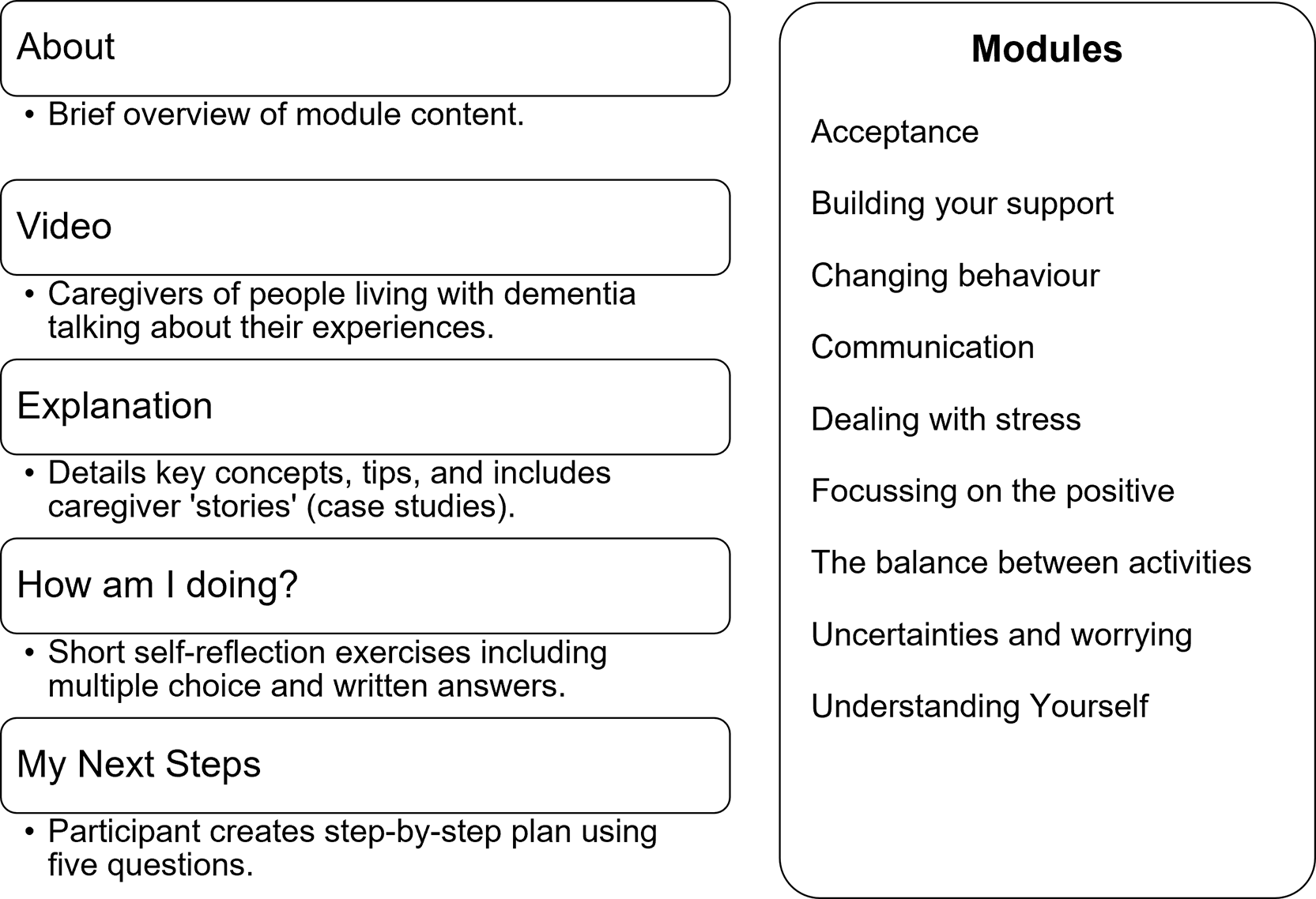
Intervention delivery and coaches: During the first session, coaches assisted participants in choosing up to four modules to work through independently at their own pace over 8-weeks and set one or more Specific, Measurable, Achievable, Relevant, Time-bound (SMART) goals using Goal Attainment Scaling (GAS).35 Coaches could also provide up to 30 minutes of online assistance (feedback and support) per week between the first and final session via the messaging function within the CareCoach platform. Frequency of online assistance was at the discretion of the caregiver and included replying to participant’s messages, signposting to further resources and services, sending prompts to encourage engagement, and providing feedback on written exercises. The final session included a review of progress of modules, exercises, and goal(s).
Coaches were healthcare professionals (e.g., NHS Band 4 equivalent health and social care worker or assistant psychologists) or research staff employed at research sites. Coaches received an intervention manual, two hours of bespoke training delivered by a clinical psychologist (‘lead coach’ and co-applicant, GR), and an online monthly group supervision session with the lead coach. The research team was available to support coaches between supervision sessions. Participants, coaches and study staff were not blinded due to the nature of the intervention.
Usual care and support: Usual care and support consisted of care and support available to caregivers in the UK according to NICE guidance.36 Support offered to caregivers varied at each site, however, this could include support groups, information leaflets, signposting, caregiver forums, and counselling, all provided through charities and/or the NHS. Participants in the usual care (control) group were given access to the online CareCoach modules without coach support for 6-months after completing the trial.
Outcomes and measures: The primary objective was to assess the feasibility of trial procedures. Key outcomes included ability to identify and consent participants, retention of participants at 6-months follow-up, fidelity of intervention delivery, and participant engagement. Progression criteria were set prior to starting the study to guide the decision to progress to full-scale trial ( Table 1). There were no changes to outcome measures after the trial opened.
Secondary outcomes were follow-up rates and viability of participant efficacy outcomes and health economic data at 6-months to inform outcome measure selection for the full-scale RCT. Caregiver self-efficacy was measured by the Caregiver Self-Efficacy Scale (CSES),37 a 9-item scale measuring a caregiver’s certainty carrying out behaviours related to caring for a person with dementia over two domains: symptom self-management and community support. Self-efficacy and mastery were also measured by the 7-item Pearlin Mastery Scale (PMS).38 Higher scores on both the CSES and PMS indicate greater levels of self-efficacy. Stress was measured using the Perceived Stress Scale (PSS)39 which consists of 14-items with a 5-point Likert response scale to report the frequency of feeling stress; a higher score indicates greater perceived stress. Depression was measured by the 20-item Centre for Epidemiological Studies Depression Scale (CES-D)40 and Patient Health Questionnaire – 9 (PHQ-9).41 Higher scores on both scales indicated greater levels of depression, though the PHQ-9 provides categories of depression severity ranging between none, minimal, moderate, moderately severe, and severe depression, while the CES-D specifies that a score greater than 16 (of 60) indicates a greater risk of clinical depression. Anxiety was measured by the Generalised Anxiety Disorder 7-item scale (GAD-7)42 over a 2-week period with a higher score indicating greater severity of anxiety. Caregiver quality of life was assessed by the Scale measuring the Impact of DEmentia on CARers (SIDECAR-D).43 This scale measures the direct impact of caring for a person with dementia using 18-items with Agree/Disagree responses. A higher score on the SIDECAR-D indicates poorer quality of life for the caregiver.
Health economic data were collected using a modified Client Service Receipt Inventory (CSRI),44 where participants reported caring activities, and the use of health and social care services for themselves and the person with dementia. As part of the health economic data collection, the EuroQol Health Related Quality of Life (EQ-5D-5L)45 measured self-reported health over five domains (mobility, self-care, usual activities, pain/discomfort, anxiety/depression). The EQ-5D-5L was scored using the ‘cross-walk’ valuation set, which estimates health related quality of life (HRQoL) on a score with anchor points of 0 (dead) to 1 (full health).46 Additionally, the EuroQol visual analogue scale (EuroQol VAS) was used which values health on a scale from 0 (worst) to 100 (best health).
The person with dementia’s symptoms were measured using a proxy measure answered by the caregiver participant: the Neuropsychiatric Inventory Questionnaire (NPI-Q)47 measured the severity (1 = mild, 2 = moderate, 3 = severe) and distress (0 to 5; 0 = not distressing, 5 = very distressing) of twelve neuropsychiatric symptoms. A higher score indicates greater severity and distress. The person with dementia’s HRQoL was measured using the proxy EQ-5D-5L.45
Coaches used the Goal Attainment Scaling (GAS)35 with participants in the intervention group to assess goal achievement. GAS scores were calculated using the standardised GAS calculation tool,48 where the GAS T-Score is a single value representing progress towards a goal (e.g. >60 = much better than expected, 50–60 = better than expected, 40–50 = less well than expected, <40 = much less than expected). Coaches completed intervention fidelity checklists (see supplementary materials) to record the content, frequency, and reflections of the initial and final sessions and online assistance.
As this study was not intended to make definitive inferences regarding intervention efficacy, a power calculation was not appropriate. We aimed to recruit 42 caregivers, based upon practicalities and time considerations. Participants were individually randomised (using 1:1 ratio, block lengths of 2 and 4, stratified by site) centrally using a bespoke REDCap database32,33 built and managed by NCTU. The Trial Manager (TM) or Trial Assistant (TA) randomised and informed participants of their group allocation via telephone call. Neither the TM nor the TA had access to the random allocation sequence.
The primary analyses are related to the trial feasibility information, particularly participant progression through the study and availability of outcome data. Numbers of eligible participants, recruitment, and attrition rates are reported. These analyses estimate key design parameters, with corresponding 95% confidence intervals (CIs), to inform a formal sample size calculation for a future full-scale trial. The Clopper-Pearson method was used to derive exact intervals.
For efficacy outcome variables, an Intention-to-Treat (ITT) approach was used when making group comparisons as an initial estimate of potential intervention effect. Statistical analyses used a classical frequentist approach and significance was set at the conventional two-sided 5% level. The distribution of each efficacy measure was inspected to assess the possibility of ‘ceiling’ or ‘flooring’ effects, which could potentially make an outcome inappropriate for a full-scale trial. Initial efficacy estimates were produced for each efficacy outcome. A General Linear Model (GML), with appropriate link and error distribution was used including randomisation group and baseline outcome value where available.
In total, sites attempted to approach 234 individuals, of whom 92 (39.3%; 95% CI 33.0% to 45.9%) were uncontactable. Of the 142 potential participants, 43 were ineligible (30.3%; 95% CI 22.90% to 38.50%) and 30 (21.1%; 95% CI 14.7% to 28.8%) declined participation, most commonly citing lack of time to commit to the study.
Sixty out of 99 (60.6%; 95% CI 50.3% to 70.4%) eligible caregivers approached to participate expressed an interest in the study ( Figure 2) and provided consent to contact (also referred to as Expression of Interest). Forty-four (73.3%; 95% CI 60.3% to 83.9%) consented to join the study and 42 were randomised. Thirty-nine (92.9%; 95% CI 80.5% to 98.5%) participants were recruited via research sites and 3 (7.1%; 95% CI 1.5% to 19.5%) self-referred via online advertisement, community groups or organisations supporting recruitment. Each site recruited between one and nine participants with a mean of 5.3 (SD = 2.4). Online consent was preferred by most of the sample, although five (11.9%; 95% CI 4.0% to 25.6%) completed consent and questionnaires by post. Sample baseline characteristics are presented in Table 2.
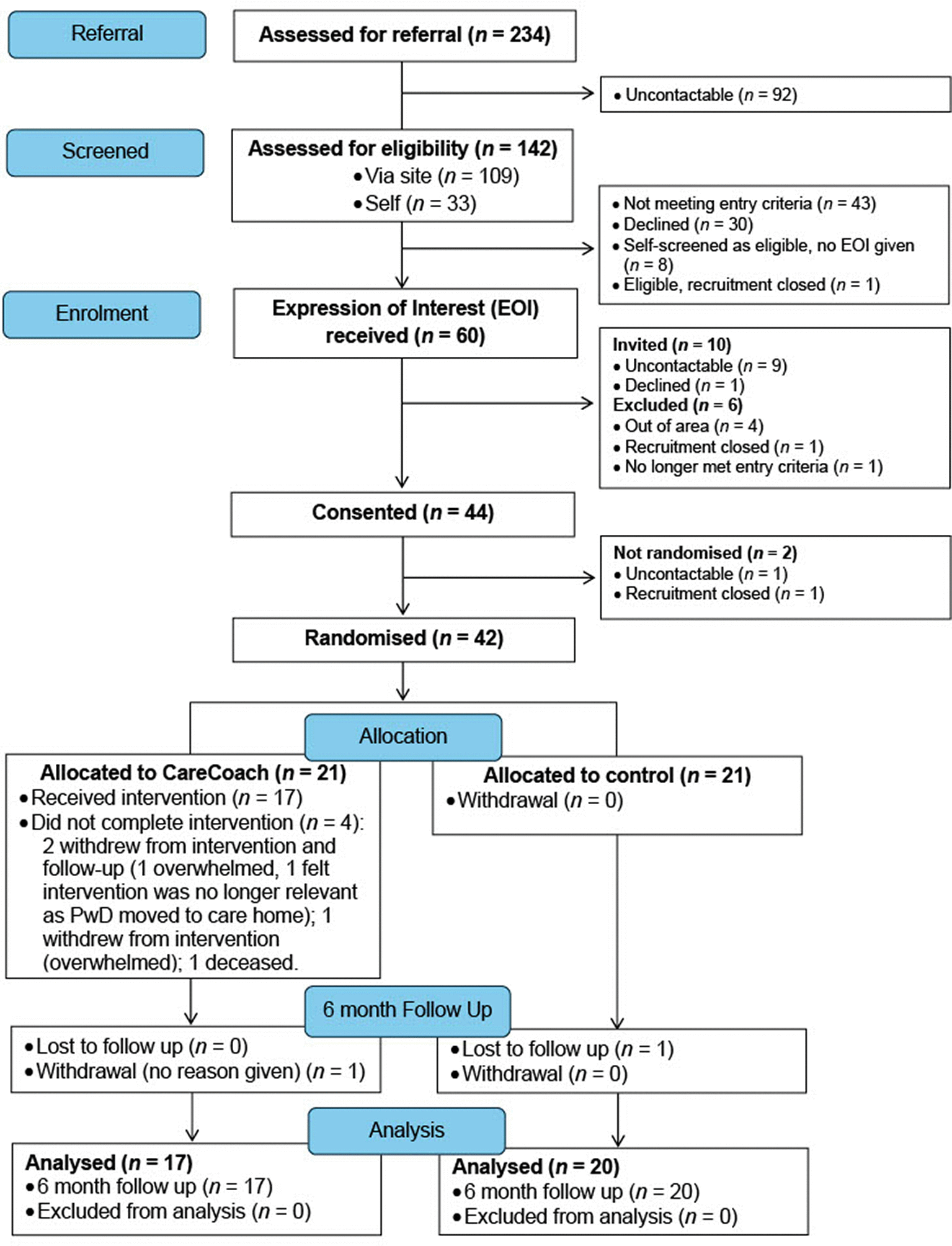
Of 21 participants who consented to take part, 17 (81.0%; 95% CI 58.1% to 94.6%) participants received the intervention; of those who did not complete the intervention, three withdrew from the study after starting the intervention, one withdrew before starting the intervention, and one participant died (unrelated to intervention). Thirty-seven out of 42 participants (88.1%; 95% CI 74.4% to 96.0%) provided 6-month follow-up data. At 6-month follow-up, six participants reported a change in caring status, either because they were no longer caring for a person with dementia and/or the person with dementia moved to a care home; however, all data were retained for analysis, irrespective of this.
Eight coaches were allocated between one and six participants each. Three sites lacked staff capacity to provide coaches, so the two coaches from the lead NHS trust delivered the intervention to participants recruited from those sites and self-referrals.
As presented in Figure 2, 20 of 21 participants (95.2%; 95% CI 76.2% to 99.9%) started the intervention and completed the initial session with their allocated coach. On average, the initial session lasted for 72.7 minutes (SD = 27, min = 30, max = 120). Seventeen out of 20 sessions (85%; 95% CI 62.1% to 96.8%) were delivered via video-call; two initial sessions were delivered by telephone at the participant’s request. Video-call was attempted for another participant but due to user difficulties, the coach delivered the session via telephone. All participants successfully logged into their CareCoach account and 12 of the 20 participants (60%; 95% CI 36.1% to 80.9%) completed the first exercise in their first module within the first week. The most chosen modules were “The Changing Person”, “Dealing with Stress”, “Understanding Yourself”, and “Communication”.
On average, the 17 participants who completed the intervention received 5.73 (SD = 1.94) online assistance contacts over 8-weeks. Coaches spent a mean of 83.27 (SD = 34.15) minutes providing online assistance per participant over 8-weeks, ranging between 30 and 145 minutes. On average, the final session lasted for 37.67 minutes (SD = 10.33, min = 25, max = 60 minutes). Fourteen of the 17 final sessions (82.4%; 95% CI 56.6% to 96.2%) were delivered via video-call; two sessions were delivered by telephone as per the participant’s request and the method of delivery for one session was not recorded. Fidelity to the intervention manual and protocol was high: 95% (19/20) of initial sessions and 94% (16/17) of final sessions were delivered in accordance with the session checklists.
All participants who completed the initial session set at least one goal using the Goal Attainment Scaling (GAS), with a median of one goal (IQR = 1). Of the 17 participants who completed the final session, 4 (23.5%; 95% CI 6.8% to 49.9%) reported achieving their goal much better than expected, 6 (35.3%; 95% CI 14.2% to 61.7%) better than expected, and 5 (29.4%; 95% CI 10.3% to 56.0%) less well than expected. GAS T-scores were unavailable for two participants (11.8%; 95% CI 1.5% to 36.4%): one due to missing data and another because their goal was self-rated as unimportant. The mean GAS T-score was 53.20 (SD 12.07) suggesting, on average, participants felt they had achieved their goal(s) better than expected.
No adverse or serious adverse events related to the intervention were reported; all recorded health incidents were unrelated to feasibility trial activities.
General Linear Model (GLM) analyses showed a statistically significant improvement in caregiver quality of life (SIDECAR-D) in the intervention group at follow-up compared with the control group (p = 0.01; Table 3). The symptom management domain of the caregiver self-efficacy (CSES) also improved more in the intervention group. Depression, anxiety, and stress scores decreased in the intervention group at follow-up, despite increases in both dementia symptom distress and severity and decreases in the person with dementia’s overall health scores. Minor improvements in community support self-efficacy and mastery were reported in both groups. It was possible to collect the required health economic data: all participants provided service use data at baseline and follow-up. All followed-up participants provided all efficacy outcome data.
This is the first study to evaluate the feasibility of CareCoach and demonstrates that a definitive trial is achievable and warranted. Beyond informing the future trial testing CareCoach, this study has generated evidence on the design and delivery of a blended online intervention for caregivers of people with dementia, including recruitment, retention, data collection, and engagement.
This feasibility study met all the pre-specified ‘green’ criteria outlined in the progression guidelines, indicating strong justification for progression to the full-scale trial to test the clinical and cost-effectiveness of CareCoach. Successful recruitment and high retention indicate that the study was acceptable and provides early insights into evaluating how caregivers engage with a blended psychosocial support intervention and factors likely to influence implementation in a definitive trial.
A lack of time to participate was a common barrier for caregivers approached about the study, which reflects the demanding nature of caregiving and its impact on engagement in research. However, other factors such as differences in recruitment pathway (e.g. research site vs self-referral), population demographics, and intervention intensity likely contribute to differences in effectiveness and participant engagement in psychological interventions for caregivers. The preference for remote delivery of study activities and coach sessions suggests that flexible models of support and engagement may be particularly important for caregivers. This finding supports the continued use of remote research procedures in the definitive trial.
Compared with other psychological interventions for family caregivers of people with dementia, such as START15 and NIDUS-Family,16,49 this programme showed similar retention rates and psychosocial benefits but achieved these with a shorter, resource efficient remote delivery model. Adherence to CareCoach was similar to NIDUS-Family (86%16,49) and START (87%15). Compared to iSUPPORT, the advantages of ‘face-to-face’ sessions are reflected in the engagement rates. For example, engagement with iSUPPORT was low: 26.3% of the sample (175 caregivers) only logged in once and 18.2% spent zero minutes using iSUPPORT.19 The low engagement level may explain the absence of clinically significant benefits at both follow-up time points in that study. These findings suggest that combining online psychosocial resources with coach support may help overcome challenges with engagement associated with self-directed online interventions by providing accountability, encouragement and personalised support. Importantly, the high fidelity rates indicate that CareCoach was both feasible to implement and acceptable for coaches to deliver.
Unlike START which is delivered in-person,15 both NIDUS-Family16,49 and CareCoach are delivered by individuals without clinical qualifications. However, unlike CareCoach, NIDUS-Family was delivered by university employed facilitators16,49 meaning implementation of the intervention in healthcare settings is yet to be tested. This is particularly important given that NIDUS-Family involved an average of 6.5 sessions over six months16 whereas CareCoach was delivered over a shorter timeframe (8-weeks). Delivering an intervention of this intensity within NHS services could present challenges that differ from those encountered in a university research setting.
In this study, goal attainment data indicated variable progress with personalised outcomes; review of goals set suggested that both participants and coaches found goal setting using Goal Attainment Scaling (GAS) difficult. Barriers to goal achievement were primarily related to limited time and goals focused on the person with dementia’s behaviour rather than the caregiver’s own actions or activities. For these reasons and given that the goal setting is embedded within the CareCoach platform modules, GAS offered little meaningful insight into the potential benefits of CareCoach compared to the standardised measures used at study endpoints.
Although GAS was successfully used in NIDUS-Family, other secondary caregiver outcomes were not significantly different between groups.16,49 Moreover, the purpose of GAS differed substantially between the studies. In NIDUS-Family, the intervention was delivered to caregiver and people with dementia as dyads; the objective of the goal setting was maintaining independence and supporting the person with dementia to live well at home.16 In contrast, CareCoach focuses exclusively on caregiver outcomes, including self-efficacy and resilience. Trends in caregiver outcomes in this study suggest the potential benefit of CareCoach on quality of life and self-efficacy despite worsening dementia symptoms. This highlights the intervention’s potential psychosocial benefits even amidst disease progression. Standardised caregiver outcomes may be more appropriate than GAS for capturing intervention effects in a future trial.
Strengths include successful recruitment, high retention and use of remote delivery and data collection methods, such as video-calls with coaches which aligned with participant preferences and enhanced accessibility. The study’s person-centred sessions with coaches allowed participants to engage meaningfully based on individual priorities, while building rapport with the coach over 8-weeks of guided support.
Limitations include recruitment predominantly via research sites, possibly biasing the sample to more engaged or supported caregivers and limiting generalisability. Although most participants were approached about this study via research sites, advertising the study online offers an opportunity for broader outreach to caregivers who are not in contact with NHS services, reducing the potential selection biases favouring those connected to healthcare services.
The homogeneity in the sample’s demographic: majority female, White British, over 60 years old, and highly educated limits the applicability to more diverse populations but is not unlike similar UK studies.16,19,49,50 The requirement for internet access and a smart device to enrol in the study may introduce sampling bias, potentially excluding individuals from lower socioeconomic backgrounds and those with limited digital literacy.
The dropout rate was low but was influenced by caregiver burden and external factors like the person with dementia’s and/or caregiver’s health deterioration. The intervention considers this as participants are encouraged to work through modules at their own pace and the platform can be accessed at any time. On a larger scale, a challenge in delivering the intervention could be scheduling the initial and final coaching sessions, which are limited to the coaches’ working hours. This is a potential limitation, particularly to working age caregivers who may be unavailable during weekday working hours. Adopting a delivery model that addresses this, such as employing coaches who are available during evenings and weekends could be advantageous when scaling to larger groups. The variability in sites’ ability to identify staff to act as coaches to deliver CareCoach highlights challenges in scaling. Nevertheless, this study demonstrates that CareCoach can be delivered effectively by staff with coach specific training, remotely, without clinical qualifications, creating opportunities for implementation beyond NHS settings and cost-effective delivery.
This study highlights the feasibility and potential benefit of delivering psychosocial interventions remotely with coach support and guidance, meeting caregiver preferences and constraints. For clinicians and policymakers, investing in accessible, flexible caregiver support programmes could improve quality of life and sustain caregiving capacity, potentially delaying institutionalisation of the person with dementia.
Future research should evaluate the clinical and cost-effectiveness of CareCoach using a full-scale trial. Research should also focus on diverse populations and flexibility of delivery to accommodate caregivers of working age. A better resourced self-referral pathway could be an effective recruitment strategy for broader outreach to caregivers in the community. Understanding how variations in caregiver burden, cultural factors, and caregiving contexts influence engagement and outcomes is essential. Furthermore, cost-effectiveness analysis would aid policymaker decisions. Finally, integration with routine healthcare workflows and community support services remain key areas for implementing caregiver support programmes.
This feasibility study demonstrated that a trial delivering CareCoach to family caregivers in the UK can be delivered, with acceptable recruitment and retention rates. While challenges with use of the Goal Attainment Scaling (GAS) were identified, overall engagement and fidelity of delivery suggest the intervention is acceptable. The results show a definitive trial is warranted to evaluate effectiveness for caregivers, implementation, and cost-effectiveness.
Provide sufficient details of any financial or non-financial competing interests to enable users to assess whether your comments might lead a reasonable person to question your impartiality. Consider the following examples, but note that this is not an exhaustive list:
Sign up for content alerts and receive a weekly or monthly email with all newly published articles
Register with NIHR Open Research
Already registered? Sign in
If you are a previous or current NIHR award holder, sign up for information about developments, publishing and publications from NIHR Open Research.
We'll keep you updated on any major new updates to NIHR Open Research
The email address should be the one you originally registered with F1000.
You registered with F1000 via Google, so we cannot reset your password.
To sign in, please click here.
If you still need help with your Google account password, please click here.
You registered with F1000 via Facebook, so we cannot reset your password.
To sign in, please click here.
If you still need help with your Facebook account password, please click here.
If your email address is registered with us, we will email you instructions to reset your password.
If you think you should have received this email but it has not arrived, please check your spam filters and/or contact for further assistance.

Comments on this article Comments (0)