Keywords
Dementia, Family carers, Caregivers, E-health, Self-management, Self-efficacy, Randomised controlled trial, Implementation evaluation

This article is included in the Programme Grants for Applied Research gateway.
Dementia, Family carers, Caregivers, E-health, Self-management, Self-efficacy, Randomised controlled trial, Implementation evaluation
It is estimated that 982,000 people live with dementia in the UK.1 Most people with dementia are cared for at home by family or friends who do so with no training and little or no formal support. A 2024 survey of 1,200 carers found that nearly three-quarters of respondents became carers due to circumstance rather than personal choice.2 The caring role is often significant; 4 out of 5 family carers take on most caring responsibilities3 and 51% report that there are no other carers to help.2 The financial stress of caring can also be challenging to cope with alongside balancing the demands of family and work.4,5
How the family carer and person with dementia acknowledge or resist physical and emotional stressors can have significant impacts on how they adapt to the dementia diagnosis.6,7 Analyses of General Practitioner (GP) surveys conducted in 2021 revealed that carers had poorer health compared to the general population and were more likely to have multiple comorbidities, or be at increased risk of developing them8 leading to increased healthcare usage.9,10 Additionally, 39% of carers report having a mental health condition, and 34% said their mental health deteriorated while caring for a person with dementia.2
Carers face barriers to accessing support related to where they live, their ethnicity, socioeconomic status, dementia subtype, and health literacy.11,12 Family members of people newly diagnosed with dementia may not use services early, either because they do not feel the need, are unaware of services available, do not see themselves as ‘carers’2 or struggle with acceptance due to stigma.4,13,14 There may also be anxiety around visiting new environments to access support, and concerns about being separated from the person they care for which can further impact carers accessing support.12
In 2013, the James Lind Alliance Priority Setting Partnership listed finding effective ways of supporting carers of people with dementia at home as a top 10 dementia research priority.15 A purposively developed, evidence-based intervention for those supporting a person with dementia early after diagnosis may reduce later psychosocial problems and reduce or delay use of health and social care services.6 Therefore, there is a need to develop effective online interventions which can be accessed flexibly by carers without requiring them to leave their relatives at home or make alternative care arrangements and deliver them in a cost-effective way given limited healthcare resources and staff availability.
Self-efficacy can be a mediator of carer well-being16 and is associated with a better capacity for ‘living well’ for carers.17 Feeling less prepared for a caregiving role is also associated with lower self-efficacy.16 Therefore, learning to positively manage life alongside dementia, rather than solely managing dementia itself, may facilitate carers’ adjustment and adaptation.18 A recent review recommends future interventions for carers focus on improving self-efficacy rather than treating it as a secondary outcome.19
Online interventions show promise supporting dementia carers18,20–25 and provide resources at a time and place convenient to carers.26–28 Internet use has doubled in older people since 201329 and 93% of households in the UK in 2023 had access to the internet.30 Whilst evidence of the effects of online interventions on carer burden remains limited, recent evidence reviews report that online interventions for carers can improve psychological outcomes including reducing anxiety,31 goal attainment,32 self-efficacy,19,33,34 and quality of life.33 However, some studies report low engagement,35,36 null results,35 and the quality of some studies remains low due to risk of bias, variability in intervention design, results, and small sample sizes.19
A Dutch intervention called ‘Partner in Balance’ (PiB) offers a hybrid intervention combining e-health and one-to-one coaching for carers of people with dementia delivered by a combination of online and in-person contacts. PiB is a self-management intervention that aims to improve carer self-efficacy by increasing knowledge and encouraging carers to develop skills, identify solutions, and set goals.37 Evidence shows promising effects in reducing carer strain and increasing self-efficacy in carers in the Netherlands.33,38 PiB has been adapted using experience-based co-design for carers in the UK,39 ready for testing as ‘CareCoach’.
A feasibility study of a randomised controlled trial using CareCoach in the UK40 met all pre-selected progression criteria (Morse et al., 2026 accepted). Recruitment and retention were feasible: 88% of participants were retained in the study and there were high data completion rates. Most carers were recruited from NHS organisations, however using a self-referral pathway demonstrated potential for broader reach across England beyond NHS services. Preliminary results suggested potential benefits of CareCoach for carer self-efficacy and quality of life. CareCoach was delivered remotely by trained coaches with high fidelity, demonstrating the acceptability and feasible delivery. Recommendations to optimise coach training, intervention delivery, and participant engagement are available and have informed further refinements of CareCoach (Katangwe-Chigamba et al., 2026 accepted). Collectively, these feasibility findings support progression to a full-scale trial to evaluate the efficacy and cost-effectiveness of CareCoach. The current trial incorporates key learnings from the feasibility study, including refined eligibility criteria, full translation of intervention videos, outcome measure selection, enhanced coach training, a co-produced intervention introduction video to manage participant expectations, and investment in a self-referral pathway to increase community outreach and sample diversity. Thus, the objective of this trial is to determine the clinical effectiveness and cost-effectiveness of CareCoach compared with usual care alone for family carers of people with dementia in the community.
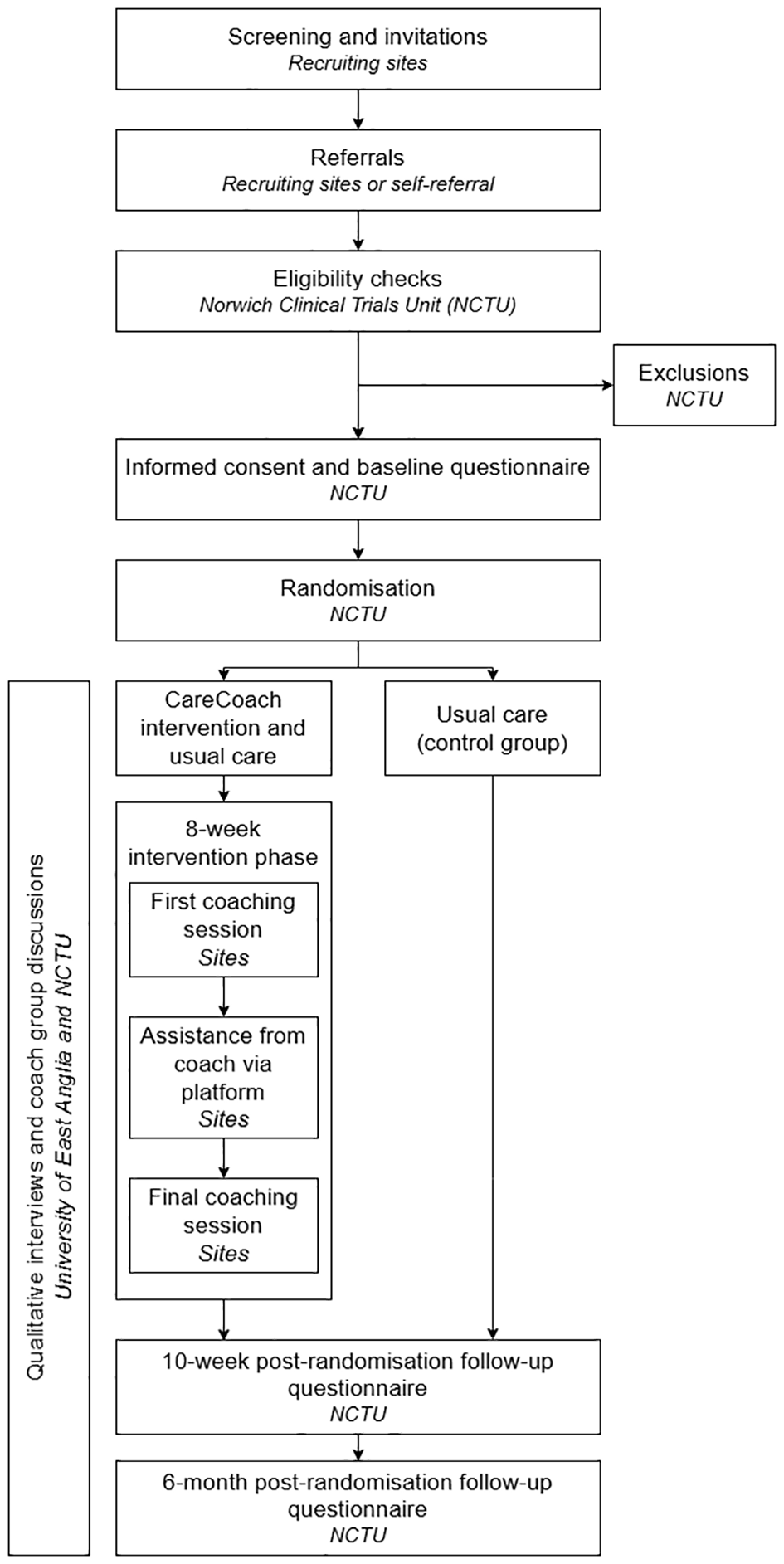
This trial is a multicentre, mixed methods, single-blinded, randomised controlled trial comprising a parallel group with an embedded mixed methods process evaluation, economic evaluation, and internal pilot. Outcomes will be collected remotely at baseline, 10-week and 6-months post-randomisation. The trial flow is presented in Figure 1, and the schedule of enrolment, interventions, and assessments in Table 1.
| TRIAL PERIOD | ||||||||||||
|---|---|---|---|---|---|---|---|---|---|---|---|---|
| Enrolment | Post-randomisation | Final follow-up | ||||||||||
| TIMEPOINT | -ti to 0 | 0 | t1 | t2 | t3 | t4 | t5 | t6 | t7 | t8 | t9 | t10 |
| ENROLMENT: | ||||||||||||
| Eligibility checks | X | X | X | X | ||||||||
| Expression of interest | X | |||||||||||
| Informed consent | X | |||||||||||
| Randomisation | X | |||||||||||
| INTERVENTION: | ||||||||||||
| Coaching sessions | X | X | ||||||||||
| Online assistance | X | X | X | X | X | X | X | X | ||||
| Usual care (if receiving) | X | X | X | X | X | X | X | X | X | X | X | |
| ASSESSMENTS: | ||||||||||||
| Participant demographics | X | |||||||||||
| Carer Self-efficacy Scale (CSES41) |  X | X | X | |||||||||
| The Pearlin Mastery Scale (PMS63) | X | X | X | |||||||||
| Scale measuring the Impact of DEmentia on CARers (SIDECAR-D56) | X | X | X | |||||||||
| The Perceived Stress Scale (PSS64) | X | X | X | |||||||||
| Generalised Anxiety Disorder Scale (GAD-765) | X | X | X | |||||||||
| Patient Health Questionnaire (PHQ-966) | X | X | X | |||||||||
| EuroQol Health related quality of life (EQ-5D-5 L42,43) | X | X | X | |||||||||
| Carer rated proxy EuroQol Health related quality of life (EQ-5D-5 L42,43) | X | X | X | |||||||||
| Modified CSRI44 | X | X | ||||||||||
| Perseverance time (TOPICS-MDS67) | X | X | X | |||||||||
| Mixed methods process evaluation: coach interviews, group coach discussions, coach session observations, carer interviews | X | X
| X | X | X | X | X | X | X | X | X | |
An internal pilot will run from trial recruitment start date until month 4 when 20% of the target sample (n = 81) are expected to be enrolled. Data from this internal pilot phase will compare observed with expected recruitment, re-estimate drop-out rates and provide an estimate of data completion rates. Progression to the remaining trial will be dependent upon these data and stopping guidelines, which will be agreed with the trial oversight committees prior to commencement of the trial. The decision to continue will be on advice from the Data Monitoring Committee (DMC), and rests with Programme Steering Committee (PSC).
The primary objective of the trial is to test the clinical effectiveness of CareCoach on carer self-efficacy symptom management (CSES41) compared to usual care alone at 6-months follow-up.
The secondary objectives are to determine the cost-effectiveness of CareCoach and to evaluate any potential effects on psychological outcomes (see Table 2) compared to usual care alone at 6-month follow-up. Cost-effectiveness will be evaluated 6-months post-randomisation using:
| Outcome | Measure |
|---|---|
| Self-efficacy | Carer Self-Efficacy Scale41 |
| Mastery | The Pearlin Mastery Scale (PMS63) |
| Carer quality of life | Scale measuring the Impact of DEmentia on CARers (SIDECAR-D56). |
| Stress | The Perceived Stress Scale (PSS64) |
| Anxiety | Generalised Anxiety Disorder Scale (GAD-765) |
| Depression | Patient Health Questionnaire (PHQ-966) |
| Perseverance time | Single question asking how long the carer could continue caring (TOPICS-MDS67). |
| Quality of life | EuroQol Health related quality of life (EQ-5D-5 L42,43) |
The implementation of CareCoach and participants’ experience is evaluated using a mixed methods process evaluation embedded within the trial. These evaluations aim to:
• Understand how CareCoach is implemented and embedded into routine practice.
• Explore carers’ experiences of receiving CareCoach and how the intervention is perceived to influence intended outcomes.
• Identify barriers and facilitators to the implementation and delivery of CareCoach, including factors that may influence its future implementation.
Family carers will be eligible for enrolment if they fulfilled all the criteria defined below:
• Caring/supporting (e.g. informally, unpaid) a person with dementia, such as a partner, family member, in-law, close friend or neighbour.
• The person with dementia (all subtypes) was diagnosed within the last 5 years.
• 18 years or over.
• Living in the UK.
• Have access to a device with a camera and microphone which connects to the internet (e.g. laptop, tablet, smartphone).
• Seeking to learn new skills and knowledge to cope well while caring for a person with dementia.
• Able to engage in and understand the programme delivered in English (with the help of family interpreter if required).
Family carers will be excluded from participating in the trial if they meet any of the criteria below:
• Insufficient cognitive abilities to engage with the online programme.
• Report feeling overburdened.
• The person with dementia lives in a care home.
• Taking part or recently taken part in research study using a similar behaviour change or psychological intervention.
• Participated in the CareCoach feasibility study.
• Is a paid, professional carer.
Potential participants will be informed that multiple members of the same family (i.e. individuals caring for the same person with dementia) should not sign up for the trial to avoid potential contamination between groups. Family carers claiming carer’s allowance are not considered as ‘paid’ carers and will not be excluded.
In the CareCoach feasibility study (Morse et al., 2026 accepted), most of the sample were recruited via a trial location. The remaining participants were recruited via an organisation supporting the trial (e.g. charity partner), community organisation or local group, or word of mouth. The present trial will use a combination of these recruitment methods. Potential participants will be identified by staff at NHS organisations (e.g. memory clinics, mental health services, GP practices), non-NHS organisations (e.g. research centres), community organisations, and charity organisations in England. Staff may identify and approach potential participants via database searches, during clinical visits, appointments, Join Dementia Research, via posters, newsletters, invitation letters, emails, and/or text messages. Family carers across the UK will be able to self-refer themselves to the trial via posters in community spaces, information advertised on social media, in press releases, newsletters, and mailing lists. Paid, targeted social media adverts will be used to recruit family carers across the UK. Trial locations will be asked to provide a minimum of two coaches to deliver the CareCoach intervention. Those without coaches will act as recruitment only locations and will be matched with a trial location with coaches.
Potential participants will be screened by trial location staff or self-screen via a form on the trial REDCap45,46 database. Those eligible will be asked to complete an expression of interest (consent to contact) form. After a valid submission of an expression of interest form, the CareCoach trial team will send the potential participant the full information sheet, consent form, and baseline questionnaire using email via the trial database or via postal invitation pack according to the carer’s contact preference. Potential participants will be asked to reconfirm their eligibility prior to completing the consent form and baseline questionnaire. The CareCoach trial team will reconfirm eligibility over the phone for potential participants who request a postal invitation pack. Every effort will be made to retain participants who move areas. Participants will have the option to give written consent to be invited to the mixed methods process evaluation carer interviews and/or future CareCoach research studies.
The target sample size is 404 participants (202 per group), calculated based upon the symptom management sub-scale within the CSES.41 Assuming a maximum 15% drop-out (11.9% was observed in the feasibility study; Morse et al., 2026 accepted), this sample size would provide 79% statistical power for an effect size of 0.3 standard deviations (a mean difference of 2.92 units); 90% statistical power for an effect size of 0.35 (a mean difference of 3.41); and 95% statistical power for an effect size of 0.4 (a mean difference of 3.90). From the feasibility study, an effect size of 0.30 was observed with an upper 95% confidence limit of 0.82 standard deviations (Morse et al., 2026 accepted). Up to 30 coaches and up to 25 carers in the intervention arm will participate in one-to-one qualitative interviews as part of the implementation qualitative sub-study.
This is an individually randomised trial. Randomisation will use 1:1 allocation ratio and will be stratified by recruiting site, participant age (<65 versus ≥65 years), and relationship to the person with dementia (spouse/partner versus other relationships). Randomisation will be blocked with random block lengths of either 2, 4 or 6. Randomisation to treatment arm will take place after consent and baseline data is collected. The randomisation scheme will be computer generated by the Norwich Clinical Trials Unit (NCTU) data manager using the REDCap45,46 database so allocation is not known prior to the participant being randomised to prevent treatment bias. The unblinded Trial Manager and/or a Trial Assistant(s) will randomise participants while on the phone with the participant and an automated email detailing their allocation will be sent by the database to each randomised participant. All participants will continue to receive usual NHS, social care, and third sector (e.g. support from charities) support regardless of randomisation into this trial.
Blinding: Due to the nature of the intervention, it will not be possible to blind participants to group allocation. Outcome assessors (Trial Assistants) who will monitor and collect missing follow-up data will be blinded to group allocation. Blinding will be implemented using permissions on the REDCap45,46 database to hide group allocation. As outcome assessors will not make clinical or safety decisions, scenarios requiring unblinding are considered unlikely. However, any incidences of unblinding and reasons for unblinding will be recorded.
CareCoach is a complex intervention designed for family carers of people with a recent (within 5 years) diagnosis of dementia. The content of CareCoach is adapted from Partners in Balance, an existing and evidence-based Dutch intervention.13,33,37,38,47–49 CareCoach uses key behavioural change techniques such as goal setting, action planning, and problem solving (Katangwe-Chigamba et al., 2026 submitted) with the aim of enhancing self-efficacy and improving psychological outcomes such as reducing stress and well-being (Morse et al., 2026 accepted). The online CareCoach platform is hosted by ilionx.
CareCoach will be delivered over 8-weeks and includes two structured online 90-minute coaching sessions on week one and week eight. Immediately after randomisation, and before the first coaching session, participants will be sent a link to watch a short video co-produced by two Patient and Public Involvement (PPI) members introducing them to CareCoach (i.e. what is involved, the role of the coach) automatically by the REDCap45,46 database. Coaches at the relevant trial location will be notified by email by the trial team when a participant is randomised to the CareCoach group. The coach will be allocated to a participant at a local level (i.e. organised between coaches). Participants who self-refer to the trial or who are recruited from a trial location without coaches will be allocated a coach at a paired intervention delivery location. Coaches should contact the participant and schedule the initial coaching session within two weeks of randomisation to ensure the final session is completed before the 10-week follow-up questionnaire. Participants should avoid a change in coach unless necessary (e.g. staff long-term sickness, coach leaves post).
The initial coaching session is intended to be delivered via video-call and will provide an introduction of CareCoach, assessment of the participant’s caring needs, orientation to the online platform, collaborative goal-setting, selection of up to four learning modules, clarification of expectations for engagement and communication, and scheduling of the final coaching session. In preparation for the initial session, coaches will create a CareCoach account for the participant, send instructions on using the CareCoach platform along with an outline of the CareCoach learning modules to give participants time and space to choose up to four most relevant to them. Participants will be encouraged to spend as much time working through their chosen modules, however approximately 30-mins to 1 hour per week is suggested during the 8-week intervention period.
The online, CareCoach web-platform contains nine modules: Acceptance, Communication, Dealing with stress, Focusing on the positive, Building your support network, The balance between activities, Changing behaviour, Uncertainties and worrying, Understanding yourself. Each module is divided into five sections: “About” (brief overview of module contents), “Video” (family carers talking about their caregiving experiences), “Explanation” (written content detailing the key concepts), “How am I doing?” (short self-reflective written exercises), and “My next steps” (participant creates a written step-by-step using five questions).
During the time between the initial and final coaching sessions there may be up to eight online contacts (i.e. one contact per week) initiated by the coach via the online messaging function on the platform. Coaches will send feedback via the online platform on exercise answers and prompts, reminders, and other support to encourage participants to complete their modules.
The coach will then meet the participant for a final session, on week eight, via video-call to review the participant’s progress, goal attainment, explore plans for sustaining or extending their use of the CareCoach modules, reflect on key learning and future needs, and provide signposting to additional resources where appropriate. The coach’s involvement with the participant ends following the final session. The participant will be signposted to the CareCoach trial team if they have any questions or concerns and they will be able to access the CareCoach online learning modules for up to 6 months but will not have access to a coach during that time. The amount and type of contacts is ultimately at the discretion of the participant, but at a minimum, participants must attend the initial and final session with the coach to have completed the intervention.
Coaches will be NHS Band four equivalent health, social care or dementia charity advisors/workers, psychology assistants or similar. Potential coaches will be approved by the Trial Manager and/or Chief Investigator prior to training. Band three or five staff may be considered provided the individual has relevant experience with carers and/or people with dementia patient groups. To avoid contamination, coaches must not be key workers for carers allocated to the control group. All coaches will receive a coaching manual and complete bespoke, online group coach training on the CareCoach intervention and delivery. The training will be delivered by a clinical psychologist (lead coach) and/or Trial Manager. While actively coaching, coaches will be required to attend online, monthly, one-hour group supervision sessions organised by the trial team and led by a lead coach.
Sessions can be split into two meetings if the participant is unable to meet for 90 minutes in one sitting. Efforts should be made by coaches to support the participant in joining the video-call for coach sessions. If this is not possible, the session can be delivered via another medium (e.g. in-person, phone-call) which will be documented in the session checklist on the trial database. The session checklists, completed by coaches, will be used to assess fidelity of intervention delivery and support the process evaluation. Coaches will record information about intervention delivery, including coaching session dates, duration, method of delivery, session notes, and reflections on sessions, and contacts. Coaches will also record the frequency and dates of contact, along with other relevant notes (e.g. the nature of the contact).
Coaches will be encouraged to contact (i.e. message) participants where there is no activity for a week. If there is no engagement with modules and no response to messages for two weeks, coaches will be asked to contact the participant by telephone. Cases of participant non-compliance and no contact will be discussed with the local principal investigator and reported to the trial team.
Usual care is as per NICE guidance for supporting people caring for people with dementia.22 This care or support may take the form of carer support groups, information leaflets produced by the NHS, Dementia UK50 or Alzheimer’s Society,51 care navigators to signpost support, local authority carer forums, Admiral Nurses,50 and carer counselling. Support services accessed during the trial will be captured from the participants using the Modified Client Service Receipt Inventory (CSRI44). Participants in the control group will be offered access to the online learning modules at the end of the trial to use independently, without coach support, for up to 6-months.
Participant service use will be collected using a self-report Modified CSRI44 over the 6-month trial period. The CSRI includes resources categories such as time spent caring, effect of caring on hours worked by the carer, secondary care services, and social care and day services by the person with dementia. To facilitate recall, participants will be provided with simple diary sheets to record health care events. These diary sheets are not collected from participants and are purely an aid to recalling service use. The modified CSRI,44 with a 3-month recall period, will be used at baseline to ascertain whether the two groups are equivalent in terms of baseline resource. Carer health related quality of life will be measured using the self-report 5Q-5D-5L.42 A carer proxy 5Q-5D-5L42 will estimate the person with dementia’s health related quality of life. The cost of delivering the intervention will be estimated using the resources required to provide coaching sessions, web-based content, coach training, and coach attendance at the online supervision sessions.58
Implementation of CareCoach will be assessed using qualitative methods including semi-structured one-to-one interviews with participants and coaches, coaching session observations, and group implementer (coach) meetings. Qualitative interviews with a sample of 25 carers in the intervention arm will explore perceived barriers (e.g. time) and facilitators (e.g. effective goal setting with the coach) to using the intervention. The interviews will also explore mechanisms of change (i.e. whether and how learning from CareCoach influenced their caring role). This will identify and characterise contextual factors which facilitate and hinder engagement with CareCoach and explore the key mechanisms through which the intervention may achieve its intended outcomes. Participants will be purposively sampled to maximise variation in characteristics including by sex, ethnicity, age, socio-economic status (i.e. highest level of education attained), rurality (according to postcode), and relationship to the person with dementia. A separate interview participant information sheet will be sent to sampled participants and additional informed consent for taking part in the interviews will be obtained by the process evaluation researcher(s) remotely via the trial database or post.
Up to 30 coaches will be recruited to take part in interviews for up to 45 minutes either face-to-face, online, or by phone. Written, informed consent will be collected from coaches before conducting an interview. Coaches from across different sites will be invited to maximise variation in characteristics including job role, geographical location, and type of trial location/organisation. Interviews will be supplemented with seven group implementers’ online meetings conducted during the intervention delivery period to problem-solve together. Meetings will be facilitated by one of the Co-CIs and/or a process evaluation researcher. A sample (10%) of coaching sessions will be observed either virtually or face-to-face by a process evaluation researcher. These will be selected to represent characteristics and experiences of the various coaches and participants, as well as variation of site and type of session (initial/final). Consent for the observations will be obtained from participants in the baseline consent and confirmed again prior to session observation. A researcher will use an observation record sheet to record any information that may inform intervention implementation and theoretical fidelity. Data collected from the implementer groups will be triangulated with interview data to shape the implementation and integration of CareCoach.
The primary analysis will use intention to treat (ITT) principles; all participants will be followed up for data collection irrespective of adherence to treatment and analysed according to group allocation rather than intervention received. Assuming a normal distribution (potentially of transformed values), a linear mixed model will be constructed. This will include recruiting site (as a random factor), CSES at baseline (as a covariate) and any factors considered prognostic and determined in advance of any analysis, together with treatment arm as a fixed effect. Sensitivity analyses will explore any variations or methods that may influence the findings. Secondary outcome measures will be analysed similarly. The Statistical Analysis Plan (SAP) will be developed by trial statisticians and Co-Chief Investigator’s and agreed by the independent DMC and PSC prior to database lock and data analysis. Statistical significance will be set at the conventional (two-tailed) 5% level and all parameter estimates will be presented with 95% confidence intervals. Analyses will be carried out by the trial statisticians in Statistical Data Analysis Software (SAS; currently version 9.4). Missing data from the primary outcome measure will be minimised by using mandatory data fields when participants complete questionnaires online and other missing data will be followed up with participants directly by the trial team. A small percentage (5% or less) of missing data is generally inconsequential in which case we will carry out analysis of available data without imputation. If data is missing from 5% to 50%, we will adopt appropriate technique for handling missing data depending on the mechanism of missingness.
All resources identified during the trial will be costed using appropriate local and national UK cost data, such as NHS reference costs52 and Unit Costs of Health and Social Care unit costs of health and social care.53 As the follow-up in this trial covers a period of 6 months, discounting will not be used. The economic evaluation will utilise both generic and condition specific outcomes measures. The base case analysis will comprise a cost-utility study looking at cost per Quality-Adjusted Life Year (QALYs). A priori, one would expect to estimate QALYs for the carers by means of the EQ-5D-5 L,42,43 obtained by self-completion at baseline, 10 weeks, and 6 months. QALYs for the person with dementia will also be estimated using the proxy EQ-5D-5 L42,43 at the same three time-points. There is some evidence to support the use of the EQ-5D-5 L42,43 in carers of people with dementia and it has been found to correlate with carer burden54 but concerns have been raised regarding its sensitivity.55 For this reason, a secondary analysis will be conducted using the primary outcome measure of change in the CSES.41 This will comprise a cost-effectiveness evaluation estimating the additional cost per additional improvement in the CSES.41
A secondary analysis will involve a cost-effectiveness evaluation using SIDECAR-D,56 an instrument to assess carer quality of life, as the outcome measure. Results will be expressed as the cost per point change in SIDECAR-D score.56 These cost-effectiveness analyses and the incorporation of proxy values for the person with dementia will comprise secondary analyses. There is work in progress to provide a preference-based scoring algorithm for the SIDECAR-D56 instrument. These values will also be used to generate QALYs for carers, these values will be reported as a secondary analysis.
The levels of missing data will be assessed. If there are low levels of missing data, then a complete case analysis (CCA) may be appropriate. If, however, missing data is deemed to be a potential problem then appropriate methods for dealing with these will be employed.57 Regression-based methods may be used to analyse costs and effects to allow for differences in baseline characteristics between groups. Non-parametric bootstrapping will be employed to allow for uncertainty. Cost-effectiveness acceptability curves (CEACs) will be used to estimate the probability that the intervention is cost-effective at different willingness to pay for a unit of the outcome measure. The analysis process will include appropriate sensitivity analysis to estimate the effects of any key assumptions made. Prior to analysis, the health economics lead will write a health economics analysis plan (HEAP) pre-specifying the intended analysis.
Transcribed interviews, implementer meetings, and accompanying observational notes will be imported into NVivo software for analysis. Qualitative data will be analysed using open coding techniques that lead to thematic descriptions of the data that can be interpreted through the lens of Normalisation Process Theory (NPT58) and Capability Opportunity Motivation Behaviour (COM-B) theoretical framework.59 This will enable comparative analysis of implementation processes over time and between settings, and attribution analyses that characterise participants’ mental models of the causal processes that shape the adoption, implementation and integration of CareCoach.
The trial was ethically approved on 27th December 2024 by the North West Greater Manchester East Research Ethics Committee (REC; reference 24/NW/0376), whose members were independent to the research team. The trial was registered on ISRCTN (ISRCTN12345678) on 27th January 2025. This paper describes protocol version 2.0, dated 10th January 2025, which was the version approved prior to the trial opening on 21st April 2025. Protocol modifications will be sent to the Sponsor for confirmation as to whether it is either substantial or non-substantial and then submitted to the Health Research Authority (HRA) or Research Ethics Committee (REC) for categorisation and approval. Once the modification is categorised it will be sent to relevant sites for consideration in accordance with standard HRA processes and timescales.
Subsequent protocol modifications (versions 3.0–6.0) were made after the trial opened; the latest version of the protocol is version 6.0 dated 20th May 2026. No modifications have significantly changed the trial objectives, design, intervention, outcomes or analysis plans. These include provision of tablet devices to participants who do not have a compatible device, minor reduction in the planned number of observations, expansion of coach recruitment to Sponsor University, inclusion of a perseverance time question, an optional participant experience survey, and optional willingness-to-pay questions for selected participants at study completion.
Written, informed consent to participate will be obtained from all participants online (eConsent) or by post. Participant facing information is designed to be suitable and accessible for carers, co-produced by the Service User Advisory Group (SUAG) and/or charity partners and approved by a REC. Individuals lacking mental capacity will not be recruited to trial. Participants have the right to refuse participation without giving a reason and are free to withdraw and/or discontinue CareCoach at any time. Routine care and/or support will continue for all participants, irrespective of group allocation and will not be discouraged from seeking support outside of the trial. Further support on mental health will be provided within questionnaires when completing mood measures. Participants will receive a £20 gift voucher upon completing the final questionnaire, irrespective of completion of intervention. At trial enrolment participants will be issued a participant identification number which is used as the primary identifier. The questionnaire data completed will be pseudonymised and not contain the participant’s name or identifiable data.
Identifiable data will be kept on the REDCap45,46 trial database to allow authorised members of the trial team to contact participants to arrange appointments/assessments. Coaches at sites will be given restricted access to selected participant contact details where it is relevant to delivering CareCoach.51,52 Identifiable data will be securely destroyed five years after the end of the trial unless the participant agree to receive CareCoach programme (which may include trial results and future research opportunities), in which case, it will be held for an additional five years following the end of the programme. Anonymised data will be stored securely for 10 years.
CareCoach is a low-risk behavioural intervention. No specific risks, or adverse events related to the trial were reported during development,39 testing of the original PiB33 or feasibility study (Morse et al., 2026 accepted). To reduce excessive data collection on events that are expected within this population such as development of new medical and/or physical health conditions, the trial will take a risk-proportionate approach and only record Serious Adverse Events (SAEs) related to the participant (not person with dementia) within 24 hours of becoming aware of the event. Untoward incidents making it difficult for the participants to complete trial activities will be logged for frequency and severity.
The University of Exeter is trial sponsor and delegated trial design, conduct, analysis, and reporting of the trial to NCTU. The CareCoach trial is overseen by the Programme Management Group (PMG) who meet every two months and consists of the chief investigators (JLC and CF), Patient and Public Involvement (PPI) co-applicant (GF), trial delivery team, charity partners, and co-applicants. An independent PSC will meet every six months and provide independent oversight of trial conduct. PSC membership includes two clinical specialists, statistician, and a PPI representative. A DMC will also meet every six months and is responsible for safeguarding the interests of participants and monitoring trial data. DMC membership consists of independent experts, including a clinician and two statisticians. Both the PSC and DMC are independent of the sponsor and funder.
A programme wide PPI advisory group (SUAG) consisting of past or current family carers of people with dementia meet every three months. GF is a co-applicant and expert by experience (carer of a person with dementia) who attends all SUAG and PMG meetings. The role of the SUAG group is to contribute their carer perspectives and experiences on the trial processes and progress. SUAG input will be communicated to the trial team member, steering groups, and oversight committees. The SUAG members have supported the CareCoach trial team by providing feedback on the trial design, materials (e.g. participant facing documents), and will assist with feedback on recruitment and dissemination of results. Two members of the SUAG, including GF, co-produced the short information video used to introduce participants to CareCoach.
Recruitment for the study is complete and ran from 7th April 2025 to 21st April 2026. Follow-up data collection is ongoing. This paper reports the trial protocol only. Results will be reported separately which will include descriptions of any deviations from the protocol. The results of the trial will be disseminated regardless of the direction of effect. Outputs from the trial will be available on the trial website for public access. The website address will be provided in the recruitment materials. Participants will be asked an optional question in the final follow-up questionnaire whether they would like to receive the CareCoach programme email newsletter which will include a lay summary of trial findings.
This is a multicentre, randomised controlled trial comparing CareCoach with usual care for carers of people with dementia. CareCoach is a co-designed UK adaptation of the Dutch PiB intervention, which previously found improvements in caregiver self-efficacy.33,37 This trial will provide the first robust evaluation of CareCoach within the UK context.
The trial design was informed by a successful feasibility study40 which met all pre-defined progression criteria (Morse et al., 2026 accepted). This trial comes when support for carers remains a top priority and ongoing need; one survey found that 85% of carers had reached crisis point and 71% did not feel they had the support they need.2 Furthermore, e-health interventions such as CareCoach align with the 10 Year Health Plan for England60 when more services are shifting from analogue (e.g. face-to-face) to digital. Online interventions are convenient for carers who can easier fit the support around their schedule without needing to arrange care for the person they care for.
This trial will contribute to the evidence of support for carers of people with dementia. It will provide evidence on the efficacy, cost-effectiveness, and engagement of a blended e-health intervention co-designed39 by and for carers. Specifically, the trial will establish the clinical effectiveness of CareCoach on the primary outcome, carer self-efficacy, and other well-being outcomes such as stress, mastery, carer burden, anxiety, and depression. If CareCoach produces positive effects on psychological outcomes there is scope to roll-out CareCoach for use to the public via the NHS, social care, and/or third sector organisations. The cost-effectiveness evaluations will provide essential information to support stakeholder commissioning and implementation decisions. Understanding the carer’s experience, how staff delivered and implemented CareCoach will provide evidence needed for stakeholder engagement and policy development.
Several interventions have been developed to support carers of people with dementia.25,31,33,35,61 These interventions have demonstrated the potential for support delivered remotely to improve caregiver well-being; however, challenges relating to engagement, null results, implementation, and accessibility remain. CareCoach builds on this existing evidence by evaluating a UK carer co-designed e-health intervention39 with carer self-efficacy as the primary outcome, a concept suggested to be a mediator of carer well-being.16 While other interventions such as iACT4Carers are effective in reducing anxiety,31 CareCoach specifically targets carer self-efficacy using self-led learning modules, interactive synchronous (video-calls) and asynchronous (messages and feedback) support. This hybrid combination may mitigate against low engagement rates seen in entirely self-led interventions35 by providing external motivation and encouraging time management.19
This trial has notable strengths including its multicentre design, assessor blinding, co-designed intervention, appropriately powered sample size, health economic, and mixed methods process evaluation. Nevertheless, there are several limitations to be considered. First, due to the nature of the intervention, it will not be possible to blind participants which, when combined with self-reported outcomes may introduce bias in follow-up data. The trial design attempts to mitigate against some of these possible effects using blinded outcome assessors to collect missing data. Second, although the 6-month follow-up allows assessment of medium-term outcomes and considers that changes to caring situation are relatively common such as death and care home admission, it may not capture longer-term effects of CareCoach. Third, while access to the internet continues to increase,30 e-health interventions may exclude carers from low socio-economic groups and low digital literacy leading to a potential sampling bias. CareCoach is currently only available on computer tablets and laptops, and some smartphones (with a large screen size). This is a limitation which will need to be addressed if CareCoach will be rolled out to the public as at present it poses an unnecessary barrier to engagement to those without devices, but also to carers who wish to use the platform more conveniently on a smartphone. Fourth, all materials in the trial, including CareCoach, are only available in English which may pose a barrier to some carer communities. This will contribute to the sampling bias and in term negatively affect generalisability of the findings. Future work may be needed to adapt the materials to prevalent languages in the UK, along with any necessary adjustments to the content to ensure cross-cultural appropriateness. Finally, the length of the intervention period (8-weeks) may not be long enough for some carers. For example, a public panel review of evidence on online interventions for carers reported that interventions lasting less than three months may be too short for meaningful engagement, which may partly explain the limited evidence of improvements for some interventions in carer self-efficacy.19 While the length of intervention period may be a limitation to some carers, CareCoach is based on self-management principles that aim to equip carers with skills and knowledge that can be applied beyond the structured 8-week programme. Participants will have continued access to CareCoach materials after completing the trial. If implemented, and depending on commissioning arrangements, CareCoach could be offered over a longer period.
If found to be effective in improving positive psychological outcomes, such as self-efficacy, CareCoach could offer an accessible and scalable support for people supporting a person with dementia. If implemented, CareCoach could meet the needs of many carers across the UK who report a lack of support after diagnosis.2 Improved well-being and self-efficacy may support carers in sustaining their caregiving role and could potentially generate wider benefits for people with dementia and health and social care systems.
Provide sufficient details of any financial or non-financial competing interests to enable users to assess whether your comments might lead a reasonable person to question your impartiality. Consider the following examples, but note that this is not an exhaustive list:
Sign up for content alerts and receive a weekly or monthly email with all newly published articles
Register with NIHR Open Research
Already registered? Sign in
If you are a previous or current NIHR award holder, sign up for information about developments, publishing and publications from NIHR Open Research.
We'll keep you updated on any major new updates to NIHR Open Research
The email address should be the one you originally registered with F1000.
You registered with F1000 via Google, so we cannot reset your password.
To sign in, please click here.
If you still need help with your Google account password, please click here.
You registered with F1000 via Facebook, so we cannot reset your password.
To sign in, please click here.
If you still need help with your Facebook account password, please click here.
If your email address is registered with us, we will email you instructions to reset your password.
If you think you should have received this email but it has not arrived, please check your spam filters and/or contact for further assistance.

Comments on this article Comments (0)