Keywords
PPI, Patient involvement, public involvement, recruitment, retention, accessibility

PPI, Patient involvement, public involvement, recruitment, retention, accessibility
In the United Kingdom there is a drive to place participants at the heart of the research journey.1 There are reported positive benefits for both participants and organisations when they take part in or are active in research.2,3 Recently in the United Kingdom (UK) the number of people taking part in commercially lead clinical research trials has fallen.4 The area of clinical trial delivery and recruitment is becoming globally competitive with the UK falling behind its contemporaries. This leads to a reduction in opportunities for patients to access the most up-to-date experimental treatments, increases NHS costs and reduces revenue. In May 2023, Lord O’Shaughnessy published his report into commercial clinical trials in the UK and recommended a doubling of the number of people taking part in clinical trials by 2027 and committed to increasing public involvement in research.4 The ‘Best Research for Best Health’ document published by the Department of Health and Social care highlighted the need to tackle injustices in research in terms of “who is involved, engaged, or participating” in research.5 Providing a high-quality experience for participants during the research journey will be key to achieving this aspirational goal. Feedback from those taking part in research will form part of the commitment to public involvement in research.
The Participant in Research Experience Survey (PRES) was launched in 2015 and is reported annually by the National Institute for Health and Care Research (NIHR) Research Delivery Networks (RDNs). It is designed to capture ‘experience’ from a research participant’s perspective and report this experience back to the wider research community. It is an anonymised process. PRES was previously delivered across fifteen NIHR Local Clinical Research Networks (LCRN) and is now delivered and reported by the local research delivery networks (RDNs). It is administered to research participants and conducted at a single time point in a research study.6,7
PRES consists of seven quantitative questions and two free text qualitative questions, with a digital PRES platform used to collate results. It is offered in electronic and paper versions and is designed to take around 5 minutes to complete. The electronic version can be accessed by either an organisation owned device, or the research participants own electronic device. The current approach to PRES provides a consolidated, retrospective view on participant experience.
PRES responses can be viewed in real time. This has been used by research delivery staff to make changes to local processes while a COVID-19 vaccine study was being conducted. Issues raised through the survey responses were dealt with swiftly and this in turn improved participant experience.8,9
Currently there is no guidance as to the time point at which PRES is offered to participants. Anecdotally, some staff do not offer PRES at the first recruitment appointment as there is a concern it overloads participants. Some others report that people really need to have had some ‘experience’ before reporting on it, so select a follow up visit for PRES; others favour using a final appointment as an exit time point. Additionally, some individuals involved in the delivery of PRES have concerns about not only research participant burden/accessibility but also the administrative burden and choose not to engage with its delivery.
Patients and public contributors have been involved throughout the development of the Open Access Digital PRES platform. They shaped the approach to collecting experience data from research participants and insisted it be “digital first”. They requested that the survey be open access and not locked to a particular platform or device in order to provide participants with an opportunity to give feedback on their experience at a time and place of their choosing. They also suggested the incorporation of technology to be inclusive (i.e. making it screen/text reader compatible).
Importantly for this study into the expansion of PRES to multiple time points, it was our public contributors who requested we investigated the acceptability of collecting data at multiple time points. Their feeling was it would be something research participants would wish to do. They appreciated that we needed an evidence base to inform the expansion of PRES and agreed to the undertaking of the EXPRESS study to gather data upon which decisions could be made. We can say with certainty that our research question was developed and informed by their priorities, experience, and preferences.
Our public contributors commissioned the research and agreed with the approach we took (we presented our plans to them, and they supported them and agreed to project funding), as an exploratory study we were limited to opportunities for there to be input into outcome measures.
The public contributors felt strongly that we should embed the additional questions (for this study) into the PRES data collection platform and that all PRES responders should be ‘invited’ to share their views on the use of PRES across multiple time points in a study journey.
The EXPRESS study was designed to gather information about the feasibility of delivering PRES at multiple time points, such as every participant at every visit. The technical approaches and solutions to multiple delivery were out with the remit of this study.
The specific objectives of the project were to explore the views from both public research participants and research delivery staff on the acceptability and deliverability of a PRES offered to every participant at every visit.
EXPRESS was a mixed methods study consisting of an online survey questionnaire for both research participants and research delivery staff, with an option of an interview for the research delivery staff. It received ethical approval from a Health Research Authority Ethics committee and local approval at each trust of the three NHS trusts where staff were invited to take part.
All participants were directed to a study website where they could access additional materials, indicate consent and fill out the questionnaire. Digital consent was obtained prior to completion of the questionnaire and after reading the participant information sheet. Access to the questionnaire was blocked until consent had been received. The study ran for 9 weeks from 1st May-30th June 2024.
In total there were 69 responses to the EXPRESS survey. Public research participants made up 30 and staff participants 39. From those 69 there were 52 fully completed questionnaire responses with a further 17 opening the survey but going no further. The results are taken from the 52 completed responses.
Public research participants who completed a PRES on their own electronic device received an automatic invite to take part in EXPRESS. The invite appeared at the end of the PRES within the ‘thank you’ message. The invite consisted of a brief explanation and a link to the EXPRESS website.
For governance purposes research participants were not allowed to access the EXPRESS study website from a trust device. Therefore, research delivery staff were requested to give a flyer to those research participants who completed a PRES on a trust device. The flyer gave brief information about EXPRESS, a web link and QR code to the study website. It was hoped these research participants would access EXPRESS at a different time via their own device.
During the nine weeks the study was running there were 569 PRES completed. Of those 42% (n = 238) were completed on the research participants own electronic device. From those 238 a total of 52 (22%) individuals went to the EXPRESS study website. Of those 52, 30 opened the questionnaire with 23 going on to complete fully. This represents 10% of the PRES completed on a participant’s own device during the study period and 4% of the total number of PRES completed. It appears all the responses were gained via the research participants own device and none via the flyer route.
Questions 1–4 of the survey covered consent, demographic and location information from the respondents. The older age group were more likely to respond to the invitation to participate in the EXPRESS study with 65% of the completed responses coming from those 50 years of age or above. Equal numbers of participants came from those who identified themselves as either male or female (47.8% n = 23) ( Table 1).
| Public demographics | Percentage | Number |
|---|---|---|
| Age | ||
| 18–20 | 0.0% | 0 |
| 21–29 | 8.7% | 2 |
| 30–39 | 4.3% | 1 |
| 40–49 | 21.7% | 5 |
| 50–59 | 13.0% | 3 |
| 60 or older | 52.2% | 12 |
| Gender | ||
| Female | 47.8% | 11 |
| Male | 47.8% | 11 |
| Prefer Not To Say | 4.3% | 1 |
The completed questionnaires came from across the North East North Cumbria CRN area. The largest percentage had completed their PRES in a Newcastle Hospitals Trust (30.4%), followed by Sunderland and South Tyneside NHS Trust (21.7%), Northumbria NHS Trust (13%) and North Tees and Hartlepool NHS Trust (13%). Of the nine areas that the LCRN NENC covers, two had no responses from research participants.
Question 5 (Figure 1) asked respondents to rate how easy it was to complete the PRES survey. They were given a 3-point scale to choose from where 1 was difficult and 3 was easy. Of the 23 responses 21 (91%) stated it was easy and 2 (9%) stated it was difficult. A free text comment was available to expand on the rated choice given (available in extended data). In total fifteen comments were left. All the comments were positive. The positives were stated as: the lay out and options to complete, clarity of requests, easy to understand, simple and clear.
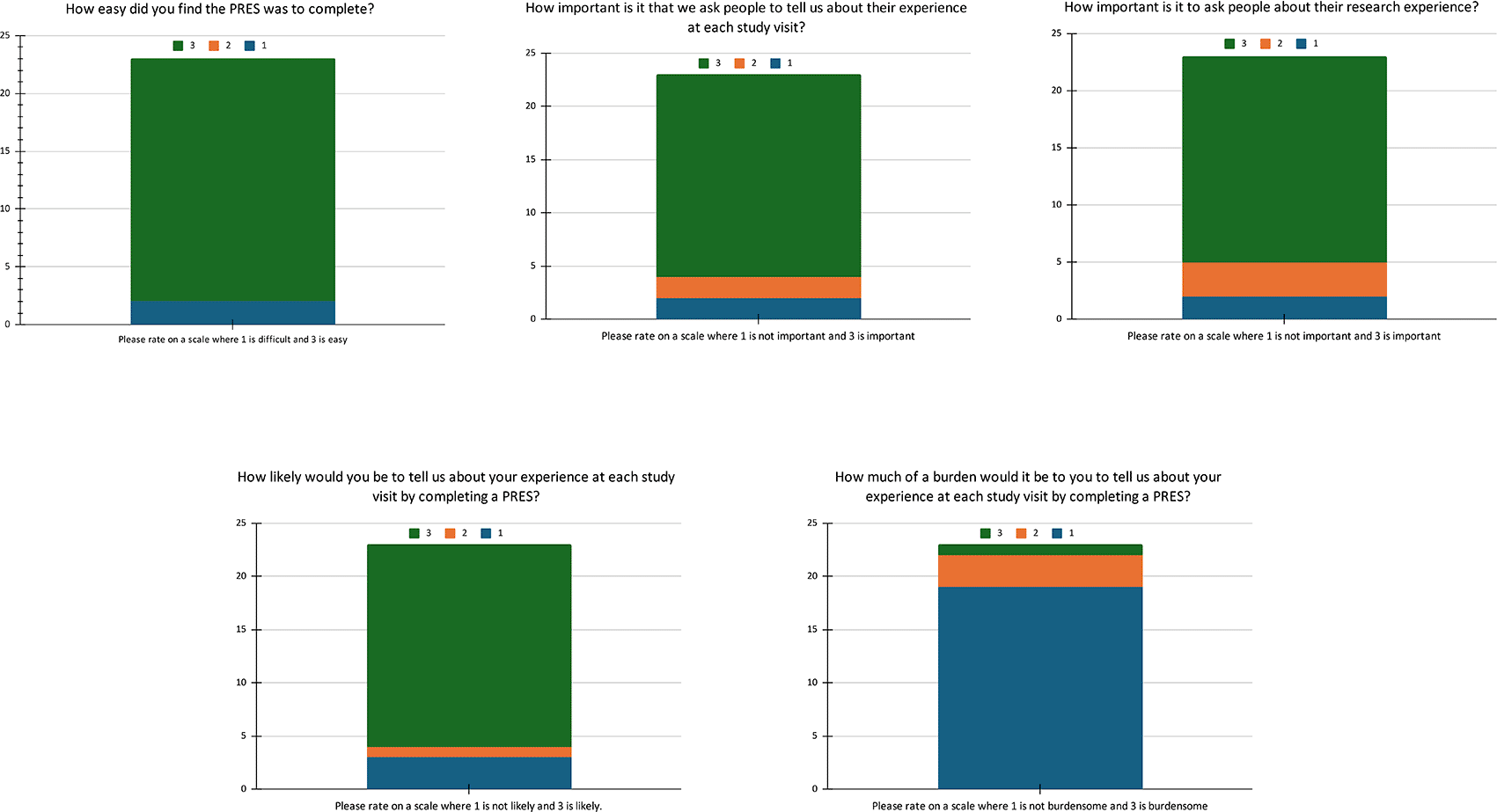
Question 6 (Figure 1) sought views on how important it was to ask people about their research experience. Responses were rated across three points again with 1 being unimportant and 3 important. Findings show that 18 (78%) felt it was important, 2 unimportant and 3 taking the midpoint. 15 free text comments were left to expand on the rated response (available in extended data). Importance was linked to increased engagement, improvements, monitoring and quality enhancement. One comment stated it increased the number of forms to fill in.
Question 7 (Figure 1) asked how important it was to ask about a participant’s experience at each visit, with 1 being unimportant and 3 being important. There were 23 responses with 19 (83%) stating important and 2 unimportant and 2 choosing the mid-point. The 15 additional free text comments were linked to monitoring expectations, tracking changes, engagement and feelings of value and suggesting improvements (available in extended data).
Question 8 (Figure 1) asked about the perceived burden of completing PRES at each study visit. Choices were 1 not burdensome and 3 burdensome. There were 19 responses for not burdensome (83%), 1 for burdensome and 2 in the mid-point. Eight free-text comments were left with seven stating it was very easy and quick so not a burden and one suggesting it would depend on how much time the participant had to spare at the visit (available in extended data).
Question 9 (Figure 1) and penultimate question asked how likely the person would be to complete a PRES at each visit. 19 stated very like (83%), 3 stated not likely, and 1 at the mid-point.
The final question asked if there were any additional questions PRES should include. Only 6 comments were left (available in extended data), and included questions about general health on the day of the survey, and questions about travel and parking.
Research staff participants were drawn from three NHS foundation Trusts across the NENC area. They were invited to take part via an email sent through the Trust Research and Development departments. The email gave an overview of the study and a link to the study website and a copy of the Participant Information Sheet. Via this route 37 members of staff visited the website, of these 29 fully completed the survey with the remaining eight opening the survey but not answering any further questions. Questions 1–4 covered consent, demographic and location information.
The age and gender profiles of the respondents reflects that of the general NHS staff population ( Table 2).
| Staff Demographics | Percentage | Number |
|---|---|---|
| Age | ||
| 18–20 | 0.0% | 0 |
| 21–29 | 6.9% | 2 |
| 30–39 | 24.1% | 7 |
| 40–49 | 24.1% | 7 |
| 50–59 | 34.5% | 10 |
| 60 or older | 10.3% | 3 |
| Gender | ||
| Female | 65.5% | 19 |
| Male | 34.5% | 10 |
Responses were received from only two of the three NHS Trusts the study was approved and launched in.
Question 5 asked the respondents whether they usually asked research participants to fill in a PRES. Of the 29 responses received 20 said Yes (69%) and 9 said No (31%).
Question 6 (Figure 2) asked how important it was to ask research participants about the experience they are having. A three-point scale was available with 1 being important, 2 neither important or unimportant and 3 being unimportant. Of the 29 responses 27 (93%) stated it was important, the remainder choosing the mid-point. A further 19 free-text comments were added to elaborate on responses (available in extended data). Most of the additional comments centred on gaining views to shape future research, ensuring quality and making improvements. A small number of comments were received which stated PRES was a tick box exercise and that it was not accessible to all patient groups.
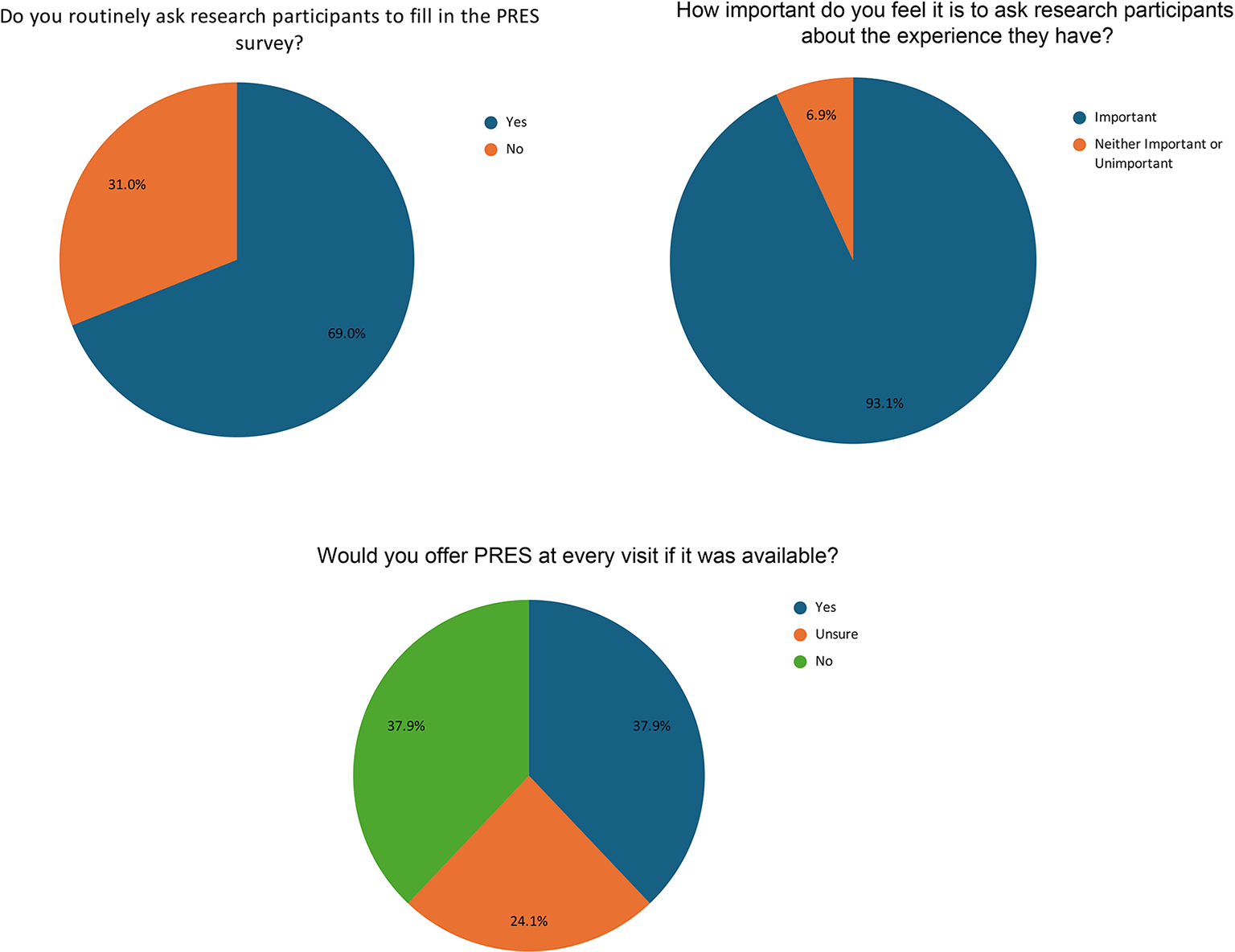
Question seven (Figure 2) asked if they would offer PRES at every visit if it was available. 11 (38%) said they would, whilst 11 (38%) said they would not, and the remaining 7 (24%) felt unsure.
Question 8 then asked about the main barriers to offering PRES at every visit. Responses were free text. All responses can be found in the extended dataset.
Multiple comments suggested there was a lack of time and capacity in study visits to add in a PRES at each visit. A further five comments suggested it would be too burdensome for participants. Burden was linked to content of study visit, such as delivery of ‘bad news’ or cognitive function tests and the frailty of some participants. It was also suggested that wholly electronic PRES delivery was not inclusive and makes it harder to engage the under-served populations. A paper format PRES was seen as a viable option where it could be completed in the research participants’ own time and returned to the study centre.
There were suggestions that multiple PRES would become repetitive and the findings devalued. Comments were made that supported an increase in delivery but only at specific time points, suggestions included annually, or every 6 months - depending on study type and duration.
Question 9 asked the respondents to suggest if PRES should gather any additional information. In total fifteen comments were made although six of the fifteen responses stated there were no additions required (available in extended dataset). Of the remaining seven comments, two talked about the need to offer a paper-based PRES and two suggested the current format included too many questions that are not about participant experience, the example given being how the participant would receive their study results. Other comments suggested a question around motivation to take part in a study, what needs changing to improve the experience, and reasons someone would or would not take part in future research again. There was one comment that thought each PRES should have study specific questions and that those questions should form part of the funding process and be submitted prior to the study beginning.
Question 10 captured the contact information of staff who wished to take part in an interview. Four members of staff left their contact details, but only one took up the opportunity to take part.
Question 11 was free-text and asked if there was anything else the respondent would like to tell us (available in extended data). Six comments were left. Concern was raised that aiding a participant to complete a digital PRES introduced an element of bias to the findings. One comment suggested there should be a PRES for consultees and a PRES for staff, the staff PRES being linked to increasing morale and retention. One comment wholly supported the proposed introduction of PRES at every visit to encapsulate the whole study experience.
As stated, only one member of staff followed up on the invitation to take part in an interview. The interview was conducted by a researcher. It was digitally recorded, transcribed and anonymised.
General support was expressed for increasing the number of times PRES was offered although there were barriers to the delivery. Barriers included staff capacity, in terms of workload and priority, organisational barriers such as lack of incentives and therefore motivation to push delivery, lack of devices to allow digital completion, perceived issues with infection control with multi-person devices, and governance issues when using email to contact participants with PRES.
Participant centred barriers included unfamiliarity with digital devices, and study visits being too intensive to add in a PRES.
It was suggested it would be very hard for staff to include a PRES at either a screening or baseline visit as these can be long and intensive. The most common visit for a current single administration PRES to be completed was thought to be the first visit after screening. It was suggested that PRES could be changed to reflect different types of study. There was felt to be a difference between gathering feedback from a participant who has engaged in a multi-visit interventional study when compared to a single visit non-interventional study. Overall, it was felt that the PRES would need to be reviewed to align it with study design and methodology.
Administration of PRES to participants also elicited some interesting comments. Whilst there is a general drive to move away from paper-based PRES, it was felt this was hard to achieve. Suggested reasons were; participants lack familiarity with electronic devices and an unwillingness to use these, the overall lack of devices, and the desire not to use the devices in areas where infection control was paramount, such as oncology.
The EXPRESS study set out to explore perceptions around increasing the number of times a PRES was offered to research participants. It questioned both research participants and research staff to elucidate any potential barriers to multiple delivery points. Delays to starting the project due to governance issues with accessing the study site via a trust device limited the duration of the study from 24 to 9 weeks. This delay and the inability to access via a trust device impacted on the total number of individuals who responded, which was below target level. The number of interviews completed was disappointing, even when adjusting for reduced study duration, it did not reach the target. This lack of engagement from the staff involved in the delivery of PRES may in itself be a signal of a disconnect with the survey. Public research participant recruitment also appears to have been impacted via the lack of engagement with the ‘flyer route’. It is not known how many, if any, flyers were distributed by staff. Recruitment was also affected as only two of the three sites chosen for staff recruitment appear to have rolled out the invite email. It is not known why the third site may not have engaged with the process.
Public research participants came from across the NENC region. They felt the current PRES was acceptable and easy to complete. They were in favour of increasing the number of times they were asked to fill in a PRES. It was not thought to be burdensome and would enhance the quality of experience. As these were a self-selecting group of people who had already completed a PRES these are not surprising findings. The only negatives stated by the same individual across the survey were that it would increase in the amount of ‘forms’ given to participants, would depend on ‘spare’ time during visits and that it was simply ‘too much’.
Staff responses were far more qualified than the public responses. Interestingly just under a third of those who responded stated they did not routinely offer a PRES to research participants. However, 93% felt it was important to collect feedback from research participants. Understanding exactly why there is a disconnect between the perceived importance of feedback versus the implementation of PRES will be key to expanding and enhancing the service. There is limited further information to explore whether these respondents were not participant facing or simply did not routinely engage with offering a PRES. It does however raise some questions about the validity of the further comments made. This area is worth exploring further to more fully understand these responses.
Staff felt it was important to collect information about experience from participants and linked that to quality improvement and future planning. There was one persistent comment that suggested that PRES was simply a ‘tick box’ exercise. This could suggest that further work is required to promote PRES and its usefulness.
The main barriers identified to increasing the delivery of PRES to each research visit were time and capacity. Capacity was further defined as the number of staff and physical space, that space often being needed by others and thus adding an additional ‘time’ pressure. Staff had a contrary view to public research participants as they felt it would be burdensome, especially in the older and frailer research participant. There was a strong narrative around the method of delivering PRES to participants. It was felt a wholly electronic format was not inclusive and contrary to serving those identified as under-served populations. Interview data also supported this where it was stated that paper PRES are posted out to participants, returned to sites and entered by staff. It appears these are ‘logged’ as an electronic return whereas they were filled out on paper by a participant. A further comment made also seems to suggest PRES may also be emailed out to participants. The current system has no process for recording this granularity of administration and return process.
There was also a difference of views where some responses seemed to suggest paper was not possible and that only an electronic return was ‘allowed’, whereas other data clearly suggested a paper format was being utilised as well as a digital format. Interview comments suggested that there were not enough trust owned electronic devices to allow for a digital route only. This warrants further clarification as it appears some staff see the digital route as replacing the paper version of the PRES to be completed onsite during a study visit, via a trust device. There seemed to be a lack of consideration regarding the digital option via the participants own electronic device, which may give more freedom for participants to choose where and when they completed the PRES. This option could therefore reduce the perceived burden to complete on site within a study visit and mitigate against a lack of trust devices. To assist the interpretation of these comments a system is required to more clearly record how and where the participant is completing PRES and whether it is paper, email, digital via trust device or digital via the research participants own device.
Whilst there was support for the premise of increasing the times PRES was delivered it was not thought it would be possible at every visit. It was also thought the type and duration of the study would need to be considered. Screening and baseline visits were identified as too busy to add in a PRES, visits where ‘bad news’ was delivered were also thought not suitable to add a PRES into. Whilst it was not stated, it could be suggested that staff felt ‘bad news’ visits may negatively impact the feedback received, the perception being ‘good’ feedback was being sought. It was suggested repeated delivery of PRES may become repetitive and therefore devalue the feedback. It was thought better to deliver PRES at certain time points in a study, such as, the first visit after baseline/screening, every 6 months or annually. This obviously is only in studies of a long duration, which tend to be interventional and would not be relevant in non-interventional/single visit studies. Interview data concurred with the view that screening and baseline visits were already very complex and that the addition of a PRES would add a further layer of complexity. Additionally, interview data suggested that it may not be appropriate to deliver a PRES with the same content across all study types. It was felt PRES should be study type specific and study visit specific-this adaptation would also go some way to addressing the previous comment regarding devaluing feedback. The distinction was drawn between complex long duration studies such as randomised controlled trials of medicinal products, and studies where there was no intervention being offered and were one or two visits in length. It was thought a final visit PRES should be different in content to other study visits. Further comments suggested that PRES should contain different questions that better capture the research experience, suggestions being issues in receiving or collecting study medication, motivation to take part in research and how study results are communicated. There was an interesting suggestion which linked funding and ethical review processes where study specific questions could form part of those applications and part of the study team’s feedback to regulators.
In general, research participants were in favour of increasing the number of times a PRES was offered through the research journey. Staff felt they required more support in terms of time and physical space. They suggested PRES could not be offered at every study visit and that the content of PRES needs to be tailored to study type and study visit. These views seem consistent with previous anecdotal evidence; however, the limited number of responses may limit the validity of responses.
There is a clear need to further investigate how PRES is both offered to participants and the process by which the data is captured. Whilst the move is to become a digital first service this appears to be not wholly supported by staff. There is a view that staff are ‘working round’ aspects of perceived digital completion so that those who are not digital natives can still have their voices heard. There is also a need to explore how PRES could become more study and visit specific to enhance the quality of the information gathered and potentially aid study teams in improving participant experience. Any further investigation of this type should explore alternate strategies to increase participant and site response.
Provide sufficient details of any financial or non-financial competing interests to enable users to assess whether your comments might lead a reasonable person to question your impartiality. Consider the following examples, but note that this is not an exhaustive list:
Sign up for content alerts and receive a weekly or monthly email with all newly published articles
Register with NIHR Open Research
Already registered? Sign in
If you are a previous or current NIHR award holder, sign up for information about developments, publishing and publications from NIHR Open Research.
We'll keep you updated on any major new updates to NIHR Open Research
The email address should be the one you originally registered with F1000.
You registered with F1000 via Google, so we cannot reset your password.
To sign in, please click here.
If you still need help with your Google account password, please click here.
You registered with F1000 via Facebook, so we cannot reset your password.
To sign in, please click here.
If you still need help with your Facebook account password, please click here.
If your email address is registered with us, we will email you instructions to reset your password.
If you think you should have received this email but it has not arrived, please check your spam filters and/or contact for further assistance.

Comments on this article Comments (0)