Keywords
Extreme weather events, Extreme weather and climatic events, Climate hazards, Climate change, Exposure, Vulnerability, Risk, Readiness, Assessment, Health system, Health facility.

Extreme weather events, Extreme weather and climatic events, Climate hazards, Climate change, Exposure, Vulnerability, Risk, Readiness, Assessment, Health system, Health facility.
 How to cite: Wanyama C, Karing'u P, Smith C et al. Tools and approaches for assessing risk and readiness of health facilities exposed to extreme weather and climatic events in Low-and-Middle Income Countries: A Scoping Review Protocol [version 1; peer review: awaiting peer review]. NIHR Open Res 2026, 6:74 (https://doi.org/10.3310/nihropenres.14272.1)
First published: 23 Jun 2026, 6:74 (https://doi.org/10.3310/nihropenres.14272.1)
Latest published: 23 Jun 2026, 6:74 (https://doi.org/10.3310/nihropenres.14272.1)
How to cite: Wanyama C, Karing'u P, Smith C et al. Tools and approaches for assessing risk and readiness of health facilities exposed to extreme weather and climatic events in Low-and-Middle Income Countries: A Scoping Review Protocol [version 1; peer review: awaiting peer review]. NIHR Open Res 2026, 6:74 (https://doi.org/10.3310/nihropenres.14272.1)
First published: 23 Jun 2026, 6:74 (https://doi.org/10.3310/nihropenres.14272.1)
Latest published: 23 Jun 2026, 6:74 (https://doi.org/10.3310/nihropenres.14272.1)
Climate change and its associated direct impacts of extreme weather events such as droughts, extreme temperatures, floods and storms pose serious threats to populations, communities, institutions and ecosystems.1 For health systems, majority of which are not climate resilient,2,3 extreme weather events pose threats such as risk of structural collapse, severe water and energy disruption and accumulation of medical waste, consequences that could seriously undermine ability to efficiently deliver safe routine and emergency healthcare services.4,5 In Low- and Middle-Income countries, where health systems face chronic stress6 from severe understaffing, old structures, inadequate medical supplies and equipment, inadequate health financing and leadership and governance challenges, additional shocks from cyclic extreme weather-related events may be difficult to absorb, plan for and correctly adapt to.7,8 Acute shocks can both worsen already existing vulnerabilities and create new ones, reducing the level of resilience for health systems.9 Resilient health systems include.
‘…institutions, infrastructure and populations, that are able to anticipate, prevent, prepare for, absorb and adapt in response to, and recover from a wide variety of shocks and stressors while delivering quality individual and population health services as needed, utilizing lessons from experiences within and outside their settings to continuously improve on their baseline capacities and performance in all contexts…’.10
To build climate-resilient health systems, i.e. those systems with capacity to ‘anticipate, respond to, cope with, recover from and adapt to climate-related shocks and stress’, 11 there is need to understand the level of vulnerability and capacity and overall risk that climate-change-induced extreme weather events pose to health systems, particularly at health facility level, where healthcare is delivered. This process can unearth the level of readiness of health facilities and systems to anticipate, prepare for, respond to, cope with, recover from and adapt to both the potential and actual negative impacts of extreme weather events. To do so, tools, approaches and methods that accurately identify and correctly determine the level of health system risk and readiness to extreme weather events are needed.
At the health facility level, it is now acknowledged that the health system comprises both the hardware and the software elements.12 Hardware elements are the tangible elements (health facility infrastructure, health workers, health products and technologies) of the health system. Software elements include both the tangible software (processes of health governance and service delivery) and the intangible software (organisational culture, relationships and power, interests and social networks, beliefs, values and norms, and practices). It is therefore necessary that tools, approaches and methods used to assess and determine health system level of risk and readiness to extreme weather events capture the most relevant, and where possible, comprehensively all these health system elements. Noteworthy, health systems operate in a wider context, influenced and shaped by political, social, economic, environmental and technological factors, and thus a further consideration of these factors is equally important (Figure 1 below).
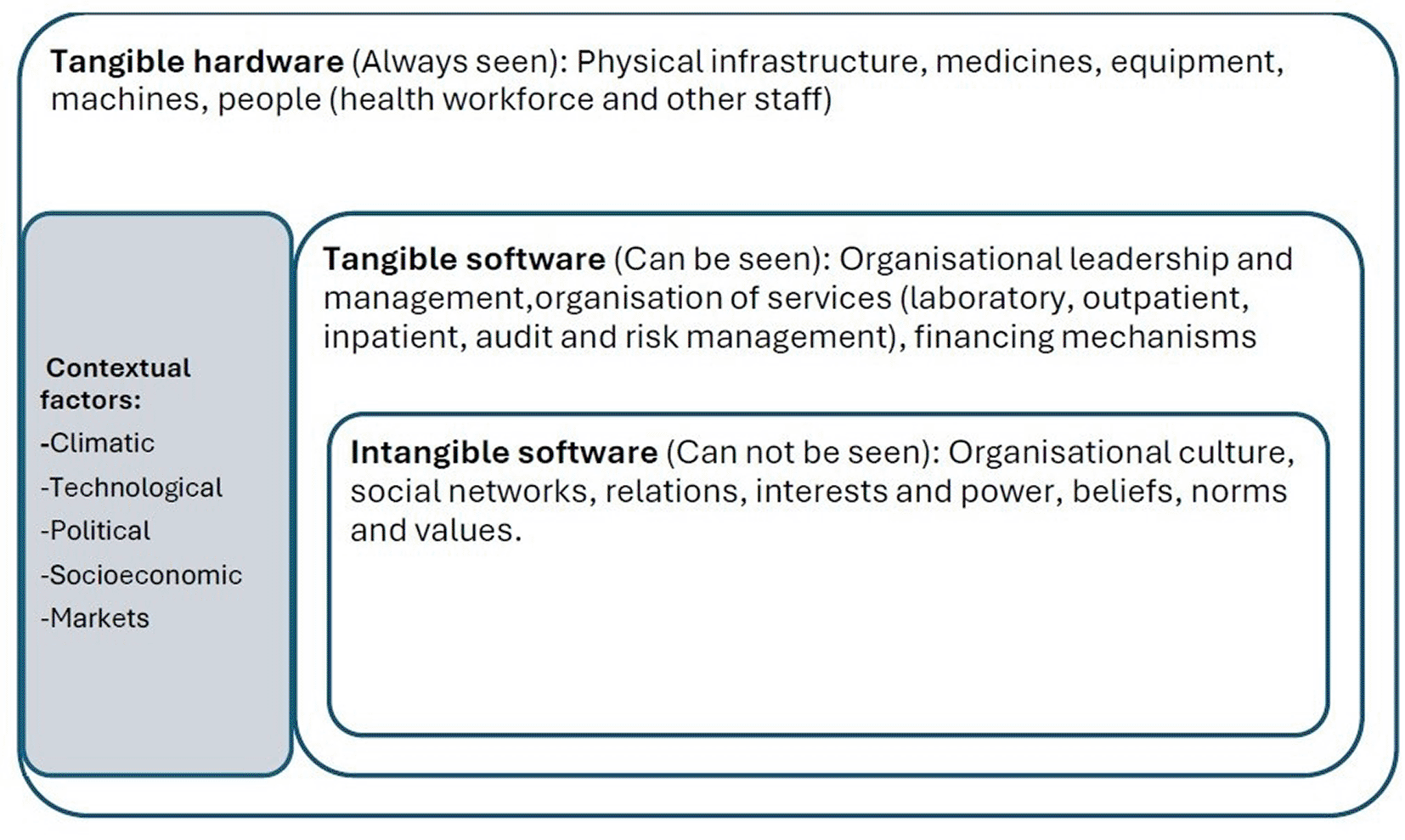
Figure 1 above describes broad health system elements (tangible hardware, tangible software and intangible software). It also highlights the value of context where the health system is situated, and the various contextual factors that potentially influence (and are influenced) by the health system elements.
These contextual factors, singly or collaboratively, whether at different times or acting at the same time, conspire to positively and negatively shape the health system, a complex and highly adaptive system to current and future shocks and stressors.
Risk of a health system at the health facility to extreme weather and climatic events can be difficult to conceptualise and measure. The concept of risk refers to the potential for adverse consequences or outcomes of an event. Extreme weather and climatic events (EWACEs) pose risk to health facilities through exposure of vulnerable health systems’ elements to climate change hazards. Also, response mechanisms13–15 to cope with the effects of EWACEs may create new or worsen existing vulnerability and therefore additional risk (Figure 2).
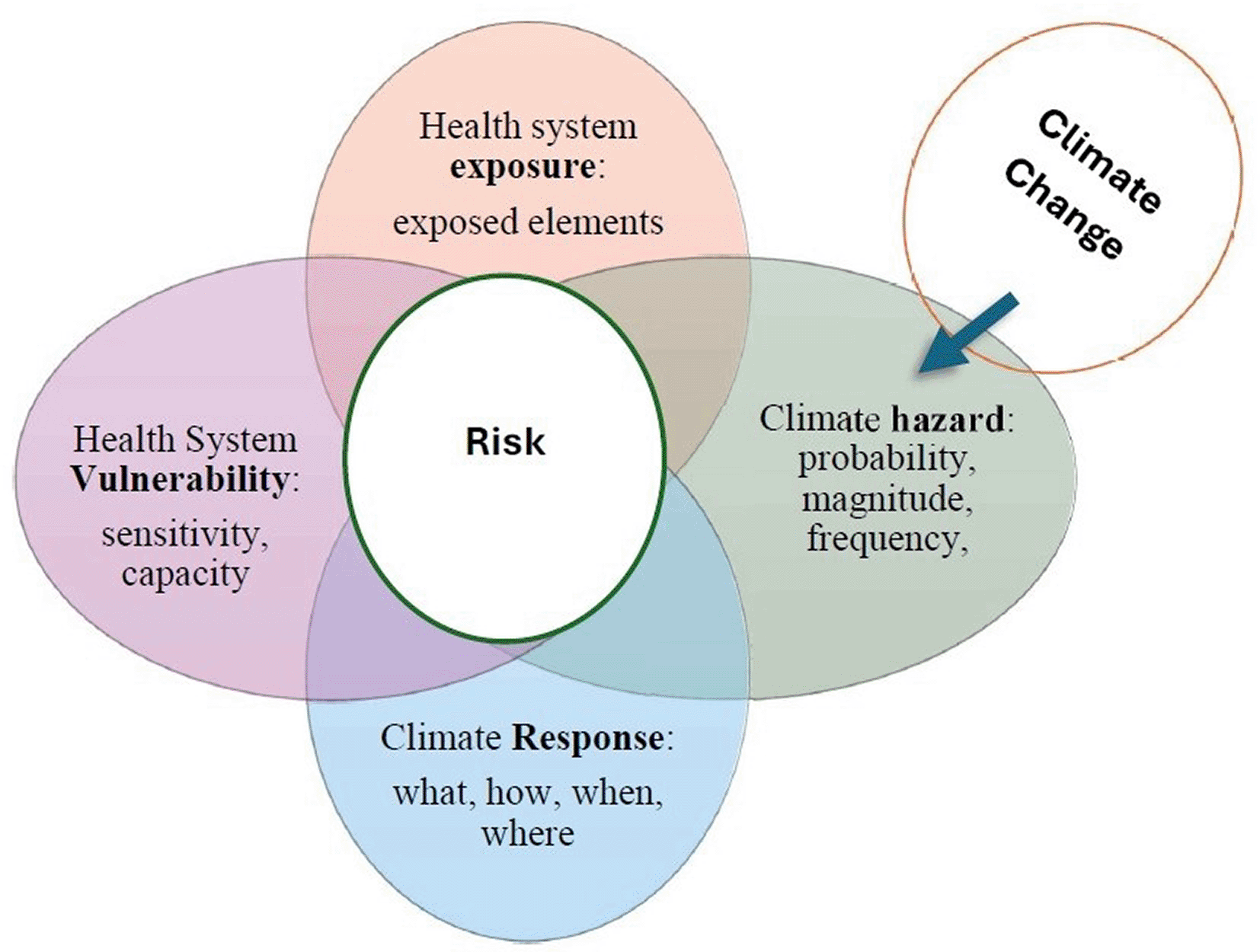
Figure 2 above, adapted from 2023 Climate change synthesis report: contributions of the I, II & III of the sixth annual report of the Intergovernmental panel on climate change: Determinants of risk (page 65),15 describes how risk of extreme weather and climatic events is conceptualised. The first level of risk is the risk of climate hazards (extreme weather and climatic events) occurring from climate change. The second level of risk is the risk of health system elements to extreme weather events. This risk is linked to exposure, vulnerability and response.
Because health facilities exist to serve population health needs, they need to remain open to those who need them, especially those who are most vulnerable. However, EWACEs pose multiple risks including of health facility closure, contamination, service interruption, limited access by those who are most vulnerable, and the health facility being unable to effectively and efficiently respond to climate-sensitive health issues alongside the expectation to deliver routine essential health services.16 Yet, it is not clearly understood which tools, methods and approaches are the most appropriate for assessing and determining risk and readiness of health facilities to EWACEs, especially for LMIC settings. Also, there is paucity of evidence on which elements or dimensions of a health system which, when assessed, can help characterize and estimate risk and readiness to EWACEs especially in already stressed health systems as is common in LMIC countries. This scoping review therefore aims to build knowledge through a systematic evidence synthesis of the most suitable tools, approaches and methods including the health system dimensions to assess health facilities' level of risk and readiness to EWACEs. The synthesised evidence will inform the development of a novel tool to assess the risk and readiness of health facilities to EWACEs, complementing ongoing empirical work in Kenya, an LMIC setting.
1.2.1 Research Question
What tools, approaches methods exist to assess and determine the level of health system risk (vulnerability, adaptive capacity) and readiness (adaptive capacity, preparedness, response plans) to extreme weather events in low-and-middle income countries?
1.2.2 Primary Objective
This scoping review aims to identify existing tools, approaches and methods for assessing elements of the health system OR health facilities to characterise level of risk and readiness to extreme weather and climatic events in low- and middle-income countries.
1.2.3 Secondary objectives
1. To characterise the extreme weather events for which the available tools were developed, with a focus on health facilities in low- and middle-income settings
2. To identify the process/approaches used in developing these tools
3. To describe the methods used to deploy these tools and approaches
4. To describe the components of health facilities OR health systems targeted for vulnerability, risk, readiness and resilience assessment abstracted from these tools and approaches for low- and middle-income settings
For this scoping review protocol, the review findings will inform the development of a novel tool for assessing health facilities in Kenya. To contextualise the review, we initiated consultations with Kenya’s Ministry of Health and the Kenya Meteorology Department in April 2025 to understand existing health system constraints and identify priority extreme weather events of national relevance. We further plan to engage these government entities together with community representatives from the four counties participating in the NEWRISK project in Kenya to appraise, validate and refine the review outputs. This process will ensure that the review findings are both relevant and applicable within the Kenyan health system and that the novel tool to be developed aligns with local priorities.
This will be an exploratory study design following the Arksey and O’Malley scoping review methodological framework originally established by Arksey and O’Malley,17 updated by Levac18 and Joanna Briggs Institute (JBI), updated guidelines for conducting and reporting scoping reviews using the PRISMA Extension for Scoping Reviews (PRISMA-ScR) guidelines.19
We will include articles from primary research studies and secondary studies/reviews (both pre-print and peer-reviewed) that have described the use of tools, approaches and guidelines for assessing health facilities or health system vulnerability, risk and readiness to extreme weather events. This evidence will be sourced from studies of any design whether conducted as observational or experimental, before-and-after, comparative analysis, mixed methods, qualitative, quantitative or reviews. We also search for tools, approaches, guidelines and policy documents from international organisational, government and non-governmental agency websites and experts in the field of climate change, disaster management and humanitarian aid. Where possible, we will also include hard copy documents from reputable humanitarian, health facility and government departments.
We will exclude studies that report assessment of health facilities for other hazards other than climate related ones.
The search will be limited to studies published in English between 1990 to 2025. 1990 has been identified by the Kyoto protocol as the base year for monitoring the impact of climate change and extreme weather events.20
We will exclude studies published prior to 1990. All studies published in languages other than English, unless they are already translated to English, will also be excluded at screening point.
2.3.1 Participants/Population
We will include all articled reporting the use of tools for assessing the health system or health facilities to determine risk and readiness to extreme weather and climatic events. The tools of interest may be assigned names such as tools/approaches/checklists/guidelines.
We will exclude studies that report other methods other than tools, approaches, checklists and guidelines or indeed tools/approaches/checklists/guidelines for assessing communities and non-health sectors/systems such as education, agriculture or trade.
2.3.2 Concept
To be eligible, the concepts of interest in this scoping review include the following
a) Scope: The extent to which the tool is used, which in this review is to assess health systems or health facilities, either for some or all levels of risk (i) exposure, (ii) vulnerability, and (iii) readiness to extreme weather events or extreme weather and climatic events or climate-linked hazards in low- and middle-income countries.
b) Process: The method used to develop the tool, e.g., expert-driven or through participatory approaches.
c) Psychometric testing: How the tool has been tested to assess its validity and reliability (testing and validation), and the contexts or settings in which it was tested and validated.
d) Format: The availability of the tool, e.g., whether it is accessible digitally (online, web-based, or other electronic formats) or as hard copies (paper-based tools).
e) Purpose: The intended use of the tool, e.g., to assess a health facility’s level of vulnerability to climate hazards.
f ) Methods: Which method (e.g facility inspection, consensus methods, interviews) used in deploying these tools.
g) Content: The domains or components or elements of the health system/health facility captured by the tool.
2.3.3 Context
In this scoping review, the context for which these tools have been developed for is the broader health system, and specifically for health facilities, or hospitals, or healthcare settings in low-and-middle income countries or settings.
We will exclude studies that were conducted in high income settings, or those that do not explicitly report the setting as low-income setting or country.
We will aim to make a comprehensive search of both published and unpublished tools, approaches, checklists, guidelines and frameworks mainly from international (such as World Health Organisation, World Bank and United Nations Climate Change), regional agencies (European Union, Africa CDC, African Union), government (Departments of health, teaching hospitals), humanitarians (Such as Care International, Concern Worldwide, International Federation of the Red Cross), and non-governmental agencies (climate change consortia, climate change consultancy firms). Additionally, relevant primary qualitative and quantitative research studies and reviews of these tools from online databases will be conducted. For online data sources, we will search three major databases (OVID-Medline, Embase and Global Health). We will also conduct further online search on Google scholar, Google web and from pre-print repositories (such as Preprints.org, BioR and MedRxiv). Additionally, we will search articles from handpicked climate-relevant journals such as Nature Climate Change, PLOS Climate, and the Lancet Countdown on health and climate change, including contacting subject-matter experts to identify unpublished or in-progress materials. All articles and resources sought will be full, open access and in English language.
2.4.1 Search question
We will restrict the search to the following search question: What tools (methods, approaches, checklists, frameworks, guidelines) are used for assessing the level of risk or impact, or vulnerability and readiness (adaptive capacity, resilience, preparedness, response plans) of health systems (or health facilities) to extreme weather events or extreme weather and climatic events or climate hazards in low and middle income countries?
We will use Boolean operator words: AND, OR, NOT to combine or restrict the search.
For the online databases, we will search one online database and an additional search on Google to identify and analyse text words (including key terms) used in the title and abstracts of articles. We will then develop key words for subsequent search in the other online databases. We will then find any additional articles from the listed references of the articles found from the databases. This work will be guided by the Librarian, listed as co-investigator.
2.4.2 Proposed Search
The proposed search strategy will be restricted for a period of 1990–2025 using the search terms described in Tables 1-2 below. Key words for search the websites of various organisations have also been proposed in Table 3 below.
Table 1 below shows the proposed search terms, including Medical Subject Headings term and controlled vocabularies for Medline Ovid.
Table 2 below shows additional search terms and syntaxes for the three databases (Medline Ovid, Embase and Global health).
Table 3 below shows the key words for use during search on the national, international, government and non-governmental organisational websites.
We will export all online articles to Zotero, an open-source online reference manager for reference library storage, deduplication and classification. From the reference manager, stored articles will be imported to Covidence systematic review management software, a web-based review management platform for any further deduplication. Two reviewers, CW and PK will screen the articles, combining titles and abstracts electronically using Covidence. CW will manually screen all duplicates and if found as errors, will be returned to the pool of articles for title and abstract screening. Thereafter, articles and abstracts of relevance will be eligible for data extraction. Again, full articles with potential relevance, based on the title will be selected by the 2 reviewers (each 100%) through Covidence. Any duplicates will be manually assessed and if erroneous, will be returned to the pool for data extraction. Any disagreements will be resolved by consensus and, if necessary, by a third reviewer (MM). All articles that are not in English language or not translated to English language will be removed at this point. The description of the selected articles will be presented narratively and using the Preferred Reporting Items for Systematic Reviews and Meta-Analysis extension for Scoping Reviews (PRISMA-ScR) diagram.
The primary reviewer, CW, will develop a data charting table for data extraction that details article name, type (checklist, tool, framework, guideline, review), author(s), date, source (online or shelf ), ownership and findings (content). The data charting will be shared with the review team for review and edits. Data will be extracted article by article by reading and re-reading the articles and charting the findings in the proposed data charting table. The content of interest is shown in the data charting template below (Table 4). We will (CW and PK) initially pilot this data charting table on approximately 5–10 articles to develop a common understanding, refine it and to resolve any misunderstandings. Where a third reviewer is needed, MM will be the tiebreaker.
Table 4 below shows a data charting and extraction template. The table will be piloted and refined during full text extraction.
This scoping review provides a learning opportunity for persons and institutions interested in conducting an assessment to determine hazard exposure, vulnerability, risk and readiness of health systems/health facilities to extreme weather events. The findings from the scoping review will initially provide a rich learning of what tools and approaches exist, how they were deployed, and what elements/domains/areas of the health system or health facility are given prominence during assessment by these tools and approaches. Secondly, the authors will, upon synthesis of these findings and those from an ongoing empirical work, aim to design a novel extreme weather event vulnerability, risk and readiness assessment tool for health systems in Kenya, a Low- and Middle-Income Country.
This proposed scoping review is part of Novel Extreme Weather and Risk Insurance for Kenya, (NEWRISK) project21 whose ethical approval has been obtained from the Scientific and Ethics Review Unit of Kenya Medical Research Institute (KEMRI/SERU/CGMR-C/315/4971). Additional ethics approval was obtained from Oxford Tropical Research Ethics Committee (OxTREC), UK, reference number 1720689.
The findings of this review will be shared with national and sub-national level stakeholders convened by the Ministry of Health, Kenya, for sense-checking to determine relevance in the Kenyan context. Subsequently, the findings will be used to inform development of a novel health facility assessment tool for Kenyan context. The novel health facility assessment tool will be used to assess health facilities in Kenya to inform preparedness, response and mitigation measures for Kenya’s health facilities.
Provide sufficient details of any financial or non-financial competing interests to enable users to assess whether your comments might lead a reasonable person to question your impartiality. Consider the following examples, but note that this is not an exhaustive list:
Sign up for content alerts and receive a weekly or monthly email with all newly published articles
Register with NIHR Open Research
Already registered? Sign in
If you are a previous or current NIHR award holder, sign up for information about developments, publishing and publications from NIHR Open Research.
We'll keep you updated on any major new updates to NIHR Open Research
The email address should be the one you originally registered with F1000.
You registered with F1000 via Google, so we cannot reset your password.
To sign in, please click here.
If you still need help with your Google account password, please click here.
You registered with F1000 via Facebook, so we cannot reset your password.
To sign in, please click here.
If you still need help with your Facebook account password, please click here.
If your email address is registered with us, we will email you instructions to reset your password.
If you think you should have received this email but it has not arrived, please check your spam filters and/or contact for further assistance.

Comments on this article Comments (0)