Keywords
Evidence Learning Sets, public health, knowledge mobilisation, local government, local authorities, alcohol licensing

Evidence Learning Sets, public health, knowledge mobilisation, local government, local authorities, alcohol licensing
Getting research evidence more integrated into decision making in local government is a priority in the UK. New mechanisms have been introduced to encourage this, including investment in Local Authority Research Practitioners, Health Determinants Research Collaborations and a range of knowledge mobilisation roles in national health research initiatives (for example, knowledge mobilisation fellows in the NIHR Applied Research Collaborations). These mechanisms typically focus on building capacity for evidence translation, developing local research projects and contributing to ‘culture change’ in local government that more routinely consults research evidence (e.g. Holding et al. 2024; Bell et al. 2025; Woodall et al. 2025).
Areas of public health practice that are complex, time bound or economically and politically sensitive are challenging for decision making. These constrained circumstances also make it difficult to bring research evidence into discussions. In addition, research may require rapid synthesis, be difficult to integrate into decisions and need time and space for open deliberation.
There is a rich tradition of models and frameworks that map out the process of better integrating evidence into decision making. Indeed, there are so many that deciding what to choose and how to apply them can be challenging (Nilsen 2015; Ziam et al. 2024). In addition to conceptual models and frameworks, there are also a range of tools and methods available to bring evidence and other forms of knowledge closer to practice. While these may not be clearly tailored to local authority public health, their broad principles and methods are applicable. For example, the NHS England knowledge mobilisation toolkit identifies 13 ways learning can be harnessed before, during and after action. These include before- and after-action review, appreciative inquiry and communities of practice (NHS England 2025). These general tools are a useful starting point for knowledge mobilisation but they may not address all of the issues identified above: the need for political sensitivity, timeliness and an opportunity to deliberate.
This paper describes an emergent method of rapid, deliberative and action-focussed knowledge mobilisation in local government: Evidence Learning Sets. Built from the foundations of Action Learning Sets (Revans 2016), the paper sets out a worked example of how an Evidence Learning Set was formed, what it included and how it was conducted. As a team of participant co-authors, we also reflect on how it progressed, morphed through doing and what were its outputs. As such, this paper offers a model of knowledge mobilisation where evidence users were both the consumers and producers of knowledge, intentionally blurring the distinction between the two (Evans and Scarborough 2014).
First, we describe how Evidence Learning Sets borrow from established models of action learning (Revans 2016), highlighting how the process both reflected and departed from traditional models. Second, the paper outlines a worked example of how an Evidence Learning Set was put into practice with public health professionals from five local authorities and a knowledge broker on the topic of alcohol licensing. Finally, we offer some reflections on the process of creating and participating in an Evidence Learning Set, the promise it offers and areas for development.
Action Learning Sets derive from a broader movement of action learning in organisations, emerging in the 1940s and becoming better defined in the 1980s (Revans 1982). Action learning is a question-based approach to problem solving, achieved through supportive conversations between people working in similar fields with shared challenges (ibid). The process of action learning is premised on people learning with and from each other in an environment that is non-judgemental, inquisitive and reflective.
Participants in Action Learning Sets explore and reflect on actions and practice in a small group setting. These ‘sets’ meet regularly to work on members’ challenges, learning together without traditional ‘instruction’ (Walia and Marks-Maran 2014). The focus is putting learning into action, reflecting on that action, learning from it and acting again. This process offers potential for rich, relevant and applied learning (INTRAC, n.d.).
Action Learning Sets have been identified as particularly suitable in situations when there is no clear ‘right answer’ to a problem or where issues present complexity, uncertainty and require deliberation (Edmonstone 2014, 2018). This necessitates an approach that ensures participants feel safe to share problems and free to ask questions in the spirit of confidentiality and honesty (NHS 2015). They have been used in a variety of contexts, including in local government transformation, health service improvement and Non-Governmental Organisation leadership (Djamankulova et al. 2010). There are a few examples of action learning applied to public health challenges (Learmonth 2005; Jacobs 2008), sometimes in local government settings (van der Graaf et al. 2021).
Our adaptations originated from our ambition for participating local government public health teams to be enabled to take actions that explicitly referred to the scientific evidence base. In our creation of Evidence Learning Sets, we borrowed from Action Learning Sets in several important ways:
1. We retained the emphasis on problems, co-learning, questioning, deliberation and sharing challenges.
2. We adopted principles of the Set as a safe environment for discovery, questions and disclosure.
3. We brought together a small group of practitioners (n = 7) with shared interests.
4. We met regularly and to a schedule (6 times over 4 months).
5. We had an action focus, albeit in adapted form (see below).
We adapted the process by:
1. Using research evidence to help answer participants’ questions. We intentionally introduced scientific literature into discussion and explored how research could help answer questions and inform decisions. Previous experience of knowledge mobilisation in public health by the lead author and a considerable evidence base on how evidence is used in decision making (Orton et al. 2011; Langer et al. 2016), tells us that research can often provide helpful yet incomplete actionable solutions to problems. The Evidence Learning Set sought to overcome this by blending the lived, learnt and professional experience with insight from the evidence base.
2. The ‘action’ phase. Actions after meetings would normally be carried out by Set members. In the Evidence Learning Set, the facilitator/broker gathered questions coming from Set discussion as a prompt for evidence search, retrieval, summary and presentation for subsequent Set meetings. Action by group members was reserved, on the whole, for the final phase of the Set when tools were created for use or ‘action’.
3. Timeframe. The Evidence Learning Set took place over a shorter-than-usual timeframe. Action Learning Sets are advised to continue throughout the lifetime of projects. This initiative, having no particular endpoint, was conducted over four months and was devised to meet a range of needs in a group with different roles, knowledge and experience in the problem domain (alcohol licensing).
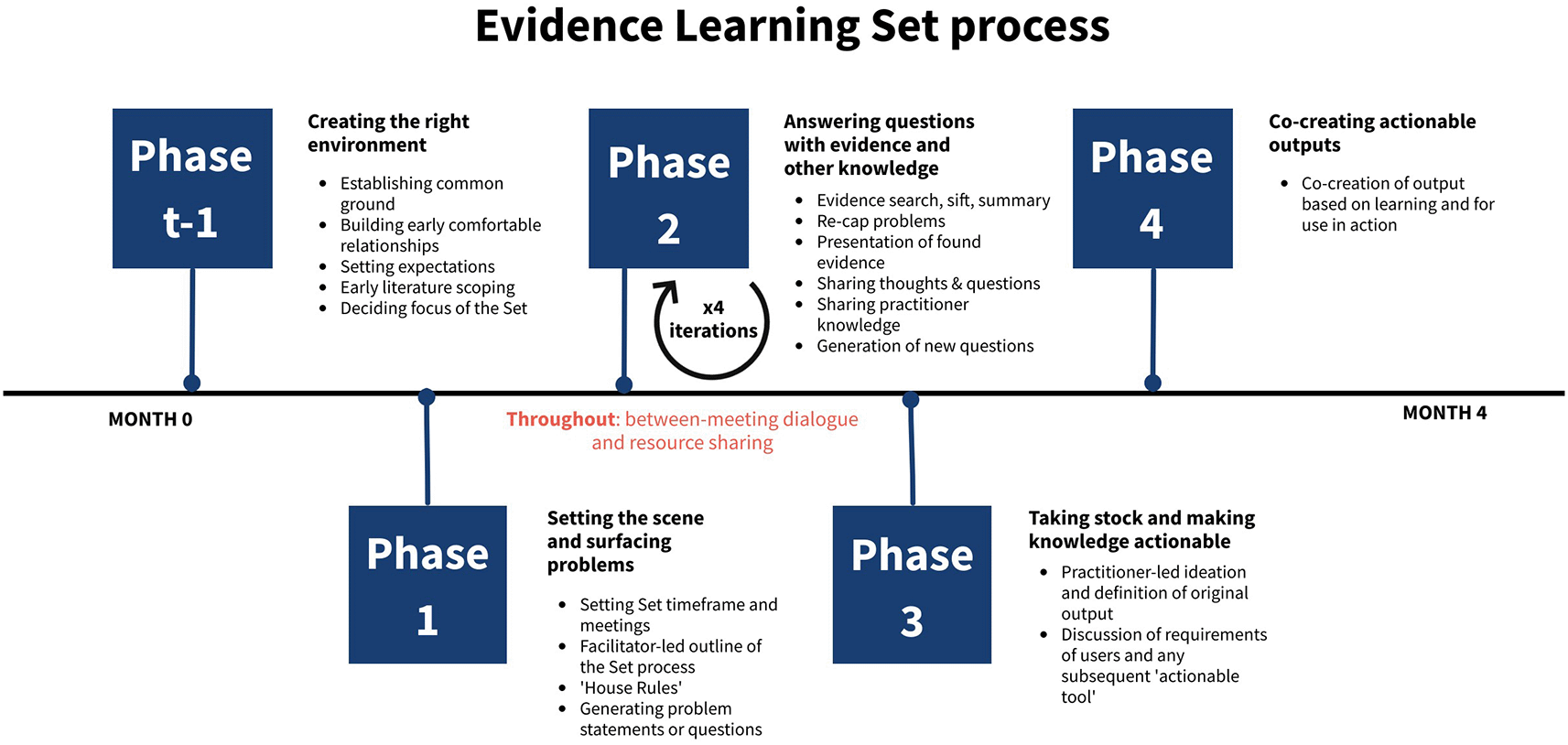
The process adopted is summarised in Figure 1. It is important to note that the process, although appearing linear, involved a lot of between-meeting dialogue, questions and resource sharing; all of which were part of the learning and development process.
In developing this method of knowledge mobilisation, we included consultation with the programme’s Public and Community Engagement Group (PACE). Led by the community organisation AFRUCA Safeguarding Children, a charity that specialises in supporting the wellbeing of minoritised families, we spoke to four group members about the topic of alcohol use, public health challenges arising from it and how issues manifest in individuals, families and communities. We discussed family challenges arising from alcohol use, the problem of easy availability (e.g. large numbers of local shops selling alcohol), underage drinking and the connections between alcohol misuse and other public health challenges such as gambling. These topics were added to the concerns raised by local government public health professionals at the start of the knowledge mobilisation project (phase t-1, see below). AFRUCA are partners in the knowledge mobilisation programme being delivered (starting 2023) and the PACE routinely advise on project issues, approaches, methods, engagement and dissemination.
The Evidence Learning Set method was devised as part of a programme of ‘rapid response’ knowledge mobilisation conducted by a funded partnership of knowledge brokers, co-design specialists, domain experts, creative partners, science communicators, local authority professionals and public participants. Funded by the National Institute for Health and Care Research (NIHR), Knowledge for Public Health (KNOW-PH) was commissioned to mobilise evidence with local government (Such et al. 2024), providing an authorising environment for action (Baum et al. 2017).
The Evidence Learning Set method emerged from a range of early experiences in the programme that highlighted the need for establishing common ground early on in a project, building conviviality, having a clear offer for local authority practitioners and setting expectations around resource intensity for participation, the time period for engagement and how projects would be conducted (Tattersall et al. 2025). These activities are frequently identified in the knowledge mobilisation literature as important pillars of engagement (Wye et al. 2019; Knowles et al. 2021; Durrant et al. 2024). As such, a pre-Set (t-1) phase was built into planning to put these known enablers into place. The process from phase t-1 to phase 4 is described below.
This phase of the project allowed potential participants to learn about the proposed project and participate in its shaping. It included five local authorities interested in addressing alcohol licensing as a public health issue. The topic focus was loosely framed, offering the team opportunities to vocalise their interests and local challenges. These were collated through online meetings by the KNOW-PH broker and four domains of interest were identified.
An initial scoping exercise of the NIHR evidence base was undertaken to establish its volume, nature and content. This was intentionally restricted to NIHR research; a fact which was made explicit to the participating professionals. Search outputs were thematically organised and shared across the team in simple tabular form.
A pre-Set meeting with potential participants was organised to discuss the findings of the scoping exercise and a collective decision made to focus on alcohol licensing. This was based on factors relating both to the evidence base such as the volume of research, its specificity to the local authority environment, and its recency, as well as the importance of the topic to the everyday challenges of the group. This negotiated and multi-faceted approach was, in effect, a compromise that would meet the needs of many but not necessarily all. Group members were offered the opportunity to drop out at this phase; no-one chose this option.
At this point, the KNOW-PH broker organised a series of six Set meetings, mostly 45 minutes in length across three months. The final Set meeting was designated as a half day workshop. At the first scheduled meeting it was made clear that local government public health professionals were not expected to attend all the meetings but that doing so would be likely beneficial overall. This was intended to acknowledge the time pressures and competing demands experienced by officials. The first session included:
• Basic introductions of Set members including roles and experience in the alcohol licensing field.
• An outline by the broker on the form and nature of an Evidence Learning Set.
• A ‘light touch’ outline of proposed ‘House Rules’ including confidentiality and openness, discussed briefly by the group.
The session focused on generating problem statements or questions that could be posed to the evidence base. Concern was raised about the legislative environment in England that marginalised public health: the Licensing Act 2003 does not include public health in its four legal objectives. Each participant had equal opportunity to outline their issues and questions.
Participants were encouraged to use open questions (what, when, how, why?) and avoid giving advice. Moreover, Set members shared their work, challenges and issues. These were discussed and noted by the broker who then shared back the questions with the team by email after the session. Overall, three problem questions were identified: 1) How can public health teams be involved in licensing decision making? 2) How can coalitions of local stakeholders be generated to build alliances for action? 3) How can public health involvement in alcohol licensing be optimised strategically and tactically?
After the first meeting, the broker was tasked with searching the NIHR evidence base for research that addressed Set questions. Inevitably, not all questions could be answered in whole or in part by the available evidence base. The broker sifted through what was available, making sure that the findings of research studies directly addressed the concerns of the group and identified elements of the problem domains that were absent from the found evidence. Significant studies on local alcohol licensing were highlighted and relayed back to the team in proceeding meetings, which followed a common pattern:
1. Short recap of the previous meeting(s).
2. Summary presentation of evidence from the research base that helped answer the Set’s questions by the broker.
3. Sharing thoughts on and asking questions about the evidence by all Set members.
4. Expansion of knowledge through the sharing of a range professional experiences and contextual nuances.
5. The generation of further questions for the next round of the Set.
This process was repeated four times. The progress of the Set was updated by the broker session-by-session on an Evidence Learning Log (Such 2026); a bespoke interactive summary of the evidence explored. This was available to all participants to reference throughout the project.
This phase was woven into the latter stages of the main body of the Evidence Learning Set sessions. Prompted by the broker, participants were encouraged to discuss what they thought would be useful for practitioners working in this domain, considering the evidence and practice knowledge gained throughout the Set. Discussion pointed towards an original output, a practical tool and something that could be shared across the broader public health community.
Our deliberations began to repeat themes and centred on a main challenge: Where should public health practitioners put their efforts in alcohol licensing when resource is limited and the external environment is not centred on public health outcomes? A range of requirements were outlined. A tool needed to be practical, easy-to-access, support but not determine decisions and flexible enough to account for context, locality and resource. A final three ideas were included in preparation for a co-creation session:
1. A short guidance document for public health teams and practitioners, potentially in the form of an infographic ‘menu of activities’.
2. An impact/effort matrix to help make decisions on when and where to act.
3. A decision support ‘tree’ or branching scenario model that would help practitioners assess when and how to act.
This phase departed from the main body of the Set in that it sought to create tools that brought together collective learning for action. This was an intentionally longer session (2.5 hours) to enable co-creation exercises. The broker prepared for the session by developing outlines of materials from the content of the previous five Set sessions. For example, a simple impact/effort template was created in Miro alongside digital ‘sticky notes’ containing many of the activities and tasks public health practitioners and the evidence described. In addition, a series of possible questions for a decision support tree were documented from the content of the Set alongside a basic mock-up of what a decision support tool might look like.
Prior to co-creation activities, new people were brought into the Set: an academic with deep domain knowledge and a third sector organisation providing alcohol services to local government. The introduction of domain experts had been suggested by Set members in earlier sessions, with the practitioner in alcohol services suggested by one of the participating public health professionals. Earlier feedback from the KNOW-PH rapid knowledge mobilisation programme had also highlighted the value placed on the professional experience of specialists. A Q&A session was held, with prepared questions created by the team and shared with contributors in advance. This section of the session meant practitioners received firsthand accounts of challenges and practices in the alcohol licensing field, some deeper insight into its complexities and advice about what kind of approach might be most fruitful for public health practitioners.
The second part of the session followed on from these detailed discussions. Guided by the broker, the team first provided a range of questions that could be included in a decision support tool. This was documented by the broker and shared with the group in real time as it was being constructed. In total, over 20 potential questions were added to the decision tree. In addition, the team undertook an exercise modelled on the design sprint ‘Crazy 8 s’ activity (Google n.d.), identifying both what they intended to do as their ‘top 3’ actions after the Set and an ideal type ‘top 3’ that participants would like to do if they had the time, resources and autonomy to enact. The rationale, purpose and content of these activities are summarised in Table 1.
The effort/impact matrix was not used during the cocreation session owing to time constraints. It was also likely to lead to repetition of many of the questions raised for the decision support tree. We decided to distribute the matrix for participants to user test and further develop outside of the Set workshop.
At the end of the Set, the broker and a science communications specialist from KNOW-PH drew from the cocreation exercise to develop prototype outputs for team members to critique. These included a video infographic and a decision support tool. These were shared at the end of the process across Set members’ and broader networks.
At the end of the Set, participants offered reflections on the process, identifying some of the essential core ingredients of the approach as well as some of the unknowns, issues and challenges. Table 2 summarises these reflections. It is not a comprehensive description of all issues; as a single and formative case example, we acknowledge that the approach requires further development, refinement and testing. In time, we would expect a full evaluative programme to examine the effect of Evidence Learning Sets on practice and ultimately, public health programmes, delivery and outcomes.
| Evidence Learning Set component | Constituent ‘ingredients’ considered important for functioning in the alcohol licensing case example | Unknowns, issues and challenges as experienced in the alcohol licensing case example |
|---|---|---|
| The environment | Convivial, friendly environment. Supported by initial house rules. | Existing relationships, unknown to the Set facilitator, may hinder (or help) the creation of a conducive environment. |
| Openness, cf. “space to talk” (Knowles et al. 2021). Encouraged by the questions-focused method of the Set and house rules. | Some Set participants contributed more than others; this may not necessarily be a learning or action barrier. A factor to be aware of as a group in case of inadvertent exclusion. | |
| Set membership & participation | Diverse and self-selecting membership. Participation flexible, with some new and occasional members welcomed into the Set after it had begun. | Members of the Set had different backgrounds, seniority and experience in public health & alcohol licensing. This mixed membership is recommended for Action Learning Sets. It is unknown what might work best for this process. There is a risk that not all suitable staff are authorised to participate. Over-flexibility may disrupt the ‘flow’ of the Set and/or relationships within it. |
| Facilitator addressed time commitment concerns early on. Flexible enough to allow for occasional non-attendance. Catch up sessions offered to those who could not attend. | Involving members of the public and communities was largely absent from the process, other than at t-1. | |
| Members were committed to participating in the sessions. | Non-participation is contrary to the ethos of action learning, as in this case of evidence-to-action learning. The extent to which action occurred after the Set is, however, largely unknown in this case and requires evaluation. | |
| Organisation | Set sessions organised in advance and as a ‘block’ of dates. Potentially helped justify involvement (time-limited, pre-planned and auditable). Spacing between sessions short (around 3 weeks) to enable flow and recall. | Not all dates suited everyone. A ‘best fit’ approach was used. Unknown if/how this was suboptimal to the functioning and outcomes of the Set. |
| Set conducted online because of geographic dispersal of members. | Face to face events, especially during co-creation phases, may be more suitable or productive than online. | |
| Evidence Learning Log completed during the Set provided a reference point for participants. Acted as a live documentation of progress through the evidence and discussion. | Sharable/digital logs may not be required. Other means of personal or team logging may be sufficient. | |
| Facilitation | Skills exercised in evidence search, sift and summary. | Support for this phase could be offered from elsewhere e.g. library services, if available. |
| Broker role enabled time to be spent on tasks between Set meetings. | Tasks of search, sift, selection and summary require time; Set likely needs resourcing appropriately. | |
| Facilitator comfortable with a ‘boundary spanning’ role. No necessary domain specific knowledge at outset. | The broker was not an experienced researcher or practitioner in alcohol licensing. The extent to which this is a (dis) advantage should be explored. Similarly, the broker may need a certain degree of research and methodological literacy to facilitate well. This requires exploration. | |
| Frequent reinforcement that, although the Set focussed initially on research evidence, all forms of knowledge were encouraged, valued and integrated. | Careful framing is needed to overcome over-privileging research evidence. Openness in sharing practice experience seemed to be a balancing factor; this requires further exploration. | |
| Managing Set time to ensure members can contribute with their practice knowledge. | Recurrent sessions in Phase 2 were 45 minutes long; tailoring may be required for specific subjects or to meet members’ needs. | |
| Emphasis on the broker as facilitator to the whole process. | Reliance, responsibility and strain on the facilitator role. Possibility this role could be shared or distributed across teams in future Evidence Learning Sets. | |
| The topic | The topic was complex; no clear ‘right answer’. | The technique may be suitable for topics where the evidence base & actions may be more definitive. |
| Derived from practice. The topic mattered to people working in local government in England. | Topics derived from lived experience e.g. of alcohol misuse may equally valuable and viable. | |
| Contextually different across geographies but similarities (e.g. legislative environment) meant diverse places faced similar challenges. | Unknown how inclusive a Set can be if context diverges considerably. The Set depends on some convergence between participants on the questions that need addressing. | |
| Content & the evidence base | Contextually relevant. The evidence needed to respond to the issues faced by practitioners in their contexts (local government) i.e. be “fit for purpose” (van der Graaf et al. 2020). | Possible that out-of-context evidence can be used for learning (e.g. evidence from policing or the NHS). Questions about the relative value and utility of such evidence. |
| Problem domain: Evidence base included strong, comprehensive works of high quality on alcohol licensing. Using NIHR studies only ensured high quality, peer reviewed work. | Strong, high-quality evidence existed but was limited owing to the specificity of the questions and the parameters of the evidence base chosen for mobilisation (NIHR evidence). Using a wider evidence base would likely add both value to the Set and complexity to the process. | |
| Included expert contributors to support deeper questioning and learning. | The timing and integration of expert contribution may be flexible to the topic and circumstances of the Evidence Learning Set. Requires testing. | |
| The co-creation phase | Co-creating actionable outputs. | May not be considered necessary or add value (this needs evaluating) but evidence suggests that learning from research is better embedded when creation is manifested in outputs. The output created by the Evidence Learning Log may be sufficient. This should be tested and tailored to each project. |
| Creativity in activities and outputs important to enhance ownership of topic, encouraging action. | Embedding creativity online was challenging; face to face work maybe more effective. Unknown if co-creating outputs enhance their use. | |
| Outputs needed to be practical and useable for public health practitioners. | There may be other audiences for actionable outputs e.g. elected members, the public. Developing final outputs probably require user testing. |
This method has not been previously implemented or validated so requires further application and evaluation to ensure it works well, for whom and in what circumstances. Our rationale for evolving Action Learning Sets to address complex challenges provides an example of how others could implement the method in the knowledge mobilisation community. There are many potential improvements and adaptations that could be made to the process trialled in this example. First, the process could more explicitly include an evaluative component, including the development and testing of a theory of change. This would help understanding the utility and effectiveness of the method. Second, the creation of actionable outputs did not guarantee their use. This points to the need for a strategy to disseminate outputs through networks, a potential additional phase of the Evidence Learning Set process. Third, not all Set questions were addressed in the evidence base consulted. For example, the use of alcohol licensing matrices to support decision making was a popular topic that did not have a clear evidence match. We attempted to fill this gap by sharing examples of matrices created by some local authorities and by discussing experiences of creating and using them in the Set. Extending the parameters of the evidence base being consulted could also help address gaps. Finally, the more robust and routine inclusion of community voice would likely enhance the content and quality of a Set.
This paper has set out the thinking behind and the practice of an Evidence Learning Set. Carried out in the context of local authority public health and through the example of alcohol licensing, it offers a potentially promising way to support the rapid mobilisation of evidence alongside other forms of knowledge to develop practice. Although based on the fundamentals of Action Learning Sets, the method differs most importantly in the way it foregrounds research evidence in the process. This is a direct response to the expressed need to make better use of research generated for the benefit of public health (NIHR 2021). It is also notable that the methodological base offers few clearly articulated, example-based and cocreated approaches that have been developed specifically for the activity of knowledge mobilisation in context of local government. We hope that the methods described here can be applied to and tested on a wide range of challenges in local government in the UK both within and beyond public health practice.
Provide sufficient details of any financial or non-financial competing interests to enable users to assess whether your comments might lead a reasonable person to question your impartiality. Consider the following examples, but note that this is not an exhaustive list:
Sign up for content alerts and receive a weekly or monthly email with all newly published articles
Register with NIHR Open Research
Already registered? Sign in
If you are a previous or current NIHR award holder, sign up for information about developments, publishing and publications from NIHR Open Research.
We'll keep you updated on any major new updates to NIHR Open Research
The email address should be the one you originally registered with F1000.
You registered with F1000 via Google, so we cannot reset your password.
To sign in, please click here.
If you still need help with your Google account password, please click here.
You registered with F1000 via Facebook, so we cannot reset your password.
To sign in, please click here.
If you still need help with your Facebook account password, please click here.
If your email address is registered with us, we will email you instructions to reset your password.
If you think you should have received this email but it has not arrived, please check your spam filters and/or contact for further assistance.

Comments on this article Comments (0)